

Accelerated aging tests compress years of real-world product degradation into weeks or months by exposing materials to elevated temperature, humidity, UV radiation, and other controlled stressors. The goal is direct: predict how a product will perform over its intended lifespan without waiting for natural aging to run its course. Standards like ASTM G154 for UV exposure, ASTM G155 for xenon arc weathering, and IEC 60335-1 for electrical appliance durability define the frameworks that make these predictions credible and defensible. Industries from medical devices and packaging to polymers, electronics, and automotive components rely on these protocols to validate materials, support regulatory submissions, and get products to market faster.
What accelerated aging tests deliver, at their best:
- Shelf-life estimation before a product has existed long enough to accumulate real-world data
- Material selection support by revealing which formulations degrade fastest under stress
- Regulatory documentation aligned with FDA, ISO, and ASTM requirements
- Quality assurance benchmarks that catch failure modes before launch
Accelerated aging tests are not a shortcut around real-world validation. They are a predictive tool that, when designed carefully and correlated against natural aging data, gives manufacturers the confidence to make durable products and honest shelf-life claims.
Table of Contents
- What methods and conditions do accelerated aging tests use?
- Which standards govern accelerated aging test protocols?
- Where are accelerated aging tests applied across US industries?
- How do you interpret accelerated aging results accurately?
- How do you analyze data from aging tests?
- How do you design an accelerated aging test plan?
- Accelerated aging vs. real-time aging: which one do you need?
- Key Takeaways
- How Sarawest USA supports your formulation and testing needs
What methods and conditions do accelerated aging tests use?
The core principle is straightforward: apply stress conditions above normal service levels to speed up degradation. The specific method depends on which failure mechanisms matter most for the product in question.
Temperature is the most common acceleration factor. The 10-degree rule, or Q10 principle, holds that raising temperature by 10°C doubles the aging rate. In practice, 3.7 weeks at 60°C equals one year at 22°C for medical devices. This only holds when the elevated temperature does not push the material past its glass-transition or melting point, which would trigger failure modes that never occur in real service.
Humidity is typically paired with temperature, particularly for polymers, packaging, and electronics. Environmental chambers maintain precise relative humidity levels while holding temperature steady, allowing researchers to isolate moisture-driven degradation like hydrolysis, swelling, or corrosion.
UV and xenon arc exposure simulate solar radiation. QUV chambers using fluorescent UV lamps follow ASTM G154, while xenon arc chambers follow ASTM G155 and ISO 4892-2. The choice between them depends on whether the product will see filtered indoor light or direct outdoor sunlight.
Additional methods used across industries:
- Oxygen bomb and ozone exposure for rubber, elastomers, and coatings susceptible to oxidative degradation
- Thermal cycling and thermal shock for electronics, automotive components, and aerospace parts where temperature swings cause fatigue
- Salt spray testing for metals and coated surfaces in marine or coastal environments
- Vibration and mechanical stress testing for structural components and circuit boards
- Chemical immersion for materials exposed to solvents, acids, or cleaning agents in service
Typical exposure times for polymers and medical devices range from one week to several months, for example, 3.7 weeks at 60°C equals one year at 22°C for medical devices, according to the Q10 principle, depending on the target lifespan and the acceleration factor applied.
Which standards govern accelerated aging test protocols?
Standards do more than define test procedures. They establish what counts as a valid result, which parameters must be reported, and how data can be used in regulatory submissions. Choosing the wrong standard for your material or application is one of the most common errors in aging test program design.
Key standards for US-based researchers and product developers:
- ASTM G154 — UV fluorescent lamp exposure for plastics, coatings, and composites; defines lamp type, irradiance, and cycle parameters
- ASTM G155 — Xenon arc weathering for materials requiring a closer solar spectrum match; used for automotive coatings, textiles, and outdoor polymers
- IEC 60335-1 — Aging and durability requirements for household and commercial electrical appliances
- ISO 4892-2 — Xenon arc exposure for plastics; widely referenced alongside ASTM G155 in automotive applications
- ISO 11403-3 — Multipoint data acquisition for plastics under prolonged heat, chemical, and weathering exposure
- ECMA-396 — Accelerated aging for optical disk media using Arrhenius and Eyring models to estimate data retrievability lifetime
- IEC 60068-2 — Environmental testing for electronic components, including thermal cycling and humidity exposure
No single standard covers every material and application. Regulatory bodies like the FDA reference specific standards for medical device packaging, while automotive OEMs may require SAE J2334 for corrosion testing. Always confirm which standard your target market or regulatory pathway requires before designing a test program.
Where are accelerated aging tests applied across US industries?
The industries that rely most heavily on aging test protocols share one characteristic: product failure in the field carries serious consequences, whether financial, regulatory, or safety-related.
Medical devices and packaging represent the most tightly regulated application. The FDA expects shelf-life data supported by accelerated aging before a sterile device reaches market. Packaging integrity, seal strength, and material compatibility all require documented test results.
Polymers and composites are tested to predict outdoor weathering performance, chemical resistance, and mechanical property retention. Because natural aging of a polymer can take decades, accelerated protocols are the only practical path to durability data within a product development cycle.
Electronics use Highly Accelerated Life Testing (HALT) and Highly Accelerated Stress Screening (HASS) to surface early failures in circuit boards, semiconductors, and connectors before production runs begin.

Automotive and aerospace components face combined stressors: UV, temperature cycling, humidity, and mechanical vibration simultaneously. Xenon arc and salt spray tests are standard for coatings and structural materials.
Lithium-ion batteries present a specific challenge. Standard single-temperature acceleration distorts the balance between competing degradation mechanisms. Dual-temperature accelerated cycling addresses this by running tests at two temperatures simultaneously, preserving the realistic interplay between capacity fade and impedance growth.
Typical service offerings from US testing facilities include sample conditioning, controlled-environment exposure, periodic property measurement, and a final data analysis report. For manufacturers working toward regulatory submissions, providers often support documentation formatted to FDA or ISO requirements. Understanding metal migration in food contact materials is a related compliance area where accelerated testing informs safe formulation decisions.
How do you interpret accelerated aging results accurately?
Getting data out of an aging chamber is the easy part. Knowing what that data actually means for real-world performance is where most programs fall short.
The foundational limitation is this: continuous exposure to severe stress can produce degradation mechanisms that never occur under normal service conditions. A polymer tested at a temperature above its glass-transition point will fail in ways that have nothing to do with how it ages at room temperature over ten years. This is why test design and result interpretation must happen together, not sequentially.
Pro Tip: Use smaller specimens under less severe conditions for longer durations rather than pushing stress levels to their maximum. Moderated conditions yield degradation data that scales more reliably to real-world performance.
Expert recommendations for reliable interpretation:
- Correlate accelerated results against real-time aging data whenever possible; natural aging remains the only definitive validation method
- Monitor degradation kinetics at multiple time points, not just at test completion
- Use multi-stress approaches (combined temperature, humidity, and UV) to replicate real failure modes more accurately
- Apply the Q10 rule only within the material's thermally stable range
- Document which properties were measured and how, so results can be compared across studies
Accelerated aging is shifting from pass/fail testing toward a design tool that informs material selection and reduces product liability. That shift requires treating test results as a starting point for engineering decisions, not a final verdict.
How do you analyze data from aging tests?
Raw aging data tells you what changed. Analysis tells you what that change predicts.
The Arrhenius model uses temperature as the single acceleration variable to estimate lifetime at ambient conditions. The Eyring model adds relative humidity as a second variable, making it more appropriate for materials where moisture-driven degradation is significant. Both models require data collected at multiple stress conditions to generate reliable lifetime estimates, not just a single elevated-stress endpoint.
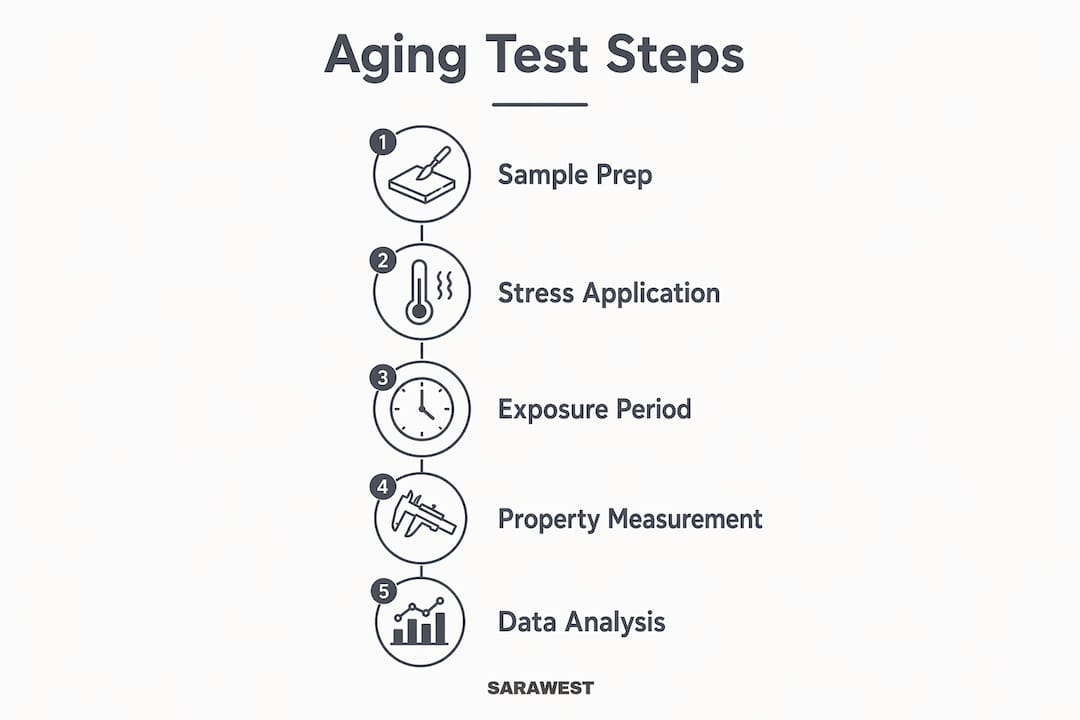
Property measurements tracked over the exposure period typically include tensile strength, elongation at break, color change (ΔE), mass loss, and surface cracking. Plotting these against exposure time reveals whether degradation follows a linear, exponential, or threshold pattern, each of which carries different implications for shelf-life claims.

Statistical validation matters. Lognormal distributions are commonly assumed for time-to-failure data, and maximum-likelihood estimation produces more precise confidence intervals than simple regression. Report both point estimates and confidence bounds when submitting data for regulatory review.
How do you design an accelerated aging test plan?
A well-designed test plan starts with the end in mind: what lifespan claim needs to be supported, and what failure mode is most likely to limit it?
Sample selection should reflect production-representative material, not lab-grade specimens. Include at least five specimens per condition and time point, with reserve sets in case degradation thresholds are not reached within the planned duration. Specimens should be exposed on all sides in a circulating-air chamber, with occupied volume kept to roughly 10% of free chamber space to maintain uniform conditions.
Stress level selection requires balancing acceleration against realism. Heat aging programs should include a minimum of three temperatures, with the highest temperature kept below the material's critical transition point. Exposure times of 1,000 hours or more at each temperature generate enough data for reliable extrapolation to service conditions.
Test duration follows from the acceleration factor. Using the Q10 principle, a target lifespan of two years at 25°C translates to roughly seven weeks at 55°C, assuming Q10 equals 2. Confirm this assumption with preliminary data before committing to a full program.
Document everything: chamber calibration records, specimen dimensions, baseline property measurements, and the exact standard followed. Reproducibility depends on this documentation, and regulatory reviewers will ask for it.
Accelerated aging vs. real-time aging: which one do you need?
Both. That is the honest answer for any product where shelf-life claims carry regulatory or liability weight.
Accelerated aging tests get a product to market faster by generating predictive data within weeks rather than years. Real-time aging tests run concurrently and serve as the validation layer. If the accelerated prediction and the real-time result diverge significantly, the real-time data wins, and the test design needs to be revisited.
The practical difference comes down to confidence level. Accelerated data is sufficient for initial regulatory submissions in many FDA pathways, with real-time data submitted as it becomes available. For materials where the acceleration model is well-established and the failure mechanism is well-understood, the gap between accelerated and real-time results tends to be small. For novel materials or complex multi-component products, that gap can be substantial, which is exactly why manufacturers must validate accelerated results against real-time aging before making final shelf-life claims.
Real-time aging also captures seasonal and geographic variability in environmental conditions, something no chamber can fully replicate. For outdoor applications especially, field exposure data from representative climates remains a critical complement to laboratory protocols.
Key Takeaways
Accelerated aging tests predict product lifespan by applying controlled stress conditions that compress years of degradation into weeks, but reliable results require careful design, appropriate standards, and real-time validation.
| Point | Details |
|---|---|
| Q10 temperature rule | Raising temperature by 10°C doubles the aging rate; 3.7 weeks at 60°C equals one year at 22°C for medical devices. |
| Standards drive validity | ASTM G154, ASTM G155, and IEC 60335-1 define parameters and reporting requirements that make results defensible in regulatory submissions. |
| Severe stress risks bad data | Continuous extreme conditions can produce degradation that never occurs in real service; moderated, intermittent cycles improve result accuracy. |
| Real-time aging validates predictions | Accelerated data supports initial submissions, but natural aging remains the only definitive confirmation of long-term performance. |
| Dual-temperature battery testing | Lithium-ion batteries require two-temperature cycling to preserve realistic competing degradation mechanisms during acceleration. |
How Sarawest USA supports your formulation and testing needs

When aging test results reveal a formulation gap, the next step is reformulation. That is where Sarawest USA's in-house R&D chemists come in. We work directly with product developers and quality teams to adapt existing formulas or build new ones from the ground up, informed by real degradation data, not guesswork. Our library of over 1,200 proprietary formulas across eight industries means we are not starting from zero when you bring us a stability challenge.
We handle everything from pilot batches to full production runs, with turnarounds that keep your development timeline intact. See our formulation track record or explore our contract manufacturing services to start a conversation with a real chemist, not a broker.