

Blanket purchase orders are the right tool when you buy the same materials repeatedly, face price or supply risk, and want to stop re-negotiating every single order. The structure is simple: one master agreement locks in price, total commitment, and key terms; individual releases handle the logistics of each delivery. The operational guardrail that makes or breaks the program is closed-loop tracking, where every release and invoice automatically reconciles back to the master so leakage never quietly erodes your negotiated savings.
Three conditions that signal a blanket program is worth pursuing:
- Predictable recurring demand with a known supplier and enough volume to give you leverage at the negotiating table
- Price volatility or supply risk that makes spot buying expensive or unreliable
- Capital planning capacity to account for the committed value on your balance sheet
For U.S. federal buyers, FAR 8.405-3 governs Blanket Purchase Agreements under GSA schedule contracts and explicitly prefers multiple-award BPAs where practicable. Private-sector procurement teams face no equivalent regulatory ceiling, but the same logic applies: competition at the master-agreement stage produces better pricing than sole-source blankets. As J. White, a long-term agreements practitioner, notes, blanket purchase agreements require significant upfront negotiating effort, especially when tying variable costs to independent market indices — but that effort pays recurring dividends on every release.
Table of Contents
- What Are Blanket Purchase Orders, and How Do They Differ from Single POs?
- How Does a Blanket PO Actually Work?
- What Are the Real Benefits and Limitations?
- What Should You Negotiate in the Master Agreement?
- How Do You Stand Up a Blanket Program Step by Step?
- How Do You Keep a Blanket Program from Leaking Savings?
- How Long Does It Take, and What Does It Cost to Set Up?
- A Chemical Manufacturing Example: How This Works in Practice
- Sample Clause Language and a Drafting Checklist
- Key Takeaways
- What a Winning Blanket Program Actually Looks Like
- Sarawest USA Supports Blanket-Style Chemical Sourcing
- Useful Sources for Procurement Teams
What Are Blanket Purchase Orders, and How Do They Differ from Single POs?
A blanket purchase order (also called a blanket purchase agreement or BPA) is a program-level contract that authorizes recurring purchases from a supplier over a defined period without requiring a new negotiation for each transaction. The master agreement holds the price, total committed quantity or value, and governing terms. Each individual delivery is triggered by a release, a lightweight order document that inherits the master's pricing.
Single purchase orders are transactional: one order, one delivery, one invoice. Standing orders differ from blankets in that they run on a fixed recurring cadence without a total commitment ceiling. A blanket PO sits between the two: it commits a total volume or value upfront, then lets you draw against it on a flexible schedule.
Federal procurement note: FAR 8.405-3 defines BPAs as ordering vehicles used to fill repetitive needs for supplies or services under GSA schedule contracts. Single-award BPAs with very large estimated values require written agency-head approval; multiple-award BPAs generally have a preferred maximum duration to meet program needs.
How Does a Blanket PO Actually Work?

The master agreement is the program. It holds three quantities you must track at all times: the committed amount (total authorized), the released amount (what has been ordered against the blanket so far), and the open balance (what remains available). Every release reduces the open balance. When the balance hits zero, the blanket is exhausted and must be renewed or replaced.
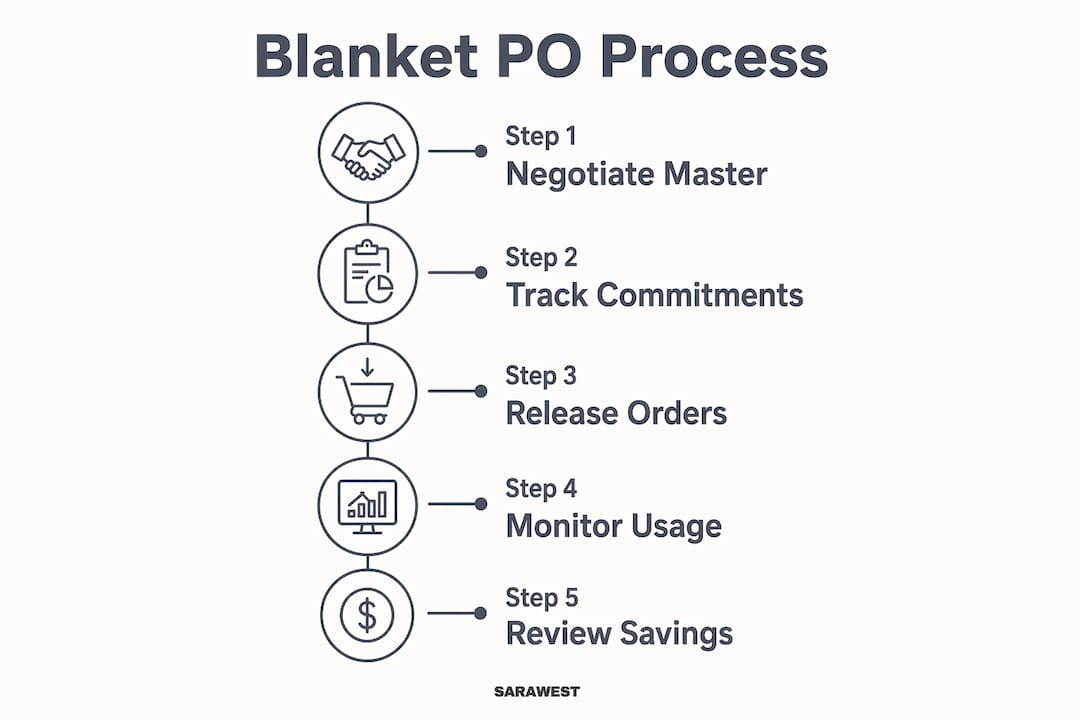
Releases inherit the blanket's contracted pricing rather than the current spot price, which is the core financial protection the instrument provides. Three-way matching in accounts payable should reference the release and the master agreement, not a spot quote. ERP systems like NetSuite and Microsoft Dynamics support this natively: purchase order lines created from a blanket reference the originating agreement and inherit contracted price and discount terms automatically.
Roles typically break down this way:
- Procurement / category manager: negotiates and owns the master agreement
- Operations / plant manager: issues releases as production needs arise
- Receiving: confirms delivery against the release, not the master
- Accounts payable: matches invoice to release and master for three-way close
What Are the Real Benefits and Limitations?
Blanket programs deliver four concrete advantages: fewer purchase orders to process per unit of spend, price stability across a volatile period, volume discounts tied to committed quantities, and better supplier planning that often translates into shorter lead times and reserved capacity.
The risks are equally real. Demand variability can leave you with committed volume you cannot absorb. Budget lock-in reduces flexibility if market prices fall sharply after you sign. And without closed-loop tracking, off-contract buys quietly accumulate and undercut your negotiated rate.
| Factor | Blanket PO | Single PO |
|---|---|---|
| Price stability | Fixed at master level | Spot price each order |
| Admin workload | Low per release | High per order |
| Flexibility | Lower (committed volume) | High |
| Supply assurance | Strong (reserved capacity) | Weak |
| Lock-in risk | Present | None |
Good candidates for blanket programs meet four conditions: predictable recurring demand, price volatility or supply risk, an established supplier relationship, and adequate capital planning to carry the commitment.
What Should You Negotiate in the Master Agreement?
The master agreement is where you win or lose margin. Every clause below belongs in the document before you sign.
- Total committed quantity or value with a clear expiration date
- Minimum and maximum release quantities per order period
- Price-fixing mechanism: firm fixed price, indexed, or cost-plus with a ceiling
- Escalation and indexing clause: tie surcharges to a named independent index (commodity indices such as the Producer Price Index for chemicals work well) and include notification and audit rights
- Delivery SLAs and lead times with defined remedies for misses
- Reserved capacity clause for high-demand periods
- Acceptance and inspection terms at the release level
- Invoicing and payment terms referencing the release number
- Termination for convenience and for cause, with cure periods
Pro Tip: Negotiate volume-based triggers into the master: when cumulative releases hit a defined threshold, the unit price steps down automatically. This converts a static contract into an active cost-management tool without requiring a renegotiation.
"Long-term purchase agreements can be extremely beneficial to both parties. For the buyer, they provide assurance of supply, risk mitigation, quality assurance, capacity, and cost reduction." — Casting Source practitioner guide
Microsoft Dynamics 365 purchase agreements support enforcement policies that cap releases at the committed maximum and lock price and discount terms, which means your ERP can enforce contractual limits automatically rather than relying on manual review.
How Do You Stand Up a Blanket Program Step by Step?
- Select the category. Identify recurring spend with price or supply risk and a supplier you have leverage with.
- Run a demand analysis. Pull 12–24 months of purchase history to build a credible volume forecast.
- Align stakeholders. Confirm budget authority with finance, operational requirements with the category owner, and ERP readiness with IT.
- Issue an RFP or RFQ. For federal buyers, FAR 8.405-3 requires fair opportunity to all BPA holders above the micro-purchase threshold.
- Award and draft the master agreement. Include all clauses from the negotiation checklist above.
- Configure your ERP. Set up the blanket, link release templates to the master, and activate three-way matching rules.
- Train release issuers. Anyone authorized to trigger a release must understand naming conventions and approval thresholds.
- Run a 90-day pilot on 1–2 SKUs. Pre-define KPIs: on-time delivery rate, price variance versus master, and administrative time saved per release.
For teams evaluating MRP and procurement tool integration, the pilot phase is the right time to validate that release workflows connect cleanly to production scheduling.
How Do You Keep a Blanket Program from Leaking Savings?
Controls are what separate a blanket program that delivers on its promise from one that quietly erodes. Authorize a named list of release issuers. Set approval thresholds tied to dollar amounts. Require every release to carry the master PO number in a dedicated reference field so AP matching is automatic, not manual.
Reporting metrics to track monthly:
- Open blanket balance versus committed value
- Release velocity against forecast
- Supplier fill rate and on-time delivery
- Price variance exceptions (releases that deviated from master pricing)
- Savings realized versus estimated spot-buy cost
Schedule a formal quarterly review to assess supplier performance, check whether the committed volume is tracking to forecast, and trigger any price review points written into the escalation clause. At renewal, run a competitive check even if you intend to extend the incumbent.
Governance note: ERP systems like NetSuite handle currency and release-to-blanket linkage across subsidiaries automatically, which matters for multi-site procurement teams managing a single master agreement.
How Long Does It Take, and What Does It Cost to Set Up?
Negotiation and award typically run 2–8 weeks for straightforward supplier relationships. Complex supply chains with custom formulations or multi-tier pricing can extend that to 12 weeks or more. System setup and a pilot run add another 4–12 weeks depending on ERP complexity.
The cost case is direct. Blanket POs reduce administrative workload by consolidating recurring purchases, cutting the number of individual purchase orders your team processes. Each PO your team does not have to create, approve, and match represents real labor hours recovered. Multiply that by annual release volume and compare it against the one-time negotiation cost to get a simple payback period.
Pro Tip: Model the ROI before you start: take your average PO processing cost, multiply by the number of releases you expect per year, add any negotiated price delta, and divide by estimated internal negotiation hours. Most programs break even within the first quarter of releases.
A Chemical Manufacturing Example: How This Works in Practice
A contract chemical manufacturer running recurring production of cleaning concentrates is a textbook blanket PO candidate. Raw-material prices fluctuate with petrochemical indices. Lead times vary. And the production schedule demands reliable supply without a new sourcing event every month.
The master agreement locks the base price for key raw materials, ties any surcharge to a named commodity index with a notification requirement, and reserves a defined monthly production capacity. Releases are triggered as production runs are confirmed, inheriting the master price and referencing it for three-way matching.
For pilot-to-scale transitions, the release structure is especially useful. A pilot batch runs as a small release against the master; if the formulation passes, full-scale production releases follow without a new negotiation. Suppliers that offer rapid formulation adjustments and pilot-to-scale production reduce the lead-time risk that makes blanket programs vulnerable during ramp-up.
Key supplier capabilities that support a blanket program in this sector:
- In-house R&D for fast formulation changes between releases
- Pilot batch capability (small releases) through full truckload production
- A broad formula library that reduces development time for new SKUs
- Rapid RFQ response so procurement can validate pricing before committing
Sarawest USA's library of over 1,200 proprietary formulas and in-house chemists make it a strong fit for blanket programs where formulation changes between releases are a real operational requirement, not a theoretical one. For commercial cleaning procurement teams specifically, recurring supply of bulk concentrates under a master agreement is a natural match for this model.
Sample Clause Language and a Drafting Checklist
Use these snippets as starting points. Adapt them with your legal counsel before execution.
Pricing and indexing: "Unit prices are fixed as set forth in Exhibit A. Supplier may request a price adjustment no more than once per calendar quarter by providing written notice and documentation referencing the [named index]. Buyer retains audit rights to verify index-based adjustments."
Minimum/maximum commitment: "Buyer commits to a minimum of [X] units and a maximum of [Y] units over the agreement term. Releases below the minimum per period do not obligate Buyer unless a separate minimum-release clause is executed."
Termination for convenience: "Either party may terminate this agreement upon [30/60/90] days written notice. Buyer shall pay for all releases accepted prior to the termination effective date."
Drafting checklist before pilot:
- Total committed quantity or value confirmed with finance
- Effective dates and renewal options defined
- Min/max release quantities per period documented
- Price-fixing and escalation mechanism agreed and indexed
- SLAs, lead times, and remedies written in
- Reserved capacity clause included
- Release template references master PO number
- Three-way matching rules configured in ERP
- Authorized release issuers named and trained
- 90-day pilot KPIs defined and baselined
Key Takeaways
Blanket purchase orders deliver durable savings only when the master agreement is well-negotiated, releases are tracked in closed loop, and governance reviews happen on a defined schedule.
| Point | Details |
|---|---|
| Use when conditions align | Commit to a blanket only when demand is predictable, price risk is real, and you have supplier leverage. |
| Separate master from releases | Lock price and capacity at the master level; use releases for logistics to preserve both stability and flexibility. |
| Negotiate protective clauses | Index-based escalation, min/max quantities, and termination for convenience are non-optional in any master agreement. |
| Track three quantities | Monitor committed, released, and open balance in your ERP to prevent leakage and catch off-contract buys early. |
| Sarawest USA as supplier fit | For chemical and cleaning-product categories, Sarawest USA's pilot-to-scale capability and in-house R&D support rapid release workflows under a blanket program. |
What a Winning Blanket Program Actually Looks Like
The procurement teams that get the most out of blanket programs share one habit: they treat the master agreement as the beginning of the work, not the end of it. The negotiation is the easy part. The discipline is in the governance — quarterly reviews, closed-loop ERP matching, and the willingness to trigger a price reopener when the index moves against you.
What I see fail most often is the assumption that a signed blanket runs itself. It does not. Releases drift off-contract. Authorized users expand informally. The open balance goes unmonitored until someone realizes the blanket expired three months ago and the team has been placing spot orders at a premium.
The chemical manufacturing use case makes this concrete. A supplier with real in-house R&D and a deep formula library can absorb a formulation change between releases without blowing up your lead time. That is the supplier characteristic that makes a blanket program resilient rather than brittle. Sarawest USA's rapid RFQ and pilot-to-scale capabilities are built for exactly that kind of release cadence.
Sarawest USA Supports Blanket-Style Chemical Sourcing
For procurement teams sourcing cleaning concentrates, sports care formulations, or specialty chemicals on a recurring basis, the supplier relationship is the program. Sarawest USA brings in-house R&D chemists, a library of over 1,200 ready-to-brand formulas, and production capacity from 1,000-unit pilots through full truckloads — all under one roof, without broker delays.
That means your releases move fast. Formulation adjustments between runs happen at the source, not through a middleman. And when you need to validate a new SKU before committing full blanket volume, Sarawest USA's pilot-to-scale manufacturing process gives you a low-risk path to a production-ready product. Review our formulation track record and reach out to start an RFQ — a real person reads every inquiry.
Useful Sources for Procurement Teams
- FAR 8.405-3 — Blanket Purchase Agreements: Primary regulatory reference for U.S. federal BPA structure, multiple-award preference, duration limits, and ordering procedures.
- Microsoft Dynamics 365 — Purchase Agreements: ERP setup guide for commitment types, enforcement policies, and price/discount inheritance on releases.
- NetSuite — Blanket Purchase Orders: Setup and release behavior documentation including currency handling and release-to-blanket linkage.
- Blanket order — Wikipedia: Encyclopedic definition and structural comparison among regular POs, blanket POs, and standing orders.
- Casting Source — Pros and Cons of Long-Term Agreements: Practitioner perspective on negotiation effort, incentive structures, and supply assurance in manufacturing contexts.
- Amazon Business — What Is a Blanket PO?: Industry guidance on administrative savings, price-lock benefits, and processing cost reduction.