

What is a certificate of analysis, and why does it matter?
A certificate of analysis is a formal, laboratory-prepared document that verifies a specific product batch meets pre-established specifications, whether internal, regulatory, or customer-defined. It is not a general product description. It is batch-specific, signed by an authorized analyst, and tied to documented test results.
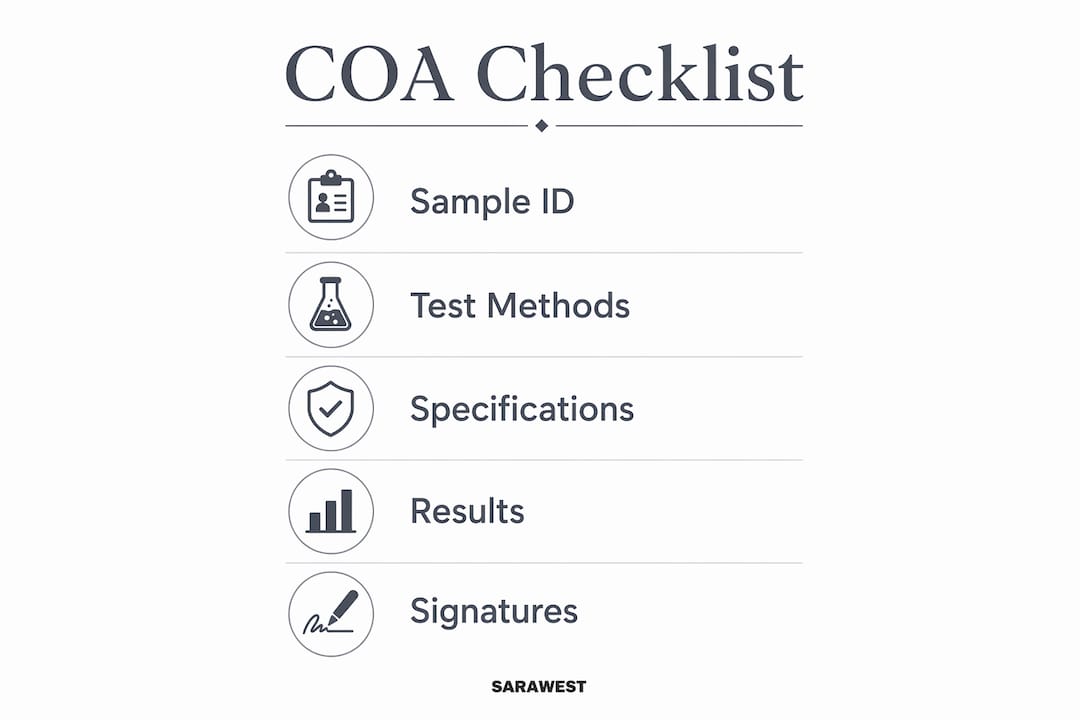
For chemical manufacturers and their clients, the COA is the paper trail that proves accountability. It covers the company name, product name, lot number, tests performed, analytical methods, results, and approval date. Regulatory agencies including the FDA, ISO, and OSHA commonly require it before a product can move through the supply chain.
The document serves multiple functions: confirming product quality and safety, supporting traceability back to a specific production batch, enabling regulatory reporting, and building trust between B2B trading partners. Without it, there is no documented proof that what shipped is what was agreed upon.
- Verifies batch compliance with agreed specifications
- Supports FDA, ISO, and OSHA regulatory reporting
- Enables full batch traceability throughout the supply chain
- Provides pass/fail determinations against defined limits
- Serves as a contractual quality document in B2B transactions
Table of Contents
- Key components every quality assurance certificate should include
- How to verify the authenticity of a lab test report
- Legal and compliance considerations for US chemical manufacturers
- Best practices for managing and interpreting COAs in contract manufacturing
- How do you obtain a COA from a manufacturer or lab?
- What testing methods generate COA data?
- What does a typical COA look like?
- Key Takeaways
- Sarawest USA brings real chemistry accountability to your COA process
Key components every quality assurance certificate should include
A complete COA leaves nothing ambiguous. Every element has a purpose, and a missing field is a red flag, not a minor oversight.
- Product identification: Full product name, description, grade, and any internal reference codes
- Batch or lot number: The unique identifier linking the document to one specific production run
- Manufacturer or supplier details: Name, address, and contact information
- Production and analysis dates: Both must be present, and the gap between them must be logical
- Analytical methods: References to recognized standards such as ISO, AOAC, or EN protocols
- Test parameters and results: Common chemical tests include pH, moisture content, viscosity, and percentage of solids
- Specification limits: The acceptable range for each parameter, with a clear pass/fail outcome
- Authorized signature: Manual or electronic, from the analyst or quality assurance officer who approved the batch
The absence of any of these elements reduces the document's reliability and can block its use in quality control or regulatory review.
How to verify the authenticity of a lab test report
Not every COA you receive is trustworthy. Experienced quality teams know what a real document looks like, and they know what to question.
- Batch traceability: The batch number must match the container label and all accompanying shipping documents. Generic or duplicated numbers across multiple deliveries are a serious warning sign.
- Analytical method references: A credible COA cites recognized standards. Vague method descriptions with no reference to ISO, AOAC, or EN protocols undermine the entire document.
- Laboratory accreditation: The issuing lab should hold ISO 17025 accreditation, which confirms its results meet international standards.
- Result variation: Real lab results show natural variation. If every single parameter lands perfectly at the center of its specification range, that is suspicious, not reassuring.
- Independent verification: Relying solely on supplier-provided documents without independent retesting exposes manufacturers to risks of inconsistent or fraudulent data, especially for high-risk raw materials.
- Document completeness: Missing dates, unsigned approvals, or absent contact information are all grounds for rejection.
Pro Tip: Restrict COA interpretation to trained personnel who work from a formal internal guide. The ANSES Fougères Laboratory developed exactly this approach, centralizing all COA evaluations through a designated reference person supported by a documented interpretation protocol.
Legal and compliance considerations for US chemical manufacturers
Passing a supplier's internal quality check is not the same as meeting US law. Meeting supplier specifications does not automatically mean legal compliance. A product can clear every internal threshold and still fail mandatory federal or state safety standards.
- The FDA, OSHA, and EPA each have product-specific and industry-specific documentation requirements that a COA must satisfy
- COA requirements vary by chemical product type, end use, and the industry sector being served
- Submitting an incomplete, inaccurate, or misleading COA carries legal liability
- Manufacturers must compare supplier COA results against applicable federal and state regulations, not just internal specs
- Documentation retention obligations apply: records must be kept for defined periods to support audits and traceability reviews
- State-level requirements can differ significantly from federal standards, particularly in regulated sectors
The practical takeaway: your compliance team, not just your purchasing department, needs to review incoming COAs against current regulatory requirements for each product category.
Best practices for managing and interpreting COAs in contract manufacturing
There is no single global standardized format for COAs, which makes internal protocols essential. Without them, the same document can be interpreted differently by different team members, leading to costly errors.
- Build a standardized internal review checklist that every incoming COA must pass before raw materials are accepted
- Train personnel specifically in chemical testing units and the distinction between active ingredient content and total chemical content. Misreading these values causes formulation errors that compound at scale
- Use dedicated software to generate, customize, and store COAs, reducing manual input errors and enabling quick retrieval for audits
- Verify that test methods, units of measurement, and batch identifiers are consistent across all documents from a given supplier
- Integrate COA data into your quality assurance process as a continuous improvement input, tracking trends by supplier and product line
- For batch traceability and supply chain integrity, maintain your own database of received COAs rather than relying on supplier archives
- Retest critical raw materials independently. Supplier data is a starting point, not a final answer
Sarawest USA's in-house R&D chemists apply this discipline directly. When formulas are developed or adapted, the COA management process is built into the production workflow from day one, not added as an afterthought.
How do you obtain a COA from a manufacturer or lab?
The process is straightforward when you know what to ask for. Most chemical manufacturers issue a COA automatically with each shipment. If one is not included, request it in writing before the order ships.
For contract manufacturing relationships, specify COA requirements in your quality agreement upfront. Define which tests are required, which standards apply, and what the acceptable specification ranges are. This prevents disputes after production is complete. Third-party labs issue COAs when you submit samples directly for independent testing, which is the right move for high-value or high-risk materials. You can also request COAs for specific historical batches from a supplier's quality department, provided the records are within their retention window. Standard work processes in manufacturing facilities typically define how and when COAs are generated and distributed, so asking your supplier to walk you through their process is a reasonable due diligence step.
What testing methods generate COA data?
The method behind the number matters as much as the number itself. A result is only as credible as the technique used to produce it.
Common analytical methods used in chemical COA generation include:
- HPLC (High-Performance Liquid Chromatography): Used to assess chromatographic purity and active ingredient content
- GC (Gas Chromatography): Applied for volatile compounds, residual solvents, and flavor or fragrance profiling
- ICP-MS (Inductively Coupled Plasma Mass Spectrometry): Used for trace metal and heavy metal detection
- Titration: Standard for measuring acid/base content, active chemical concentration, and similar parameters
- Karl Fischer titration: The recognized method for precise moisture content determination
- Viscometry: Measures flow properties relevant to cleaning products, personal care formulations, and industrial chemicals
- pH measurement: A baseline test for nearly every aqueous chemical product
Each method should be cited by name and standard reference on the COA. A result listed without a method reference cannot be independently verified or reproduced.
What does a typical COA look like?
A well-structured COA follows a predictable layout. The header identifies the issuing company, the product, and the batch. The body contains the test table. The footer carries the authorization.
| Section | Typical Content |
|---|---|
| Header | Company name, address, document title "Certificate of Analysis" |
| Product info | Product name, grade, batch number, date of manufacture |
| Test table | Parameter name, method reference, specification limit, result, pass/fail |
| Certification | GMP compliance statement, compendial standards met |
| Authorization | Authorized signatory name, role, date of approval |
The test table is the core of the document. Each row names a parameter, cites the method, states the specification, and records the actual result. A "Pass" notation without a defined criterion behind it is not acceptable on a compliant COA. Page numbering and a total page count should appear on every page to confirm document completeness.
Key Takeaways
A certificate of analysis is only as useful as the verification process behind it. Supplier documents must be checked against US regulatory requirements, not just internal specs.
| Point | Details |
|---|---|
| COA definition | A batch-specific lab document verifying product compliance with internal, regulatory, or customer specifications. |
| Required elements | Every COA must include batch number, test methods, results, specification limits, dates, and an authorized signature. |
| Authenticity red flags | Perfect results with no variation, missing batch IDs, and absent method references all signal unreliable documents. |
| US compliance gap | Passing supplier specs does not guarantee FDA, OSHA, or EPA compliance; always verify against applicable regulations. |
| Sarawest USA | In-house R&D chemists integrate COA management into every contract manufacturing project from formulation through production. |
Sarawest USA brings real chemistry accountability to your COA process
If you've been burned by suppliers who hand over a COA and call it done, you already know the gap between a document and actual quality accountability. Sarawest USA is built differently. With over 1,200 proprietary formulas and real in-house R&D chemists, every production run comes with the chemistry expertise to back up what's on the page.
Whether you need a pilot batch or a full truckload, Sarawest USA handles formulation, production, and quality documentation without brokers in the middle. That means faster turnarounds, direct answers, and COA data you can actually stand behind. Our contract manufacturing process is built for businesses that need to move quickly and comply fully. See what that looks like in practice through our client case studies, and reach out to get a real person working on your project today.