

For short-life shipping labels and receipts, direct thermal is the right call. For chemical products, frozen goods, outdoor exposure, or anything that needs to stay scannable beyond six months, thermal transfer is the only defensible choice.
The total cost of ownership often flips the math. Direct thermal looks cheaper upfront, but printhead replacement costs accelerate fast without the ribbon buffer that thermal transfer provides. Barcode reliability follows the same logic: thermal transfer's ribbon-dependent density holds up under abrasion, solvents, and UV in ways heat-sensitive media simply cannot.
TL;DR:
- SATO America documents that direct thermal printheads last roughly 25%–50% as long as thermal transfer printheads, a TCO factor most procurement teams underestimate.
- Ricoh guidance sets the direct thermal threshold at labels needed for fewer than six months; beyond that, thermal transfer is the recommended default.
- Sarawest USA R&D chemists flag label failures on chemical products as one of the most preventable compliance risks in contract manufacturing, and we build label-media compatibility into every pilot run.
Table of Contents
- How do direct thermal and thermal transfer actually produce an image?
- Side-by-side comparison: the dimensions that drive procurement decisions
- Which industries should use which method?
- How to think about total cost of ownership, not just sticker price
- Choosing the right label media, ribbons, and substrates
- What operations teams need to know about uptime and maintenance
- Eight questions to choose between direct thermal and thermal transfer
- Label durability and regulatory requirements for chemical products
- Key Takeaways
- What Sarawest USA R&D chemists actually see in the field
- Useful sources and vendor references
How do direct thermal and thermal transfer actually produce an image?
Both methods use heat. What the heat touches is what separates them.
Direct thermal activates a heat-sensitive coating baked into the label stock itself. The printhead contacts the media directly, no ribbon involved. Fewer moving parts, lower hardware cost, and nothing to load between runs. The tradeoff: that same reactive chemistry darkens or fades when exposed to heat, sunlight, or chemicals, even after printing.
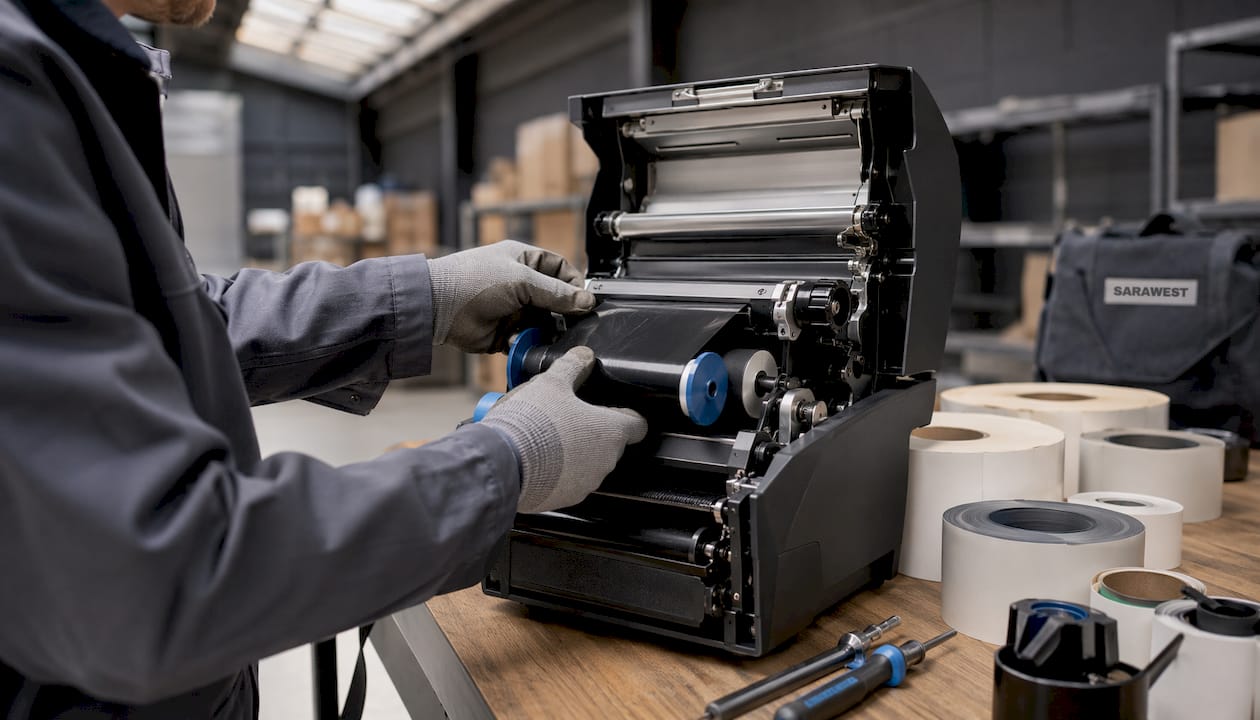
Thermal transfer works differently. The printhead heats a ribbon, melting ink onto the substrate. The ribbon travels between the head and the label, acting as both the ink source and a protective buffer. That buffer is why thermal transfer supports polyester, polypropylene, and film stocks that have no heat-sensitive coating.
Direct thermal pros/cons at a glance:
- ✓ Lower hardware cost, simpler operation, faster speeds (up to 14 ips on some models)
- ✓ No ribbon inventory to manage; supports sustainability targets by eliminating ribbon waste
- ✗ Labels fade under heat, UV, or chemical contact; not suitable for labels beyond six months
- ✗ Printhead wears faster from direct media contact
Thermal transfer pros/cons at a glance:
- ✓ Durable, long-lasting images resistant to abrasion, solvents, and UV
- ✓ Broad substrate compatibility; color ribbons available for branding
- ✗ Higher upfront hardware cost; ribbon adds per-label expense and setup time
- ✗ Typical speeds run 2–4 ips, slower than direct thermal equivalents
Side-by-side comparison: the dimensions that drive procurement decisions
| Dimension | Direct Thermal | Thermal Transfer |
|---|---|---|
| Initial hardware cost | Lower | Higher |
| TCO at scale | Higher (printhead replacement, label cost) | Lower for long-life, harsh-environment labels |
| Print durability | Fades within months under heat/UV/chemicals | Resists abrasion, solvents, UV for years |
| Barcode integrity | Adequate for short-life, indoor use | Consistent density; preferred for compliance barcodes |
| Consumables | Label stock only | Label stock + ribbon (wax, wax-resin, or resin) |
| Supported substrates | Coated paper, select coated synthetics | Paper, polyester, polypropylene, metalized film |
| Print speed | 4–14 ips (model-dependent) | 2–4 ips typical |
| Color capability | Black only | Color ribbons available |
| Printhead life | 25%–50% of thermal transfer lifespan | Longer; ribbon backcoat lubricates and protects head |
| Maintenance | Simpler; debris burns directly onto head | Ribbon traps contaminants before they reach the head |
| Ideal use cases | Shipping labels, receipts, fresh-food tags | Chemical labels, frozen goods, outdoor, asset tags |
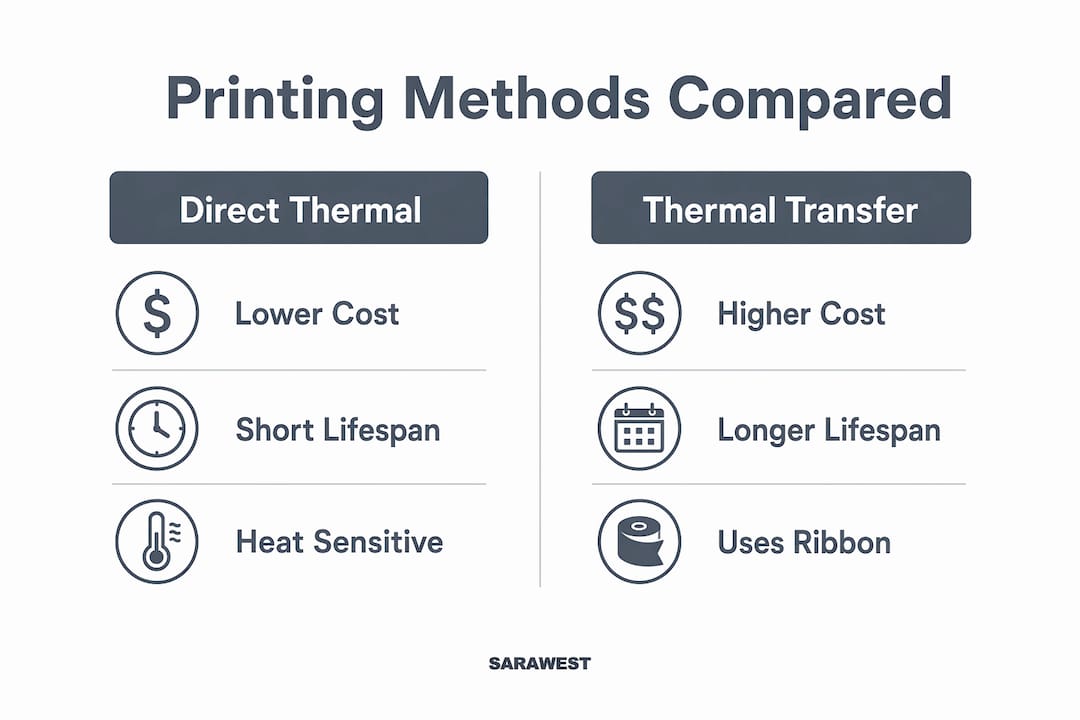
Two non-obvious impacts deserve attention. First, the ribbon in thermal transfer is not just an ink source. Its backcoat lubricates the printhead and shields it from abrasive debris. In dusty production environments, that protection directly reduces unplanned downtime. Second, thermal transfer's density is ribbon-dependent, which means print quality stays consistent across long runs. Direct thermal density can drift as media chemistry varies batch to batch.
Pro Tip: Before full deployment, print 50 test labels on your actual substrate and ribbon combination. Run a fingernail scratch test, a solvent wipe, and a barcode scan after 48 hours in your target environment. Failures at this stage cost almost nothing. Failures after a production run cost everything.
Which industries should use which method?
Match the technology to the environment. Short-lived fresh-food labels can use direct thermal, but frozen, chemical, and outdoor labels require thermal transfer to avoid fading and compliance failures.
- Fresh perishables: Direct thermal works well. Labels need to survive days, not months, and indoor cold-chain conditions are manageable.
- Frozen products: Thermal transfer on synthetic stock. Freeze-thaw cycles and condensation degrade heat-sensitive coatings quickly.
- Long-distance and international logistics: Thermal transfer for pallet and container labels that may sit outdoors or in extreme temperatures for weeks.
- Chemical and industrial products: Thermal transfer is the only option. Solvent contact, abrasion in drums, and GHS/HazCom legibility requirements all demand it. A resin ribbon on polyester stock is the standard setup.
- Retail shelf tags: Either method works for short-cycle retail; thermal transfer for permanent or seasonal tags that stay on shelves for months.
- Branding and high-definition graphics: Thermal transfer with color ribbons gives you the graphic detail and color-coding that direct thermal cannot produce.
How to think about total cost of ownership, not just sticker price
Purchase price is the wrong number to optimize. Procurement decisions that focus only on hardware cost miss the larger TCO driven by printhead replacement, consumable cadence, and label failure rates.
Direct thermal media can cost more than thermal transfer label stock plus ribbon, with the gap ranging from 5% to 50% depending on materials and volume. Add printhead replacement frequency (25%–50% of thermal transfer lifespan), and the math often favors thermal transfer for any label life beyond six months.
| TCO Line Item | Direct Thermal | Thermal Transfer |
|---|---|---|
| Hardware amortization | Lower | Higher |
| Label media cost | Can be higher per label | Lower stock cost; ribbon adds $0.01–$0.03/label |
| Printhead replacement | More frequent (25%–50% lifespan vs. TTR) | Less frequent; ribbon buffer extends head life |
| Ribbon inventory | None | Ongoing; wax, wax-resin, or resin by substrate |
| Failure-related downtime | Higher in harsh environments | Lower; ribbon traps debris |
| Reprint cost from fading | High if environment is wrong | Minimal for matched media-ribbon pairs |
Pro Tip: Run a 30-day pilot tracking four metrics: labels printed, ribbon rolls consumed, printhead hours logged, and unreadable barcode incidents. Those four numbers give you a real cost-per-label figure that no vendor quote can fake.
Choosing the right label media, ribbons, and substrates
Ribbon type determines what substrate you can print on. Get this pairing wrong and labels fail regardless of which printer you buy.
- Wax ribbons: Best on paper stocks, lowest cost, suitable for indoor labels not exposed to solvents or abrasion.
- Wax-resin ribbons: Coated paper and some synthetics; better abrasion resistance than pure wax.
- Full resin ribbons: Required for polyester, metalized silver, and any label facing chemicals, extreme heat, or outdoor UV. The only correct choice for GHS-compliant chemical labels.
For direct thermal, coated paper handles most short-life indoor applications. Coated synthetic direct thermal stocks exist but carry a cost premium and still cannot match the durability of thermal transfer on equivalent substrates.
Testing checklist before locking a media-ribbon combination:
- Adhesion pull test on the actual container surface
- Solvent or chemical rub test matching your product's chemistry
- Freeze-thaw cycle test (minimum three cycles for frozen applications)
- UV/light exposure test for any outdoor label
- Barcode scan test after each environmental stress
Pro Tip: Standardize on two or three media-ribbon combinations across your SKU range rather than optimizing each label individually. Fewer combinations mean simpler inventory, faster changeovers, and less room for operator error.
What operations teams need to know about uptime and maintenance
Speed and uptime look different depending on which technology you run.
Direct thermal typically operates at higher speeds, ranging from 4 to 14 ips depending on the model, making it suitable for high-volume shipping label lines. Thermal transfer generally runs at slower speeds, around 2–4 ips, since ribbon handling adds setup time and complexity.
Common failure modes to plan for:
- Direct thermal: Printhead element burnout from debris contact; label fading from heat or UV exposure; sensor calibration drift from media variation
- Thermal transfer: Ribbon wrinkling or tearing from improper tension; ribbon-media mismatch causing smearing; printhead streaking if ribbon runs out mid-roll
Recommended spare parts to stock: one spare printhead per printer, platen rollers, cleaning cards or isopropyl wipes, and a two-week ribbon buffer. Clean the printhead after every roll change on direct thermal systems. On thermal transfer systems, inspect ribbon tension guides weekly and replace platen rollers on the manufacturer's recommended cycle.
Eight questions to choose between direct thermal and thermal transfer
- How long does the label need to stay scannable? If more than six months, prefer thermal transfer.
- What environment will the label face? Solvents, UV, freezing, or outdoor exposure all point to thermal transfer.
- What is your daily print volume? High-volume, short-life shipping favors direct thermal on cost.
- What substrate does your container require? Polyester, polypropylene, or metalized film requires thermal transfer.
- Are barcodes contractually or regulatorily required to scan? Default to thermal transfer for serialized tracking and GHS labels.
- Do you need color or high-definition graphics? Only thermal transfer supports color ribbons.
- What is your 24-month TCO budget? Factor printhead replacement and reprint costs, not just hardware price.
- Do you have sustainability targets? Direct thermal eliminates ribbon waste and can support reduced carbon footprint goals, but only where label life permits.
Red flags that require thermal transfer: any label on a chemical product, any label expected to survive more than one year, any barcode subject to retailer or regulatory scan requirements, and any application involving solvent or abrasion contact.
When issuing RFQs, ask vendors for: sample labels with GHS statements printed on your actual substrate, ribbon compatibility reports for your container material, and printhead MTBF data for the specific model under your volume conditions.
Label durability and regulatory requirements for chemical products
GHS and HazCom regulations under OSHA require hazard information to remain legible throughout a product's lifecycle. That is not a suggestion. A faded pictogram or unreadable signal word is a compliance failure, regardless of what was printed at the factory.
For chemical products, the minimum label requirements from a durability standpoint are:
- Solvent resistance: the label must not degrade on contact with the product it identifies
- Abrasion resistance: drum and IBC labels face handling abuse that wax-ribbon prints cannot survive
- Long-term legibility: labels on stored chemicals may need to remain readable for years
- Barcode scannability after environmental exposure: required for serialized tracking and audit trails
Concrete buyer checks to build into procurement:
- Accelerated aging test: 72 hours at elevated temperature and humidity before scanning
- Solvent rub test: wipe with the actual product chemistry, not just isopropyl alcohol
- Scannability verification after each environmental stress cycle
- Confirm permanent-ink requirements for any regulated form or certification label
Pro Tip: Include a compliance clause in supplier contracts that specifies the test standards labels must pass, the sample retention period, and the corrective action protocol if a label lot fails. A verbal commitment from a vendor is not a compliance record.
Key Takeaways
Thermal transfer is the default choice for chemical, frozen, outdoor, and compliance-critical labels; direct thermal fits short-life, high-volume shipping and receipt applications where label life stays under six months.
| Point | Details |
|---|---|
| Match method to label life | Direct thermal for under six months; thermal transfer for anything longer or harsher. |
| TCO beats sticker price | Printhead replacement at 25%–50% of thermal transfer lifespan makes direct thermal costlier at scale. |
| Chemical labels need thermal transfer | GHS/HazCom legibility requires solvent-resistant, abrasion-resistant prints that only thermal transfer delivers. |
| Test before you commit | Run a 30-day pilot tracking labels printed, ribbon use, printhead hours, and barcode failures. |
| Ribbon-media pairing is where failures live | Spec the ribbon and label stock together, confirmed for the same substrate, before production. |
What Sarawest USA R&D chemists actually see in the field
The label failures we see most often on chemical products are not random. They follow a pattern: a solvent-based cleaner attacks the adhesive, a drum label gets abraded during palletizing, or a freeze-thaw cycle lifts a paper direct thermal label off a container that was never designed for cold storage. Every one of those failures was preventable with the right media-ribbon combination chosen before the first production run.
Our in-house R&D chemists treat the label stack as part of the formulation decision, not an afterthought. When we run pilot batches through our contract manufacturing process, we ask packaging teams to sign off on label adhesion and solvent resistance before we scale. That step has caught more compliance problems than any post-production audit. With over 1,200 proprietary formulas across eight industries, we have seen what happens when the label and the product chemistry are not matched, and we build that matching into every engagement from the start.
If you are developing a chemical product, a cleaning formulation, or any product where the label faces real-world abuse, request samples and let our team run a label compatibility trial alongside your pilot run. We handle the chemistry. The label should hold up just as well as what is inside the container.
Useful sources and vendor references
Resources worth consulting as you finalize your technology choice and run procurement pilots:
- SATO America white paper: Five-factor comparison of direct thermal vs thermal transfer, including printhead life data and media cost analysis. Use this for TCO modeling and maintenance planning.
- Ricoh Electronics guidance: Practical speed and label-life thresholds with application-specific recommendations. Use this to set your six-month label-life decision point.
- Zebra FAQ: Substrate compatibility and barcode integrity guidance. Use this for media selection and print quality benchmarks.
- Sarawest USA capabilities: Pilot-to-scale production details, including how label compatibility testing fits into the manufacturing process.
- Sarawest USA case studies: Proof points on rapid prototyping and formulation-to-packaging integration across industries.
- Thermal paper roll stock reference: Real-world direct thermal roll specifications useful for operations teams evaluating media options.