

What is EPA disinfectant registration and why does it matter?
Every disinfectant sold in the United States must clear one gate before it reaches a shelf: EPA registration. Under the Federal Insecticide, Fungicide, and Rodenticide Act (FIFRA), no disinfectant can be sold or distributed unless the U.S. Environmental Protection Agency has reviewed and approved it. That approval confirms the product meets minimum efficacy and safety standards, protecting both public health and the businesses that use these products.
The U.S. Environmental Protection Agency Headquarters administers this process through its Office of Pesticide Programs, specifically the Antimicrobials Division. Firms like Pesticide Registration Associates help manufacturers navigate the submission process, but the legal obligation sits squarely with the manufacturer or distributor.
What happens if you skip registration? Selling an unregistered disinfectant is a federal violation. Penalties include product seizure, fines, and injunctions. The reputational damage to a brand can outlast any fine.
Key reasons EPA registration matters for your business:
- Confirms the product kills what the label claims, against specific pathogens
- Satisfies procurement requirements for hospitals, schools, and government contracts
- Protects you from liability when a product fails to perform as labeled
- Enables legal marketing claims, including "disinfectant," "sanitizer," and "sterilizer"
- Opens the door to supplemental distributor registrations for faster market entry
How to read and understand EPA registration numbers on product labels
The EPA registration number is the single most reliable way to confirm a disinfectant's legal status. Every registered product label carries an "EPA Reg. No." printed directly on the container, formatted as two or three number sets separated by dashes.

A two-part number like 12345-12 identifies a primary registration. A three-part number like 12345-12-2567 identifies a supplemental distributor product, meaning a brand that markets the same formulation under a different name. Both are legally valid. The supplemental product carries the same chemical composition and efficacy as the primary, so if the primary registration appears on an EPA list, the supplemental version qualifies too.
Do not confuse the registration number with the establishment number. The establishment number identifies the facility where the product was manufactured, not the product itself. Mixing these up is one of the most common compliance errors we see in the field.
What to look for on a disinfectant label:
- "EPA Reg. No." followed by the two or three-part number
- Active ingredients listed by chemical name and percentage
- Specific use directions for each claimed pathogen
- Contact time (how long the surface must remain wet)
- Use site restrictions (hospital, residential, food-contact surfaces)
- Precautionary statements and first aid language
How to register a disinfectant with the EPA: the step-by-step process
Registration is not a single form. It is a structured process that can take months, and the quality of your preparation determines how smoothly it goes.
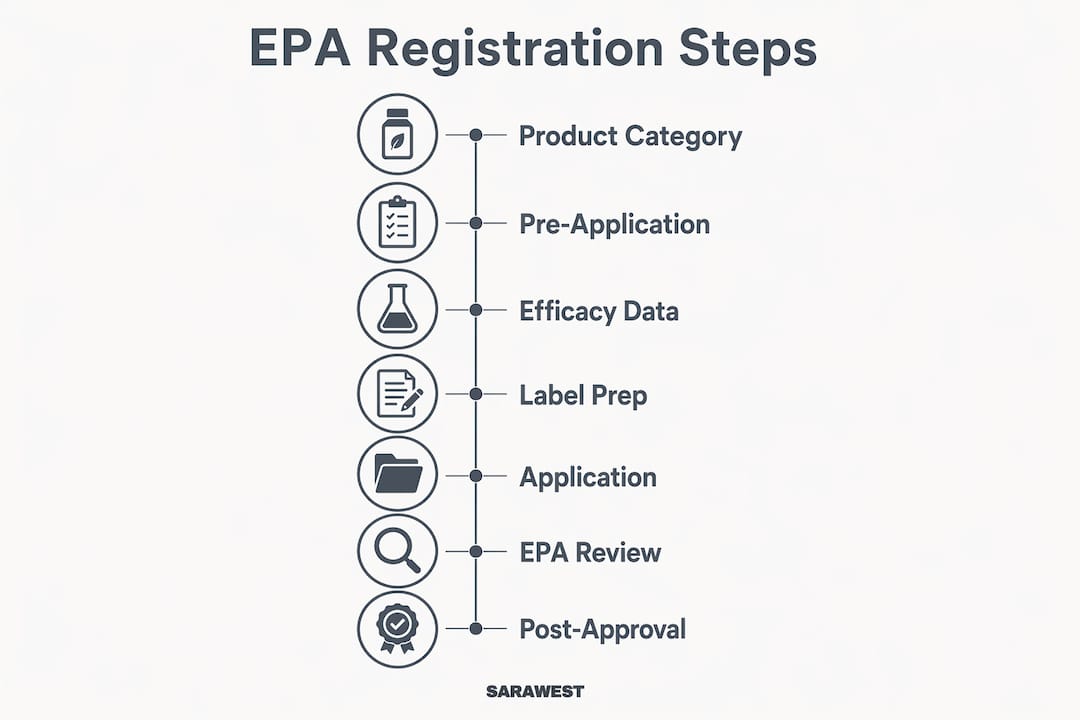
Step 1: Determine your product category. EPA registers three types of disinfectants based on efficacy data: Limited (effective against one major group of microorganisms), General or Broad-spectrum (effective against both gram-positive and gram-negative bacteria), and Hospital disinfectants, which must also demonstrate effectiveness against the nosocomial pathogen Pseudomonas aeruginosa. Knowing your category before you apply shapes every data requirement that follows.

Step 2: Request a pre-application meeting. Contact the EPA's Antimicrobials Division Product Team before assembling your application. This meeting clarifies data requirements, labeling expectations, and whether your product qualifies as a pesticide or a pesticidal device. Skipping this step is where many applications go sideways.
Step 3: Compile efficacy and safety data. Public health disinfectants require submission of efficacy data. Non-public health products must generate the data but do not always submit it unless EPA requests it. Safety data covers toxicology, environmental fate, and physical or chemical properties.
Step 4: Prepare your label. EPA reviews and approves label language. Every claim on the label must be supported by the data you submit. Misbranding, including false or misleading efficacy claims, is a federal offense.
Step 5: Submit your application with fees. Applications go through EPA's electronic submission system with the required forms, data packages, and fee payment.
Step 6: EPA review and response. The agency reviews your submission, may issue deficiency notices requesting additional data, and ultimately approves or denies the application.
Step 7: Post-approval. Once registered, you may pursue supplemental distributor registrations to allow other brands to market your formulation without repeating the full data submission.
How to verify EPA registration and find official disinfectant lists
Verification takes two minutes when you know where to look. Find the EPA Reg. No. on the product label, then run it through one of EPA's online tools. The NPIC Product Research Online (NPRO) lookup confirms registration status and approved uses. List N covers disinfectants approved for SARS-CoV-2. List P covers products effective against Candida auris, the drug-resistant fungal pathogen increasingly present in healthcare settings.
One important caveat: inclusion on any EPA list does not constitute an endorsement of one product over another. The lists confirm that EPA reviewed efficacy data for the listed pathogen. Always check that the product label includes specific use directions for the pathogen you need to address.
| Resource | Purpose | How to use |
|---|---|---|
| NPRO (NPIC lookup tool) | Confirm registration status and approved uses | Enter EPA Reg. No. from product label |
| List N | Disinfectants for SARS-CoV-2 | Search by registration number or product name |
| List P | Disinfectants effective against Candida auris | Search by registration number; verify label directions |
| Selected EPA-Registered Disinfectants page | Browse lists by pathogen (TB, MRSA, Norovirus, Ebola, and more) | Navigate by list letter (A, B, G, H, J, K, L, M, N, O, P, Q, S) |
| DfE-Certified Disinfectants list | Find products meeting both registration and Design for the Environment standards | Search by EPA Reg. No., product, or company |
The regulatory framework: FIFRA and what it requires from you
FIFRA is the federal law that governs every pesticide sold in the United States, and disinfectants are pesticides under that law. FIFRA section 3 mandates registration for all pesticides before sale or distribution, with narrow exceptions for minimum-risk products. Antimicrobial disinfectants face additional data requirements under FIFRA section 3(h).
The law draws a clear line between pesticide products and pesticidal devices. A UV light system that claims to disinfect is a pesticidal device. Devices do not require product registration under FIFRA section 3, but they must be manufactured in an EPA-registered establishment, governed under 40 CFR 152.500. That establishment number is not the same as a product registration number, and the legal implications differ significantly.
Post-registration compliance is ongoing. Registrants must maintain records, report adverse effects, and update labels when formulations or use patterns change. Public Water Systems bear direct responsibility for verifying that every disinfectant they use carries a valid EPA registration, shifting compliance accountability across the entire supply chain.
Expert perspectives on navigating EPA disinfectant registration challenges
The most preventable registration failures come from two sources: confusing establishment numbers with product registrations, and submitting applications without a pre-application consultation. A formal determination from EPA on whether your product qualifies as a pesticide or a pesticidal device costs $2,482 and takes about four months. That investment is far cheaper than a rejected application or an enforcement action.
EPA registration confirms regulatory minimum standards, but it differs from third-party certifications like NSF that involve ongoing auditing and retesting. For buyers comparing NSF vs EPA registration, the distinction is real: EPA approval is a legal prerequisite for sale, while NSF certification signals a higher tier of quality assurance through continuous third-party verification.
At Sarawest USA, we work with manufacturers and importers who need EPA-compliant disinfectant formulations built right from the start. Our in-house R&D chemists understand the data requirements for each disinfectant category, which means your formulation is designed to support registration, not retrofitted after the fact.
Common reasons EPA denies disinfectant registrations:
- Efficacy data does not meet the standard for the claimed disinfectant category
- Label claims are not supported by submitted data
- Missing or incomplete toxicology or environmental fate data
- Misbranding, including vague or misleading efficacy language
- Failure to document pre-submission consultation when one occurred
Pro Tip: Request a pre-application meeting with the EPA Antimicrobials Division before you spend a dollar on efficacy testing. The meeting is free, and the guidance you receive can prevent months of rework.
What does EPA disinfectant registration actually cost?
Registration fees are set under the Pesticide Registration Improvement Act (PRIA) and vary by application type. A standard new registration for an antimicrobial product carries a fee in the range of several thousand dollars, with higher fees for applications requiring more extensive data review. Small businesses and certain public interest applicants may qualify for fee waivers or reductions.
Beyond the EPA fee itself, the real cost of registration is the efficacy and safety testing required to support the application. Laboratory testing for a hospital-grade disinfectant, which must demonstrate effectiveness against Pseudomonas aeruginosa in addition to standard gram-positive and gram-negative organisms, costs substantially more than testing for a limited disinfectant. Expect to budget for toxicology studies, environmental fate data, and label development on top of the EPA submission fee.
A formal product determination (PRIA code M009) to confirm whether your product is a pesticide or a pesticidal device costs $2,482 with a four-month review window. Supplemental distributor registrations carry lower fees because they leverage the primary registrant's existing data package, making them a cost-efficient path for brands entering the market on an established formulation.
How to amend or update an existing EPA disinfectant registration
Registrations are not static documents. When your formulation changes, your use sites expand, or your label language needs updating, you must file an amendment with EPA. Amendments go through the same PRIA fee schedule as new applications, though minor label changes typically carry lower fees than formulation amendments.
Adding a new pathogen claim requires submitting efficacy data for that pathogen, even if the product is already registered for other organisms. Expanding to a new use site, such as adding food-contact surface directions to a product previously labeled only for hard nonporous surfaces, requires data to support the new claim and EPA approval of the revised label.
Supplemental distributor registrations must stay in sync with the primary registration. If the primary registrant amends the formulation or label, supplemental distributors need to update their own registrations accordingly. Letting that alignment lapse creates a compliance gap that can expose both parties to enforcement risk.
Record-keeping is non-negotiable throughout. Registrants must retain production records, sales data, and adverse effects reports, and make them available to EPA on request. Building that documentation habit from day one is far easier than reconstructing records under scrutiny.
Ready to bring a registered disinfectant to market?
Sarawest USA builds disinfectant formulations designed to support EPA registration from the ground up. Our chemists know what the Antimicrobials Division wants to see in a data package, and our contract manufacturing capabilities scale from pilot runs to full truckloads once your registration clears. Tell us what you need made. We'll handle the rest.
Key Takeaways
EPA disinfectant registration under FIFRA is a legal prerequisite for sale in the U.S., requiring efficacy data, approved labeling, and ongoing post-registration compliance from every manufacturer and distributor.
| Point | Details |
|---|---|
| Registration is mandatory under FIFRA | No disinfectant can be legally sold in the U.S. without EPA registration, with narrow minimum-risk exceptions. |
| Registration numbers have two or three parts | A two-part number is a primary registration; a three-part number identifies a supplemental distributor product with equivalent efficacy. |
| Pre-application meetings prevent denials | Consulting the EPA Antimicrobials Division before submitting clarifies data requirements and reduces rejection risk. |
| Verification uses List N, List P, and NPRO | Enter the EPA Reg. No. from the product label into these tools to confirm registration status and approved pathogen claims. |
| Amendments require new data and fees | Adding a pathogen claim or new use site requires submitting supporting efficacy data and paying applicable PRIA fees. |