

What's the real difference between essential and fragrance oils?
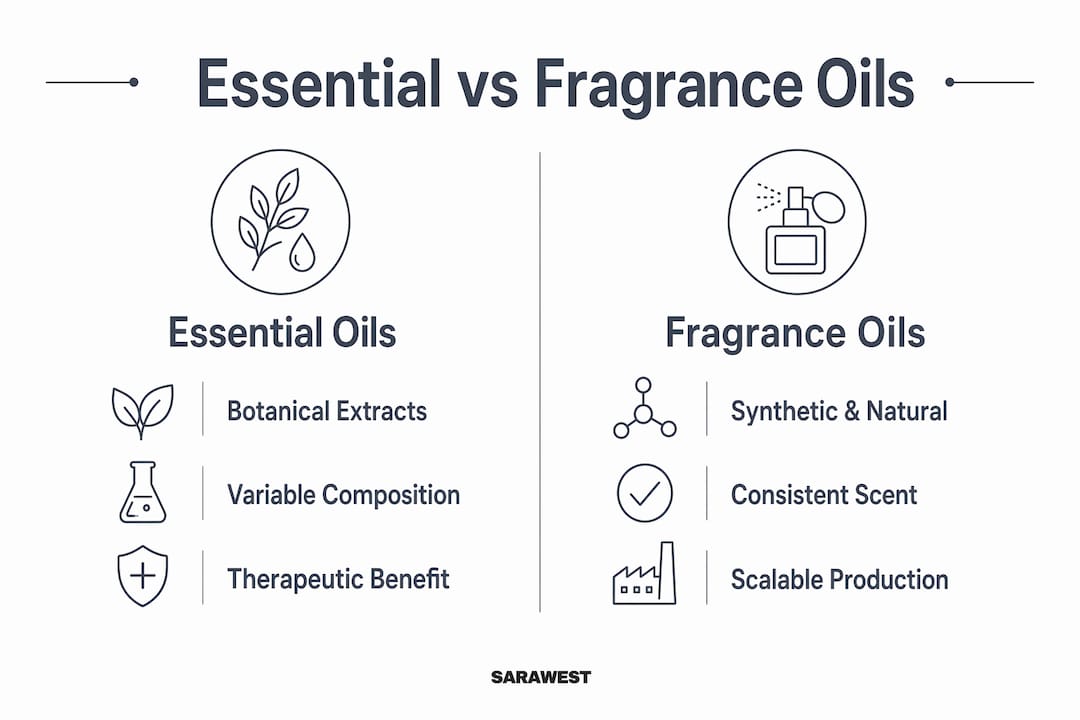
For commercial formulators, the essential vs fragrance oil decision comes down to three things: origin, consistency, and what you're asking the oil to do in your product. Essential oils are natural botanical extracts, steam distilled or cold pressed directly from plant material. Fragrance oils are lab-engineered blends of synthetic aroma molecules and natural isolates, built specifically for reproducible performance at scale.
Here's the short version for anyone making a sourcing or formulation call:
- Essential oils contain 20–200+ distinct compounds (terpenes, esters, alcohols) that vary by plant species, harvest season, and extraction method
- Fragrance oils are formulated from synthetic aromatics and natural isolates for batch-to-batch consistency, heat stability, and predictable scent throw
- Cost: Essential oils like rose or sandalwood carry significant price volatility tied to crop yields and supply chains; fragrance oils offer predictable, lower-cost inputs for large production runs
- Regulatory profile: Fragrance oils are tested against IFRA standards; essential oils require separate safety assessments and may trigger allergen labeling obligations
- Best fit: Essential oils suit therapeutic, botanical, or artisan-positioned product lines; fragrance oils suit high-volume, consistency-driven manufacturing
Neither is universally superior. The right choice depends on your product's purpose, your production scale, and your brand positioning.
Table of Contents
- What you need to know about essential oils in manufacturing
- Why fragrance oils are built for industrial production
- How to choose between essential and fragrance oils for your product
- How Sarawest USA approaches oil selection and custom formulation
- Key Takeaways
- The industry gets this choice wrong more often than it should
- Sarawest USA builds the formulation your product actually needs
What you need to know about essential oils in manufacturing
Essential oils are volatile botanical concentrates. The extraction method shapes everything about the final oil: steam distillation for most leaves and woods, cold pressing for citrus peels, CO2 extraction for delicate resins. Each method yields a chemically distinct profile, which is exactly what makes essential oils both valuable and difficult to manage at scale.
The complex, variable chemistry of essential oils is their greatest commercial asset and their biggest manufacturing liability. Lavender from one harvest smells subtly different from the next. That's authentic. It's also a quality control challenge when you're running 10,000-unit batches.
Where essential oils genuinely add value in commercial products:
- Therapeutic and aromatherapy product lines where natural compound activity is part of the product claim
- Premium personal care formulations where botanical sourcing supports brand storytelling
- Clean-label products where consumers expect recognizable, plant-derived ingredients
- Artisan or small-batch runs where batch variability is manageable
Where they create real manufacturing friction:
- Oxidation and volatility: many essential oils degrade quickly without antioxidants or stabilizers, shortening shelf life
- Phototoxicity: bergamot and certain citrus oils contain furanocoumarins that cause photosensitivity reactions, requiring careful formulation controls
- Allergen disclosure: compounds like linalool and limonene trigger EU and increasingly US labeling requirements
- Supply volatility: sandalwood, rose, and frankincense prices swing with climate and geopolitical conditions
For brands building around natural positioning, essential oils are worth the complexity. For anyone prioritizing scale and consistency, the math usually points elsewhere.
Why fragrance oils are built for industrial production
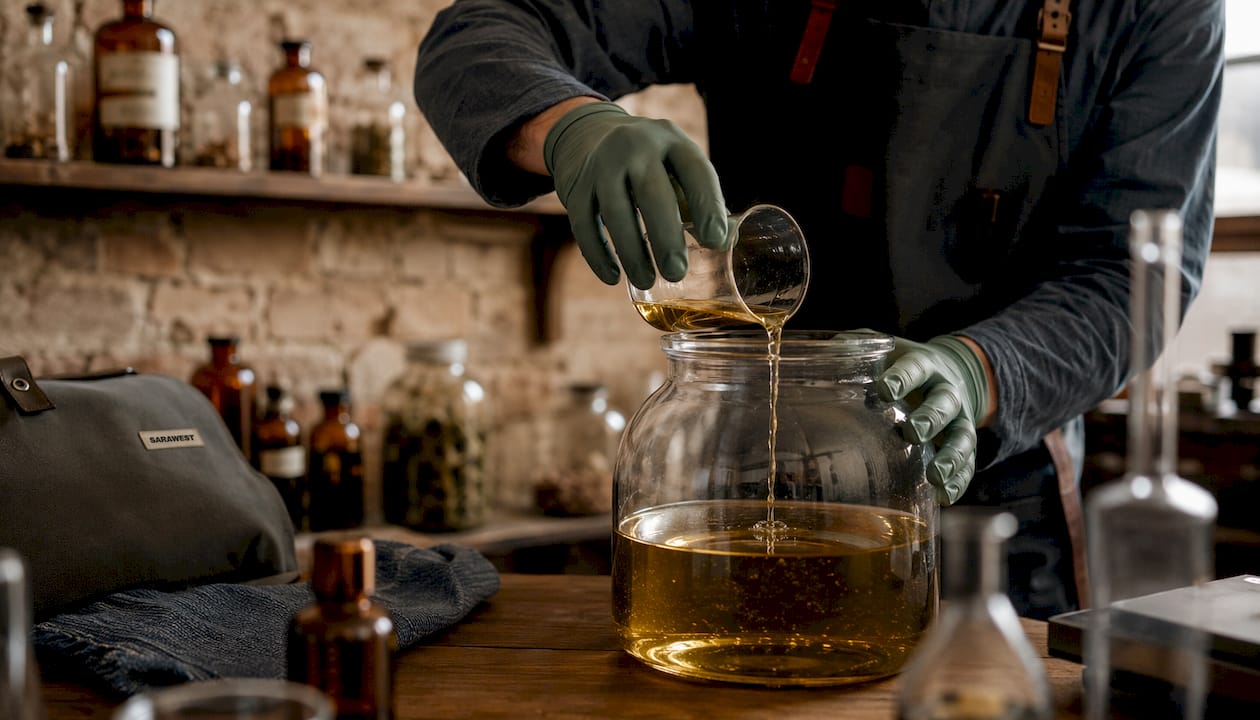
Fragrance oils exist because commercial manufacturing needs what nature can't reliably deliver: the same scent, the same performance, every single batch. They're developed in labs where perfumers blend synthetic aromatic molecules with natural isolates into repeatable formulas. The result is a product engineered for your specific matrix, whether that's wax, surfactant, polymer, or alcohol.
About 95% of synthetic fragrance raw materials derive from petroleum feedstocks, with a growing share produced through biotech fermentation. That's the backbone of their cost advantage and their stability profile.
What fragrance oils deliver that essential oils can't match at scale:
- Consistent scent throw across candles, detergents, air fresheners, and personal care products
- Heat and UV stability, critical for products that sit in warehouses or on retail shelves
- Formulation flexibility: solvent-based concentrates, water-compatible emulsions, and microencapsulated powders for specialty applications
- Broader creative palette, including scent profiles that have no botanical equivalent
- Phthalate-free, IFRA-compliant options with full safety data sheet documentation
For commercial cleaning products, the scent consistency that fragrance oils provide across large batches is a direct operational advantage. Facilities managers and end buyers notice when a product smells different run to run. Fragrance oils eliminate that variable. For context on how scent and safety intersect in industrial cleaning environments, factory cleaning safety protocols offer useful grounding on what formulators need to account for.
The sustainability picture is also shifting. Responsible manufacturers increasingly use natural isolates and biotech-derived synthetics to reduce pressure on overharvested botanicals while maintaining performance.
How to choose between essential and fragrance oils for your product
The decision framework isn't complicated, but it does require honesty about what your product actually needs to do.
Start with product purpose. If therapeutic benefit is a core claim, essential oils are non-negotiable. If scent is purely atmospheric or functional, fragrance oils almost always perform better and cost less.
Consider your production scale. Pilot batches can absorb essential oil variability. Full production runs cannot. Batch-to-batch consistency becomes a quality control requirement, not a preference, once you're shipping at volume.
Run the cost model. Essential oil pricing is tied to agricultural supply chains. A drought in a key growing region can spike your input costs mid-contract. Fragrance oils carry predictable pricing that supports stable product margins.
Map your regulatory obligations. Both oil types require safety documentation, but the pathways differ. Essential oils need individual safety assessments and may require allergen labeling. Fragrance oils need IFRA compliance documentation and safety data sheets. Know which framework applies to your product category and target market before you finalize a formula.
- Assess whether your brand positioning requires "natural" or "botanical" labeling claims
- Evaluate shelf life requirements against each oil type's stability profile
- Factor in your supply chain's ability to manage agricultural commodity risk
- Confirm allergen disclosure requirements for your distribution markets
Pro Tip: Natural isolates offer a middle path. These are single odor molecules extracted from plants and sometimes reproduced synthetically, giving you botanical authenticity with the stability and standardization of engineered fragrance. For brands that want a "natural-derived" story without the batch variability of full essential oils, hybrid formulations using isolates are worth serious consideration.
How Sarawest USA approaches oil selection and custom formulation
Most contract manufacturers hand you a spec sheet and ask you to decide. We don't work that way. Our in-house R&D chemists sit down with your product goals, your regulatory requirements, and your cost targets, then build the formulation around those constraints, not around what's easiest to source.
Sarawest USA's proprietary formula library covers 1,200+ formulations across eight industries, including commercial cleaning, sports care, equine products, and solar care. That depth means we've already solved most of the essential-versus-fragrance-oil trade-offs in real production contexts. We know where essential oils hold up and where they fail at scale. We know which fragrance oil matrices perform in high-pH cleaning formulations and which break down.
When a client came to us needing a botanical-positioned sports care line with a 24-month shelf life, the answer wasn't pure essential oils. We built a hybrid formulation using natural isolates anchored by a fragrance oil base, delivering the "plant-derived" story the brand needed with the stability their retail distribution required. That's the kind of problem our chemists solve every week.
Our formulation track record spans pilot batches to full truckloads. Compliance and safety testing are built into the process, not bolted on at the end. If you need IFRA documentation, safety data sheets, or allergen disclosure support, that's part of what we deliver.
Key Takeaways
Essential oils and fragrance oils each have a defined role in commercial formulation, and choosing correctly from the start prevents costly reformulation later.
| Point | Details |
|---|---|
| Origin drives everything | Essential oils are botanical extracts with variable chemistry; fragrance oils are engineered for reproducible performance. |
| Scale favors fragrance oils | Batch-to-batch consistency and cost predictability make fragrance oils the default for high-volume manufacturing. |
| Regulatory paths differ | Essential oils need individual safety assessments; fragrance oils require IFRA compliance documentation and safety data sheets. |
| Hybrid formulations exist | Natural isolates bridge botanical authenticity with synthetic stability, a practical middle path for clean-label brands. |
| Sarawest USA | In-house R&D chemists build formulations around your product goals, from pilot batch to full production scale. |
The industry gets this choice wrong more often than it should
The conventional framing treats essential oils as "premium" and fragrance oils as a compromise. That framing costs brands real money and creates real formulation problems.
Industry expert Liz Fulcher of the Aromatic Wisdom Institute puts it plainly: the choice should be driven by product outcome, not by a perceived quality hierarchy. A fragrance oil that performs consistently across 50,000 units is not inferior to an essential oil that smells slightly different in every batch. It's a different tool for a different job.
What the industry underestimates is how much the "natural is better" narrative inflates essential oil adoption in contexts where it creates genuine risk. Phototoxic citrus oils in leave-on personal care products. Oxidized tea tree in cleaning formulations that sat in a warm warehouse. Lavender batches that smell noticeably different because the harvest was early. These aren't edge cases. They're predictable consequences of applying a variable natural input to a consistency-demanding manufacturing context.
The smarter move is to start with your product's functional requirements and work backward to the ingredient. Sometimes that's a pure essential oil. Often it's a fragrance oil. Increasingly, it's a hybrid built from natural isolates and engineered aromatics. The brands getting this right aren't the ones most committed to one camp. They're the ones most honest about what their product actually needs to do.
Sarawest USA builds the formulation your product actually needs
Faster than a broker, more accountable than a commodity supplier. Sarawest USA gives you direct access to in-house chemists who have already worked through the essential-versus-fragrance-oil trade-offs across cleaning, sports care, equine, and personal care product lines. No intermediaries. No guesswork on compliance.
Whether your product needs botanical authenticity, engineered scent consistency, or a hybrid approach that delivers both, we build it from our library of 1,200+ proprietary formulas or from scratch. Pilot batches ship fast. Full production scales without reformulation surprises. See our proven formulation work or get a quote for your specific product today. A real person reads every inquiry.