

Which foam testing methods matter most for your formulation?
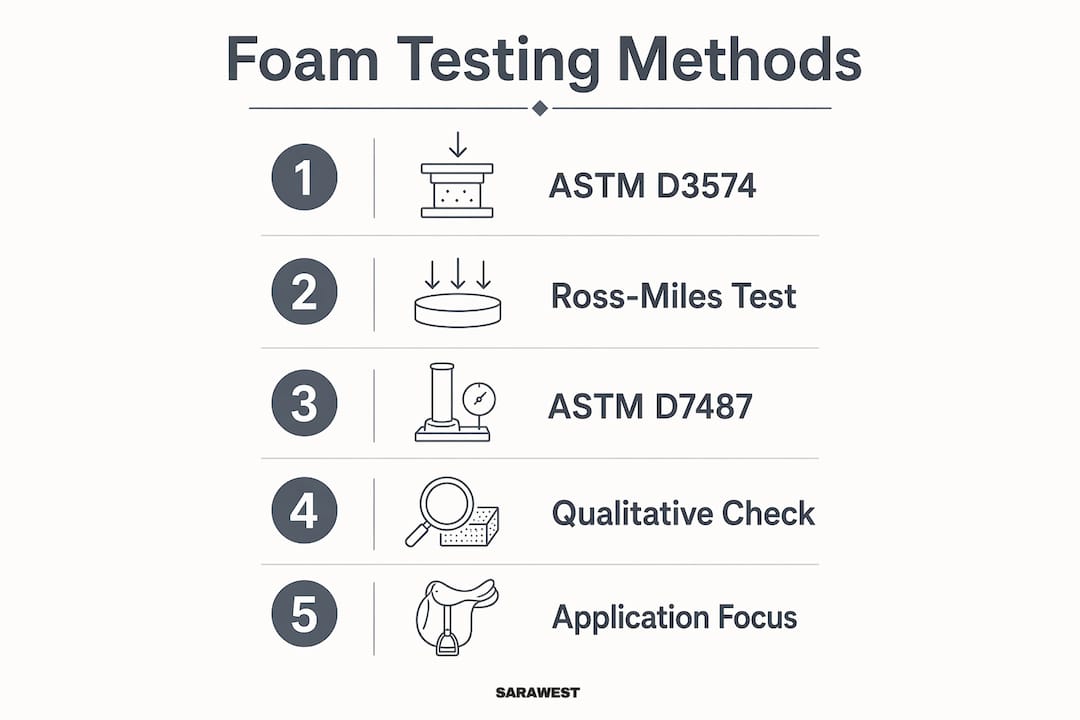
Choosing the right foam testing methods isn't a formality. It's how you know whether a formula works before it ships. For chemical manufacturers and formulators in the United States, the core toolkit includes three ASTM-standardized approaches: mechanical evaluation under ASTM D3574, liquid foamability assessment via the Ross-Miles method (ASTM D1173-07), and reaction kinetics monitoring through the ASTM D7487 Cup Foam Test.
Here's what each method covers:
- ASTM D3574 measures mechanical properties of flexible polyurethane foams: firmness, compression set, tensile strength, tear resistance, and fatigue behavior.
- Ross-Miles (ASTM D1173-07) quantifies foam height and stability over time in surfactant-containing liquid formulations, used for cleaning and care products.
- ASTM D7487 Cup Foam Test captures reaction kinetics during polyurethane foam formation, including cream time, string gel time, and free rise density.
- Qualitative inspection of cell structure, color, odor, and surface properties catches formulation errors that mechanical tests miss.
- Process monitoring via rise pressure, reaction temperature, and dielectric polarization gives real-time insight into foam formation dynamics.
No single test tells the whole story. Sarawest USA's in-house R&D chemists select and combine these methods based on each product's end-use requirements, keeping both cost and decision speed in check.
Table of Contents
- 1. ASTM D3574: the mechanical foundation for polyurethane foam evaluation
- 2. How the Ross-Miles method measures liquid foam performance
- 3. ASTM D7487 Cup Foam Test: tracking reaction kinetics in real time
- 4. Qualitative inspection and process monitoring round out foam quality assurance
- 5. How Sarawest USA applies foam testing to build better formulas
- Key Takeaways
1. ASTM D3574: the mechanical foundation for polyurethane foam evaluation
ASTM D3574 is the definitive U.S. standard for flexible polyurethane foam, built around eight sub-tests that measure the mechanical properties most relevant to real-world performance. Labs don't run all eight for every formulation. They select based on end-use: mattress firmness calls for indentation force deflection (IFD); automotive seating adds fatigue and compression set; packaging applications may prioritize creep behavior.
Key sub-methods and what they reveal:
- Test A (IFD): Measures foam firmness by recording the force needed to indent a 50-square-inch platen to 25% and 65% of foam thickness. The primary indicator of comfort and support.
- Test D (Compression Set): Samples compressed to 50%, 75%, or 90% of thickness for 22 hours, then allowed 30 minutes of recovery. Quantifies durability and long-term shape retention.
- Tensile Strength and Elongation: Measures the stress required to pull foam apart and how far it stretches before failure. Relevant wherever foam is stretched during use.
- Tear Resistance: Force required to propagate an existing tear, divided by sample thickness. Useful for durability screening in high-flex applications.
- Fatigue Testing: Dynamic pounding, roller shear, and caster tests simulate real-world wear cycles to predict long-term performance.
Sample preparation is non-negotiable. ASTM D3574 requires conditioning at 23°C ± 2°C and 50% ± 5% relative humidity for a minimum of 16 hours, with specimens cut in the correct orientation relative to foam rise direction. Testing machines must meet specified force accuracy and crosshead speed requirements of 25 and 50 mm/min. Skip the conditioning step and your data is unreliable, full stop.
Selecting only the tests relevant to a product's application keeps R&D costs proportional. Not every foam formula needs a full fatigue battery. That's a judgment call your chemists should make with the end product in mind.
2. How the Ross-Miles method measures liquid foam performance
The Ross-Miles foam test, standardized as ASTM D1173-07, is the industry benchmark for measuring foamability and stability in surfactant-containing solutions. It's the go-to method for cleaning products, personal care formulations, and any liquid chemistry where foam behavior matters to the end user.
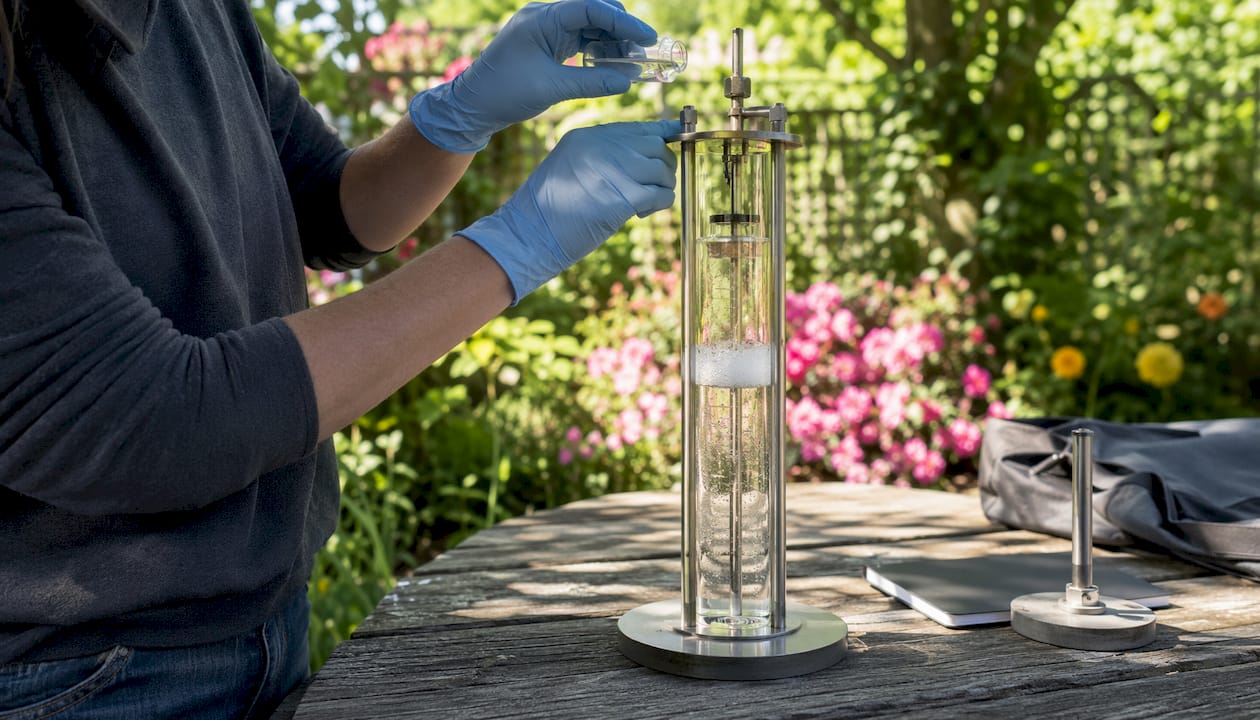
The procedure is straightforward. A measured volume of surfactant solution flows from a standardized reservoir down into a receiver vessel containing the same solution. The turbulence generates foam. Height is recorded immediately after the pour, then periodically during several minutes. That decay curve tells you how persistent the foam is, not just how much forms initially.
Critical procedural details:
- Solutions must be fully dissolved and free of particulate matter. Insoluble components or hydrolyzable agents distort results and produce data that doesn't reflect actual formulation performance.
- Temperature control of the solution and the test environment affects foam stability readings. Standardized conditions are required for cross-batch comparability.
- The receiver vessel dimensions are fixed by the standard. Substituting non-standard glassware invalidates the measurement.
For formulators developing commercial cleaning products, Ross-Miles data directly informs surfactant selection and concentration decisions. A formulation that generates strong initial foam but collapses within one minute signals instability that will show up in field performance. One that holds height across all five readings indicates a stable foam system worth advancing to scale.
This method complements mechanical testing by focusing entirely on the liquid phase. It doesn't tell you anything about cured foam structure, but for surfactant-based products, it's often the first test that determines whether a formula is worth developing further.
3. ASTM D7487 Cup Foam Test: tracking reaction kinetics in real time
The Cup Foam Test under ASTM D7487 is built for one purpose: capturing what happens during polyurethane foam formation, not after. It measures cream time (when the reaction visibly initiates), string gel time (when the foam reaches pull consistency), and free rise density. Together, these parameters give you a kinetic fingerprint of the formulation.
Why does that fingerprint matter? Because small changes in catalyst level, blowing agent concentration, or raw material lot can shift reaction timing in ways that only show up during formation. A final mechanical test on cured foam won't catch a cream time that's drifted by 10 seconds. The Cup Foam Test will.
Practical considerations for reliable results:
- Operator consistency is the biggest variable. Lab-to-lab and operator-to-operator variability in this test can be substantial. Mixing technique, transfer speed, and timing discipline all affect the data. Explicit protocols agreed upon between the manufacturer and the testing lab are required before results carry any weight.
- Faster formulations amplify variability. Cream time measurement becomes less precise as reaction speed increases. Slower formulations introduce more variability in free rise time measurement. Know your formulation's speed profile before interpreting results.
- Equipment setup matters. Consistent mixing container geometry, mixing speed, and component temperatures must be documented and held constant across runs.
For foam density guidance and understanding how free rise density connects to final product performance, the Cup Foam Test is the most direct measurement available during R&D. Sarawest USA uses this test as a core tool in rapid prototyping, catching formulation drift early and making adjustments before committing to larger production runs.
4. Qualitative inspection and process monitoring round out foam quality assurance
Mechanical tests and reaction kinetics don't capture everything. Qualitative inspection of installed or cured foam reveals formulation and application errors that standardized tests can miss entirely.
What trained inspectors look for:
- Cell structure uniformity: Irregular or collapsed cells indicate mixing problems, blowing agent issues, or temperature inconsistencies during formation.
- Color consistency: Off-color foam often signals contamination or raw material variation.
- Surface stickiness or brittleness: Tack-free time problems or over/under-crosslinking show up here before mechanical testing is even run.
- Odor: Residual solvent or off-gassing from incomplete reaction is detectable by smell and warrants further investigation.
Beyond visual and sensory inspection, process monitoring during foam formation adds another layer of control. Rise pressure measurement captures the mechanical stress the foam exerts as it expands, reflecting cell wall properties and gelling behavior. Dielectric polarization sensors track the chemical reaction in real time by measuring changes in the system's electrical properties as polymerization progresses. Ultrasonic sensors, paired with master curve software, provide objective rise profiling that removes operator subjectivity from height measurement entirely.
One gap worth knowing: reliable non-destructive testing for bubble size and distribution in cured foam plastics doesn't yet exist as a standardized commercial method in the U.S. market. Vibration analysis has been explored as a potential approach, but it hasn't reached the point where it produces geometry-independent, actionable results without significant additional testing effort.
Temperature and humidity affect every foam test outcome. Standardized conditioning isn't optional. It's the only way to generate data that holds up across batches, labs, and time.
5. How Sarawest USA applies foam testing to build better formulas
Testing data is only as useful as the decisions it drives. At Sarawest USA, our in-house R&D chemists don't run tests for the sake of compliance documentation. They use foam quality assessment results to make real formulation calls, fast.
Here's how that works in practice:
- Test selection is application-driven. A commercial cleaning product gets Ross-Miles testing and qualitative inspection. A polyurethane foam for a care product gets ASTM D3574 mechanical evaluation plus Cup Foam Test kinetics. Running every test on every formula wastes budget and slows development.
- Pilot batches are tested before scale-up. Our process doesn't skip from bench to full production. Every formula goes through a pilot run with full documentation of test results, so adjustments happen before they're expensive.
- Quantitative and qualitative data work together. A formula that passes IFD and compression set but shows irregular cell structure on inspection doesn't ship. Both data streams matter.
- Regulatory compliance is built in, not added on. ASTM standards aren't a checkbox at the end of development. They're the framework our chemists work within from the first prototype.
Pro Tip: When evaluating a new foam formulation, run the Cup Foam Test first. It's fast, low-cost, and catches catalyst and blowing agent issues before you invest in full mechanical testing. Fix the kinetics, then confirm the mechanical properties.
Our library of over 1,200 proprietary formulas means we're not starting from zero for most clients. We adapt proven chemistry, test it against your specifications, and scale it. See how that process has worked for other brands in our formulation case studies.
If you're ready to move from concept to tested formula, tell us what you need. A real chemist reads every inquiry.
Key Takeaways
Selecting the right foam testing method for your application is the single most important decision in foam formulation development.
| Point | Details |
|---|---|
| ASTM D3574 covers mechanical properties | Eight sub-tests evaluate IFD, compression set, tensile, tear, and fatigue; select based on end-use application. |
| Ross-Miles quantifies liquid foam stability | Foam height readings at 0, 1, 3, and 5 minutes reveal surfactant performance for cleaning and care products. |
| Cup Foam Test captures reaction kinetics | ASTM D7487 measures cream time, string gel time, and free rise density to detect formulation drift early. |
| Qualitative inspection catches what instruments miss | Cell uniformity, color, odor, and surface properties reveal mixing and application errors in cured foam. |
| No reliable NDT for bubble size exists yet | Non-destructive bubble size measurement is not yet standardized; vibration analysis remains exploratory. |