

Freeze thaw testing measures how repeated freezing and thawing affects a formulation's stability, performance, and container integrity. If your commercial cleaning or sports-care product will ever sit in an unheated warehouse, ride in a winter delivery truck, or ship to the Midwest or Northeast, you need this data before you scale.
When to test:
- During formulation screening, before you commit to a formula
- Before pilot production, when packaging decisions are still reversible
- Prior to large-scale shipping to cold-climate distribution centers
Two reference points anchor every credible test program in the U.S.: ASTM C666 as a commonly cited freeze thaw protocol (adapted for formulated products), and ISO/IEC 17025 as the lab accreditation standard that makes your results defensible. Sarawest USA runs in-house R&D alongside manufacturing, which means formulation and testing iteration happen on the same floor.
Table of Contents
- What freeze thaw damage actually looks like in formulated products
- Which endpoints to measure and how to set pass/fail criteria
- Which standards and labs apply in the U.S. testing market
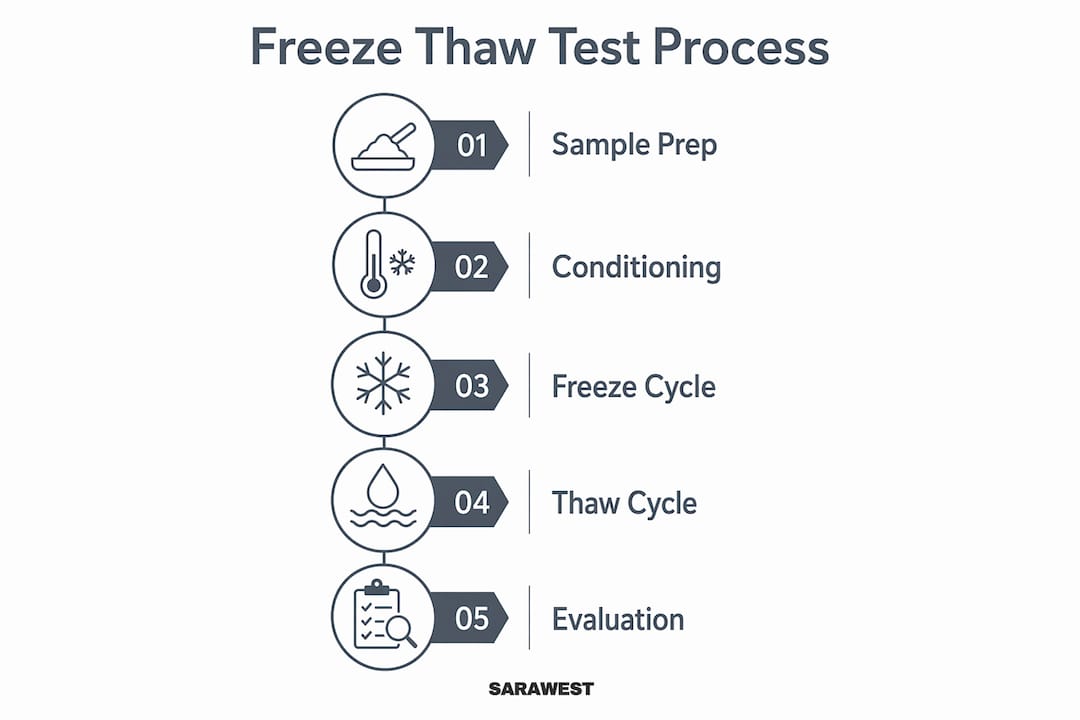
- How to design a practical freeze thaw test for your product
- Formulation and packaging strategies that improve freeze thaw resilience
- Where freeze thaw testing fits in your development timeline
- When does partnering with a contract manufacturer make sense?
- What does freeze thaw testing cost and how long does it take?
- Key Takeaways
- The lesson most teams learn too late
- Sarawest USA handles formulation, testing, and scale in one place
- Useful standards and references to share with your lab
What freeze thaw damage actually looks like in formulated products
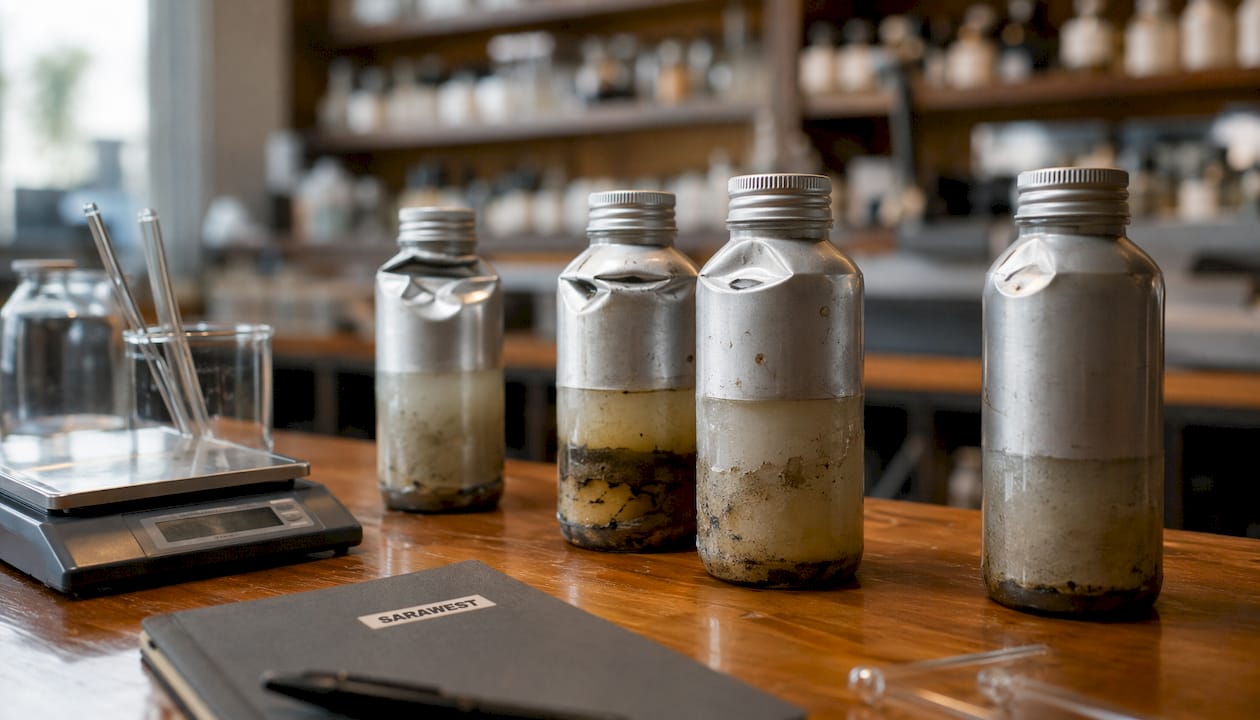
Most product teams picture cracked concrete when they hear "freeze thaw cycles." For liquid and semi-solid chemistries, the failure modes are different and often subtler.
Common failure modes to watch for:
- Phase separation or irreversible emulsion break
- Viscosity loss (product goes watery) or unexpected gelation
- Active ingredient assay loss from precipitation or degradation
- pH drift outside specification
- Particle aggregation or crystal growth
- Container rupture, seal failure, or cap deformation
The physics driving these failures is the same 9% volume increase water undergoes when it freezes. Inside a formulation, that expansion creates localized pressure, concentrates dissolved species as ice forms, and disrupts microstructure. Each cycle adds cumulative damage. A product that looks fine after one winter transit may fail after three.
Pro Tip: Visual appearance is the last thing to change. Internal separation and assay loss often precede any visible sign. Run viscosity and pH checks after cycle one, not just at the end of the test.
Which endpoints to measure and how to set pass/fail criteria
Choosing the right endpoints is where most teams either over-engineer the test or miss the failure that matters. Keep it functional: measure what predicts whether the product works in the field.
Core endpoints:
- Visual/phase separation: volume percent of separated layer (pass: no visible layer >5% by volume)
- Viscosity/rheology: Brookfield spindle measurement, pass within ±20% of initial spec
- pH change: pass within ±0.5 units of initial value
- Active assay: API or active ingredient recovery, pass at ≥90% of labeled claim
- Particle size distribution: for emulsions and suspensions, D90 shift <15%
- Container integrity: no leak, rupture, or permanent deformation
- Performance test: surface cleaning efficacy, foam retention, or friction coefficient for sports-care applications
Set pass/fail criteria tied to function, not arbitrary numbers. A viscosity shift of ±20% may be acceptable for a rinse-off cleaner and catastrophic for a high-viscosity sports lubricant. Run a minimum of three replicates (n=3) per condition to generate statistically meaningful data.
| Endpoint | Typical Method | Example Pass/Fail Threshold |
|---|---|---|
| Phase separation | Visual + graduated cylinder | No layer >5% by volume |
| Viscosity | Brookfield RV, spindle 4 | Within ±20% of initial |
| pH | Calibrated pH meter | ±0.5 units of initial |
| Active assay | HPLC or titration | ≥90% recovery |
| Particle size | Laser diffraction (D90) | <15% shift from baseline |
| Container integrity | Visual + pressure/leak test | No leak, rupture, or deformation |
NRMCA guidance reinforces the value of measuring sorptivity and saturation alongside standard endpoints, particularly for semi-solid or porous-matrix formulations where uptake drives vulnerability.
Which standards and labs apply in the U.S. testing market
ASTM publishes the most commonly referenced freeze thaw protocols in the U.S. ASTM C666 covers concrete, and ASTM D560/D560M covers soil-cement mixtures. For formulated liquid and semi-solid products, labs adapt these cycle profiles to match the product type and exposure scenario. No single ASTM standard covers commercial cleaning or sports-care formulations directly, which means your test plan defines the protocol.
What to require from any accredited lab:
- ISO/IEC 17025 accreditation (the global benchmark for testing lab competence)
- Documented experience with formulated chemistries, not just construction materials
- Ability to run custom cycle profiles with defined temperature ramps and soak times
- Raw data delivery: replicate values, time-temperature logs, and instrument calibration records
State DOT protocols, such as Indiana DOT ITM No. 209-15, prescribe cycles from below −15°F to 70–75°F with a 3% NaCl brine solution. These are useful references for extreme cold-chain exposure scenarios, even when your product is not an aggregate.
RILEM's position is direct: no single standardized lab test can perfectly predict field performance. Lab results are repeatable benchmarks, not guarantees. Treat them as comparative risk signals and pair them with real-world or field exposure samples when the stakes are high.
How to design a practical freeze thaw test for your product
A defensible test plan answers five questions before a single sample goes into the chamber.
- Define worst-case exposure. What is the coldest temperature your product will realistically reach during transport or storage? GLISA methodology documents that freeze thaw cycles vary significantly by region — a product shipping to Minnesota faces a different profile than one staying in Texas.
- Choose a cycle profile. A common starting point: −15°F to 70°F with defined hold times at each extreme. Milder profiles (20°F to 70°F) suit products with moderate cold-chain risk.
- Set the number of cycles. Screening: 1–3 cycles. Pre-pilot validation: 10–50 cycles. Full qualification: 50–300 cycles, depending on industry risk and shelf-life claims.
- Decide on replicates. Minimum n=3 per condition. Include ambient-held controls.
- Select endpoints from the table above and document acceptance criteria before testing begins.
Sample conditioning and controls:
- Pre-condition samples to representative fill level and moisture content
- Include container controls (empty containers cycled alongside filled ones)
- Use randomized specimen IDs to prevent observer bias during evaluation
Accelerated cycles compress calendar time but can overdrive failure modes that would not appear in real-world conditions. Pair accelerated testing with at least a small set of real-time or field exposure samples when the product is high-value or the failure mode is unclear.
Formulation and packaging strategies that improve freeze thaw resilience
Higher water content and porosity accelerate freeze thaw vulnerability. The practical levers for formulated products follow the same logic.
Formulation levers:
- Reduce free water activity: optimize water-to-active ratios and consider humectants that bind water
- Add freeze thaw stabilizers or cryo-protectants (polyols, certain glycols) to suppress ice crystal growth
- Select emulsifiers rated for low-temperature stability
- For semi-solids, control sorptivity and void structure in the matrix
Packaging and process controls:
- Maintain adequate headspace to accommodate volume expansion
- Specify container materials that resist brittle fracture at low temperatures; material selection for cold-exposure applications follows similar principles across industrial product categories
- Use robust seal and closure systems rated for thermal cycling
- Control fill level and degassing to minimize entrained air
Pro Tip: After freeze cycles, subject filled containers to a mechanical drop or vibration test. Brittleness from cold exposure can cause seal failures that only appear under handling stress, not static inspection.
Where freeze thaw testing fits in your development timeline
Testing is not a single event. It is a thread running from concept to post-launch.
- Concept screening: 1–3 cycle functional check on core endpoints. Fast, cheap, and eliminates obvious failures before you invest in formulation work.
- Formulation optimization: 10–50 cycles with iterative assay and viscosity tracking. This is where you compare stabilizer options and emulsifier candidates.
- Pilot production: Confirm that packaging and fill-line effects do not introduce new vulnerabilities. Production-representative fills behave differently from hand-filled lab samples.
- Pre-launch qualification: Full stability matrix, 50–300 cycles, complete assay and performance panels.
- Post-launch monitoring: Periodic testing of production lots, especially when raw material suppliers or packaging vendors change.
Go/no-go checklist before scaling:
- Consistent pass/fail results across all pilot runs
- Validated container integrity under production fill conditions
- Documented acceptance criteria signed off by QA before the qualification run begins
When does partnering with a contract manufacturer make sense?
You need an external partner when you lack in-house test capability, need rapid formulation iteration paired with freeze thaw data, or when packaging and fill-line effects must be evaluated under real production conditions.
What an integrated R&D and manufacturing partner provides:
- Combined formulation optimization and custom test plan design in one workflow
- Coordination with ISO/IEC 17025-accredited labs and documented lab partnerships
- Pilot batch runs at production-representative scale
- Data-rich reports with raw replicate values, pass/fail justification, and traceability
Sarawest USA's in-house R&D chemists work directly on formulation iteration alongside pilot-to-scale manufacturing, which means freeze thaw failures caught at the bench get fixed before they become production problems. With over 1,200 proprietary formulas across commercial cleaning, sports care, and six other industries, the starting point for most clients is an existing formula adapted to their cold-chain requirements, not a blank page.
What does freeze thaw testing cost and how long does it take?
Typical timelines:
- Quick screening (1–3 cycles): 1–2 weeks
- Custom accelerated testing (10–50 cycles): 2–6 weeks
- Full qualification matrix with multi-endpoint analysis: 4–12+ weeks
- Additional time for pilot production validation: add 2–6 weeks depending on batch size
Cost drivers:
- Number of cycles and endpoints
- Number of analytical assays (HPLC, particle size, performance testing)
- Sample quantity and conditioning requirements
- Container testing scope
- Whether testing is in-house at the contract manufacturer or sent to a third-party accredited lab
Integrated contract manufacturers reduce total calendar time by running formulation adjustments and test cycles in parallel rather than sequentially. Contact Sarawest USA for a tailored RFQ that scopes both formulation and testing in a single project plan.
Key Takeaways
Freeze thaw durability is a formulation, packaging, and process problem simultaneously — no single fix covers all three.
| Point | Details |
|---|---|
| Test early and often | Run a 1–3 cycle screen during formulation screening before committing to pilot production. |
| Measure what matters | Track viscosity, pH, active assay, and container integrity — not just visual appearance. |
| Use accredited labs | Require ISO/IEC 17025 accreditation and raw data delivery from any lab you engage. |
| Combine strategies | Formulation stabilizers, packaging material choices, and process controls work together; none alone is sufficient. |
| Sarawest USA | Offers in-house R&D, pilot-to-scale manufacturing, and testing coordination for commercial cleaning and sports-care brands. |
The lesson most teams learn too late
There is a pattern we see repeatedly: a product developer runs a solid bench-scale formulation, passes internal QA, and ships a pilot run in November. By February, the returns start. Containers have bulged. The emulsion has broken. The product looks fine at room temperature but was never tested below 32°F with a production-representative fill.
The overlooked variable is almost always packaging. Teams treat the container as a passive vessel. It is not. It is part of the formulation system. A container that performs well at 70°F can become a failure point at −10°F, especially when fill level, headspace, and seal compression interact with thermal cycling. Start instrumented testing early, include assay and viscosity from cycle one, and never sign off on a container without a filled-unit freeze test under production conditions.
Sarawest USA handles formulation, testing, and scale in one place
Hiring a separate formulator, a separate test lab, and a separate manufacturer adds weeks and introduces gaps where accountability disappears. Sarawest USA is built differently: real in-house chemists, contract manufacturing from pilot batches to full truckloads, and testing coordination that keeps your freeze thaw data tied directly to your production formula.
Whether you are launching a new commercial cleaning line, reformulating a sports-care product for cold-climate distribution, or validating packaging for a white-label program, we scope the work, run the chemistry, and deliver data you can hand to your QA team. Explore our commercial cleaning manufacturing capabilities or request a tailored RFQ today. A real person reads every inquiry.
Useful standards and references to share with your lab
- ASTM D560/D560M: Standard test methods for freezing and thawing of compacted soil-cement; useful cycle-profile reference adaptable to formulated products.
- Indiana DOT ITM No. 209-15: Prescribes −15°F to 70–75°F cycles with 3% NaCl brine; benchmark for extreme cold-chain exposure testing.
- NRMCA freeze thaw durability guidance: Covers degree of saturation and sorptivity as durability predictors; directly applicable to semi-solid formulations.
- RILEM position on testing limitations: Explains why no single lab test predicts field performance and why multi-pronged strategies are necessary.
- GLISA freeze thaw cycle methodology: Regional U.S. freeze thaw cycle data useful for mapping lab cycles to realistic shipping and storage exposures.
- NIH/ORF technical bulletin on freeze thaw mechanisms: Explains the 9% volume expansion mechanism and cumulative internal damage progression.