

For most US manufacturers, the choice between HDPE and PET bottles comes down to one question: does your product need to be seen, or does it need to be protected? PET (polyethylene terephthalate) delivers glass-like clarity and superior gas barrier performance, making it the standard for beverages, food, and retail personal care. HDPE (high-density polyethylene) is tougher, chemically resistant, and opaque, built for detergents, industrial chemicals, and pharmaceuticals.
| Property | HDPE | PET |
|---|---|---|
| Appearance | Opaque/semi-translucent | Crystal clear |
| Resin code | #2 | #1 |
| Density | 0.95 g/cm³ | 1.38 g/cm³ |
| Chemical resistance | Excellent | Good (not strong solvents) |
| Moisture barrier (WVTR) | 0.5 g-mil/100in²/24hr | 2.0 g-mil/100in²/24hr |
| Stress crack resistance | Fair (grade-dependent) | Excellent |
| Typical applications | Cleaning, industrial, pharma | Beverages, food, personal care |
When HDPE wins:
- Your formula contains bleach, caustic soda, surfactants, or concentrated acids
- The product requires opacity for light protection
- Rough handling or cold storage is part of the supply chain
- You need squeeze dispensing
When PET wins:
- Product visibility drives retail appeal
- You're packaging carbonated beverages or oxygen-sensitive foods
- Lightweight shipping economics matter at scale
- A strong recycling story supports your brand
How material properties drive HDPE vs PET bottle performance
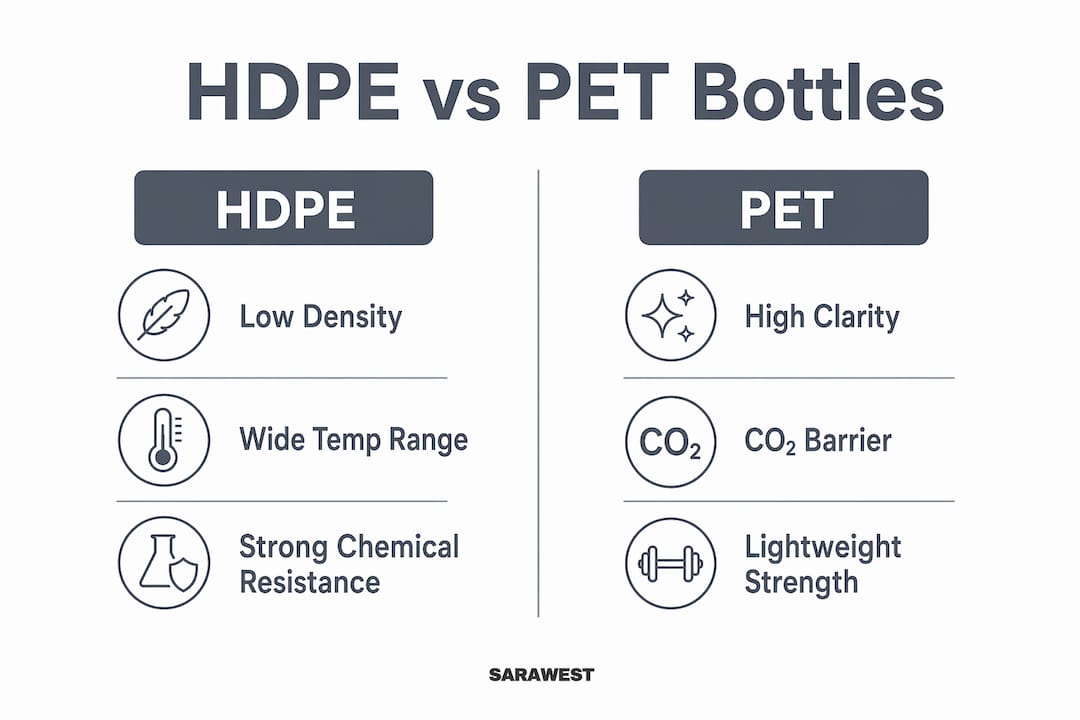
The density difference between these two materials tells the whole story. HDPE has a lower density with a loosely crystalline structure that gives it toughness and flexibility. PET runs denser, producing a rigid, glass-like material with excellent tensile strength.
Temperature tolerance is where HDPE pulls ahead in real-world conditions. HDPE handles a working range of approximately -78.9°C to 75°C, while PET's effective range narrows to roughly -40°C to 55°C. Despite PET's higher melting point compared to HDPE, HDPE performs better across extreme temperature swings, cold storage, and hot-fill applications up to 75°C.
On barrier performance, the two materials split the job. HDPE's WVTR of 0.5 g-mil/100in²/24hr makes it the better moisture barrier. PET's WVTR of 2.0 is less impressive for moisture, but PET outperforms HDPE on oxygen and CO₂ retention, which is why every carbonated beverage company defaults to it.
Key property contrasts:
- HDPE resists concentrated bleach, caustic soda, hydrochloric acid, and most surfactants; PET does not
- PET offers excellent stress crack resistance; HDPE's resistance varies by molecular weight grade
- HDPE is more flexible and squeezable; PET is more rigid with better design moldability
- PET accepts custom colors and tints well; HDPE is manufactured in virtually any color for brand coding
| Metric | HDPE | PET |
|---|---|---|
| Operating temp range | -78.9°C to 75°C | -40°C to 55°C |
| Melting point | — | — |
| WVTR | 0.5 g-mil/100in²/24hr | 2.0 g-mil/100in²/24hr |
| Impact resistance | Excellent | Good |
| Stress crack resistance | Fair | Excellent |
| Flexibility | High | Low |
Which industries and products belong in each bottle type?
1. Household and commercial cleaning products
HDPE is the only viable choice here. Concentrated surfactants, sodium hypochlorite (bleach), caustic soda, and phosphoric acid will permeate or degrade PET over time. HDPE's chemical inertness makes it standard across the cleaning industry, and its squeeze-dispensing flexibility adds functional value. Sarawest USA's commercial cleaning formulations are built with HDPE compatibility as a baseline requirement.
2. Industrial chemicals and agricultural inputs
HDPE handles petroleum derivatives, herbicides, pesticides, and most organic solvents without degradation. The impact resistance matters here too: industrial logistics is rough, and HDPE's durability reduces product loss during handling.
3. Pharmaceuticals
Both materials appear in pharma, but HDPE dominates for liquid medications, prescription bottles, and anything requiring light protection. Amber or white HDPE blocks UV effectively. PET works for transparent pill packaging and diagnostic vials where visibility is required.
4. Carbonated and still beverages
PET is the universal standard. Its CO₂ barrier keeps carbonation intact, its clarity showcases the product, and its lightweight construction cuts freight costs at high volume. Water, juice, soda, and sports drinks all default to PET.
5. Food packaging
PET's FDA approval for food contact, combined with its clarity and oxygen barrier, makes it the go-to for condiments, cooking oils, salad dressings, and sauces at retail. HDPE handles bulk and catering formats for edible oils where aesthetics matter less.
6. Personal care and cosmetics
The split here depends on positioning. Premium serums, toners, and lotions favor PET for its glass-like retail appeal and pump closure compatibility. Shampoos and body washes often use HDPE for squeeze dispensing and surfactant resistance. White-label personal care lines frequently run both materials across a single product range.
7. Sanitizers and disinfectants
HDPE handles alcohol and biocide concentrations that would stress PET. Any formula above standard consumer alcohol concentrations belongs in HDPE.
Regulatory compliance and branding: what your bottle choice commits you to
Both HDPE and PET carry FDA approval for food and beverage contact in the US, but the applications differ in practice. PET is the dominant FDA-approved material for direct food and beverage packaging. HDPE is preferred for industrial and chemical applications because of its chemical inertness and its long track record with regulatory bodies overseeing household and industrial chemical packaging.
Branding implications run deeper than most manufacturers expect. PET's glass-like transparency lets the product sell itself on the shelf. A clear serum or a vibrant juice needs no label to communicate quality. HDPE's opacity shifts the entire branding burden onto the label and color coding, which is actually an advantage in cleaning product ranges where color indicates product type at a glance.
Regulatory and marketing factors to evaluate:
- FDA food contact compliance: both qualify, but verify the specific resin grade and additives
- Chemical product regulations: HDPE is the standard for EPA-regulated cleaning and industrial chemicals
- Label adhesion: HDPE's matte surface offers good print adhesion; PET's glossy surface delivers excellent label clarity
- Child-resistant closures: both materials accommodate CRC caps, but confirm neck finish compatibility before committing to a run
- Sustainability claims: PET's resin code #1 status supports recycled content narratives more readily in US markets
Environmental stress cracking and long-term durability
Environmental stress cracking (ESC) is the failure mode that catches manufacturers off guard. ESC occurs when a plastic under mechanical stress contacts a chemical that accelerates crack formation at the bottle wall. HDPE is more susceptible than PET, particularly in thinner wall sections and with aggressive formulations.
The molecular weight of the HDPE grade determines how much risk you carry. Higher molecular weight grades reduce crystallinity and significantly lower ESC risk. If your formula contains essential oils above 5%, highly concentrated surfactants, or strong organic solvents, standard HDPE grades may not hold. PET, being amorphous and engineered to resist crystallization under stress, handles these scenarios better from a stress cracking standpoint.
- HDPE ESC risk increases with: thin walls, high surfactant concentration, essential oils, strong organic solvents
- Higher molecular weight HDPE grades reduce ESC risk substantially
- PET's amorphous structure gives it better inherent stress crack resistance
- Impact resistance favors HDPE in drop and rough-handling scenarios
Pro Tip: Run compatibility testing with your actual formula before committing to a bulk production run. Fill sample bottles, seal them, and store them at elevated temperature for 30 days. Stress cracking failures that would take months in ambient conditions appear in weeks under heat.
Sustainability: how HDPE and PET compare on recycling and lifecycle impact
PET carries resin code #1, the highest recycling priority in US municipal programs. Its widespread use in beverage packaging means collection infrastructure is well established, and sorted PET feedstock is homogeneous enough to support a near-circular supply chain for fiber and packaging applications. HDPE carries resin code #2 and is accepted in most US curbside programs, but its recycling rate in municipal streams runs lower than PET's.
Lifecycle economics split differently by application. Lightweight PET reduces freight costs and carbon footprint per unit shipped, a real advantage for high-volume consumer goods. HDPE's impact resistance reduces product loss during industrial logistics, which carries its own lifecycle value when the product inside is expensive or hazardous.
- PET (#1): highest US recycling rate, strong rPET supply chain, preferred for sustainability-forward brand narratives
- HDPE (#2): widely accepted in curbside programs, recyclable up to 10 times, commonly remolded into piping and lumber
- PET's lighter weight lowers per-shipment carbon output at scale
- HDPE's durability reduces breakage losses in industrial and agricultural distribution
Side-by-side summary and recommendations for US manufacturers
| Dimension | HDPE | PET |
|---|---|---|
| Chemical resistance | Excellent (bleach, acids, surfactants) | Good (dilute acids, alcohols, oils) |
| Clarity | Opaque/translucent | Crystal clear |
| Temperature range | -78.9°C to 75°C | -40°C to 55°C |
| Moisture barrier | Superior (WVTR 0.5) | Good (WVTR 2.0) |
| Gas barrier (O₂/CO₂) | Poor | Excellent |
| Stress crack resistance | Fair (grade-dependent) | Excellent |
| Impact resistance | Excellent | Good |
| Recycling code | #2 | #1 |
| Typical cost | Slightly lower | Slightly higher |
| Best applications | Cleaning, industrial, pharma, ag | Beverages, food, personal care |
Choose HDPE when:
- Your formula contains bleach, caustic soda, strong acids, or concentrated surfactants
- The product requires hot-fill capability (up to 75°C)
- Opacity protects a light-sensitive formula
- Industrial handling demands maximum impact resistance
Choose PET when:
- Product visibility is a retail differentiator
- You're packaging carbonated beverages or oxygen-sensitive foods
- A strong recycling narrative supports your brand positioning
- Lightweight shipping economics matter at volume
At Sarawest USA, our in-house R&D chemists evaluate bottle compatibility as part of every formulation project. We've seen too many manufacturers lock in a bottle before testing the formula, then face ESC failures or regulatory gaps at scale. Our formulation track record covers eight industries, and packaging compatibility is built into the process from day one.
How bottle choice affects product shelf life and performance
HDPE's moisture barrier advantage translates directly to longer shelf life for products sensitive to humidity, including concentrated cleaning agents, pharmaceuticals, and agricultural inputs. Its WVTR of 0.5 keeps moisture out more effectively over extended storage periods than PET's 2.0 rating.
PET's strength is retention. Its oxygen and CO₂ barrier preserves carbonation and prevents oxidation in food products, extending shelf life for fast-moving consumer goods. A juice or salad dressing in PET stays fresher longer than it would in a material with poor gas barrier performance.
Filling temperature matters too. Standard PET softens above 65°C, making it unsuitable for hot-fill processes without a heat-set grade. HDPE handles fills up to 75°C without deformation, covering sauces, cleaning concentrates, and thermally processed foods.
Cost comparison: material, manufacturing, and total landed cost
Raw material costs favor HDPE slightly, with HDPE generally costing less per ton and per unit than PET, though exact figures vary with market conditions.
PET's lighter weight recovers some of that gap in freight. At high shipping volumes, the weight difference per unit adds up to real savings on fuel and carrier costs. HDPE's durability advantage shows up on the other side: fewer breakage losses in industrial distribution mean lower total landed cost for heavy-use applications.
Hidden cost factors worth building into your analysis:
- Tooling and mold costs vary by bottle geometry, not material
- Label and decoration costs can run higher for HDPE if color coding requires custom pigmentation
- ESC-related failures in HDPE, if the wrong grade is specified, carry recall and replacement costs that dwarf any material savings
Consumer perception and market trends shaping bottle decisions in 2026
Transparency sells. Consumer preference for visible products has pushed PET into premium personal care and food categories where HDPE once held ground. The branding impact of a clear bottle is a genuine marketing asset, particularly for serums, supplements, and specialty foods where color and texture communicate quality before the label is read.
Sustainability perception is shifting the conversation around both materials. Brands using PET can point to resin code #1 and established rPET supply chains. HDPE brands are leaning into durability and reusability narratives, particularly in cleaning concentrates where refillable HDPE containers reduce single-use waste.
The lightweighting trend favors PET in consumer goods. Thinner walls, optimized geometry, and reduced material per unit lower both cost and carbon output without sacrificing performance. For industrial and B2B applications, HDPE's durability story continues to win where product protection outweighs shelf appeal.
Work with Sarawest USA on your next packaging decision
Choosing the right bottle is only half the equation. The formula inside has to be compatible with the container from day one. At Sarawest USA, our chemists don't hand you a formula and walk away. We work through packaging compatibility, fill temperature, chemical resistance, and regulatory requirements as part of every project, whether you're running a 1,000-unit pilot or scaling to full truckloads.
We've built over 1,200 proprietary formulas across eight industries, and we know which combinations fail in the field. Request samples and test your formula in the actual bottle before you commit to a production run. Real chemistry, real accountability, ships out the door right.
Key Takeaways
HDPE wins on chemical resistance and moisture barrier performance; PET wins on clarity, gas barrier, and recyclability, making the right choice entirely formula-dependent.
| Point | Details |
|---|---|
| Barrier performance splits by application | HDPE's WVTR of 0.5 blocks moisture better; PET's WVTR of 2.0 still outperforms on oxygen and CO₂ retention. |
| Chemical resistance determines cleaning product choice | Bleach, caustic soda, and concentrated surfactants require HDPE; PET degrades under these conditions. |
| Temperature range favors HDPE | HDPE handles -78.9°C to 75°C; PET's effective range narrows to -40°C to 55°C in real-world use. |
| Recycling code signals market priority | PET (#1) carries the highest US recycling rate; HDPE (#2) is widely accepted but recycled at lower rates. |
| Cost difference is real but narrow | HDPE runs approximately $550–$900 per ton versus PET's $600–$1,000, with freight and breakage costs shifting the final tally. |