
A commercial mane detangler runs on four functional classes: light cationic conditioners, lubricating film-formers, low-viscosity humectants, and mild surfactants or solubilizers. If you're building a supplier order today, prioritize:
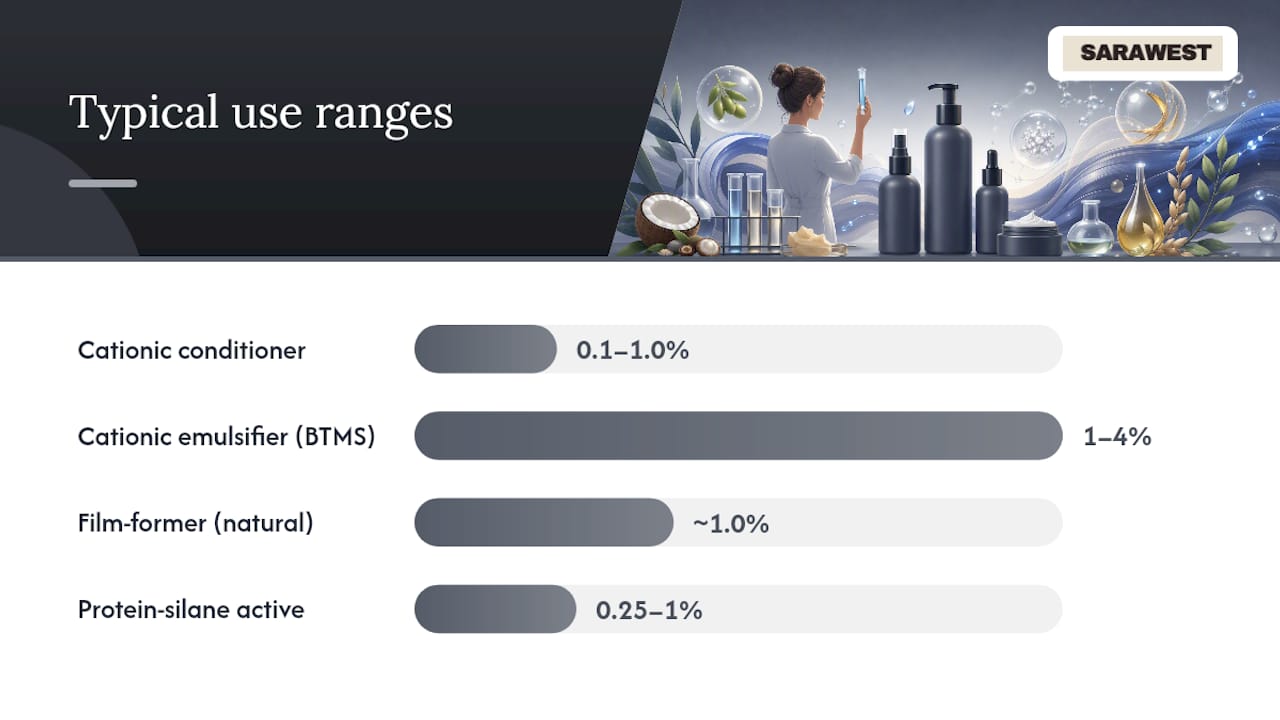
- Cetrimonium Chloride (0.1%–1.0%)
- Behentrimonium Methosulfate (BTMS, 1%–4%)
- Polyquaternium-7 (0.1%–2%)
- Hydrolyzed Vegetable Protein PG-Propyl Silanetriol, also known as Keravis (0.25%–1%)
- A tara plus red-algae biopolymer at a usage level typical for efficacy
- Caprylyl Methicone in a range suitable for silky feel enhancement
- Glycerin (2%–5%)
- Polysorbate 20 used for mild solubilization at typical levels
Statistic callout: A tara plus red-algae (Kappaphycus alvarezii) biopolymer tested at 1.00% w/w reduced rheological hysteresis and improved shine and smoothness across shampoo, conditioner, and leave-in prototypes, giving formulators a concrete natural-origin benchmark. Sarawest USA stocks and specs materials at these exact tiers for pilot batches.
Key Takeaways
A commercial mane detangler needs cationic conditioners, film-forming biopolymers or silicones, humectants, and mild surfactants combined at supplier-verified use levels and validated through combing-force and shine testing before scale-up.
| Point | Details |
|---|---|
| Order four core classes first | Cationic conditioners, film-formers, humectants, and mild surfactants cover the functional bases for any detangler format. |
| Trial biopolymers at 1% | Tara/red-algae biopolymer at 1.00% w/w delivered measurable shine and smoothness gains in published prototype data. |
| Demand full supplier specs | Require INCI, assay percentage, charge density, viscosity, and a certificate of analysis with every raw-material shipment. |
| Test before scaling | Run combing force, gloss delta, and tensile strength tests on pilot batches before committing to full production. |
| Work with an in-house formulator | Sarawest USA adapts proven batch sketches into pilot-ready detangler formulas with in-house R&D and 1,000-unit pilot runs. |
Table of Contents
- What Ingredients Go Into a Mane Detangler Formula?
- Sample Batch Sketches for Shampoo, Conditioner, and Leave-In Detanglers
- What Should You Ask Suppliers Before Ordering Raw Materials?
- How Do You Avoid Manufacturing and Stability Failures?
- What Regulatory and Safety Checks Does a Detangler Need Before Launch?
- Which Bench Tests Confirm a Detangler Actually Works?
- Why In-House R&D Changes the Timeline for Detangler Launches
- How Sarawest USA Supports Your Detangler Project
- Frequently Asked Questions
- Sources
What Ingredients Go Into a Mane Detangler Formula?
Detangling performance comes down to reducing friction between hair fibers, and every raw material in the formula either lowers that friction, holds moisture in the shaft, or carries the active payload evenly across the strand. That's the standard formulation logic behind what the industry calls conditioning actives, and it applies whether you're building a rinse-off conditioner or a leave-in spray for retail or equine-grade use.
Cationic conditioners carry a positive charge that binds to the negatively charged keratin surface, smoothing the cuticle and cutting static. Cetrimonium Chloride works at 0.1%–1.0% in rinse-off systems and up to 0.25% in leave-on sprays; above that, several regional guidelines flag leave-on caps worth confirming with your regulatory contact before scale-up. Stearalkonium Chloride is a plant-derived alternative with CIR-affirmed use levels in the 0.1%–5% range, useful when a client wants to avoid the BTMS family entirely.
Film-forming biopolymers and silicones deposit a thin protective layer that lowers combing force. Caprylyl Methicone and cyclomethicones remain the fastest route to a silky feel at 0.5%–3%, but tara/red-algae biopolymers are gaining ground because they bond to keratin through hydrogen bonding and deliver measurable shine gains without a silicone label. Hydrolyzed Vegetable Protein PG-Propyl Silanetriol (Keravis) does double duty, penetrating the cortex with its low-molecular-weight fraction while its larger fraction forms a surface film; manufacturer guidance commonly cites 0.25%–1% in leave-on products.
Humectants and wetting agents keep the strand pliable so detangling doesn't snap dry hair. Glycerin at 2%–5%, propanediol, and butylene glycol all pull moisture into the fiber, while levan-based polysaccharides are showing up as multifunctional humectant adjuncts that can reduce reliance on heavier surfactant systems.
Mild surfactants and solubilizers matter most in rinse-off formats or when you need to disperse oils in a leave-in.
| Function | INCI examples | Typical use range | Compatibility note |
|---|---|---|---|
| Cationic conditioner | Cetrimonium Chloride, Stearalkonium Chloride | 0.1%–1.0% (rinse-off); ≤0.25% leave-on | Incompatible with anionic surfactants; precipitates on contact |
| Cationic emulsifier | Behentrimonium Methosulfate (BTMS) | 1%–4% | Best at acidic pH; needs heat-phase processing |
| Film-former (natural-origin) | Tara/red-algae biopolymer | ~1.00% w/w | Hydrates slowly; pre-disperse before heat phase |
| Protein-silane active | Hydrolyzed Vegetable Protein PG-Propyl Silanetriol | 0.25%–1% | Stable across broad pH; add in cool-down phase |
| Silicone film-former | Caprylyl Methicone, cyclomethicone | 0.5%–3% | Not water-soluble; needs emulsification or oil-phase inclusion |
| Humectant | Glycerin, propanediol | 2%–5% | High loading can slow preservative efficacy |
| Solubilizer | Polysorbate 20 | 0.5%–2% | Nonionic; compatible with cationics |
Rinse-off detanglers can carry heavier polymer loads because water dilutes the film on application. Leave-in sprays need lighter loading and better sprayability, which is why formulators often lean on Keravis or a diluted biopolymer rather than a high-viscosity gum.
Pro Tip: When a client demands a "natural-origin" claim, swap silicone-heavy formulas for a tara/red-algae biopolymer at 1% and cite the hydrogen-bonding mechanism directly in your technical dossier. It gives you a defensible efficacy claim without a silicone disclosure.
Sample Batch Sketches for Shampoo, Conditioner, and Leave-In Detanglers
Published prototype data from ACS Omega gives a workable starting point for three product formats. These aren't finished formulas. They're skeletons you adapt for viscosity, fragrance, and preservative system.
The 1.00% w/w biopolymer inclusion held constant across all three formats in the source study, which makes it a safe default trial level regardless of product type. Cetrimonium Chloride and BTMS are interchangeable depending on whether you want a lighter spray-friendly conditioner or a richer rinse-off cream. Fragrance and preservative levels stay flexible, but never skip the compatibility check between your chosen preservative and the humectant load.
- Swap Caprylyl Methicone for a plant-derived ester if the client wants a silicone-free claim.
- Reduce polymer percentage before adjusting pump size if a leave-in spray clogs.
- Never combine an anionic thickener with a high-cationic-charge system without a compatibility trial first.
Pro Tip: Forum-documented formulation trials show that heavy polyquaternium or guar loading is the most common reason a leave-in spray fails atomization testing. If your pump clogs, cut the polymer percentage before you touch the nozzle spec.
What Should You Ask Suppliers Before Ordering Raw Materials?
Every RFQ you send should nail down the same handful of specification points, because a vague spec sheet is how a pilot batch turns into a scrapped batch.
- INCI name and confirmed assay or active matter percentage.
- Charge density for cationics and molecular weight or viscosity grade for polymers.
- Viscosity at 25°C and recommended dilution behavior.
- Recommended use level range and diluent or concentrate format.
- Shelf life, storage temperature, and residual solvent data.
Request a certificate of analysis, a microbial load report, and a heavy-metal limit statement with every shipment. If the material touches a leave-on formula, ask for preservative effectiveness data too.
- "What is the active percentage and recommended working dilution?"
- "Provide viscosity at 25°C and the pH stability range."
- "Can you document natural-origin or biodegradability claims for this lot?"
- "What are your IFRA compliance documents for any fragrance components?"
Pro Tip: Confirm minimum order quantities and lead times before you commit to a formula. A biopolymer with a 12-week lead time will stall your launch timeline faster than any formulation problem.
How Do You Avoid Manufacturing and Stability Failures?
Order of addition determines whether your detangler ships clean or comes back from stability testing separated. Follow this sequence:
- Prepare the water phase and disperse humectants first.
- Hydrate polymers slowly, pre-dispersing biopolymers before heat exposure.
- Heat the oil phase (BTMS, esters, silicones) separately and combine at matching temperatures.
- Add cool-down actives, including Keravis and fragrance, below 40°C.
- Adjust final pH and confirm viscosity before filling.
Cationic and anionic ingredients will precipitate on contact, so audit every surfactant and preservative for anionic charge before it enters a quat-based system. High humectant loading, meanwhile, can reduce preservative efficacy by tying up available water, so run a full preservative efficacy test rather than assuming your standard system will hold.
Run stability at 45°C for four weeks, three freeze/thaw cycles, and a centrifuge test for phase separation before you approve packaging compatibility. In-process checks should confirm viscosity, pH, and microbial count at every batch. A pilot run at Sarawest USA typically moves from raw material receipt to packaged goods in under three weeks, giving brands a realistic scale-up window without guessing at production timing.
What Regulatory and Safety Checks Does a Detangler Need Before Launch?
Before a formula ships, confirm INCI labeling accuracy, review the SDS for every raw material, and validate preservative efficacy through formal PET testing. Fragrance components need an IFRA compliance check, and cationic conditioners need a leave-on concentration review against regional guidance, since several markets flag upper limits for quats in leave-on products.
Screen every supplier's certificate of analysis against your restricted-ingredient list, and have a substitution plan ready if a flagged material shows up in a shipment.
Statistic callout: Marketing claims like "reduces combing force" or "improves shine" require bench substantiation, not just formulator confidence. The 1% biopolymer trial data showing measurable shine and smoothness improvement is exactly the kind of numeric backup regulatory and legal teams want on file before a claim goes to print.
Which Bench Tests Confirm a Detangler Actually Works?
Run these in sequence before scaling to pilot production:
- Combing force reduction, measured on tress samples pre- and post-treatment.
- Gloss or shine delta using a gloss meter against an untreated control.
- Tensile strength and fiber diameter change, especially when testing biopolymer or Keravis inclusion.
- Smoothness rating through a trained panel or instrumental friction test.
Lab testing establishes baseline numbers; a consumer panel of 20 to 30 users confirms the effect holds up in real-world use. The ACS Omega prototype data reported measurable tensile and appearance improvements at 1% biopolymer inclusion, giving you a citable benchmark for technical dossiers rather than a marketing-only claim.
Statistic callout: Keravis-type protein-silane actives are documented to improve fatigue lifetime in flexabrasion studies, which is the mechanical proxy most labs use to support a "strengthens hair" claim.
Why In-House R&D Changes the Timeline for Detangler Launches
Every batch sketch in this guide still needs a chemist who can adjust it for your specific fiber type, packaging, and claim strategy. That's the gap between a published prototype and a shelf-ready product, and it's where an in-house team earns its keep, cutting the back-and-forth that stalls a project when formulation and supplier qualification happen under one roof instead of across three vendors.
How Sarawest USA Supports Your Detangler Project
Building a detangler from scratch means juggling raw-material sourcing, compatibility testing, and stability validation before a single unit ships, and most brands don't have the bandwidth to run all three in parallel. Sarawest USA closes that gap with in-house chemists who adapt formulas like the batch sketches above to your fiber type, packaging, and claim goals, then move straight into pilot production without routing through a broker.
Our library includes over 1,200 proprietary formulas across eight industries, including equine and horse care, so a mane detangler project often starts closer to finished than you'd expect. If a natural-origin claim matters to your brand, our clean-label manufacturing line handles biopolymer substitutions without slowing your timeline. Pilot batches start at 1,000 units, and white-label options exist for brands who want a ready-to-brand formula rather than a custom build from zero.
Send us your ingredient matrix and target use levels, and request samples through our sample request page or start a formal contract manufacturing RFQ to get pricing and a production timeline back this week.
Frequently Asked Questions
What is the difference between a detangler and a conditioner? A detangler focuses on immediate friction reduction using lightweight cationics and film-formers at lower total loading, while a conditioner typically carries heavier cationic emulsifiers like BTMS for deeper conditioning and richer sensory feel. Many commercial products blend both functions in one formula.
What are the best natural detangler ingredients for a clean-label claim? Tara and red-algae biopolymers are the strongest current option, delivering measurable shine and smoothness at around 1% without a silicone label. Glycerin and plant-derived quats like Stearalkonium Chloride round out a natural-leaning formula.
How much should a mane detangler cost to formulate per batch? Cost depends heavily on which actives you choose. A biopolymer or Keravis-based formula runs higher than a basic Cetrimonium Chloride and glycerin blend, so get a raw-material cost breakdown from your contract manufacturer before finalizing the formula.
Can I make a detangler using DIY ingredients? Small-batch DIY recipes exist using diluted conditioner, glycerin, and water, but they lack the preservative systems, stability testing, and consistent supplier-grade actives needed for a commercial product sold at scale.
What surfactants work best for a mild rinse-off detangler? Nonionic solubilizers like Polysorbate 20 pair well with cationic conditioners without stripping the conditioning film, making them the preferred choice over harsher anionic surfactants in detangler-specific rinse-off formulas.
Sources
- Pubs
- Pubmed
- Hydrolyzed Vegetable Protein PG-Propyl Silanetriol | Keravis | Cosmetic Ingredients Guide
- Cetrimonium Chloride: A Must-Have for Soft Manageable Hair?