

What is preservative efficacy testing and why does it matter?
Preservative efficacy testing, also called Antimicrobial Effectiveness Testing (AET) or a challenge test, is the scientific process that confirms a cosmetic or personal care product's preservative system can stop microbial growth under real-world conditions. It is not optional. For any water-based, multi-use product, it is the difference between a formulation that protects consumers and one that quietly fails them.
The regulatory foundations are USP <51>, ISO 11930, and FDA guidance. Each framework requires that you challenge your finished product with specific microorganisms, measure how effectively the preservative system responds, and document results against defined acceptance criteria. Testing must be performed on the product in its actual marketed packaging, not a lab surrogate.
Key reasons PET is non-negotiable for US product developers:
- Demonstrates preservative protection against bacteria, yeast, and mold throughout shelf life
- Satisfies FDA and USP regulatory requirements for multi-dose and multi-use products
- Validates that "clean beauty" or natural preservation strategies actually work
- Identifies packaging interactions that could compromise preservative performance
- Supports regulatory submissions with documented, reproducible data
AEMTEK Laboratories and Sara West LLC are two US-based partners that bring accredited testing capability and formulation depth to this process, respectively.
US regulatory requirements and key terminology you need to know
Three terms appear constantly in this space: PET (Preservative Efficacy Testing), AET (Antimicrobial Effectiveness Testing), and challenge testing. They describe the same procedure. The terminology shifts depending on whether you are working under a pharmaceutical or cosmetic framework, but the science is identical.
- USP <51> governs antimicrobial effectiveness testing for pharmaceutical and OTC products in the US, dividing products into four categories based on route of administration
- FDA guidance recommends a risk-based approach to microbial testing, directing resources toward higher-risk product profiles
- ISO 11930 is the internationally recognized cosmetics standard, integrating formulation, packaging, and manufacturing context into its assessment
- GMP is a prerequisite, not a substitute: preservatives protect against contamination during consumer use, not against poor manufacturing hygiene
- Testing must be conducted on the final product in its marketed packaging, since packaging materials can interact with and alter preservative performance
The FDA's risk-based framework means you do not need to test every SKU with equal intensity. Products with higher water activity, broader consumer exposure, or complex formulations warrant more rigorous evaluation.
How preservative efficacy testing is actually conducted
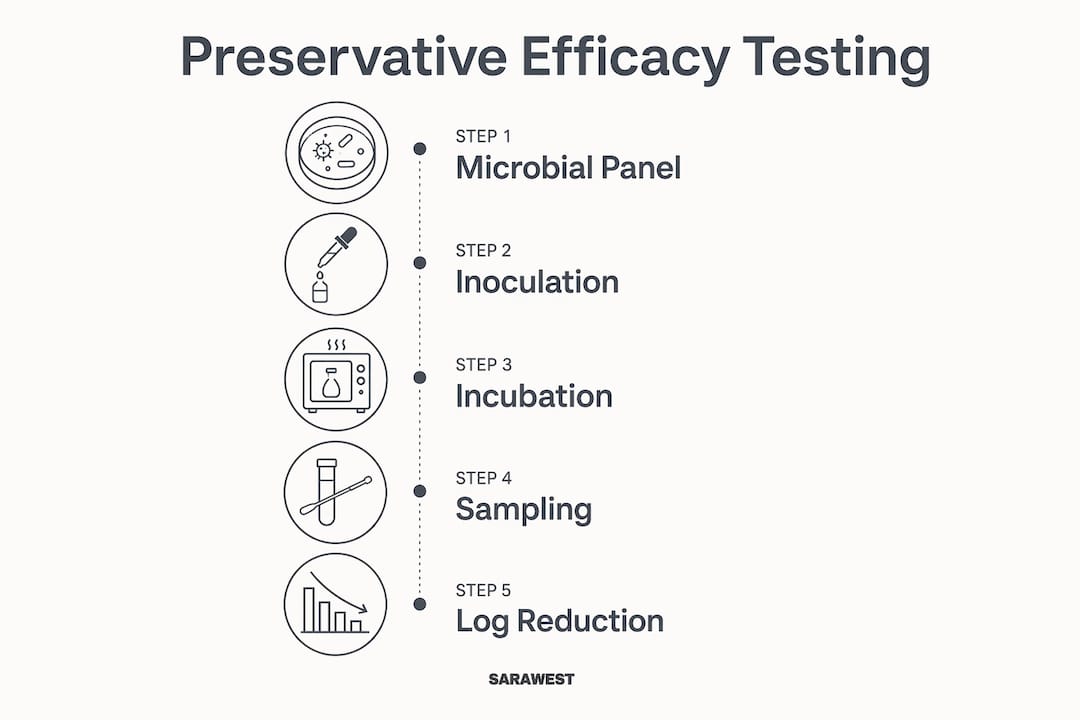
The procedure follows a consistent structure across both USP and ISO frameworks. Understanding each step helps you design a test that generates defensible data.
Microbial challenge panel
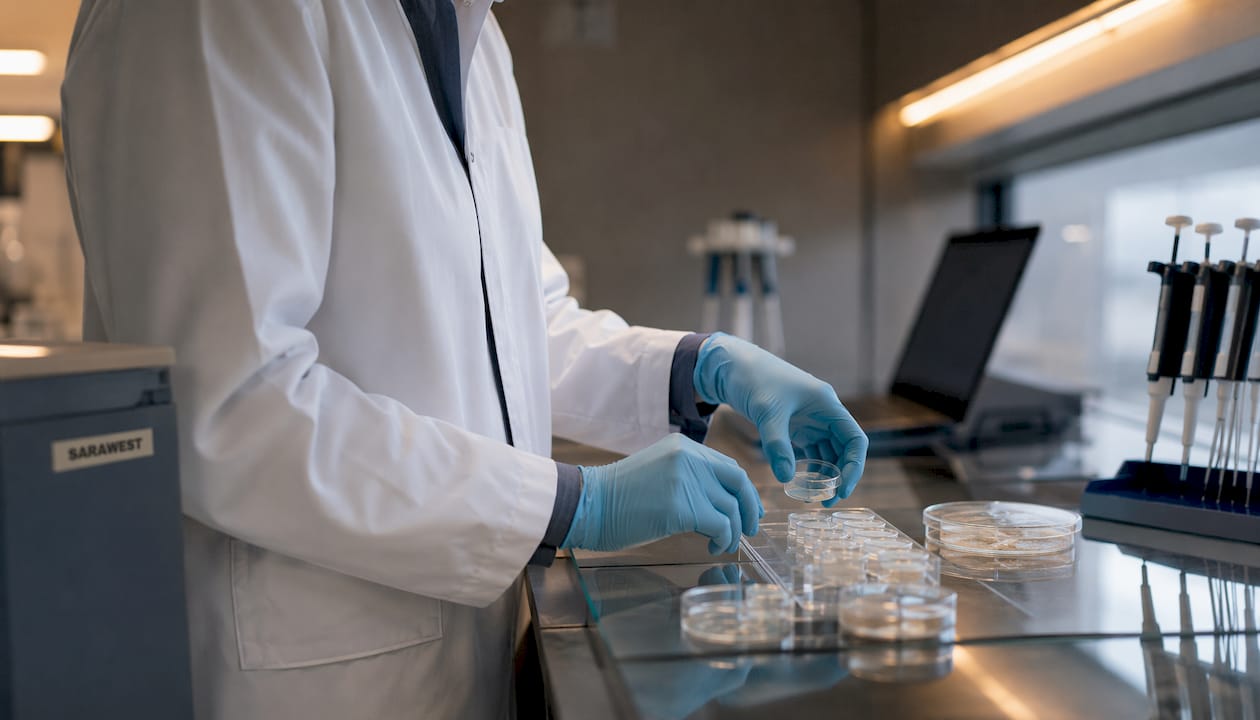
USP <51> specifies five organisms: Staphylococcus aureus, Pseudomonas aeruginosa, Escherichia coli, Candida albicans, and Aspergillus brasiliensis. ISO 11930 uses the same panel. Each organism targets a different contamination risk: gram-positive bacteria, gram-negative bacteria, yeast, and mold.
Inoculation and initial load
Each organism is inoculated at a high microbial load consistent with standard testing practice into separate product samples. The inoculum volume is 0.5%–1.0% of total product volume. This simulates a realistic contamination event without overwhelming the system artificially.
Incubation and sampling
Samples are incubated at controlled temperature and sampled at defined intervals. Sampling commonly occurs at multiple defined intervals across the test period. Surviving microbial populations are counted using plate-count methods and expressed as CFU/mL.

Log reduction calculation
Results are expressed as log₁₀ reductions from the initial count. Log reductions describe the proportional decrease in microbial populations over time. These values are compared against the acceptance criteria for the applicable standard and product category.
| Test Stage | Parameter | Typical Requirement |
|---|---|---|
| Inoculation | Initial load | 10^5–10^6 CFU/mL |
| Sampling intervals | Days | 0, 7, 14, 28 |
| Bacteria (USP Cat. 2) | Log reduction by Day 14 | ≥2.0 log |
| Bacteria (USP Cat. 2) | Day 28 | Stability of microbial count without increase |
| Yeast and mold (USP Cat. 2) | Days 14 and 28 | Stability of microbial count without increase |
Pro Tip: Always confirm your neutralizer (inactivator) is validated before running the full test. An ineffective neutralizer will carry over active preservative into the plate count, artificially suppressing colony counts and producing false-pass results.
How USP <51> and ISO 11930 differ on acceptance criteria
Both standards use the same microbial panel and a 28-day window, but their pass/fail criteria diverge in ways that matter for global product strategy.
- USP <51> uses fixed log reduction thresholds by product category. Category 2 topicals require at least a 2.0 log reduction in bacteria by day 14 and no increase by day 28. Yeast and mold must show no increase from the initial count at days 14 and 28.
- ISO 11930 Criteria A is stricter: bacteria must show a 3.0 log reduction by day 7. Yeast must show a 1.0 log reduction by day 7. This is the preferred standard for products sold in the EU.
- ISO 11930 Criteria B is less strict than Criteria A but still requires a 3.0 log reduction in bacteria by day 14, making it more demanding than USP for bacterial endpoints.
- A formulation can pass USP and fail ISO Criteria A. If you are developing for global markets, design to ISO Criteria A from the start.
- ISO 11930 also incorporates a risk-based element: packaging design, water activity, and manufacturing controls all factor into the overall antimicrobial protection assessment, not just the challenge test result alone.
Formulation and external factors that affect preservative performance
The challenge test result reflects your entire system, not just the preservative ingredient. Several variables outside the preservative itself can determine whether a product passes or fails.
- Water activity (Aw): Products with Aw below microbial growth thresholds have inherent stability. Controlling Aw through humectants or anhydrous formulation can reduce preservative demand.
- pH: Most preservatives operate within a narrow pH window. Parabens, for example, lose efficacy above pH 6. Formulating outside a preservative's optimal pH range is one of the most common causes of test failure.
- Chelators: Ingredients like EDTA disrupt gram-negative bacterial cell walls, enhancing preservative penetration. Removing chelators from a "clean" formula without compensating elsewhere often leads to failure against Pseudomonas aeruginosa.
- Packaging: Airless pumps reduce oxygen exposure and repeated contamination events. Plastic leaching or permeability can bind or degrade preservatives before they reach the microorganism.
- Consumer use: Multi-use containers are repeatedly opened, introducing new contamination with each use. The challenge test simulates this, but the packaging design determines how severe that exposure actually is.
- GMP: Preservatives are not a substitute for clean manufacturing. They protect against incidental contamination during consumer use, not against bioburden introduced during production.
Validation and repeatability of preservative efficacy tests
A single passing result is not enough. Regulatory submissions and long-term product reliability both require that your test method is validated and that results are reproducible across batches and labs.
Validation confirms that the test method itself is fit for purpose: the neutralizer effectively inactivates the preservative without harming the organisms, the recovery media supports growth, and the inoculum preparation is consistent. Without this, a passing result could reflect method failure rather than genuine preservative activity.
Repeatability testing involves running the same protocol on multiple batches of the same formulation. Variability between runs should be minimal. If results shift significantly between batches, the root cause is usually inconsistent inoculum preparation, neutralizer performance, or incubation conditions.
The D value method offers a more quantitative approach to repeatability assessment. It calculates the time required for a 90% reduction in microbial population under constant preservative exposure, using linear regression of survival curves. This gives you a numeric benchmark that is easier to compare across formulation iterations than a simple pass/fail result.
Once efficacy is confirmed during development, ongoing monitoring shifts to GMP and process controls rather than repeated challenge testing on every production batch.
Documentation and reporting for regulatory submission
Your test report is a regulatory document. It needs to hold up under scrutiny from the FDA, a contract manufacturer's quality team, or a global retailer's compliance review.
A complete PET report includes: the test standard used (USP <51>, ISO 11930, or both), the product name and batch number, packaging description, the microbial panel with ATCC strain numbers, inoculation concentrations, incubation conditions, sampling intervals, raw CFU counts at each time point, calculated log reductions, neutralizer validation data, and the pass/fail determination against stated criteria.
For stability submissions under ICH Q1E, antimicrobial preservative effectiveness must be addressed during formulation development. After the first production-scale lot passes PET at expiry, chemical assay of preservative concentration can replace repeat microbial challenge testing in the ongoing stability program.
Keep raw data, plate count records, and incubation logs. Regulatory reviewers may request them, and any gap in the chain of evidence can delay or invalidate a submission.
Common pitfalls and how to troubleshoot them
Most PET failures trace back to a small set of recurring problems. Knowing them in advance saves time and reformulation cycles.
Neutralizer failure is the most dangerous pitfall because it produces false-pass results. Always validate the neutralizer with a recovery control before running the full test. If recovery falls below acceptable limits, reformulate the neutralizer or switch to a membrane filtration method.
Inoculum preparation errors cause inconsistent starting counts. Organisms must be within five passages of the original ATCC culture. Cultures that have drifted too far from the reference strain may show altered sensitivity to preservatives, producing results that do not reflect real-world performance.
pH drift during incubation can shift preservative activity mid-test. Monitor pH at each sampling interval, particularly for formulations with buffering capacity that changes over time.
Packaging incompatibility shows up as unexpected failures in the final packaged product that did not appear in bulk testing. Always run PET in the actual marketed container. Plastic leaching, cap liner interactions, and pump mechanism contamination are all real failure modes.
Gram-negative failures against Pseudomonas aeruginosa are the most common single-organism failure in topical products. This organism is notoriously resistant to many common preservatives. If your formula fails here, evaluate chelator inclusion, preservative concentration, and pH before reformulating entirely.
How AEMTEK Laboratories and Sarawest USA support your compliance
Getting PET right requires two things working together: an accredited lab that runs the test correctly, and a formulation partner who builds preservation into the product from day one.
AEMTEK Laboratories holds A2LA, PJLA, AIHA-LAP, and SWRCB ELAP accreditations, covering microbiological testing for cosmetics, skincare, pharmaceutical, and personal care products. Their scope spans the full range of antimicrobial testing methods, from USP <51> challenge testing to environmental microbiology. Accreditation at this level means their results carry weight in regulatory submissions without additional qualification.
Sarawest USA approaches preservation differently. Our in-house R&D chemists build preservative efficacy considerations into formulation from the prototype stage, not as an afterthought before submission. With over 1,200 proprietary formulas across eight industries, including personal care and commercial cleaning, we have seen what works and what fails under challenge conditions. That depth shows up in the formulation decisions we make before a product ever reaches a lab.
| Service Feature | Accredited Testing Lab | Contract Manufacturer with R&D |
|---|---|---|
| USP <51> / ISO 11930 testing | Yes | Coordinates with lab partners |
| Formulation design for PET compliance | No | Yes, in-house chemists |
| Accreditation (A2LA, PJLA, etc.) | Yes | GMP-aligned manufacturing |
| Scale from pilot to production | No | Yes, pilot batches to truckloads |
| Documentation for regulatory submission | Test reports | Full formulation and batch records |
If you are developing a water-based personal care product and need a formulation built to pass challenge testing the first time, talk to us. Request samples from existing formulas or bring us a spec. A real chemist reads every inquiry.
Key Takeaways
Preservative efficacy testing requires validated methodology, the right microbial panel, and a formulation built to meet USP or ISO acceptance criteria from the start.
| Point | Details |
|---|---|
| ISO 11930 Criteria A requires a 3.0 log bacterial reduction by Day 7; USP Category 2 requires 2.0 log by Day 14. | |
| Test in final packaging | Packaging materials can alter preservative performance; bulk testing alone is not sufficient for regulatory submission. |
| Validate your neutralizer | Neutralizer failure produces false-pass results; always run a recovery control before the full challenge test. |
| GMP is not replaceable | Preservatives protect against consumer-use contamination, not manufacturing bioburden; GMP controls remain mandatory. |
| Formulation design drives results | pH, water activity, chelators, and packaging all affect challenge test outcomes before a preservative is even selected. |