
A commercial saddle soap formulation is a manufacturer-grade product specification, not a kitchen recipe scaled up. It defines measurable targets for pH, cleaning strength, conditioning, and film formation, then proves those targets hold up in a pilot batch before anyone commits to full production. The recommended next step for most brands is simple: write the spec, then run a pilot with an experienced contract manufacturer. One option built specifically for that pilot-to-scale handoff is a contract manufacturer specializing in such transitions.
TL;DR:
- Most saddle soap formulations should target a pH around 8 to effectively clean leather without causing damage over time.
- A pilot batch should be run using actual raw material lots and scaled appropriately to identify mixing issues, stability concerns, and packaging compatibility.
- Surfactant levels must be optimized to balance cleaning power with gentle conditioning, avoiding excessive foaming or residue.
- Raw material traceability and quality, especially for beeswax, stearic acid, and glycerin, are critical to ensure batch consistency and reduce supply disruptions.
- Packaging format heavily influences formulation choices, requiring adjustment in viscosity, scent stability, and shelf-life testing strategies.
Table of Contents
- What Ingredients Go Into a Commercial Saddle Soap Formulation?
- What Performance Specs Should You Set Before Formulating?
- How Do You Take a Saddle Soap Formula from Pilot to Production?
- What Regulatory and QC Checks Does Manufactured Saddle Soap Need?
- How Does Packaging Format Change the Formulation?
- How Do You Choose and Work with a Formulation Partner?
- What Do Traditional and Glycerin-Based Saddle Soap Recipes Look Like?
- Where Do Saddle Soap Raw Materials Come From, and What Should You Check?
- How Sustainable Are Commercial Saddle Soap Formulations?
- Why Do Saddle Soap Formulas Separate, Foam Too Much, or Fail Shelf Life?
- Where Did Saddle Soap Come From, and How Has the Formula Changed?
- Practitioner Notes on Avoiding Costly Formulation Mistakes
- Get a Pilot Batch Started with Sarawest USA
- Sources
- FAQ
What Ingredients Go Into a Commercial Saddle Soap Formulation?
Every saddle soap formula balances four functional categories, and the ratios between them determine whether the finished product cleans well, conditions leather, or does both without leaving residue.
Surfactants carry the cleaning load. Mild anionic or amphoteric surfactants work best against leather because harsher detergents strip natural oils and dry the hide over repeated use. Dosing typically stays lean, often in the low single-digit percentages, to avoid over-defatting.
Humectants and conditioners are where saddle soap earns its reputation for feel. Glycerin is the traditional workhorse, and lanolin or lanolin substitutes add the tack and suppleness leather workers expect after a wipe-down. Get this ratio wrong and the bar either feels greasy or dries out too fast between uses.
Waxes and film formers handle waterproofing and pore sealing. Beeswax and hydrogenated tallow glycerides show up in published commercial formulas for exactly this reason, building a light barrier without clogging the leather's natural breathability.
Emulsifiers and pH agents keep water-containing formulas stable across a shelf life, and a documented industry example lists water, glycerin, sodium hydroxide, stearic acid, beeswax, tallow glycerides, an emulsifier, and a preservative system as the core structure.
- Surfactant type and dose drive cleaning power without over-drying leather
- Humectant ratio controls tack, feel, and conditioning longevity
- Wax/film-former load sets waterproofing and pore-sealing performance
- Preservative choice must survive the water phase and pass challenge testing
- Supplier traceability keeps every batch consistent, lot to lot
What Performance Specs Should You Set Before Formulating?
Set the target before the beaker comes out. A spec without measurable acceptance criteria is a wish list, not a formulation.
- Cleaning efficacy — test against soiled leather swatches using a standardized wipe-and-rinse protocol, scoring residue removal on a simple pass/fail or graded scale.
- pH window — leather-safe formulas typically land near neutral to slightly alkaline. The published Koster Keunen reference formula targets roughly pH 8 ± 0.5, checked with a calibrated bench meter, not strips.
- Conditioning benchmark — run a small evaluator panel that rates suppleness and tack 24 and 72 hours after application, since some conditioning agents fade fast.
- Waterproofing and film formation — a water-bead test on treated swatches after a set dry time gives a quick pass/fail read on wax coverage.
- Viscosity/rheology — this needs to match the packaging format, since a tub product and a pump bottle demand very different flow behavior at fill temperature.
Pro Tip: Write your acceptance criteria as numbers, not adjectives. "Beads water for 60 seconds without wicking" is testable. "Feels waterproof" is not.
How Do You Take a Saddle Soap Formula from Pilot to Production?
Bench chemistry and production reality rarely behave the same way, and the gap between them is where most launch delays get born. A structured pilot sequence closes that gap before it costs you a truckload of product.
- Bench replicate using the actual target raw-material lots, not substitutes, to catch reactivity issues early.
- Pilot batch, typically 10 to 50 times the bench size, to verify mixing profile, heat control, and repeatability across runs.
- Engineering run on near-production equipment to validate fill and pack behavior at the intended line speed.
- Production sample with a full certificate of analysis, confirming the formula holds specification outside the lab.
Scale-up carries real risk. Heat transfer and shear scale nonlinearly, so a mixing profile that works flawlessly at bench scale can break an emulsion at pilot volume. Ingredient substitutions made under supply pressure can shift pH stability or preservative performance without warning. Mitigating this means running design-of-experiment trials before committing to a single mixing intensity, and lining up more than one supplier for anything that isn't a commodity input, a step scale-up guidance consistently recommends.
Pro Tip: Telescoping production steps together can cut per-unit cost meaningfully at scale, but only attempt it once you have in-line monitoring and a pilot run that proves the combined step behaves predictably.
A completed pilot should hand you a validated batch manufacturing record, stability data, and a full tech-transfer packet ready for the next production site.
What Regulatory and QC Checks Does Manufactured Saddle Soap Need?
Before any commercial saddle soap ships, a handful of checks protect both the brand and the buyer.
- Confirm every raw material against the TSCA inventory and screen against restricted-substance lists before formulation is finalized, not after.
- Run batch-release QC: pH, viscosity, microbial limits, and a preservative efficacy challenge test on every new formula and periodically on production runs.
- Complete accelerated and real-time stability testing so shelf-life claims hold up under actual storage conditions.
- Prepare SDS documentation and GHS hazard communication for every SKU, plus fragrance and allergen labeling where applicable.
- Maintain document control: certificates of analysis, batch records, supplier certificates, and full traceability back to raw-material lots.
Skipping any one of these turns a minor formulation tweak into a recall risk months later.
How Does Packaging Format Change the Formulation?
Packaging isn't an afterthought bolted onto a finished formula. It shapes the formula itself.
- A pump or spray format demands lower viscosity and tighter particle control than a tub or tin, where a thicker, waxier paste is expected and even desired.
- Headspace and oxygen exposure matter more in wide-mouth tubs, so chelators or mild antioxidants often need to be added to protect scent and color stability over shelf life.
- Shelf-life testing should run both accelerated (elevated temperature) and real-time tracks, with acceptance criteria set before the first pilot batch, not after a customer complaint.
- Any claim on the label, conditioning, waterproofing, or gentle cleaning, needs a formulation test result behind it, not just a good feeling from the bench chemist.
How Do You Choose and Work with a Formulation Partner?
Two engagement paths exist: a spec-based build, where you hand over your performance targets and let the chemist design to them, or a custom development project, where you're solving a problem that no existing formula addresses. Either way, your RFQ should spell out target claims, packaging format, target cost, and expected order volume.
A capable partner should hand you pilot samples, a stability summary, a certificate of analysis, an MSDS, a full tech-transfer pack, and batch manufacturing and production records, the same documentation an integrated process-development partner is built to produce.
This manufacturer works from an extensive library of proprietary formulas across multiple industries, staffed by R&D chemists who can adapt existing bases or build new chemistry from scratch, servicing orders ranging from pilot batches to full truckloads.
| What to Request | Why It Matters |
|---|---|
| Pilot samples with COA | Confirms the formula holds spec outside the lab |
| Stability summary | Validates shelf-life claims before launch |
| Tech-transfer packet | Prevents rework when moving to production scale |
| BMR/BPR documentation | Backs regulatory and retailer compliance needs |
- Bring your performance targets, not just a vague product idea, to the first conversation.
- Ask for pilot turnaround timelines up front, since a rushed pilot often means a rushed mistake.
- Request same-day response where speed matters. Some manufacturers, Sarawest USA included, are built for that pace.
What Do Traditional and Glycerin-Based Saddle Soap Recipes Look Like?
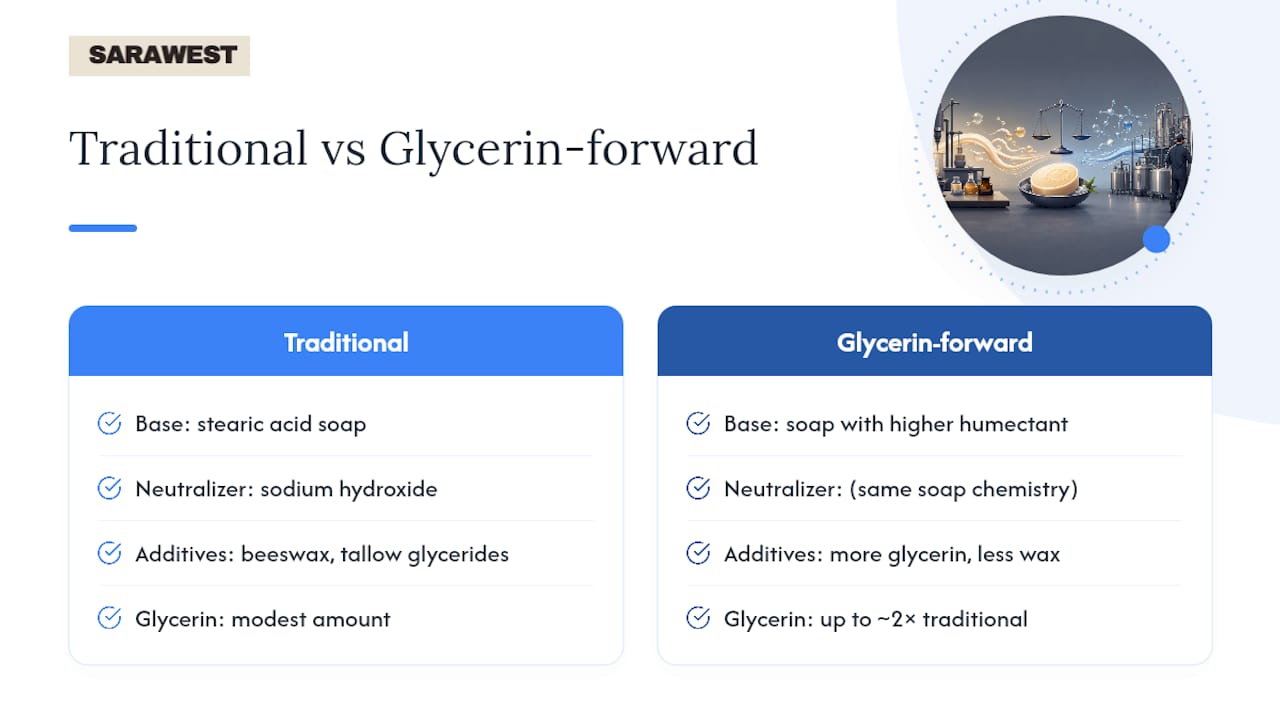
Traditional saddle soap formulas lean on a soap base built from stearic acid neutralized with sodium hydroxide, blended with beeswax and hydrogenated tallow glycerides for waterproofing, and finished with a modest glycerin addition for feel. A published commercial reference lists water, glycerin, sodium hydroxide, stearic acid, beeswax, tallow glycerides, an emulsifier, and a preservative as the working structure, processed by heating the wax and fatty acid phase to 80 to 85 degrees Celsius before combining with the aqueous phase and adjusting pH to roughly 8.
Glycerin-forward variations push the humectant load higher, sometimes doubling the glycerin content relative to a traditional base, trading a bit of waterproofing strength for noticeably softer, more supple leather after treatment. These formulas suit show tack and fine leather goods where feel matters more than heavy-duty water resistance.
pH variations matter more than most brands expect. A formula sitting near pH 8 cleans effectively without stripping natural oils, but pushing alkalinity higher to boost cleaning speed risks drying out vegetable-tanned leather and fading dyes over repeated use. Lower-pH variants, closer to neutral, sacrifice some cleaning punch for gentler long-term contact, which matters for daily-use tack shop products versus occasional deep-clean formulas.
Every recipe variant still needs the same discipline: define the target pH window, the conditioning benchmark, and the waterproofing pass criteria before locking proportions, then confirm those targets in a pilot batch rather than trusting the bench version to translate directly to production.
Where Do Saddle Soap Raw Materials Come From, and What Should You Check?
Beeswax, stearic acid, and hydrogenated tallow glycerides are the backbone raw materials in most commercial saddle soap formulas, and sourcing quality here directly affects batch-to-batch consistency.
Beeswax quality varies significantly by grade and origin, and refined, filtered beeswax behaves far more predictably in a heated wax phase than a crude, unfiltered lot with variable melting points. Stearic acid comes in different purity grades, and a lower-purity lot can throw off saponification calculations and leave the finished bar feeling gritty or unevenly textured.
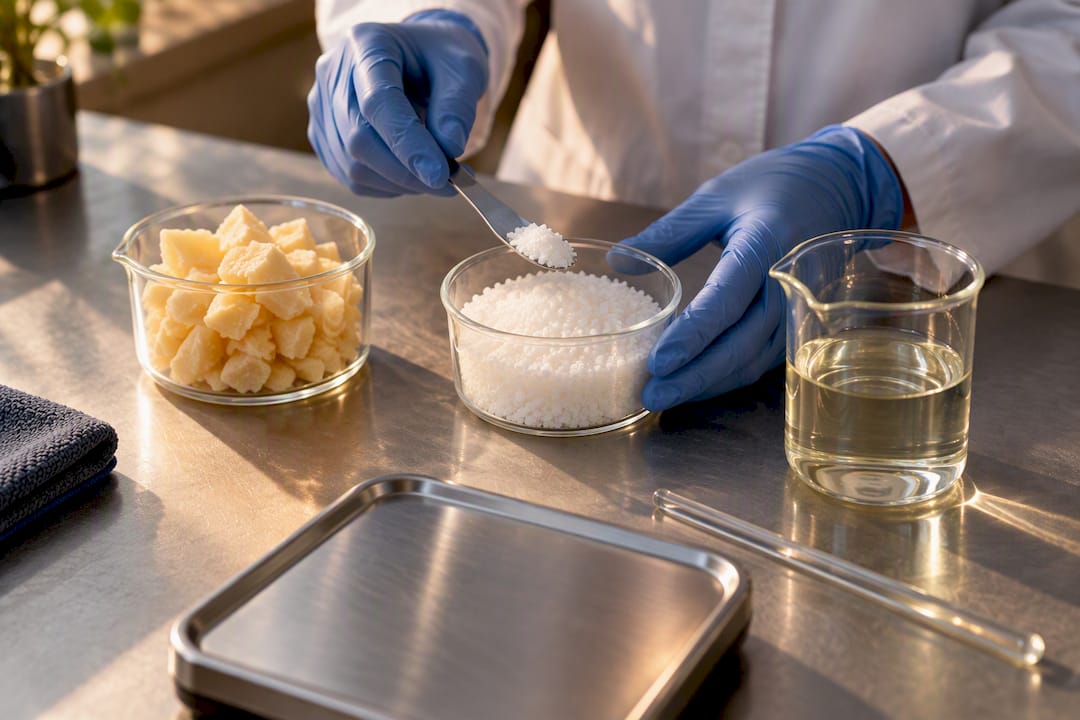
Glycerin sourcing splits between vegetable-derived and synthetic sources, and while both function similarly in the formula, some private-label brands specifically request vegetable-derived glycerin for label positioning even though performance differences are minimal.
Supplier traceability matters more than most first-time formulators realize. A single-source raw material creates a real vulnerability: if that supplier has a quality lapse or a supply disruption, your entire production schedule stalls. Qualifying at least two suppliers per key raw material, especially waxes and surfactants, protects your production calendar far more cheaply than scrambling for an emergency substitute mid-run.
Certificates of analysis from every raw-material lot should feed directly into your document control system, so a formulation issue three months post-launch can be traced back to a specific lot rather than triggering a full recipe re-investigation.
How Sustainable Are Commercial Saddle Soap Formulations?
Saddle soap formulations sit in a reasonably favorable sustainability position compared to many household chemical categories, largely because the core ingredients, tallow derivatives, beeswax, and glycerin, are biodegradable and derived from renewable sources rather than petrochemical feedstocks.
That said, sourcing choices still carry real environmental weight. Tallow-derived ingredients depend on the broader meat supply chain, which some brands increasingly want to disclose or avoid for plant-based positioning, opening the door to vegetable-based wax and glycerin alternatives at a modest cost premium.
Packaging is often the bigger sustainability lever than the formula itself. A tin or refillable tub creates less plastic waste than a single-use pump bottle, and brands positioning around sustainability frequently choose packaging format as the primary lever rather than reformulating the chemistry.
Preservative selection also intersects with sustainability conversations, since some traditional preservative systems face increasing scrutiny from environmentally conscious buyers even when they remain fully compliant. Brands building a sustainability claim into their marketing need to back it with a specific, defensible choice, biodegradable surfactant selection, recyclable packaging, or a disclosed tallow-free formula, rather than a vague "eco-friendly" label with no formulation change behind it.
Why Do Saddle Soap Formulas Separate, Foam Too Much, or Fail Shelf Life?
Separation is the most common pilot-stage failure, and it almost always traces back to insufficient emulsifier load or an unstable heat profile during the wax-phase blend. If a formula looks fine at bench scale but separates at pilot volume, the mixing intensity or heat transfer rate likely didn't scale proportionally, a nonlinear scaling problem that catches even experienced formulators off guard.
Excess foaming usually points to surfactant overdose relative to the formula's cleaning target. Since saddle soap doesn't need aggressive foam to clean leather effectively, dialing back surfactant concentration by even half a percentage point often resolves it without sacrificing cleaning performance.
Shelf-life failures, discoloration, rancid odor, or preservative breakdown, typically stem from one of three causes: an underpowered preservative system that fails its challenge test, oxygen exposure through poor packaging headspace control, or a raw-material substitution made under supply pressure that shifted the formula's pH stability without anyone flagging it.
The fix for all three issues is the same: catch them in pilot testing, not after the truckload ships. A stability panel and a preservative efficacy challenge test on the pilot batch, run before committing to full production, surfaces separation and preservation problems while the fix still costs a reformulation instead of a recall.
Where Did Saddle Soap Come From, and How Has the Formula Changed?
Saddle soap traces back to 19th-century tack rooms, where stable hands mixed simple soap bases with neatsfoot oil and beeswax to clean and condition leather harness and saddlery in daily use. The original formulas were crude by modern standards, built from whatever fats and lye were on hand, but the core idea, combine mild cleaning with a conditioning and waterproofing layer, has survived essentially unchanged for well over a century.
What's changed is precision. Early saddle soap makers worked by feel and experience, with no pH meter and no stability testing. Modern commercial formulation replaces that guesswork with measurable targets, documented processing temperatures, and repeatable batch records, the same 80 to 85 degree Celsius wax-phase heating and pH 8 target found in published reference formulas today.
Variations have multiplied along the way. Glycerin-forward formulas emerged for finer leather goods needing extra suppleness. Paste, liquid, and spray formats split off to match different use cases, from full harness cleaning to quick spot treatment. And ingredient sourcing shifted as tallow-based waxes faced competition from plant-derived alternatives driven by both cost and label positioning. The formulation challenge that started in a 19th-century tack room, balance cleaning against conditioning without damaging the hide, remains exactly what a modern pilot batch is still built to solve.
Practitioner Notes on Avoiding Costly Formulation Mistakes
The choices you lock in during route selection, ingredient family, process sequence, pilot approach, cost more to unwind later than they do to get right early. Single-source raw materials, thin preservative margins, and undersized pilot sampling are the three mistakes that resurface most often once a formula hits production volume. Engage process chemists before the bench work is finished, qualify a second supplier for anything critical, and confirm packaging compatibility before the first full run.
— Faisal Mansur
Get a Pilot Batch Started with Sarawest USA
One contract manufacturer offers a direct route to a working saddle soap formulation without brokering through a middleman, providing same-day access to in-house R&D chemists and an extensive library of proprietary formulas across various industries, including leather and equine care, enabling faster adaptation of existing bases compared to starting from scratch.
Whether you need a spec-based pilot run or a fully custom formula, orders scale from a pilot batch to a full truckload without a broker in between. Leather and leathercraft brands looking for a private-label base can start with the Leather & Leathercraft product line, and companies ready to move past the concept stage can request a pilot quote directly through Contract Chemical Manufacturing. Brands that want a ready-to-brand formula with less development time should look at White Label Manufacturing. Tell Sarawest USA what you want made, and a real chemist reads every request.
Sources
- Saddle Soap — Koster Keunen
- The Ultimate Chemical Manufacturing Scale-Up Checklist - Re:Build Optimation
- Process Chemistry: Lab to Pilot in 5 Stages | ChemContract
FAQ
What Is a Commercial Saddle Soap Formulation?
It's a manufacturer-grade product spec with measurable targets for pH, cleaning strength, conditioning, and waterproofing, validated through pilot batch testing before production. It differs from a home recipe because every performance claim needs a documented test result behind it.
What pH Should a Saddle Soap Formula Target?
A published reference formula lands around pH 8 ± 0.5, measured with a calibrated bench meter rather than test strips. That range cleans effectively while staying gentle enough for repeated leather contact.
How Long Does Pilot-to-Scale Development Usually Take?
Timelines vary by formula complexity and whether you're adapting an existing base or building custom chemistry from scratch. Sarawest USA offers same-day turnaround in some cases, with exact timelines available through a direct technical consultation.
Does Sarawest USA Offer Private-Label Saddle Soap Formulations?
Yes, through its White Label Manufacturing and private label services, backed by an in-house library of proprietary formulas across multiple industries. Current pricing and order minimums are available directly on the site.
What Documentation Should a Contract Manufacturer Provide?
Expect pilot samples with a certificate of analysis, a stability summary, an MSDS, a tech-transfer packet, and batch manufacturing or production records. These deliverables, standard from an integrated process-development partner, prevent rework when moving from pilot to full-scale production.