

A supplier audit checklist for contract chemical manufacturing must produce one thing: an evidence-backed, defensible approval decision that confirms your manufacturer can consistently meet your specs, regulatory obligations under ISO 9001 and TSCA, and EHS requirements. Not a gut feeling. A documented record.
Three actions to take right now:
- Map scope to risk. Tie your audit depth to contract and specification risk: hazardous chemistry, proprietary formulations, and regulated outputs demand a deeper check than commodity cleaning concentrates.
- Request specific evidence. Ask for a current ISO 9001 certificate, recent certificates of analysis (COAs), and the three most recent batch records before you schedule anything onsite.
- Apply a scored checklist. Use a standardized scorecard with defined pass/fail thresholds and CAPA deadlines so audit results drive contract decisions, not just conversation.
Treating audits as annual rituals is how companies end up with contract auto-renew complacency: a supplier selected two years ago, never re-evaluated, quietly slipping on delivery and quality. A structured vendor audit checklist breaks that cycle.
Table of Contents
- What should your supplier audit checklist actually cover?
- How do you score a supplier audit fairly?
- How to plan and run a supplier audit
- What happens after the audit?
- What KPIs should you track between audits?
- Your one-page audit cheat sheet
- What should a reputable contract manufacturer already have ready?
- Key Takeaways
- The audit criteria that actually separate good manufacturers from compliant ones
- Already audited your options? Here is what Sarawest USA brings to the table
- Authoritative sources and further reading
What should your supplier audit checklist actually cover?
The core categories for a contract chemical manufacturer map directly to ISO 9001:2015 Clause 8.4 and ISO 19011:2018 auditing guidance. Nine categories cover the ground:
- Supplier and audit details (legal entity, facility address, audit type, auditor names)
- Quality management system and certification
- Document and record control
- Formulation and recipe control, including change control
- Process control and in-process checks
- Laboratory testing, COAs, and sampling
- Traceability and batch records
- EHS and hazardous materials handling
- Sub-tier supplier control and delivery performance
Each line in your checklist must map a requirement to the exact evidence you will request and the action you take if the supplier fails. Vague templates that list categories without defining what "good" looks like are not audit tools. They are conversation starters.
| Checklist Item | Evidence to Request | What "Good" Looks Like | Pass/Fail Criteria | Action if Nonconformant |
|---|---|---|---|---|
| ISO 9001 certification | Current certificate + latest surveillance report | Certificate in scope, not expired, issued by accredited body | Valid certificate covering manufacturing scope | Major NC: hold approval pending re-cert |
| Formulation change control | Change control SOP + recent change log | Documented approval workflow before any formula change | All changes logged, approved, and communicated | Major NC if undocumented changes found |
| Batch record completeness | Three most recent batch records | Lot number, inputs, weights, QC sign-off, release status | 100% of reviewed records complete and signed | Minor NC: corrective plan within 30 days |
| COA accuracy | COAs for last 5 shipments vs. spec sheet | Results within spec, method cited, lab identified | Zero out-of-spec releases without documented disposition | Major NC if out-of-spec product shipped |
| EHS compliance | MSDS/SDS for all hazardous inputs, incident log | Current SDS on file, incident log reviewed and closed | No open critical incidents; SDS current | Major NC if SDS missing for any hazardous input |
| Calibration records | Calibration logs for weighing and test equipment | All critical instruments calibrated on schedule | No overdue calibrations on production equipment | Minor NC: recalibration overdue |
| Operator training matrix | Training records for production and QC staff | All operators trained and signed off on current SOPs | No untrained operators on active production lines | Minor NC: training plan within 30 days |
| Sub-tier supplier control | Approved supplier list + sub-tier COAs | Sub-tier suppliers qualified and monitored | Approved list current; sub-tier COAs on file | Minor NC if list outdated or COAs missing |
Pro Tip: Request COAs from the supplier's own lab AND from any third-party lab they use. Discrepancies between the two are one of the clearest signals of a quality system under pressure.
How do you score a supplier audit fairly?
A scored checklist converts findings into a rating that drives contract decisions. Weight categories by their impact on product safety and regulatory exposure.
| Category | Weight | Scoring Scale | Pass Threshold |
|---|---|---|---|
| QMS and certification | — | 0–5 | ≥3 |
| Lab testing and COA accuracy | — | 0–5 | ≥3 |
| Batch record traceability | 15% | 0–5 | ≥3 |
| EHS and hazardous materials | 15% | 0–5 | ≥3 |
| Delivery and performance | 15% | 0–5 | ≥3 |
| Corrective action history | 10% | 0–5 | ≥2 |
Scoring example:
- Score each category 0–5 (0 = critical failure, 5 = fully conformant with evidence).
- Multiply each score by its weight percentage.
- Sum weighted scores to a 0–100 overall rating.
- Apply the approval rule: ≥80 = approved; 60–79 = conditional approval with CAPA; <60 = reject or probation.
To avoid single-stakeholder bias, collect independent scored inputs from QC, engineering, and procurement before consolidating. Each function sees different failure points: QC catches lab gaps, engineering spots process control weaknesses, and procurement flags delivery and commercial risk.
How to plan and run a supplier audit
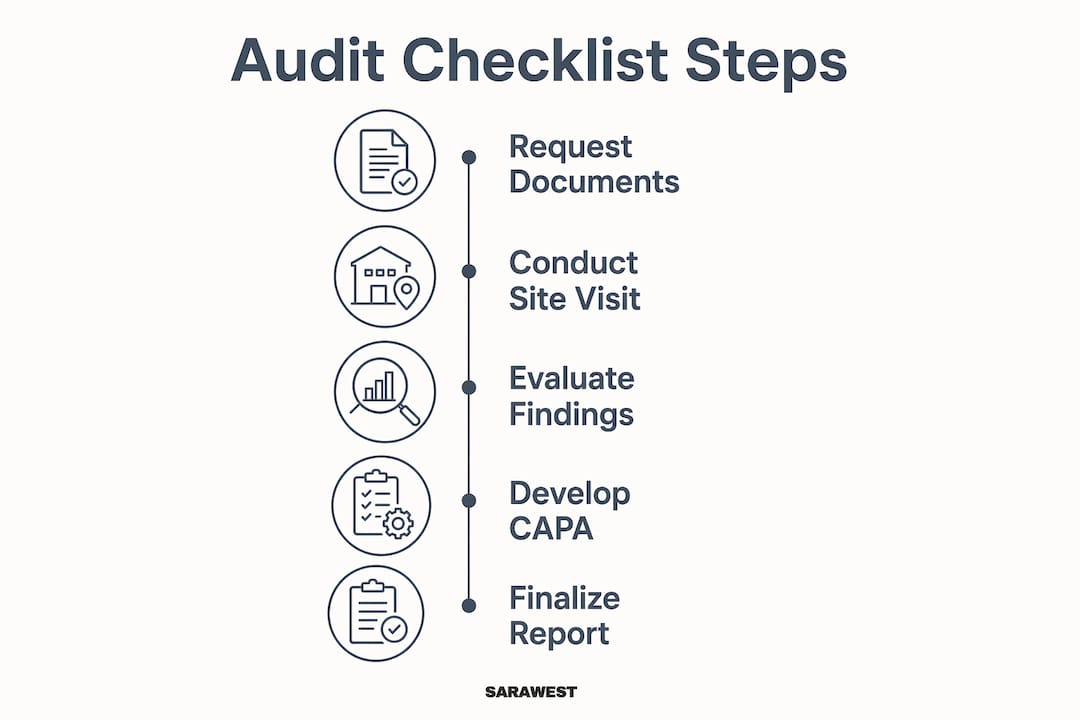
Pre-audit document request. Before any site visit, ask for: QMS manual, current ISO certificate, COAs for the last five lots, three recent batch records, calibration reports, operator training matrix, and any incident logs from the past 12 months. If a supplier cannot produce these within five business days, that delay is itself a finding.

Onsite agenda. A typical one-day audit at a contract chemical site runs: opening meeting (30 min), production floor walkthrough and in-process observation (90 min), records review in QC and document control (90 min), sample selection and chain-of-custody documentation (30 min), and closing meeting with preliminary findings (30 min).
Remote audit alternatives. Document-focused remote reviews work for periodic surveillance of established suppliers. Live video walkthroughs can substitute for a floor observation when travel cost outweighs risk. Third-party lab verification of COAs adds independent confirmation without a site visit. Remote audits are not appropriate for initial qualification of a new chemical manufacturer or for any for-cause audit triggered by a quality event.
Risk-based tiering determines depth: critical suppliers handling hazardous chemistry or proprietary formulations warrant 30–40 checklist items and an onsite visit; standard suppliers may need only 10–15 items with a remote review.
Auditor qualifications. The lead auditor should have working knowledge of ISO 19011:2018 auditing methods, practical chemistry or chemical manufacturing experience, and no commercial relationship with the supplier being assessed. Cross-functional review inputs are mandatory.
Pro Tip: Collect physical samples during the site visit and commission third-party testing independently. A supplier's own COA confirms their process; an independent result confirms your product.
What happens after the audit?
Every audit produces three deliverables: a report, a CAPA plan, and a contract action.
Audit report components: executive summary with overall score and approval recommendation; scored findings by category with objective evidence references (document IDs, photos); classification of each finding as major nonconformance, minor nonconformance, or observation; and recommended commercial action.
| Finding Class | Definition | CAPA Timeline |
|---|---|---|
| Major nonconformance | Systemic failure or regulatory risk | Immediate containment + 30-day root cause + 60-day corrective plan + 90-day verification |
| Minor nonconformance | Isolated gap, no immediate risk | Corrective plan within 30 days; closure evidence within 60 days |
| Observation | Improvement opportunity | Supplier response within 60 days; no hold on approval |
Contract implications. Conditional approval language should specify the CAPA deadline, the evidence required for closure, and the consequence of non-closure (production hold, contract suspension, or termination). Right-to-audit clauses must be enforced, not waived. CAPA closure requires documented evidence: updated SOPs, re-test reports, or a re-audit finding, not just a supplier's written assurance.
What KPIs should you track between audits?
Scheduled audits catch problems at a point in time. KPIs catch drift between audits. Track these monthly for critical suppliers:
- On-time delivery rate (target: ≥95%)
- Invoice accuracy rate (target: ≥98%)
- Defect rate / parts per million (set per product category)
- COA variance rate (out-of-spec results as a percentage of lots shipped)
- Corrective action closure rate (open CAPAs closed on time)
- Lead-time stability (variance from quoted lead time)
Trigger an out-of-cycle audit immediately when any of these occur: a safety incident at the supplier's facility, two consecutive delivery failures, a new production line or facility, a merger or ownership change, or a significant formula change not communicated through change control. Integrating these triggers into your supplier lifecycle prevents the slow drift that annual-only reviews miss.
Review cadence by tier: critical suppliers annually, significant suppliers every 12–24 months, routine suppliers every 2–3 years.
Your one-page audit cheat sheet
Print this or load it on mobile before a supplier call or site visit.
Must-have evidence (request before the audit): Current ISO 9001 certificate, COAs for last 5 lots, 3 recent batch records, calibration logs, training matrix, incident log, MSDS/SDS for all hazardous inputs, approved sub-tier supplier list.
Pass/fail triggers (any one = hold approval): Expired or out-of-scope ISO certificate; out-of-spec product shipped without documented disposition; missing SDS for a hazardous input; undocumented formula changes; overdue critical instrument calibrations.
Digital tools. Mobile audit apps combine checklist structure with real-time photo capture, automatic scoring, and CAPA tracking. Excel scorecards work for smaller programs. Store all audit records in a centralized repository tagged to supplier ID and contract number so findings are traceable across audit cycles.
What should a reputable contract manufacturer already have ready?
A compliant contract chemical manufacturer should hand you most of this evidence without being asked twice. Here is what to expect and what to probe:
- In-house R&D documentation: proprietary R&D reports, formula development logs, and pilot batch reports that show the chemistry behind the product, not just the finished COA.
- Calibration and maintenance logs: current for all production-critical equipment, with no overdue items.
- Operator training matrix: signed records showing every active operator is trained on current SOPs.
- Batch records: complete, legible, and available for the last three production runs of any product you are evaluating.
- COAs: issued per lot, with method references and lab identification.
Sarawest USA's contract manufacturing operation is built around exactly this kind of document readiness: in-house R&D chemists, a proprietary library of 1,200+ formulas, and pilot-to-scale capability across eight industries including commercial cleaning and clean-label manufacturing. When you run a supplier evaluation against this checklist, ask for case studies and sample data to reconcile against the evidence categories above. A manufacturer that can produce pilot batch reports, COAs, and calibration logs on request is one whose quality system is real, not performative.
Key Takeaways
A supplier audit checklist for contract chemical manufacturing must link every requirement to specific evidence, a pass/fail threshold, and a CAPA deadline to produce defensible approval decisions.
| Point | Details |
|---|---|
| Evidence-based checks only | Every checklist line needs a required document (COA, batch record, certificate) and a defined action if missing. |
| Score with weights and thresholds | Use weighted categories (QMS —, lab/COA —, etc.); overall score below 60 triggers rejection or probation. |
| Trigger audits, not just schedules | Safety incidents, formula changes, and ownership changes must force an out-of-cycle audit regardless of calendar. |
| Multi-stakeholder scoring | QC, engineering, and procurement must each score independently to eliminate single-perspective bias. |
| Sarawest USA audit readiness | Sarawest USA provides in-house R&D documentation, COAs, batch records, and pilot-to-scale evidence aligned to these checklist requirements. |
The audit criteria that actually separate good manufacturers from compliant ones
Most audit guides focus on what documents to collect. That is necessary but not sufficient. The real signal is whether a manufacturer's quality system is operational or merely documented.
A supplier can hand you a current ISO 9001 certificate and a clean batch record and still be running a quality system that exists only on paper. The tell is in the details: calibration logs that are always exactly on schedule (suspiciously perfect), training matrices signed off in bulk on the same date, or COAs that never show a value outside the middle third of the spec range. Real manufacturing has variation. A quality system that shows none is either exceptional or fabricated.
The other thing auditors consistently underestimate is the formulation change control gap. In contract chemical manufacturing, a formula adjustment that seems minor to a production chemist can change a product's regulatory classification, its shelf stability, or its interaction with packaging. Change control is not a paperwork exercise. It is the mechanism that keeps your product the same product across production runs. When you audit formulation controls, ask to see the last three change requests, including any that were rejected. A supplier with no rejected changes in two years either has a perfect process or a broken one.
Confidentiality is real, and a good auditor respects it. You do not need to see a proprietary formula to verify that change control exists. Redacted change logs, witnessed testing, and summary R&D reports give you the evidence you need without exposing IP. Ask for what you need to verify the system, not everything you could theoretically request.
Already audited your options? Here is what Sarawest USA brings to the table
If your checklist review has you looking for a contract chemical manufacturer that walks in already prepared, Sarawest USA is built for exactly that conversation. Real in-house R&D chemists. A 1,200+ formula library across eight industries. Pilot batches to full truckloads, with the documentation to match.
We are not a broker. Every formula, every batch record, every COA comes from our facility. When you request an audit pack, we hand you the actual documents: calibration logs, training matrices, pilot batch reports, and COAs issued per lot. No scrambling, no third-party delays.
Ready to put us through your checklist? Request samples from up to three SKUs, review our formulation track record, or submit an RFQ directly. A real person reads every inquiry and responds with specifics, not a template.
Authoritative sources and further reading
| Source | Type | What it covers |
|---|---|---|
| ISO 9001:2015 Supplier Audit Checklist | Standards guidance | QMS audit structure aligned to ISO 9001 Clause 8.4 and ISO 19011 audit method |
| Supplier Audit Checklist (MapTrack) | Template | Core checklist categories, conform/non-conform check design, and CAPA grading |
| Vendor Audit Checklist (OnGrid) | Best practices guide | Evidence-based design principles, event-trigger rules, and lifecycle integration |
| Vendor Risk Assessment Checklist (ThirdProof) | Risk framework | Risk-based tiering, audit depth by vendor tier, multi-dimensional scoring |
| Supplier Audit Checklists (GoAudits) | Template + digital tools | PDF, Excel, and mobile audit app formats with CAPA tracking |
| Vendor and Supplier Evaluation Form (FlexForm) | Scorecard template | Standardized scorecard, KPI tracking, multi-stakeholder scoring guidance |
| Supplier Evaluation Form (YSU Procurement) | Institutional template | Structured evaluation form covering delivery, quality, price, and customer service |