

The core difference between white label and private label comes down to one word: exclusivity. White label products are pre-made by a manufacturer and sold to multiple retailers, each slapping their own logo on the same formula. Private label products are made exclusively for one brand, with that brand controlling the specifications, formulation, and packaging.
Here is what separates them at a glance:
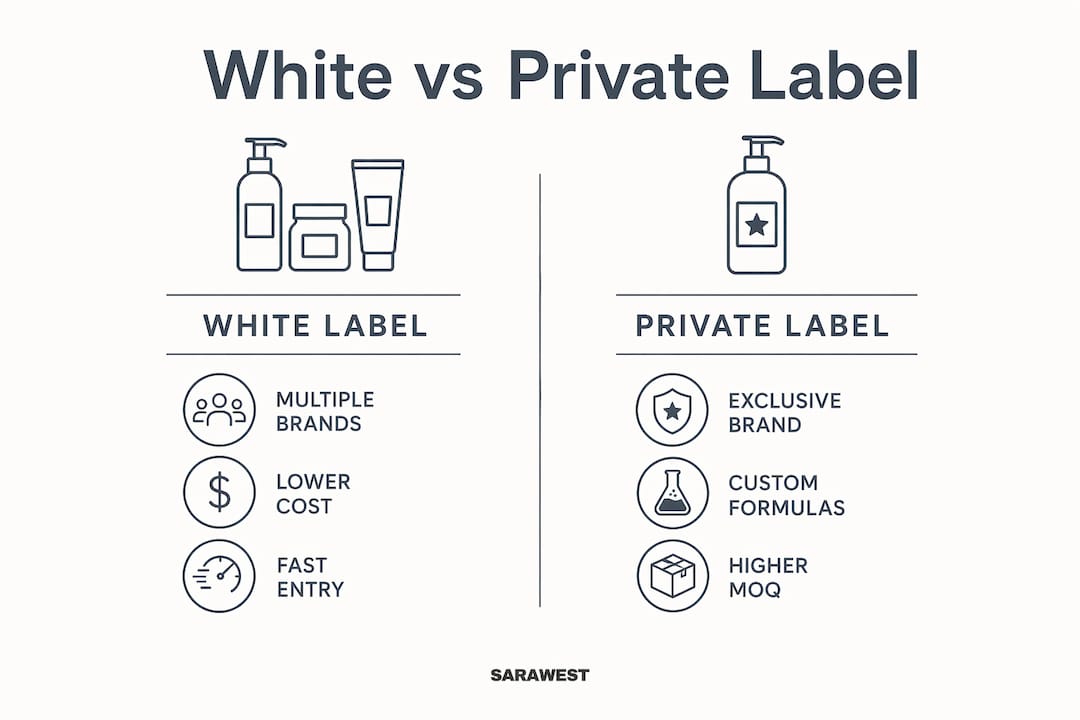
- Exclusivity: White label products are sold to any buyer. Private label products belong to one brand only.
- Customization: White label offers surface-level changes (logo, color, packaging). Private label allows full control over ingredients, design, and performance specs.
- Cost: White label carries lower upfront costs. Private label requires R&D investment and higher minimum order quantities (MOQ).
- Speed to market: White label ships faster because the product already exists. Private label takes longer due to custom development.
- Typical use cases: White label suits fast market entry and product line expansion. Private label fits brand building and long-term differentiation.
Neither model is better by default. The right choice depends entirely on where your business is and where you want it to go.
How white label vs private label products compare side by side
The difference between white label and private label sharpens considerably when you lay them against each other on the dimensions that actually affect your bottom line.

White label products are generic, pre-manufactured items sold under multiple brand names, offering fast market entry and lower upfront costs but no exclusivity. Private label products provide exclusive branding and customization, requiring higher upfront investment and longer development time.
| Dimension | White Label | Private Label |
|---|---|---|
| Exclusivity and branding control | Shared with other retailers; logo only | Exclusive to your brand; full spec control |
| Customization level | Minimal (packaging, color, label) | High (formula, design, ingredients, performance) |
| Cost and investment required | Low upfront; no R&D | Higher MOQ, R&D, and development costs |
| Speed to market | Fast; product already exists | Slower; custom development required |
| Typical use cases / business goals | Market testing, fast expansion, low-risk launch | Brand asset building, IP protection, premium pricing |
| Best for | Entrepreneurs validating demand quickly | Brands building long-term competitive advantage |
The intellectual property angle is where the gap widens most. Private label contracts grant exclusivity and protect unique formulations, unlike generic white label products that can be sold to multiple brands. With white label, your competitor could be selling the exact same product under a different name tomorrow. That is not a hypothetical risk. It is the structural reality of the model.
Private label MOQ for manufacturing is generally higher than for white label due to formulation and production complexities. That cost is real, but it buys you something white label never can: a product your competitors cannot copy and sell.
What are the real advantages of each model?
White label advantages
- Lower barrier to entry. No R&D budget required. You source a finished product and focus on marketing.
- Faster launch. Products are already manufactured, tested, and ready for white label fulfillment. You skip months of development.
- Flexible order sizes. White label manufacturers typically offer lower MOQs because they produce in bulk for multiple buyers.
- Reduced risk. You are selling a proven product. The formula has already been tested and refined by the manufacturer.
- Focus on sales. Without production responsibilities, your team concentrates on distribution, marketing, and customer acquisition.
Private label advantages
- True exclusivity. Your product cannot be sold by a competitor. That protection is the foundation of real brand equity.
- Higher margins. Exclusive products support premium pricing. Customers pay more for something they cannot find elsewhere.
- IP protection. Your formulation is yours. A private label manufacturer will not share your formula with other clients.
- Brand differentiation. Custom packaging, custom formulas, and custom performance specs let you build a product story no generic item can match.
- Customer loyalty. Consistent, exclusive products build repeat buyers. White label products, by contrast, can be reformulated by the manufacturer without your input.
Which brands are actually doing this in the US?
The clearest way to understand the difference between white label and private label is to look at brands you already know.
Private label examples:
- Trader Joe's is one of the most studied private label operations in American retail. Nearly every product on its shelves carries the Trader Joe's name, with specifications controlled exclusively by the company. Shoppers cannot buy those products anywhere else.
- ALDI runs a similar model. Its store brands are exclusive, price-competitive, and tightly controlled in formulation. Trader Joe's and ALDI exemplify private label grocery brands with signature products exclusive to their stores.
- Amazon's house brands operate as private label, with the retailer controlling branding and product specifications exclusively across categories from batteries to clothing.
- ZARA controls its own product design and branding end to end, making it a private label model in fashion. You cannot buy a ZARA-designed piece from another retailer.
White label examples:
-
IKEA occupies an interesting middle ground. Many of its products are designed in-house with exclusive specs, but its approach to generic home goods and accessories shares characteristics with white label retail branding.
-
White Label Enterprise and Sarawest USA both offer white label manufacturing services in the United States, with proprietary formulas available for licensing. Sarawest USA goes further, offering both white label licensing and fully custom private label development through in-house chemists.
How do you choose between white label and private label?
The decision framework is simpler than most people expect. Answer these questions honestly and the path becomes clear.
- What is your budget? If you have no R&D allocation, white label is your starting point. Private label requires investment before a single unit ships.
- How fast do you need to launch? A tight timeline favors white label. Custom development takes time, and rushing it produces mediocre products.
- How important is exclusivity? If your competitors can sell the same product, your only differentiator is price. That is a race you do not want to run long-term.
- Are you testing or building? White label is ideal for validating demand. Private label is the right move once you know the market wants what you are selling.
- What are your IP concerns? If your formula or product design is central to your brand, private label with a solid exclusivity agreement is the only real protection.
Pro Tip: A proven growth path is to launch with white label to validate demand quickly, then transition to private label once you have confirmed the market and can justify the higher MOQ and development costs. This hybrid approach reduces early-stage risk without locking you out of exclusivity later.
For custom packaging and branding, private label gives you far more latitude to build a product identity that holds up over time.
What contract manufacturing actually looks like from the inside
Most entrepreneurs understand the theory. Fewer understand what the manufacturing side of this decision actually involves.
Sarawest USA operates a 30,000-square-foot facility in Pampa, Texas, with over 1,200 proprietary formulas across eight industries, including commercial cleaning, sports care, solar care, leather care, and equine products. That library is the foundation of its white label product offering. Clients license an existing formula, apply their branding, and go to market without touching R&D.
Private label at Sarawest USA works differently. In-house chemists adapt existing formulas or build entirely new ones to client specifications. That process involves real back-and-forth on performance targets, ingredient sourcing, and regulatory compliance. The result is a formula the client owns exclusively.
The MOQ question comes up in every conversation. White label orders at Sarawest USA start at 1,000 units, keeping entry costs manageable. Private label runs require dedicated production time and custom sourcing, which pushes MOQs higher and extends lead times. That is not a flaw in the model. It is the cost of owning something real.
Quality control is another area where the two models diverge sharply. With white label, the manufacturer controls the formula. If they change an ingredient or reformulate for cost reasons, you may not find out until customers notice. Private label contracts include tighter specifications and notice clauses, giving you more leverage when issues arise.
Key Takeaways
Private label wins on exclusivity and brand defensibility. White label wins on speed and cost. The right model depends on your stage, budget, and how much your product formula matters to your competitive position.
| Point | Details |
|---|---|
| Exclusivity is the core difference | White label products are sold to multiple retailers; private label belongs exclusively to one brand. |
| Cost and MOQ trade-offs are real | Private label requires higher upfront investment and minimum order quantities due to custom formulation. |
| White label suits early-stage testing | Launch fast with a proven formula, then move to private label once demand is confirmed. |
| IP protection lives in private label | Private label contracts restrict manufacturers from selling your formula to competitors; white label offers no such protection. |
| Sarawest USA supports both models | Over 1,200 ready-to-brand formulas for white label, plus in-house chemists for fully custom private label development. |
The model you choose shapes the brand you build
Most entrepreneurs come to this decision focused on cost. That is understandable, but it is the wrong lens. The real question is what kind of competitive position you are trying to build.
White label gets you to market fast. That speed has genuine value, especially when you are testing a new category or expanding a product line without committing to development costs. The risk is not the upfront price. The risk is that you are building on a foundation someone else controls. The manufacturer can change the formula. A competitor can source the same product. Your brand differentiation lives entirely in your marketing, not your product.
Private label flips that equation. The upfront investment is higher, and the timeline is longer, but what you build is actually yours. The formula, the performance specs, the packaging design — all of it is locked to your brand. That is what makes private label the stronger long-term play for any entrepreneur serious about building a brand asset rather than just moving inventory.
The misconception worth correcting: private label does not automatically mean higher quality. The real value is exclusivity and IP protection, not a guarantee that the product performs better than a white label equivalent. A well-sourced white label product can outperform a poorly developed private label one. What private label guarantees is that your competitors cannot sell your product. That protection is worth more than most entrepreneurs realize until they lose it.
Sarawest USA: white label and private label from one manufacturer
If you have read this far, you already know the decision is not simple. What makes it harder is finding a manufacturer who can actually support both paths without pushing you toward the option that is easier for them.
Sarawest USA is built for exactly this. With over 1,200 proprietary formulas ready to license for white label, and in-house chemists who can build custom formulations for private label from the ground up, you get real options from one source. No brokers. No intermediaries. Pilot batches to full truckloads, with turnarounds that do not waste your launch window.
Browse Sarawest USA's proven formulation track record or request samples before committing to a production run at sarawestusa.com/request-samples. A real person reads every inquiry.