
Anti-fog performance comes down to two competing chemistry strategies: surfactant thin films that lower water's surface tension, and engineered hydrophilic or hydrophobic coatings that spread condensation into a transparent sheet instead of scattering droplets. The chemistry choice matters less than what's inside it. PFAS compounds have turned up in commercial anti-fog sprays at concentrations that should worry any formulator, which makes safety screening, not just optical clarity, the first checkpoint before a formula leaves the bench.
TL;DR:
- Most anti-fog formulas contain surfactants or hydrophilic polymers that reduce water surface tension or actively pull water into a transparent sheet, but PFAS compounds have been found in some products at concerning levels.
- Formulations must be carefully tested for durability, with static and dynamic contact angles, transmittance, haze, and wash-off resistance, to ensure they withstand real-world use.
- Long-lasting coatings rely on inorganic nanoparticles or hybrid polymer architectures, but stability may decline under prolonged water immersion, requiring careful material selection.
- PFAS in anti-fog sprays originate from fluorinated chemistries like fluorotelomer alcohols, and formulators should screen raw materials and prefer nonfluorinated options to reduce environmental and health risks.
- Contract manufacturers can rapidly develop customized anti-fog formulas, but starting with nonfluorinated, hydrophilic polymer strategies offers a safer and more scalable path to optical clarity.
Table of Contents
- What Chemistries Make Up an Anti-Fog Spray?
- How Does Anti-Fog Spray Actually Prevent Fogging?
- What Does a Typical Anti-Fog Formula Look Like?
- Which Advanced Coatings Should R&D Teams Be Watching?
- Is PFAS a Real Concern in Anti-Fog Sprays?
- What Lab Tests Prove an Anti-Fog Formula Works?
- Where Does SaraWest USA Fit Into Anti-Fog Formulation?
- What Formulators Get Wrong About Anti-Fog Chemistry
- Ready to Prototype an Anti-Fog Formula?
- Sources
- FAQ
What Chemistries Make Up an Anti-Fog Spray?
Every anti-fog formula, whether it's a $4 drugstore spray or a lab-grade coating precursor, is built from a handful of functional ingredient classes. Understanding what each one does lets you swap suppliers or troubleshoot batch failures without starting from scratch.
- Surfactants carry the load. Nonionic ethoxylates, anionic alkyl sulfates, and occasionally cationic quaternary ammonium compounds reduce water's surface tension so condensation spreads into a film rather than beading. Reference summaries of anti-fog agents consistently cite ethoxylates and polysiloxanes as the workhorse chemistries.
- Silicone emulsions (polysiloxanes) contribute film uniformity and anti-smear behavior, especially on plastic and polycarbonate lenses where surfactants alone leave streaks.
- Fluorinated chemistries, including fluorotelomer alcohols and ethoxylates, were historically prized for low surface energy and durability. They're also the biggest liability on this list, and the next section explains why.
- Carrier solvents (water, isopropyl or ethyl alcohol) control drying speed and evaporation profile.
- pH adjusters, typically citric acid, stabilize the surfactant system and prevent hydrolysis over shelf life.
- Preservatives and rheology modifiers round out the system, protecting against microbial growth in water-based sprays and adjusting viscosity for even application.
Substrate compatibility drives ingredient selection more than most formulators expect. Glass tolerates aggressive surfactant loads. Polycarbonate and coated optical lenses do not; excess surfactant or solvent can craze the coating or strip anti-reflective layers, so lower-concentration, silicone-buffered systems are the safer default for eyewear.
How Does Anti-Fog Spray Actually Prevent Fogging?
Fogging happens when water vapor condenses into microdroplets that scatter light instead of transmitting it. Anti-fog chemistry interrupts that process through one of two mechanisms.
- Surface tension reduction. Surfactants lower water's tendency to bead, so instead of forming discrete droplets, condensation spreads into a thin, continuous, optically clear film. This is the fast-acting mechanism behind most consumer sprays.
- Superhydrophilic film formation. Hydrophilic polymer networks, often built on hydrogen-bonding functional groups, actively pull water into a sheet across the surface rather than merely reducing surface tension. Interfacial chemistry research from McGill's Office for Science and Society frames this as the central lever separating short-term sprays from durable coatings.
A third, less common strategy goes the opposite direction: hydrophobic, low-surface-energy coatings that shed water entirely before it can nucleate. These trade some durability and optical risk for water resistance, useful for automotive glass but rarely chosen for eyewear.
The metrics that matter here are static and dynamic contact angle, optical transmittance, haze percentage, and wetting kinetics under controlled humidity. A formulation that hits a contact angle under 10 degrees but fails transmittance testing isn't ready for eyewear, no matter how well it resists fog in the lab.
What Does a Typical Anti-Fog Formula Look Like?
Schematic formulations help you prototype fast without reverse-engineering a competitor's exact ratios. Here are three starting architectures worth testing on the bench.
- Thin-film spray: water carrier, 2 to 8 percent nonionic surfactant, a small silicone emulsion fraction for smear resistance, typically included without precise percentage disclosed, and citric acid to bring pH into the mildly acidic range that stabilizes the surfactant blend. Push surfactant loading too high and you'll get haze on cooling; that ceiling is worth testing early.
- PVA-based hydrophilic coating: polyvinyl alcohol as the film-forming polymer, a crosslinker to lock in water resistance after application, and a plasticizer to prevent brittleness. Drying or low-heat curing sets the hydrogen-bonding network that gives these coatings multi-day durability instead of single-use performance.
- Ionic-liquid-infused approach: appropriate when you need weeks of anti-fog performance in air exposure rather than hours, using a hygroscopic ionic liquid infused into a nanostructured silica framework.
Patent disclosures such as WO2017222478A2 describe biologically derived surfactants, including glycolipids, fatty acids, and phospholipids, combined with citric acid and silicone emulsion in simple aqueous preparations, offering a lower-irritation profile for near-eye products.
Pro Tip: Run ocular irritation screening on any near-eye formula before optimizing optics. A coating that scores beautifully on contact angle but fails a basic biocompatibility check is a formula you'll be reworking twice.
Which Advanced Coatings Should R&D Teams Be Watching?
Simple sprays reapply every few hours. The research frontier is chasing coatings that last weeks without sacrificing transparency, and three approaches stand out for formulators building a longer-term roadmap.
- Inorganic nanoparticle coatings using TiO2, SiO2, or ZnO create durable superhydrophilic or superhydrophobic surfaces. Review literature on inorganic antifogging materials documents these as the dominant direction for long-term performance, though nanoparticle loading has to be tightly controlled to avoid haze.
- Twisted, non-coplanar polymer architectures combined with a PVA cross-linked skeleton expand molecular free volume and strengthen the hydrogen-bond network, increasing moisture absorption capacity without adding coating thickness.
- Photothermal additives, such as CTB nanoparticles absorbing near-infrared light, actively warm the coating surface to prevent condensation rather than just passively absorbing it.
A 2025 study on a hybrid PVA-SPPESK matrix loaded with CTB nanoparticles reported extended anti-fog duration and improved moisture absorption while retaining visible transparency, pairing a passive hydrophilic network with an active photothermal mechanism in a single coating.
Ionic-liquid-infused silica frameworks deserve a specific caveat: they deliver self-healing, reversible anti-fog behavior lasting many weeks under air exposure, but stability drops sharply under prolonged immersion in bulk water. If your end-use involves splashing or submersion, budget time for gel-matrix stabilization work before committing to this route.
Choose a hybrid strategy only when a simple spray demonstrably fails your durability spec. Complexity buys you longevity, but it also multiplies your manufacturing controls and your optical risk.
Is PFAS a Real Concern in Anti-Fog Sprays?
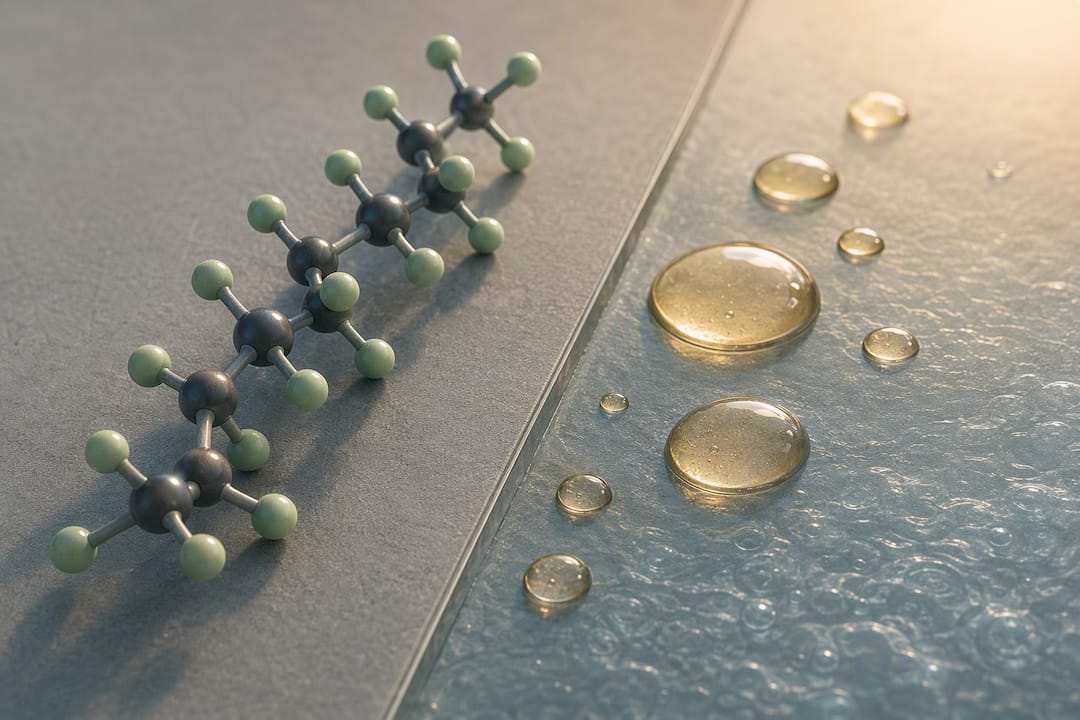
Yes, and the data is specific enough to act on. Researchers detected fluorotelomer alcohols and fluorotelomer ethoxylates, both PFAS classes, in commercial anti-fog sprays and cloths, with one study reporting concentrations up to 20.7 mg of PFAS per mL of solution. That's not a trace contamination story. It's a formulation choice that some manufacturers are still making, likely for the durability and low surface energy fluorinated chemistries provide.
PFAS persistence in the environment and in the body is well documented, which means a supply-chain declaration gap on fluorinated raw materials is a liability that follows the product to market. Practical next steps for any formulation team:
- Screen incoming surfactant and silicone raw materials for PFAS content before qualifying a supplier.
- Require written raw-material declarations, not verbal assurances, from every surfactant and additive vendor.
- Default to nonfluorinated surfactant classes (ethoxylates, biobased glycolipids) unless a specific performance gap forces a fluorinated alternative.
- Run biocompatibility testing on any formula intended for near-eye or skin-contact use, independent of PFAS status.
What Lab Tests Prove an Anti-Fog Formula Works?
A formula that fogs in the shower isn't ready for a customer's face. Getting from bench to pilot run requires a defined test sequence, not a single pass/fail check.
- Cold and warm cycling. Expose the coated substrate to repeated humidity and temperature swings to simulate real-world fog conditions rather than a single static exposure.
- Contact angle protocol. Measure both static and dynamic contact angle before and after cycling. A shift of more than a few degrees after cycling signals a coating that won't hold up in the field.
- Optical measurement. Track transmittance and haze percentage. Eyewear-grade formulations generally need transmittance loss and haze increases small enough to be imperceptible to the wearer.
- Abrasion and wash-off testing. Simulate cloth wiping, handling, and washing to confirm the coating survives normal use rather than just a single application.
- Stability testing. Watch for phase separation over time, confirm microbial preservation is holding, and set a real shelf-life window rather than an assumed one.
Scale-up introduces its own failure points. Batch-to-batch reproducibility, shear effects from in-line mixing, and consistent QA sampling all need to be locked down before a pilot batch becomes a production run.
Pro Tip: Test contact angle and transmittance together, every time, not as separate checkpoints. A formula can pass wetting tests and still fail visually the moment it goes under bright light.
Where Does SaraWest USA Fit Into Anti-Fog Formulation?
Some contract manufacturers run anti-fog development with in-house chemists, a large library of proprietary formulas, and rapid prototyping without routing through a broker.
- Discovery to prototype. You describe the performance target and substrate; our chemists start from an existing base formula or build new.
- Testing and pilot run. Formulas move through contact angle, transmittance, and stability checks before scaling.
- Flexible order sizes. Pilot batches and full truckload runs both move through the same pipeline, with turnarounds fast enough to compress your iteration cycle.
What Formulators Get Wrong About Anti-Fog Chemistry
Most formulators reach for the fluorinated option first because it's durable and well documented in older literature. That instinct is backwards now. Start with nonfluorinated, hydrophilic polymer strategies, and reserve ionic-liquid or nanoparticle systems for the specific durability gaps a simple film can't close. PFAS screening on every raw material belongs at the front of the process, not the end of it. Document your test plan and supplier declarations before you commit to a pilot run. The chemistry that looks safest on paper is the one you can actually stand behind at scale.
— Faisal Mansur
Ready to Prototype an Anti-Fog Formula?
If you're staring at a formulation gap between a fluorinated legacy chemistry and a PFAS-free alternative that still hits your optical targets, that's exactly the kind of problem Sarawest USA's in-house chemists solve without routing your project through a broker or a six-month development cycle.

Some companies maintain a large library of proprietary formulas across several industries, including chemistries overlapping with anti-fog systems, allowing faster prototyping by adapting existing base formulas instead of starting from scratch, with pilot batches moving through testing on relatively fast timelines. Whether you need a fully custom formulation or a white label product under your own brand, our contract chemical manufacturing team can take your specification from bench sketch to pilot run. Request a formulation consultation and describe your substrate, performance target, and volume needs. A real chemist reviews every submission.
Sources
- Long-lasting and stable anti-fog coating combined with active and passive strategy (PMC)
- WO2017222478A2 - Anti-fog spray (Google Patents)
- Fundamentals of antifogging strategies, coating techniques and properties of inorganic materials (review PDF)
FAQ
What Is Anti-Fog Spray Made Of?
Most anti-fog sprays combine a surfactant (nonionic ethoxylates or biobased glycolipids), a small silicone emulsion fraction, a water or alcohol carrier, and citric acid as a pH adjuster. Some commercial products also contain fluorinated compounds like FTOHs, which is the ingredient class formulators should screen out first.
Can I Make My Own Anti-Fog Solution at Home?
DIY anti-fog solutions using diluted dish soap or shaving cream work by the same surface tension mechanism as commercial sprays, but they lack the pH stabilization, preservatives, and silicone smear resistance of an engineered formula, so performance is inconsistent and short-lived.
Do Anti-Fog Sprays Actually Work?
Yes, both surfactant-based sprays and engineered hydrophilic coatings measurably reduce fogging by changing how condensation forms on a surface, though sprays typically need reapplication within hours while coatings can last days to weeks depending on the chemistry.
Do Anti-Fog Sprays for Glasses Actually Work?
Anti-fog sprays formulated for glasses work through the same surfactant or hydrophilic film mechanism as other anti-fog products, but formulators should favor lower-surfactant, silicone-buffered systems on lenses to avoid crazing polycarbonate or stripping anti-reflective coatings.
How Do I Avoid PFAS in Anti-Fog Formulations?
Screen every surfactant and silicone raw material for PFAS before qualifying a supplier, require written material declarations, and default to nonfluorinated surfactant classes like ethoxylates or biologically derived glycolipids unless a specific performance requirement demands otherwise.