
Start here: water as the balance, a volatile solvent such as isopropyl alcohol or ethanol in a moderate amount, a low-residue surfactant in a small to moderate proportion (an alkyl polyglucoside or amine oxide), a small amount of chelant, and a small to moderate amount of alkaline adjuster depending on the soils you're targeting. That's a defensible starting point for a bench trial, not a finished product, but it's close enough to real commercial ratios that you'll spend your first round of testing tuning, not guessing.
This baseline scales two directions. A ready-to-use formula sits at the lean end of those ranges, built for spray-and-wipe simplicity on light residential grease and fingerprints. A concentrate pushes solvent and surfactant toward the top of the range, engineered for dilution by the distributor or the end user. Both share the same skeleton. What changes is concentration and, sometimes, which chelant or surfactant class you pick for the dilution water you expect downstream.
Before you touch a beaker, flag three things that will bite you later if ignored:
- VOC content varies by state and by product category, and solvent choice is often the single biggest lever on your compliance status.
- Ammonia fumes cut grease fast but bring respiratory irritation and surface compatibility issues that alcohol-based systems avoid.
- Water quality determines whether your finished product streaks on the shelf even when the formula is chemically sound.
Key Takeaways
A stable, streak-free glass cleaner formulation depends on balancing solvent volatility against surfactant wetting power while controlling water hardness with a chelant.
| Point | Details |
|---|---|
| Start with the baseline matrix | Water (balance), 2 to 8% IPA or ethanol, a low-residue surfactant in a small to moderate proportion, a small amount of chelant. |
| Match solvent to VOC limits | Glycol ethers add solvency but push VOC content higher than IPA or ethanol alone. |
| Water quality drives streaking | Use distilled or deionized water and a chelant at 0.05 to 0.2% to prevent mineral redeposit. |
| Run full QC before scaling | Confirm pH, visual clarity, preservative effectiveness, and freeze-thaw stability before committing to a production run. |
| Bring in a contract manufacturer at scale | Sarawest USA offers pilot batches from 1,000 units and in-house R&D chemists for VOC reformulation and private label launches. |
Table of Contents
- Glass Cleaner Formulation Matrix: Balancing Solvency, Wetting, and Residue
- What Ingredients Actually Belong in a Glass Cleaner, and Why
- Lab-Ready Recipes: Three Formulas Worth Piloting
- The QC Checks That Keep a Glass Cleaner Formula Stable
- Safety and Regulatory Checkpoints Before You Scale
- How Sarawest USA Helps You Move From Bench to Production
- What Most Formulation Guides Get Wrong
- Ready to Turn a Bench Formula Into a Real Product?
- Frequently Asked Questions
- Sources
Glass Cleaner Formulation Matrix: Balancing Solvency, Wetting, and Residue
Every glass cleaner formulation is really a negotiation between four jobs: dissolving oily soil, wetting the surface evenly, keeping hard-water minerals from redepositing, and cutting through alkaline grime. Get the ratios wrong and you trade one failure mode for another, usually streaking for slow drying, or cleaning power for surface haze.
The matrix below is a starting map, not a locked recipe:
- Solvency (dissolves grease and oily film): isopropyl alcohol or ethanol, 2 to 8% for ready-to-use, up to 15 to 20% in stronger commercial blends; glycol ethers, 3 to 5%, for tougher soils.
- Wetting and rinse-off (spreads the cleaning film evenly, prevents beading): nonionic or amine oxide surfactants, 0.2 to 4%.
- Sequestration (keeps calcium and magnesium from redepositing as haze): sodium gluconate or citrate-based chelants, 0.05 to 0.2%.
- Alkalinity (boosts grease-cutting on heavy commercial soils): ammonia or ethanolamine, 0 to 0.5%, pushing pH toward 8 to 10 when included.
Solvent choice drives drying behavior more than any other single ingredient. IPA evaporates fast and leaves minimal residue, which is why it dominates consumer glass cleaner formulations. Ethanol behaves similarly but costs more in most regions and carries denaturant considerations. Glycol ethers evaporate slower and dissolve tougher soils, which makes them useful in commercial-strength blends but riskier for VOC compliance and slower drying on vertical glass. Technical industry data puts glycol ether loading at 3 to 5% and total alcohol content anywhere from 5 to 20% depending on whether the product targets consumer or industrial use, with finished pH typically landing between 6.5 and 10.
Surfactant selection is where most first-pass formulas go wrong. A surfactant with too low an HLB value won't disperse oily soils in a water-dominant system; too high, and you get foam that lingers on vertical glass and drags dust back onto the surface as it collapses. Low-foaming nonionics and amine oxides in the 0.2 to 5% range solve both problems at once, which is why they show up in nearly every commercial formulation guide worth reading.
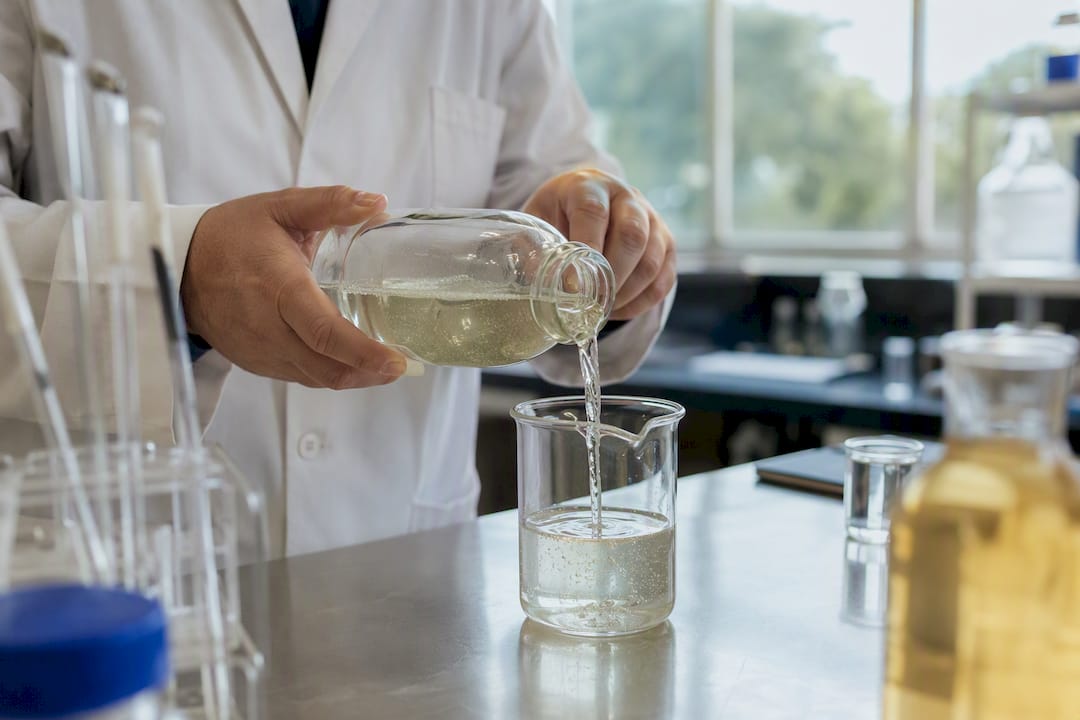
The physics underneath all of this is wetting: how a thin film's surface tension and contact angle determine whether it sheets off evenly or beads and dries into streaks. A fast solvent evaporates before the film has time to level itself, so you need a surfactant doing the wetting work in the meantime. That tradeoff, evaporation speed against film uniformity, is the single most useful mental model for troubleshooting a streaky prototype.
What Ingredients Actually Belong in a Glass Cleaner, and Why
Once the matrix is set, the real work is choosing specific raw materials that hit your target ranges without creating downstream problems in stability, cost, or compliance.
Solvents. Isopropyl alcohol is the default choice for a reason: it evaporates fast, dissolves grease and fingerprints well, and leaves almost no residue behind. The tradeoff is flammability at higher concentrations and a VOC contribution you'll need to account for in labeling. Ethanol performs similarly and is often preferred where availability or local sourcing favors it, though denaturant packages can introduce their own odor and compatibility questions. Glycol ethers bring stronger solvency for commercial-grade soil loads but push VOC content up fast, so reserve them for products where you've already confirmed your target market's VOC ceiling.
Surfactants. Alkyl polyglucosides (APGs) are a strong low-residue choice, biodegradable and gentle on both skin and glass in the 0.2 to 2% range. Amine oxides bring slightly more foam control and work well paired with ammonia-based alkaline systems. Nonionic surfactants with an HLB in the 10 to 13 range wet glass surfaces efficiently without leaving the oily feel some anionic surfactants impart.
Alkaline agents. Ammonia at low dosage (typically under 0.5%) cuts grease and grime faster than almost anything else in the toolbox, which is why traditional formulas lean on it. It also causes the fumes and surface compatibility concerns that push many commercial formulators toward ethanolamine or simply relying more heavily on solvent and surfactant power instead.
Chelants and water quality. Hard water minerals are the quiet cause behind most streaking complaints that formulators can't explain by looking at the surfactant alone. Sodium gluconate or citrate-based chelants at 0.05 to 0.2% sequester calcium and magnesium before they can redeposit on the glass as the film dries. Industry guidance consistently recommends distilled or deionized water as the batch base wherever cost allows it, since tap water variability can undo an otherwise sound formulation.
Preservatives and additives. Any water-based formula without enough solvent or alkalinity to self-preserve needs an active preservative system, commonly methylisothiazolinone (MIT) or an approved alternative, dosed per your supplier's recommended range and confirmed with challenge testing. Defoamers matter more in concentrate products meant for dilution through foam-generating equipment. Anti-static or anti-fog additives are worth considering for automotive and specialty glass lines, but they add cost and complexity that most general-purpose formulas don't need.
Pro Tip: Run your chelant trial against your actual local tap water, not distilled water alone. A formula that looks streak-free in the lab can fail within days once it meets the mineral content your customers actually have coming out of the faucet.
Formulation guides across the industry converge on similar numbers: glycol ethers around 3 to 5%, surfactants from 0.2 to 5%, and pH running in a moderately acidic to alkaline range depending on whether the product leans alkaline for grease-cutting or neutral for surface safety. That convergence is a useful sanity check: if your bench formula lands far outside those bands, you should be able to explain why.
Lab-Ready Recipes: Three Formulas Worth Piloting
Theory only gets you so far. Here are three starting formulas, each built around a different use case, with the mixing sequence that keeps them stable.
1. Ammonia-free household ready-to-use Water as the main ingredient, with small amounts of isopropyl alcohol, alkyl polyglucoside surfactant, sodium gluconate chelant, preservative and fragrance.
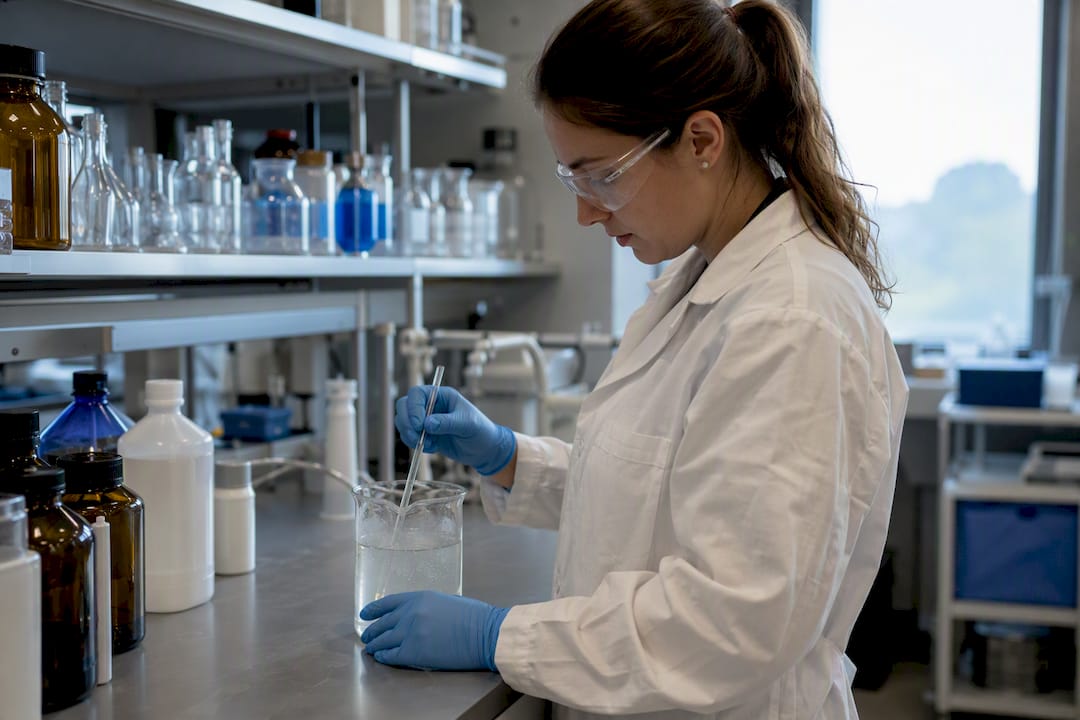
2. Commercial-strength trigger spray Water (balance), IPA 8%, glycol ether 3%, amine oxide surfactant 1.5%, ammonia 0.3%, sodium gluconate 0.15%, preservative per supplier dosage.
3. Dilutable concentrate (1:10 dilution target)
Order of addition matters more than most first-time formulators expect:
- Charge the batch tank with water and begin low-shear agitation.
- Add the chelant first and confirm full dissolution before proceeding.
- Add surfactant slowly to avoid premature foam generation.
- Introduce the solvent (IPA, ethanol, or glycol ether) with continued agitation.
- Add alkaline agents last, since ammonia off-gasses faster once other actives are already dissolved and the batch is closer to final volume.
- Add preservative and fragrance at the end, once the batch has cooled if any exothermic mixing occurred.
Once mixed, run three quick in-process checks before you call the batch good: pH against your target range, visual clarity against a light source to catch haze or undissolved surfactant, and a quick surface-clean test on an actual glass panel to confirm no streaking or residue under normal room lighting.
Scaling introduces new variables that a 10 L bench batch never reveals. At 100 L, mixing time and shear rate both need adjustment to avoid incomplete dissolution of the chelant. At 1,000 L and beyond, filler equipment interacts with your foam profile in ways a beaker never will, and packaging compatibility becomes a real constraint rather than an afterthought. Trigger sprayers, PET bottles, and HDPE containers each respond differently to solvent load. High-alcohol concentrates, in particular, can cause PET to craze or leach plasticizers over time if the resin grade isn't matched to your formula's solvent content.
Pro Tip: Test your packaging compatibility at the same concentration you plan to ship, not the diluted version. A concentrate that's fine at 1:10 dilution can still stress a PET bottle wall at full strength during a three-month accelerated stability test.
The QC Checks That Keep a Glass Cleaner Formula Stable
A formula that looks perfect on day one can fail on a shelf in Arizona in July or a warehouse in Minnesota in January. Small manufacturers skip QC steps at their own risk, because the failures that show up after shipping are far more expensive than the ones caught in the lab.
Run these checks as standard practice, not as an occasional spot-check:
- pH testing on every batch, confirmed against your target range and rechecked at accelerated-aging intervals.
- Visual clarity under consistent lighting to catch early haze formation before a customer does.
- Microbial challenge testing, also called preservative efficacy testing, to confirm your preservative system actually holds up against bacterial and fungal challenge over the product's claimed shelf life.
- Freeze-thaw cycling, since a formula that separates or clouds after a single freeze cycle will fail in any cold-climate distribution chain. Freeze-thaw protocols typically run three to five cycles between freezing and room temperature.
- Centrifuge and separation checks to flag emulsification problems before they show up as a cloudy layer in a customer's bottle six months later.
- VOC measurement against your target compliance ceiling, especially if your formula leans on glycol ethers or higher alcohol content.
Process controls matter just as much as the finished-batch tests. Mixing order, inline filtration, and proper deaeration all prevent the haze and micro-foam that otherwise show up weeks later in finished inventory. If your finished product foams excessively on dispensing, the fix is usually a defoamer dose adjustment or a surfactant swap, not a wholesale reformulation. Foam testing methods can isolate which surfactant or additive is driving the problem before you waste a full production run chasing the wrong variable.
Safety and Regulatory Checkpoints Before You Scale
Solvent choice is your biggest VOC lever, and VOC rules vary meaningfully by state and by product category. Before finalizing a formula meant for wide distribution, confirm your solvent loading against the strictest jurisdiction you plan to sell into rather than the loosest.
Your safety data sheet and label need to cover the basics without exception: full ingredient disclosure appropriate to your jurisdiction, hazard statements for any flammable or irritant components, PPE guidance for anyone handling concentrate, and clear storage directions. OSHA's chemical data resources are the reference point for hazard classification and PPE requirements on the solvents and surfactants common to this category.
A few red flags deserve explicit attention:
- Never formulate or allow end-use mixing of ammonia-based cleaners with bleach or hypochlorite products, which generates toxic chloramine gas.
- Alcohol and glycol ether blends above certain concentrations carry real flammability risk during storage and transport.
- Bulk shipments of higher-alcohol concentrates may trigger DOT hazardous materials classification, which affects your shipping costs and documentation requirements well before it affects your formula.
How Sarawest USA Helps You Move From Bench to Production
Formulating in a beaker is one thing. Scaling that same chemistry into a stable, compliant, repeatable production batch is a different discipline entirely, and it's where most small manufacturers hit a wall they didn't see coming.
Sarawest USA runs pilot batches starting at 1,000 units, backed by a library of more than 1,200 proprietary formulas across eight industries, including commercial cleaning. Real in-house R&D chemists adapt an existing glass cleaner base or build a new one from your exact specifications, with turnarounds fast enough that some projects move from brief to sample the same day.
If you're testing a bench formula for personal or small-batch use, DIY makes sense. Once you're chasing VOC reformulation, consistent multi-batch stability, or a private label launch that needs to hit shelves on a schedule, that's the point where a contract manufacturer's commercial cleaning capabilities start saving you more time and money than they cost.
- 1,200+ proprietary formulas across eight industries, including commercial cleaning
- Real in-house R&D chemists, not brokers relaying your spec to a third party
- Pilot runs from 1,000 units up through full truckload production
- Turnarounds fast enough to move from concept to sample in days, sometimes hours
| Point | Details |
|---|---|
| Formula viability | Sarawest USA's R&D team can validate and refine a bench formula before committing to a full production run. |
| Scale-up support | Pilot batches start at 1,000 units, letting you test market response before a truckload commitment. |
| Private label speed | Same-day sampling turnarounds are available for brands ready to move fast on launch timelines. |
What Most Formulation Guides Get Wrong
Most advice on glass cleaner formulation treats the ingredient list as the whole story. It isn't. The ratio between solvent volatility and surfactant wetting power decides whether a formula streaks, and that relationship gets almost no attention in the recipes that circulate online. A formula can hit every recommended percentage range and still fail on the glass if the surfactant can't level the film before the solvent flashes off.
The other blind spot is water quality. Formulators obsess over exotic surfactant chemistry while ignoring that a $0.02 dose of chelant solves more real-world complaints than switching surfactant classes ever will. If your prototype works in the lab but fails in the field, check your dilution water before you touch the formula.
My honest read: most small manufacturers should spend less time chasing a proprietary surfactant blend and more time nailing water quality, preservative efficacy, and packaging compatibility. Those unglamorous variables fail more launches than the actual cleaning chemistry does. Get the boring parts right first.
Ready to Turn a Bench Formula Into a Real Product?
Sarawest USA gives you a faster path from formula to finished product than building an in-house lab from scratch, and without the broker layer that slows down most contract manufacturing relationships. You work directly with the chemists adjusting your formula, whether that means reformulating for lower VOC content, dialing in a private label glass cleaner recipe, or scaling a concentrate you've already proven on the bench.
This fits you if you've validated a formula and need someone who can move it from a 10 L pilot to a full production run without months of back-and-forth. Sarawest USA's contract manufacturing team handles everything from raw material sourcing to packaging compatibility testing, and the case studies show how that process plays out for real client launches. If you want to see finished quality before committing to a production run, you can request product samples and get a direct read on what a Sarawest USA formulation looks and performs like before you sign off on anything.
Frequently Asked Questions
What is the basic glass cleaner formulation ratio? Adjust upward for a concentrate meant for dilution.
Can I make an effective DIY glass cleaner recipe without ammonia? Yes.
Why does my homemade window cleaner leave streaks? Streaking usually comes from hard water minerals redepositing as the film dries, or from a surfactant that can't wet the surface evenly before the solvent evaporates.
What surfactants work best for a low-residue commercial glass cleaner?
Is isopropyl alcohol or ethanol better for glass cleaner formulation? Both evaporate quickly and leave minimal residue. IPA tends to be more cost-effective and widely available, while ethanol may be preferred where local sourcing or denaturant regulations favor it. Neither has a clear performance edge for typical formulations.
When should a small manufacturer switch from DIY formulation to contract manufacturing? Once you need consistent multi-batch stability, VOC-compliant reformulation across state lines, or a private label launch on a fixed timeline, a contract manufacturer's pilot-to-scale capabilities typically save more time and cost than continuing to formulate in-house.