
For most private-label buyers, the smartest route is a bio-enzymatic concentrate that targets odor and organic buildup without triggering pesticide regulation. If your claims stop at cleaning and don't include antimicrobial or pathogen-killing efficacy, you avoid EPA registration entirely. If you need those claims, plan for that process from day one. Either way, your next move is the same: lock down your label claims, then request a working prototype from a contract manufacturer.
TL;DR:
- Barn cleaning formulations should focus on neutralizing ammonia and controlling odors without claiming pathogen kill to avoid EPA registration requirements.
- Proper formulation includes maintaining a stable pH around 9 to 10, ensuring solubility in hard water, and tailoring the product to application method and equipment.
- EPA registration is necessary only if antimicrobial or disinfectant claims are made; general cleaning and deodorizing claims typically do not require it.
- Bio-enzymatic formulas effectively address ammonia at the source and should be validated for cold-water activation, especially in unheated barns during winter.
- Working with an in-house manufacturer that provides direct chemist support, stability testing, and clear scale-up procedures reduces the risk of costly regulatory or formulation mistakes.
Table of Contents
- What Does a Barn Cleaner Formulation Actually Need to Do?
- Do You Need EPA Registration for a Barn Cleaner?
- Bio-Enzymatic vs. Conventional Chemistry: Which Should You Choose?
- How Should Packaging Match the Way Customers Apply the Product?
- What Should You Expect From a Contract Manufacturer on Scale-Up?
- What Testing Should You Require Before Launch?
- What I've Learned Sourcing Barn Cleaners for Private Label
- Ready to Build Your Barn Cleaner Line? Here's How Sarawest USA Helps
- Where to Verify These Regulatory and Technical Details
- Sources
- FAQ
What Does a Barn Cleaner Formulation Actually Need to Do?
A barn cleaner formulation earns its place on a shelf by doing four jobs at once: stripping organic residue, neutralizing ammonia, controlling odor at the source, and in some product lines, brightening stall surfaces without corroding metal fixtures. We've seen brands chase one of these goals and ignore the other three, and the returns start rolling in within a season.
The physical specs matter as much as the performance targets. Most professional formulations land in a moderately alkaline pH range, often around 9 to 10, because that range balances grease-cutting power against material safety on wood, concrete, and galvanized steel. Solubility, foam stability, and viscosity all need tuning to match how the product will actually be used, whether that's a foam gun in a wash bay or a hand sprayer in a tack room.
Key formulation requirements to lock down before scale-up:
- pH control: stable in the 9 to 10 range for organic soil removal without surface damage
- Foam behavior: enough stability to hold dwell time on vertical stall walls
- Solubility: full dispersion in cold or hard water, since barns rarely have heated wash lines
- Preservative system: protects against microbial growth in concentrate over long shelf life
- Concentrate vs. RTU: concentrates cut shipping weight and let distributors set their own dilution tiers, while ready-to-use formats reduce user error at the point of application
Buyers building a private-label equine wash line should treat these specs as negotiable starting points, not fixed requirements. A private-label equine wash formulation built for barn surfaces looks different from one built for horse coats, and your contract manufacturer should be adjusting both independently.
Do You Need EPA Registration for a Barn Cleaner?
Registration hinges entirely on what your label claims. Antimicrobial and disinfectant claims require EPA registration under FIFRA, including a registration number printed on the label. Odor control and general cleaning claims typically avoid that requirement, but the label copy still needs careful review to make sure marketing language doesn't accidentally cross into disinfectant territory.
Here's how the decision tree usually plays out for barn and stall products:
- Claim is "cleans and deodorizes" — no FIFRA registration required, but label wording still needs legal review to avoid implying pathogen control.
- Claim is "kills germs" or "disinfects" — EPA registration required, with supporting efficacy data tied to specific pathogens.
- Claim mixes both — the disinfectant claim controls, and the entire product falls under registration rules.
Statistic to know: Sanitation protocols under 9 CFR § 3.131 require hard-surfaced pens to be washed with hot water and soap or detergent, or detergent followed by an effective disinfectant, after any infectious event. That single rule is why so many equine facilities keep two separate products on hand rather than one.
The EPA's Pesticide Registration Manual warns manufacturers directly: claiming pathogen kill without registration is a regulatory exposure, not a marketing shortcut. If your team is unsure which side of the line a claim falls on, get legal guidance on EPA disinfectant registration before the label design is final, not after.
Bio-Enzymatic vs. Conventional Chemistry: Which Should You Choose?
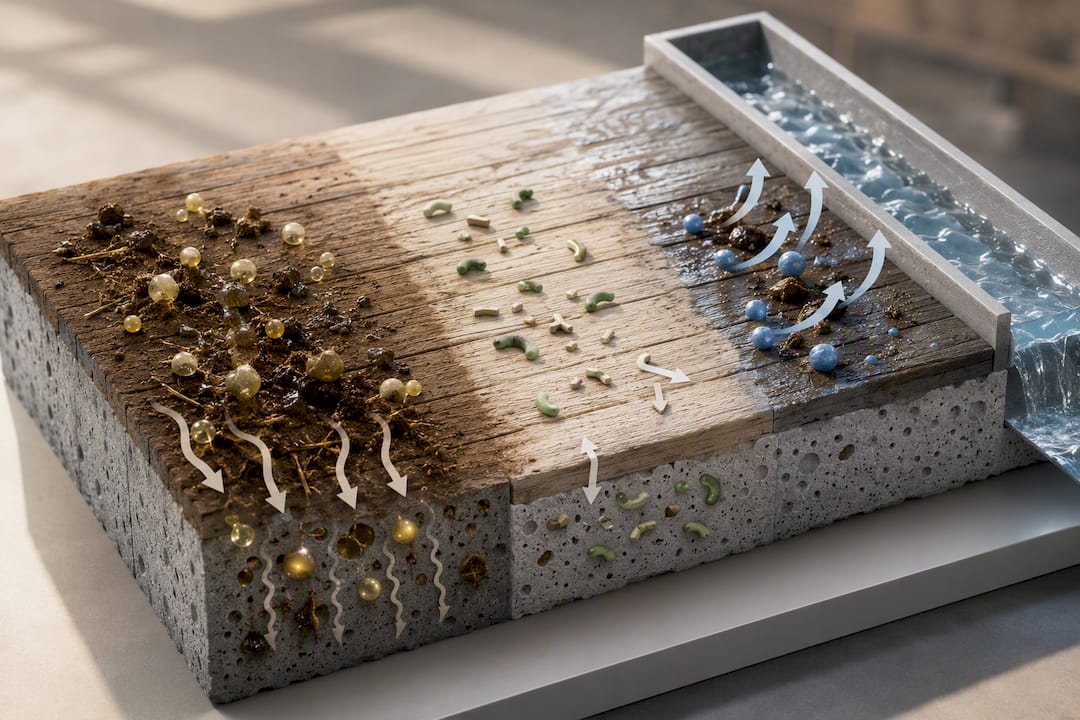
Bio-enzymatic formulations dominate the modern barn cleaning category, and there's a chemical reason why. Enzyme blends are built to digest urea and organic residue in porous substrates like wood and concrete, breaking down ammonia-producing compounds at the source instead of masking the smell with fragrance. That's a meaningfully different mechanism from a surfactant that just lifts soil off the surface and rinses it away.
Conventional surfactant and solvent chemistries still earn their place, particularly where soiling is heavy and a fast rinse matters more than long-term odor prevention. A wash bay handling manure-caked equipment on a tight turnaround often needs the aggressive lift a solvent-forward formula provides, even if it means reapplying an enzyme treatment afterward for deeper odor control.
Supporting additives round out both approaches:
- Buffers to hold pH stable across a product's shelf life
- Foam stabilizers to extend dwell time on vertical surfaces
- Corrosion inhibitors to protect metal stall fixtures and equipment
- Odor neutralizers layered on top of enzyme action for immediate results while the enzymes work over hours
Dilution ranges vary widely by soil load, but most concentrates are built to scale from light maintenance cleaning to heavy-duty stripping using the same base formula.
Pro Tip: Ask your manufacturer whether their enzyme system is validated for cold-water activation. Enzymes formulated for warm-water activation lose most of their effectiveness in an unheated barn in January, and that gap doesn't show up until a customer complains.
A bio-enzymatic odor neutralizer built specifically for animal premises gives you a benchmark for what a properly tuned enzyme system should deliver.
How Should Packaging Match the Way Customers Apply the Product?
Formulation and packaging aren't separate decisions. A product engineered for foam gun application needs different surfactant chemistry than one designed for a simple pressure washer downstream injector, and getting that wrong means the product underperforms no matter how good the base chemistry is.
| Application Method | Best-Fit Format | Typical Dilution Intensity |
|---|---|---|
| Foam gun / foam cannon | Concentrate, drum or pail | Medium to heavy duty |
| Pressure washer downstream injector | Concentrate, drum | Light to medium duty |
| Hand pump sprayer | RTU or lightly diluted concentrate | Light duty |
| Bulk mop-and-bucket | Concentrate, jug or pail | Medium duty |
Packaging choice also carries safety and labeling weight. Concentrates need clear dilution instructions and PPE guidance since they're handled at higher strength before use. Drum systems suit high-volume commercial barns and boarding facilities, while smaller RTU bottles fit retail and single-stall use cases better. Storage guidance matters too: enzyme-based products can lose potency in freeze-thaw cycles, so cold-chain notes on the label protect both the product's performance and your brand's reputation.
What Should You Expect From a Contract Manufacturer on Scale-Up?
Moving from concept to shelf-ready product runs through a predictable sequence, and buyers who skip steps almost always pay for it later in reformulation costs. Expect a pilot batch first, stability checks across temperature and time, then a defined scale-up milestone before committing to a full production run.
What to require from a manufacturer during this phase:
- Pilot batch samples before committing to production volume
- Stability data covering at least 30 to 90 days across temperature extremes
- Batch records and a Certificate of Analysis for every production run
- Clear lead-time commitments from pilot to truckload, in writing
Sarawest USA approaches this with in-house R&D chemists working directly with clients, cutting out the broker layer that slows down most contract manufacturing relationships. That structure, paired with a proprietary formula library spanning eight industries, means prototyping can move fast because the chemists adapting your formula are the same ones who'll be running it on the production floor. Order sizes range from pilot batches to full truckloads, which matters if you're testing a new barn cleaner line before committing to a warehouse full of inventory. The Barn Bright mineral cleaner line is a working example of a barn-specific product built through exactly this kind of process.
What Testing Should You Require Before Launch?
Testing requirements split cleanly along the same line as your label claims. Disinfectant claims require EPA-style efficacy testing against named pathogens, using the 810 series test guidelines that replaced the older 91 series non-public-health protocols. Odor and organic-soil claims need performance testing instead, which is less regulatory-heavy but still needs to hold up under scrutiny.
Minimum testing to request:
- Stability matrix: temperature cycling, light exposure, and freeze-thaw testing
- Preservative challenge test: confirms microbial resistance across shelf life
- Performance benchmarking: ammonia reduction or soil removal measured against a control
- Acceptance criteria in writing: defined pass/fail thresholds before the batch ships
Results belong on your technical datasheet, not buried in an internal file. A datasheet that shows real stability data builds more trust with retail buyers than any marketing claim you could write instead.
What I've Learned Sourcing Barn Cleaners for Private Label
The costliest mistakes I've seen are avoidable ones: labeling a product as a disinfectant without registration, choosing a concentrate that doesn't foam right for the customer's equipment, or skipping stability testing to hit a launch date. Before your first manufacturer call, request pilot samples, a Certificate of Analysis, stability data, and an NDA discussion. Walk in with that checklist and you'll filter out unprepared vendors fast.
— Faisal Mansur
Ready to Build Your Barn Cleaner Line? Here's How Sarawest USA Helps
Some contract manufacturers provide private-label buyers direct access to the chemists formulating their product, without brokers between specs and the lab bench.
If you've been comparing formulation partners based on turnaround time alone, the real differentiator is what happens before that clock even starts. Custom formulation, white-label manufacturing, and pilot-to-truckload production all run through the same in-house team, which means your prototype request doesn't get queued behind someone else's project or routed through three layers of account management. Whether you're launching your first barn cleaner or adding one to an existing product line, the path is the same: define your target claims, request a pilot batch, and review stability data before committing to volume.
Start that process now by reaching out through white label manufacturing to discuss your formulation specs, or explore contract chemical manufacturing if you need a fully custom build from scratch. Either way, a real chemist reads your request and responds directly.
Where to Verify These Regulatory and Technical Details
- APHIS guidance on disinfectant use in animal premises
- 9 CFR § 3.131 sanitation requirements
- Sarawest USA product pages for manufacturer specifications
Sources
- APHIS guidance on disinfectants and animal premises
- 9 CFR § 3.131 — Sanitation requirements for pens and runs
- EPA archived guidance on non‑public‑health test guidelines
FAQ
Does a Barn Cleaner Need EPA Registration?
Only if the label makes an antimicrobial or disinfectant claim. General cleaning and deodorizing claims can typically avoid FIFRA registration, but the label copy still needs a careful legal review to stay on the right side of that line.
What's the Difference Between a Cleaner and a Disinfectant Claim?
A cleaner claim addresses soil, odor, and organic residue removal. A disinfectant claim asserts pathogen kill, which requires EPA registration and supporting efficacy data before it can appear on a label.
Are Bio-Enzymatic Barn Cleaners Effective for Ammonia Control?
Bio-enzymatic systems are formulated to break down urea and organic matter, addressing ammonia at its source rather than covering the smell. This makes them a preferred choice for ongoing stall maintenance where pathogen claims aren't required.
How Fast Can a Private-Label Barn Cleaner Go From Concept to Production?
Timelines depend on formulation complexity and testing scope, but rapid prototyping can shorten the concept-to-pilot phase considerably. In-house chemists working directly with clients can remove the delays associated with broker-managed manufacturing relationships.
What Should I Ask a Contract Manufacturer Before Committing to a Production Run?
Request pilot batch samples, a Certificate of Analysis, stability data across temperature extremes, and clear lead-time commitments in writing. Confirm minimum order volumes match your launch plan, whether that's a pilot batch or a full truckload.