
The fastest route to market is private-label manufacturing for product founders and a narrow, metrics-driven pilot for service founders. Either path starts with the same three moves: register your entity and get an EIN through SBA guidance, lock in insurance before you quote a single job, and prepare your SDS, label, or SOP file with a manufacturing partner like Sarawest USA before you print anything.
TL;DR:
- Private label manufacturing offers faster market entry with existing formulas but provides limited differentiation, suitable for quick launches.
- Custom formulation enables unique product claims but requires longer development, more testing, and careful contract negotiations on ownership and modifications.
- Compliance demands hazard classification, proper labeling, and safety data sheets, with EPA Safer Choice recognition needing early ingredient disclosure and performance proof.
- Successful pilots depend on clearly defined metrics, tight scope, and documented results that demonstrate repeatability and meet buyer expectations.
- Launch pitfalls include overextending with multiple SKUs or marketing before operational proof, emphasizing the importance of proving one offer before scaling.
Table of Contents
- What Does a Commercial Cleaning Brand Launch Actually Require?
- Should You Go Private Label or Custom Formulation?
- What Compliance and Labeling Steps Are Legally Required?
- How Do You Turn a Pilot Into a Recurring Contract?
- How Should You Price a New Cleaning Product or Service?
- How Do You Run a Cleaning Product Pilot That Actually Predicts Success?
- How Does a Manufacturing Partner Shorten Your Time to Market?
- The Mistakes That Actually Sink Year One
- Ready to Move From Plan to Pilot Batch?
- Primary Sources for Regulations and Launch Checklists
- Sources
- FAQ
What Does a Commercial Cleaning Brand Launch Actually Require?
Most founders overbuild the wrong things first. They design a logo before they have insurance. They write marketing copy before they have a safety data sheet. A real commercial cleaning brand launch runs on documentation and operational proof, not brand polish. Here's the sequence that actually works, phase by phase.
Days 1 to 20: Business foundation.
- Choose your entity structure (LLC is standard for most single-location operators) and get your EIN.
- Pull local licenses and permits. Requirements vary by state, county, and city, so check with your local authority before assuming a blanket rule applies.
- Get insured. Buyers routinely ask for a certificate of insurance before signing, and SBA's insurance guidance walks through commercial property coverage, business owner's policies, and workers' compensation. A licensed agent will help you match coverage to your actual risk.
- If you're bidding municipal or facilities contracts, ask about bonding requirements now, not after you've won the bid.
Days 20 to 45: Operational build-out.
- Write your core SOPs: chemical handling, dilution ratios, equipment maintenance, incident reporting.
- Build a hiring and training plan, even if it's just you and one technician for now.
- Decide product versus service and split your deliverables accordingly: a product founder needs a label file, SDS, and a defined MOQ; a service founder needs a scope-of-work template and a pricing sheet.
Days 45 to 90: Sales readiness. Build a sample kit, a one-page product or service card, and a trial offer with a defined measurement plan. This is the phase most founders rush, and it's the one that actually wins contracts.
Should You Go Private Label or Custom Formulation?
Private label wins on speed. You pick from a manufacturer's existing formula library, brand it, and ship. Lower technical burden, shorter approval cycles, and typically lower minimum order quantities than a from-scratch formula. The tradeoff: differentiation is thin. If a competitor sources from the same library, your product may perform identically.
Custom formulation wins on differentiation but costs you time. Expect longer stability and performance testing, more documentation for regulatory review, and a manufacturer relationship that needs real technical depth, not just a catalog. This route makes sense when you have a specific performance claim to prove (faster grease-cutting, lower dwell time, a fragrance-free formula for a health care client) and the runway to test it properly.
Before signing with any manufacturer, verify these contract items:
- Who owns the formula if you leave the relationship
- Change control procedures for any formula modification
- Rejected-batch handling and who absorbs the cost
- Minimum order quantities at pilot scale versus production scale
A manufacturer's in-house R&D capacity and pilot batch capability determine your actual timeline far more than your own planning does. EPA's Safer Choice guidance makes a related point worth internalizing: settle your manufacturing route before you finalize brand identity, not after.
Pro Tip: Ask a prospective manufacturer for a rejected-batch example from another client relationship. How they answer tells you more about their quality culture than any spec sheet will.
What Compliance and Labeling Steps Are Legally Required?
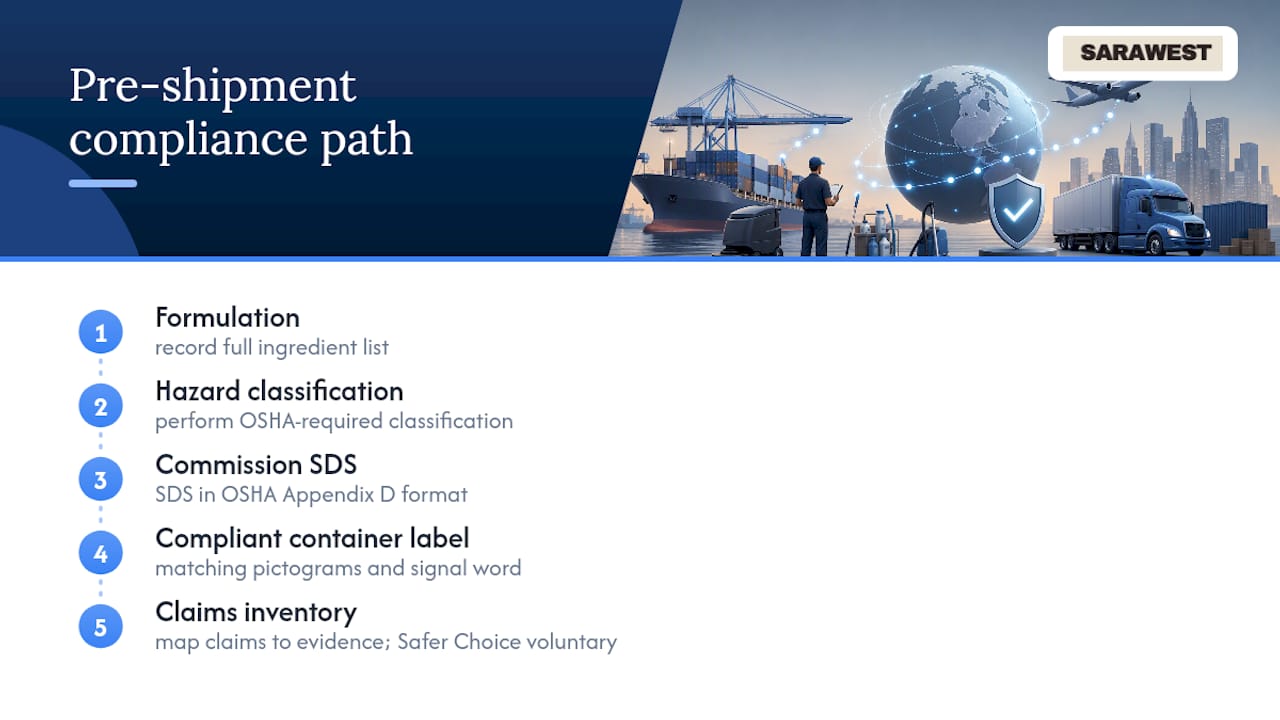
Every chemical-product brand selling into commercial workplaces needs three things in place before the first case ships: hazard classification, a compliant shipped-container label, and a safety data sheet. This isn't optional paperwork. OSHA's Hazard Communication Standard requires employers whose workers handle these chemicals to maintain a written hazard-communication program, provide SDS access, and train staff on what's in the bottle.
Your SDS needs to follow the format specified in OSHA's Appendix D, covering identification, hazard classification, composition, first aid, handling, and disposal, among other required sections. Your shipped-container label needs matching hazard pictograms and signal words. Get these two documents wrong and a facilities buyer's safety officer will reject you before your product ever touches a mop bucket.
EPA's Safer Choice program is a different animal entirely: voluntary, not required, but valuable if you want to make substantiated "safer" or "green" claims. Recognition requires full ingredient disclosure, a product and ingredient assessment against Safer Choice criteria, and a formal partnership agreement with the EPA. Skip it if eco-positioning isn't core to your brand. Pursue it early if it is, because retrofitting a claim you can't back up is far harder than building the evidence from day one.
Statistic Callout: Safer Choice recognition isn't a marketing badge you slap on after launch. It requires disclosing every ingredient and proving product performance against category-specific criteria before EPA signs off, which means the assessment has to start during formulation, not after your label is printed.
Before you go further, assemble three things: your label file, a commissioned SDS, and a claims inventory that maps every marketing statement to actual evidence.
How Do You Turn a Pilot Into a Recurring Contract?
Commercial buyers don't sign because your product works. They sign because you can prove it works, repeatedly, under their conditions. That proof comes from a documented pilot, not a sales pitch.
- Define measurable outcomes before you start. Cost per use, dwell time, worker acceptance, and rework rate are the four metrics facilities managers actually care about.
- Build your sample kit and one-page card. Include usage instructions, dilution guidance, and a clear point of contact. A facilities manager who has to guess how to use your product won't finish the pilot.
- Scope the pilot tightly. Pick one building, one shift, or one workflow. Define the timeframe (two to four weeks is typical), the success metrics, and the specific acceptance criteria the buyer needs to see before they'll expand the order.
- Set a QA and inspection cadence. Weekly check-ins during the pilot catch problems before they become the reason the contract dies quietly.
Pro Tip: Ask your pilot contact for one specific complaint before you leave, even if the trial is going well. Founders who only ask "how's it going" get "fine." Founders who ask "what would you change" get the feedback that saves the contract.
How Should You Price a New Cleaning Product or Service?
Cost per use, not sticker price, is what separates a profitable SKU from one that quietly bleeds margin. For a concentrated cleaner, divide the total product cost by the number of diluted-use applications it yields. A gallon of concentrate diluted at appropriate ratios can produce many uses, resulting in a real cost per use that is typically lower than typical retail spray products. That number is what you compare against a competitor's ready-to-use spray, and it's usually the number that wins or loses the sale.
Your minimum order quantity and freight terms shape your margin just as much as your formula does. A low MOQ keeps cash tied up for less time but often raises your per-unit cost; a high MOQ does the opposite and adds warehousing risk. Freight on 55-gallon drums versus cases of quart bottles changes your landed cost enough to flip a deal from profitable to break-even.
Protect your cash flow on the contract side too:
- Ask for a deposit before production on any custom order
- Stage production in batches tied to milestone payments rather than one lump invoice
- Budget for insurance, bonding, payroll, and sample production as fixed costs before your first sale, not after
How Do You Run a Cleaning Product Pilot That Actually Predicts Success?
A single narrow workflow pilot reveals problems a lab test never will. Sprayer compatibility, real-world dosing errors, and worker resistance to a new scent or texture all show up only when the product meets an actual mop cart on an actual Tuesday shift.
- Pick one location and one use case. Resist the urge to test five buildings at once; you'll drown in variables and learn nothing clean.
- Instrument it properly. Track sample volumes used, run a simple observation checklist for the janitorial staff, and get a written buyer signoff at the end, not just a verbal "seemed fine."
- Read the results honestly. If cost per use tracks but worker acceptance is low, that's a training or scent issue, not a formula failure. If dwell time isn't matching your label claim, that's a formula issue that needs your manufacturer's attention before you scale.
How Does a Manufacturing Partner Shorten Your Time to Market?
The single biggest timeline risk in a product launch isn't marketing. It's waiting on a formula that doesn't exist yet, or discovering three months in that your manufacturer can't scale past a pilot batch. Sarawest USA works from a library of over 1,200 proprietary formulas across eight industries, including commercial cleaning, with in-house R&D chemists who can adapt an existing base or build something new to spec.
Before you commit to any manufacturer, ask these questions directly:
- What's the realistic turnaround from signed order to pilot samples in hand?
- What's the minimum order quantity at pilot scale versus production scale?
- Do they support labeling and SDS documentation, or is that entirely on you?
- What's the change control process if you need to adjust the formula after your first run?
A partner who answers clearly, without routing you through three layers of broker, is the one worth building a launch around.
The Mistakes That Actually Sink Year One
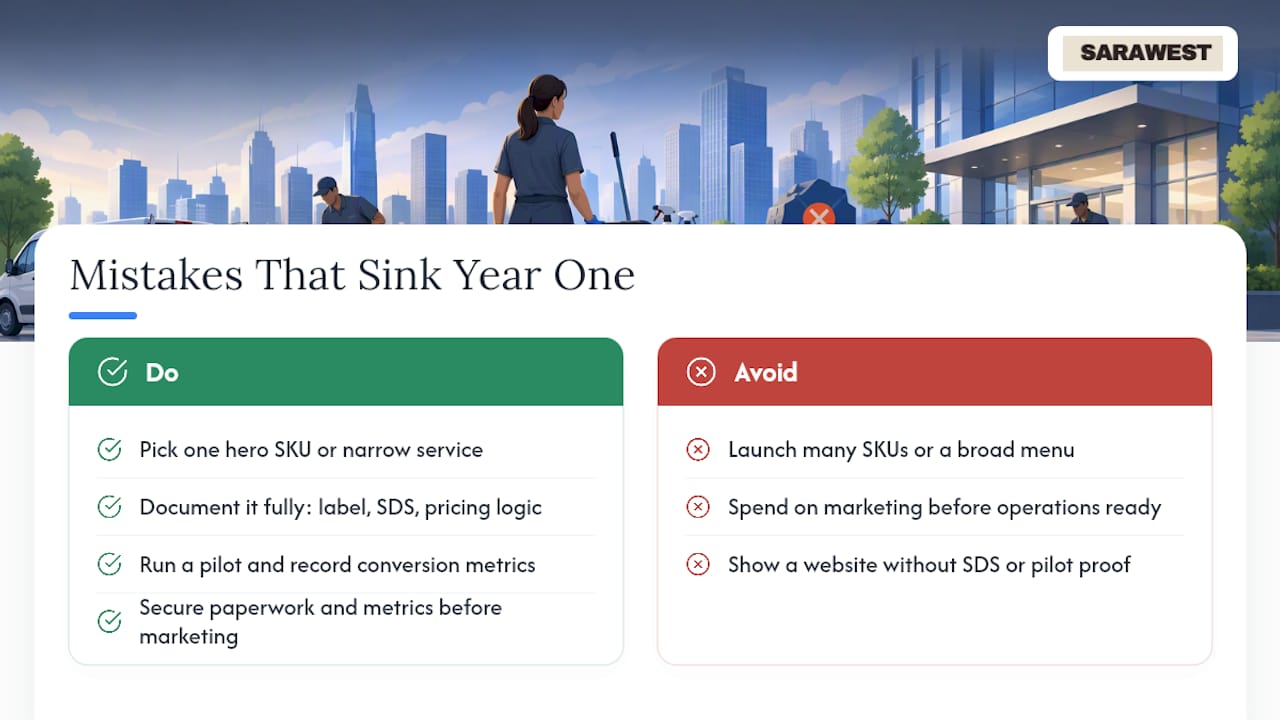
The founders who struggle most in year one almost always share one habit: they launch too many SKUs or too broad a service menu before proving a single offer works. Pick one hero SKU or one narrow service line, document it completely (label, SDS, pilot results, pricing logic), and prove it converts before you add a second thing.
Marketing spend before operational readiness is the second trap. A polished website means nothing to a facilities buyer who asks for your SDS and gets silence. Get the pilot metrics and paperwork solid first. The sales pipeline follows naturally once you have something real to show.
— Faisal Mansur
Ready to Move From Plan to Pilot Batch?
A reliable manufacturing partner removes the biggest bottleneck in a commercial cleaning brand launch: waiting weeks for a manufacturer to even respond to a formulation question. Direct access to in-house R&D chemists, not a broker relaying messages, and pilot batches that scale into full truckload production without switching vendors mid-growth make a difference.
Whether you're sourcing from an existing formula through private label cleaning products, need a fully custom build through contract chemical manufacturing, or want to explore the white label manufacturing path for a faster launch, the vendor evaluation questions above apply directly here: ask about turnaround, MOQ, and labeling support, and expect real answers. Reach out to request a sample kit or a quote on your specific formula, and get a working timeline back before you've committed a dollar to marketing you don't need yet.
Primary Sources for Regulations and Launch Checklists
For business setup and insurance, start with SBA's business planning guidance and its insurance overview. For chemical safety obligations, review OSHA's HazCom requirements and the SDS format in Appendix D. For voluntary eco-certification, see EPA's Safer Choice label criteria. For launch sequencing, the 90-day US launch plan is a useful reference.
Sources
- Plan your business | U.S. Small Business Administration
- Hazard communication (HazCom) | App State Environmental Health & Safety
- 90-Day United States Launch Plan for Cleaning Products — US Brand Launch Blog
FAQ
What Is the Largest Commercial Cleaning Company in the US?
The commercial cleaning industry includes several large national players, but market leadership shifts by segment (janitorial services versus cleaning products) and isn't tracked by a single authoritative ranking. New brand founders are better served focusing on a defensible niche than benchmarking against national giants they can't out-scale in year one.
What Is a Good Slogan for a Commercial Cleaning Business?
A strong slogan names a specific outcome, not a generic promise: think measurable results (dwell time, turnaround, worker safety) rather than vague claims like "spotless every time." Tie it to whatever your pilot data actually proves, since a slogan you can't back up with evidence undermines the trust you're trying to build.
What Are the Top Cleaning Products Commercial Buyers Look For?
Facilities buyers consistently prioritize concentrated multi-surface cleaners, disinfectants with verified dwell times, and low-odor formulas for occupied spaces. The specific products vary by facility type (health care, food service, offices), but all of them require a complete SDS and label before a buyer will even test them.
How Do You Start a Cleaning Product Brand?
Start by choosing your manufacturing route, private label for speed or custom formulation for differentiation, before finalizing any brand identity. From there, secure your entity and insurance, commission your SDS and label file, and run one pilot with a defined MOQ through a manufacturer like Sarawest USA before committing to broader distribution.