
Kitting groups multiple components into one ready-to-ship unit with its own SKU. Case packing loads finished, primary-packed products into corrugated shipping cases for shelf or pallet delivery. Choose kitting when you're bundling parts into a single offer. Choose case packing when you're moving finished goods to retail or distribution. Most product launches need both.
- Kitting: multiple SKUs become one, tracked as a single unit
- Case packing: finished goods get loaded, sealed, and labeled per GS1 packaging levels for shipping
- Contract manufacturers like Sarawest USA often run both under one roof, from formulation through the final case
Key Takeaways
Kitting bundles components into a single trackable SKU, while case packing prepares finished goods for shipment, and most production runs eventually need both.
| Point | Details |
|---|---|
| Kitting reduces picks | Combining SKUs into one unit cuts pick time and simplifies inventory tracking. |
| Case packing ends the line | Loading, sealing, and labeling cases comes after primary packaging is complete. |
| Match method to volume | High-mix, low-volume work favors manual kitting; steady single-SKU runs justify automated case packers. |
| RFQs need specifics | Share SKU dimensions, volumes, kit configuration, and barcode specs for an accurate quote. |
| Sarawest USA runs both | Pilot batches from 1,000 units through full truckloads with in-house formulation, kitting, and case-pack support. |
Table of Contents
- What Is Kitting in Supply Chain Operations?
- What Are Case Packing and Co-Packing?
- Kitting vs. Case Packing: How Do You Choose?
- What Are Common Kitting and Case Packing Use Cases?
- How Do Kitting and Case Packing Work Step by Step?
- Which Equipment and Formats Handle Case Packing?
- What Drives Costs and Timelines in Kitting and Case Packing?
- How Do Contract Manufacturers Support Kitting and Packing?
- Operational Tradeoffs We See in Practice
- How Can Sarawest USA Support Your Kitting and Case Packing Project?
- Sources
What Is Kitting in Supply Chain Operations?
Kitting turns two or more separate components into a single, ready-to-ship item with one SKU assigned to the whole unit. That single-SKU trick is the entire point. Combining products into a ready-to-ship unit means your pickers grab one item instead of hunting down five, and your inventory system tracks one line instead of a scattered mess.
There are a few common variations worth knowing:
- Pre-kitting assembles units ahead of demand and stores them ready to ship.
- On-demand kitting builds the kit only after an order comes in, which suits products with frequent configuration changes.
- Subscription box kitting follows a recurring cadence, often with rotating contents each cycle.
- Material kitting stages components for a manufacturing line rather than a customer order.
The payoff shows up in labor hours. Fewer picks per order, faster packing, and a simpler inventory count all follow directly from treating a bundle as one trackable unit. The tradeoff: you still need to track raw component stock underneath the finished-kit SKU, which means two inventory layers instead of one, plus staging space and periodic cycle counts to keep both numbers honest.
What Are Case Packing and Co-Packing?
Case packing is the secondary-packaging step that happens after products are already sealed in their primary packaging. It groups those units and loads them into corrugated shipping cases, ready for a pallet or a store shelf. Case packing groups primary-packed products and loads them into shipping cases, whether that loading happens by hand or by machine.
You'll run into a handful of standard formats on any production floor:
- Inner packs hold a small multipack inside a larger case
- Master cases carry the full shipping quantity for one SKU
- Mixed cases combine several SKUs for one order or promotion
- Retail-ready display cartons open directly onto the shelf, cutting labor at the store level
Co-packing services bundle case packing with upstream work like formulation, filling, and labeling, which is why brands without their own production line often outsource the whole sequence rather than just the final box. Case packing sits at the end of the line, right before palletizing and shipping.
Kitting vs. Case Packing: How Do You Choose?
The decision usually comes down to four practical axes: how many SKUs you're combining, how much volume you move, how much storage you have for finished units, and whether your line runs on forecast or on just-in-time orders.
- High SKU variability, moderate volume favors on-demand kitting over pre-kitting.
- Limited warehouse space pushes you toward just-in-time kitting or case packing instead of building inventory ahead.
- Steady, single-SKU volume justifies automation on the case-packing side.
- Fragile or irregular items often need manual handling regardless of volume.
| Factor | Kitting | Case Packing |
|---|---|---|
| Best for | Bundling multiple SKUs into one offer | Preparing finished goods for shipment |
| Efficiency driver | Fewer picks per order | Line speed and automation |
| Flexibility | High, especially on-demand | Lower once cases and dielines are set |
| Main cost factor | Component storage and labor | Tooling, changeovers, carton stock |
Quick gut check: if you're solving a "how do we combine these items" problem, start with kitting. If you're solving a "how do we get finished goods into a truck" problem, you're in case-packing territory.
What Are Common Kitting and Case Packing Use Cases?
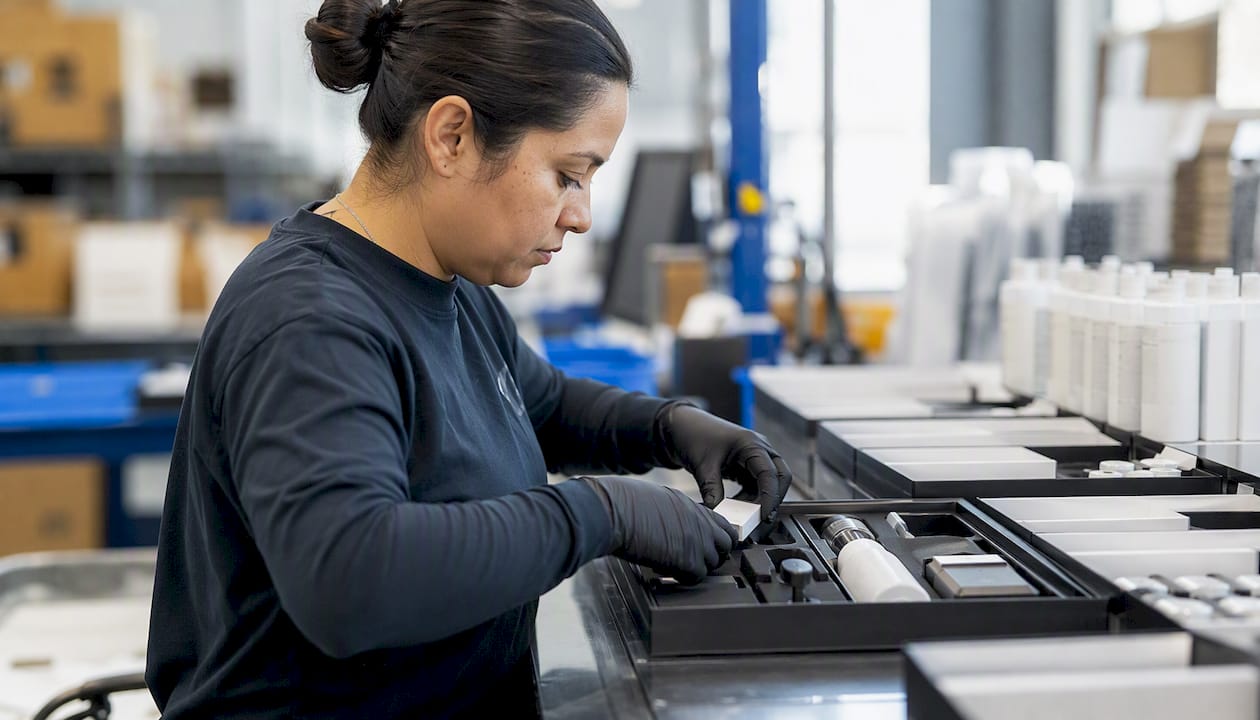
Ecommerce brands lean hard on pre-kitting for subscription boxes and promotional bundles, where the same combination of items ships repeatedly and predictability beats flexibility. Retail programs go the other direction: case packing builds display shippers and mixed cases that a store associate can drop straight onto a shelf without repacking anything.
Manufacturing floors use a third variant entirely. Material kitting stages just-in-time kits at individual workstations, so an assembly line never stalls waiting for someone to hunt down a fastener or gasket. It's less about shipping and more about keeping a line moving.
- Ecommerce bundles: subscription boxes, promo multipacks
- Retail programs: display shippers, mixed cases for grocery or big-box accounts
- Manufacturing: workstation kits for assembly
- Combined runs: product launches, seasonal multipacks, and limited-run promotions where you're bundling components AND preparing retail-ready cases in the same production window
Product launches are where the two processes usually converge. A new sports-care line, for instance, might kit a bottle with a sample sachet and an insert card, then case pack the finished kits into retail-ready cartons for a big-box rollout, all in a single production run.
How Do Kitting and Case Packing Work Step by Step?
Kitting follows a predictable sequence on the floor:
- Identify and stage the components that make up the kit
- Pick each part according to the bill of materials
- Assemble the kit
- Inspect for completeness and defects
- Assign the finished-kit SKU and barcode
- Stage the kit for fulfillment or the next production step
Case packing picks up from there, or from any primary-packed product line:
- Products arrive from upstream primary packaging (filling, capping, labeling)
- Units are collated into the correct count per case
- Cases are loaded, top-load, side-load, or wrap-around depending on the format
- Cases are sealed
- Cases are labeled with carton markings and barcodes
- Sealed cases move to the palletizer
Every stage needs a QC checkpoint tied to batch and lot data, not just a visual pass. A warehouse management system that assigns distinct identifiers to the kit SKU, the inner case, and the master case is what makes a recall or a customer complaint traceable back to a specific run instead of a guess.
Which Equipment and Formats Handle Case Packing?
Trays, inner packs, master cases, display shippers, shrink bundles, and multipacks cover most of what you'll spec on an RFQ. The equipment side ranges from manual hand-packing up through fully automatic case packers running top-load, side-load, or wrap-around configurations, plus robotic pick-and-place arms for higher-mix kitting lines.
- Pack orientation affects both damage rates and case cube efficiency
- Padding and dunnage matter most for fragile or glass components
- Dielines for inner and outer packaging need to match your actual carton dimensions, not a template
- Barcode placement should follow GS1 packaging level conventions so scanners read consistently at receiving
Shrink bundling is its own category. Shrink tunnel systems build consistent multipacks, but film choice depends heavily on bottle material and shape.
Pro Tip: Before committing to a production run, test shrink film adhesion on your actual bottle, not a standard sample. Glass, PET, and HDPE all behave differently under heat, and an irregular contour can wrinkle film or crack a label that looked fine on a straight-sided bottle.

What Drives Costs and Timelines in Kitting and Case Packing?
Labor versus automation is the biggest lever. A high-mix, low-volume kitting operation usually costs more per unit in labor than a single-SKU line running on an automated case packer, but the automation only pays off once volume justifies the tooling. SKU changeovers, carton die costs, and storage space for pre-kitted inventory all stack on top of that baseline.
Timelines typically run through a pilot batch, a tooling or recipe setup window, and a sample approval cycle before full production starts.
When you request a quote, hand the co-packer or contract manufacturer these details up front:
- Full SKU list with dimensions and weights
- Expected volumes, broken out daily, weekly, and monthly
- Kit configuration or component matrix
- Desired packaging materials and finish
- Barcode specs at every packaging level
- QA and certification requirements
- Staging and delivery terms
A complete file handoff with print-ready PDFs, dielines, and a written release note naming the approved final file prevents the version confusion that causes most production delays. Also ask directly about changeover time between recipes or SKUs. That number tells you more about real-world line speed than any spec sheet.
How Do Contract Manufacturers Support Kitting and Packing?
A contract manufacturer handling kitting and case packing typically owns the whole chain: formulation, packaging file handoff, kit assembly, case packing, lot control, and barcoding. Buyers should expect pilot-to-scale flexibility and in-house chemists who can adapt a formula fast rather than routing every change through a broker.
Sarawest USA runs pilot batches from 1,000 units up through full truckloads, backed by a library of more than 1,200 proprietary formulas and in-house R&D chemists across eight industries. That range lets a client move from a prototype to a retail-ready case without switching vendors mid-project.
- In-house formulation support, not outsourced brokering
- Rapid prototyping and sample approval built into the process
- Pilot runs scaled to full production without a new vendor search
Operational Tradeoffs We See in Practice
Flexibility costs money. Pre-kitting inventory saves labor at pick time but ties up storage and cash in finished units that might not sell as forecast. Automated case packing makes sense for high-volume, single-SKU lines; manual packing still wins for low-volume or fragile items where a machine's changeover time eats any speed gain.
Watch for vague RFQ responses that dodge changeover times or skip lot-control details entirely. That's usually where a quote falls apart later.
How Can Sarawest USA Support Your Kitting and Case Packing Project?
If you're comparing in-house build-out against outsourcing, the calculus usually comes down to speed and flexibility without adding headcount or buying equipment you'll use twice a year. Sarawest USA runs contract chemical manufacturing with in-house R&D chemists on staff, which means formula changes and packaging adjustments happen without waiting on a broker to relay messages back and forth.
That structure matters most when you're moving from a pilot to a full production run. Sarawest USA handles pilot batches from 1,000 units up through full truckloads, and the same team that develops your formula can carry it through kitting and case-pack setup. If you're in commercial cleaning, sports care, or one of Sarawest's other eight served industries, start by requesting samples or sending over your SKU list and RFQ checklist. A contract manufacturing quote gets you real numbers on lead time and pricing instead of a generic estimate.
Sources
- What is kitting? | Shopify Enterprise
- Case Packing and Automated Case Packer Systems - Cybernetik
- How to Hand Off Packaging Files to Suppliers Without Version Chaos | SKUWorks Guides
- Shrink Wrap Machine for Soda Bottles | Polypack