
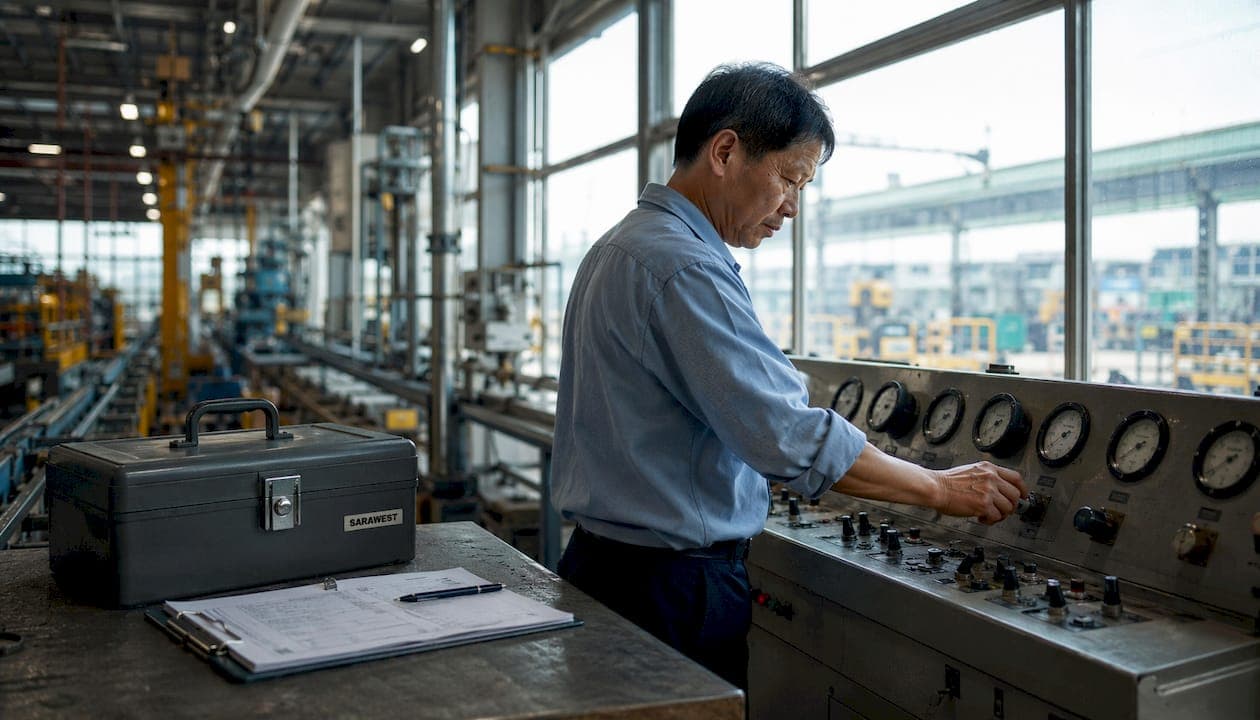
Scaling up manufacturing means increasing production capacity reliably while preserving quality, cost targets, and the process controls that got you here. The short roadmap: validate demand, run a bounded pilot, identify your bottlenecks, ramp your supply chain, secure capital and governance, then execute in stages. If you need one concrete next step today, run a short pilot or perform a bottleneck and capacity-utilization audit before committing a dollar of CapEx. Sarawest USA partners with brands at exactly this stage, handling pilot-to-scale production from 1,000-unit runs through full truckloads, so you can move fast without betting the business on unproven volume.
Core roadmap at a glance:
- Validate demand with 3+ months of consistent order data before committing to scale
- Run a pilot or NPI batch to confirm process performance at the next volume tier
- Perform a bottleneck analysis to find where throughput actually breaks down
- Qualify and dual-source critical suppliers before ramping production
- Align finance, procurement, engineering, and quality under a single governance structure
- Monitor post-scale KPIs and treat scaling as an iterative cycle, not a one-time event
Table of Contents
- What does "scale up manufacturing" actually mean, and how does it differ from scale-out?
- How do you know you are ready to scale production?
- What is the step-by-step roadmap for scaling manufacturing operations?
- How do you scale the supply chain without introducing new risk?
- How do you maintain quality and compliance while scaling production?
- Should you expand your current facility, build new, or outsource to a contract manufacturer?
- What does a scale-up program actually cost, and how long does it take?
- How Sarawest USA executes the scale-up roadmap for chemical brands
- Key Takeaways
- The part of scaling that most playbooks skip
- Ready to move from pilot to production? Sarawest USA can get you there.
- Useful sources and further reading
What does "scale up manufacturing" actually mean, and how does it differ from scale-out?
The industry draws a clear line between two strategies. Scale-up increases output by moving to larger, higher-throughput equipment. Scale-out increases capacity by replicating a validated smaller unit or extending run time. Both expand production, but they carry very different risk profiles, capital requirements, and validation burdens.
Scale-up suits products where the process is well understood, equipment can be sized up without changing chemistry or mechanics, and capital is available for larger assets. It tends to deliver lower unit costs at high volume. The risk: physical scale changes mixing dynamics, heat transfer, and microenvironments. In chemical and pharma processes, blindly multiplying batch size risks product quality and requires staged revalidation, not a simple 10X multiplication.
Scale-out suits products with formulation sensitivity, regulatory complexity, or capital constraints. You replicate what already works rather than redesigning it. The trade-off is higher per-unit cost and a more complex operational footprint as you manage multiple lines or sites.
| Dimension | Scale-Up | Scale-Out |
|---|---|---|
| Capital intensity | High (new large equipment) | Moderate (replicate existing units) |
| Unit cost at volume | Lower | Higher |
| Validation burden | High (process changes with scale) | Lower (validated unit is replicated) |
| Speed to capacity | Slower (design, install, validate) | Faster (add proven units) |
| Best fit | Stable, well-understood processes | Sensitive formulations, constrained capital |
| Risk profile | Process change risk | Operational complexity risk |
When to choose scale-out over scale-up:
- Formulation is sensitive to mixing energy, temperature gradients, or batch time
- Regulatory approval is tied to a specific equipment configuration
- Capital is limited and you need capacity in months, not years
- You are still learning demand patterns and want to preserve flexibility
The practical guidance: start with scale-out when process robustness is unproven, then consolidate to scale-up once you have validated performance data at the next tier.
How do you know you are ready to scale production?
Most scaling failures trace back to one mistake: moving too fast on signals that looked like demand but were not. Readiness is not a feeling. It is a set of measurable thresholds.
Operational signals to watch:
- Sustained order increase over at least 3 consecutive months, not a single spike
- Lead-time stability: your current process delivers on time at current volume
- Overall Equipment Effectiveness (OEE) trending upward and consistently above your baseline
- Customer contracts or purchase orders that commit future volume, not just intent
Capacity indicators: Before buying equipment, check what you already have. In many factories, median equipment runtime can be as low as 32.04%, indicating significant hidden capacity and the importance of a thorough utilization audit before any CapEx.
Financial signals:
- Gross margin holds or improves as volume increases (no margin compression from overtime or expedited materials)
- Working capital is predictable: supplier credit terms are stable and receivables cycle is understood
- You can model the cash gap between production ramp and customer payment without a crisis
Readiness checklist:
- 3+ months of consistent order growth confirmed
- OEE audited and hidden capacity quantified
- Lead-time performance stable at current volume
- Margin analysis completed at the next volume tier
- Supply-chain capacity confirmed with key suppliers
- Capital source identified for the next phase
Pro Tip: Before any equipment purchase, run a bottleneck analysis. Reactive scaling often shifts the constraint rather than removing it. Fix the bottleneck first, then decide whether new equipment is actually needed.
What is the step-by-step roadmap for scaling manufacturing operations?
Scaling is a continuous, data-driven cycle, not a single project. The leaders who do it well treat each phase as a gate: you earn the right to proceed by meeting defined criteria, not by hitting a calendar date.
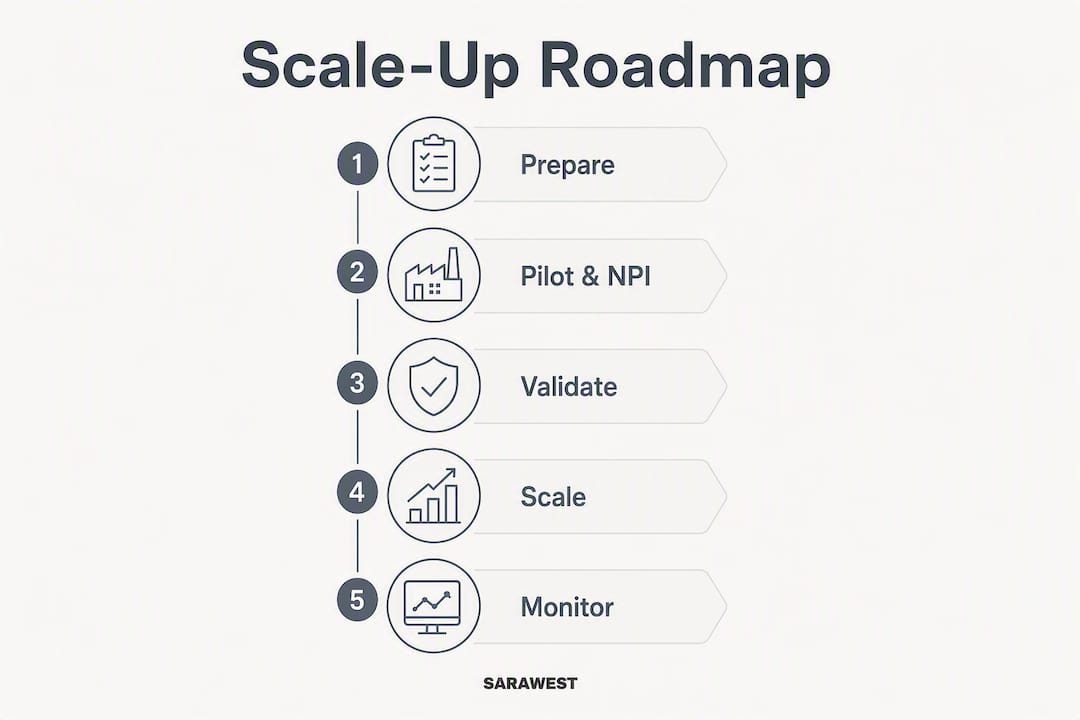
Phase 1: Prepare (governance and funding)
Assign a cross-functional steering group with clear owners: procurement owns supplier readiness, engineering owns process and equipment, quality owns validation and compliance, finance owns budget and cash-flow modeling. Without this structure, missed deadlines and reactive fixes are almost guaranteed. Lock the funding source before the pilot starts, not after.

Phase 2: Pilot and NPI
Run a bounded pilot at the next volume tier, typically a few weeks. The pilot's job is to surface process failures cheaply. Define pass/fail criteria before you start: yield targets, cycle time, defect rate, and equipment uptime. Document everything. A pilot that reveals a problem is a success. A pilot that hides one is expensive.
Phase 3: Validate and optimize
After the pilot, analyze every deviation. Revalidate any process parameter that changed with scale. Fix shift-to-shift variance before adding capacity. Standardizing across shifts is higher-impact than adding a new line, because shift variance transfers the constraint to a different time of day rather than eliminating it. Update your process documentation, batch records, and control charts to reflect the validated state.
Phase 4: Scale execution
Ramp production in stages: 25%, 50%, 75%, then full rate. Each stage is a checkpoint. Supplier ramp, workforce training, and equipment commissioning should be sequenced so no single dependency creates a bottleneck at the next stage. Change management matters here. Operators who understand why the process changed perform better than those who were simply handed new instructions.

Phase 5: Steady-state monitoring
Post-scale, set KPIs that track the health of the new operating level: OEE, first-pass yield, supplier on-time delivery, and cost per unit. Treat any sustained deviation as a signal to investigate, not a variance to absorb.
How do you scale the supply chain without introducing new risk?
Your production ramp is only as fast as your slowest supplier. Supply-chain readiness is where most scale-up programs stall, and it is almost always because procurement was brought in too late.
Supplier strategies that reduce risk:
- Dual-source every critical raw material before the scale run begins, not after a shortage
- Negotiate capacity reservation agreements with key suppliers: they hold volume for you in exchange for purchase commitments
- Create a formal supplier qualification lane so new vendors can be onboarded without disrupting current supply
- Request ramp-rate commitments in contracts: suppliers should confirm they can increase delivery volume on a defined schedule
Contract clauses worth requesting:
- Lead-time SLAs with penalty and bonus structures tied to your production schedule
- Confidentiality provisions for proprietary formulations and process parameters
- Force majeure and allocation protocols so you understand your priority position during supply disruptions
Inventory approach during ramp: Just-in-time works at steady state. During a ramp, it is a liability. Build safety stock for critical components before the scale run starts. Calculate safety stock based on supplier lead time variability, not average lead time. The difference between average and worst-case lead time is the number that actually matters.
Risk mitigation checklist:
- Critical parts identified and dual-sourced
- Alternative materials qualified for top-three highest-risk inputs
- Logistics redundancy confirmed (backup carrier or freight route)
- Supplier financial health reviewed for top-five spend categories
- Inventory buffer in place before scale run begins
How do you maintain quality and compliance while scaling production?
Quality does not scale automatically. Every change in equipment size, batch volume, or run rate is a potential source of process drift, and the time to catch it is during validation, not after a customer complaint.
When to revalidate
Revalidate whenever you change equipment, batch size, run rate, or a critical process parameter. For chemical and biological products, physical scale changes mixing dynamics and heat transfer in ways that are not always predictable. Staged revalidation is mandatory for sensitive chemistries. A sample test plan should include: incoming material verification, in-process checks at defined intervals, finished-product testing against specification, and a statistical sample size appropriate for the batch size.
Process controls that protect quality
Statistical process control (SPC) and control charts give you early warning before a process drifts out of specification. In-line quality checks, where feasible, catch deviations faster than end-of-batch testing. The goal is to build quality into the process, not inspect it in afterward.
Documentation priorities
Traceability is non-negotiable. Every batch needs a complete batch record: raw material lot numbers, equipment IDs, operator sign-offs, in-process results, and a certificate of analysis (COA) for the finished product. During scale-up, COA practices become more complex as batch sizes grow and customer specifications diversify. Build your documentation system to handle that complexity before you need it.
Validation checklist for pilots and scale runs:
- Pass/fail criteria defined before the run starts
- Sample sizes calculated for the new batch volume
- In-process checkpoints scheduled and assigned
- Deviation log active and reviewed daily
- Batch records complete and signed before product ships
- COA issued for every production lot
Should you expand your current facility, build new, or outsource to a contract manufacturer?
This is the decision that most directly determines your time-to-market and your capital exposure. There is no universal right answer, but there are clear criteria for each path.
Greenfield construction offers design freedom and a purpose-built layout, but it carries the highest initial CapEx and the longest timeline. Expanding an existing site is faster and cheaper on paper, but hidden costs accumulate: legacy remediation, utilities upgrades, layout rework, and the operational disruption of construction around live production. Before committing to expansion, collect detailed equipment specifications, review impact assessments, and consider outsourcing project management for startup to avoid pulling your internal team off production.
Outsourcing to a contract manufacturer converts CapEx to OpEx, compresses time-to-market, and transfers process risk to a partner with existing validated capacity. It is particularly favorable when pilot-to-scale speed matters, formulation confidentiality can be protected by contract, and your volume does not yet justify owning dedicated equipment.
| Factor | Expand existing | Greenfield | Contract manufacturer |
|---|---|---|---|
| Time to capacity | Moderate | Long | Short |
| CapEx required | Moderate | High | Low (OpEx model) |
| Flexibility | Low (constrained by site) | High (designed to spec) | High (shared capacity) |
| Hidden cost risk | High (remediation, utilities) | Low (new build) | Low (partner absorbs) |
| Formulation control | Full | Full | Contractual |
| Best fit | Incremental volume growth | Long-term, high-volume commitment | Pilot-to-scale, speed, capital efficiency |
Key outsourcing criteria:
- Partner has validated capacity at your target volume tier
- QA systems are documented and auditable
- Lead-time transparency: you can see the production schedule, not just a promise
- Scalability: the partner can grow with you, not just handle today's order
- Red flags: no COA process, no batch records, no dedicated account contact, and no clear escalation path for quality issues
What does a scale-up program actually cost, and how long does it take?
Budget and timeline are the two questions every board asks, and the two areas where most plans are optimistic. Here is a realistic framework.
Major cost buckets:
- Pilot and NPI: formulation development, sample production, testing, and iteration
- Equipment: purchase or lease of production assets, installation, and commissioning
- Facility work: layout changes, utilities, permitting, and any remediation
- Working capital: inventory build-up ahead of the ramp and the receivables gap during ramp
- Validation: testing, documentation, third-party audits if required
- Training: operator qualification, supervisory development, and change management
Typical phase durations:
- Pilot and NPI: several weeks depending on formulation complexity
- Validation and optimization: several weeks after pilot completion
- Scale execution (ramp to full rate): several months for most production environments
- Steady-state monitoring: ongoing, with formal review at 90 days post-ramp
Schedule risk concentrates at two points: supplier ramp delays and extended validation cycles. Build a substantial schedule contingency into both. Hidden remediation costs at existing facilities are the most common budget surprise; audit the site before finalizing the budget, not after signing the lease.
Financing options by stage:
- Internal cash flow: appropriate for pilot and NPI phases where spend is bounded
- Bank equipment loans: standard for defined equipment purchases with clear asset value
- Vendor financing: some equipment suppliers offer deferred payment or lease structures that preserve cash during ramp
- Contract manufacturing as an OpEx alternative: converts the entire capital program into a per-unit cost, eliminating the financing question for brands that are not yet at scale
How Sarawest USA executes the scale-up roadmap for chemical brands
We built Sarawest USA to solve the problem that stops most brands at the pilot stage: the gap between a validated formula and a production run that ships on time, at spec, and at a price that makes sense. Our 30,000 sq ft facility in Pampa, Texas handles everything from 1,000-unit pilot batches to full truckloads, with in-house R&D chemists who adapt existing formulas or build new ones from scratch.
The engagement flow is direct. You submit an RFQ, our chemists review your specification, we produce a pilot batch, you approve the sample, and we move to a scale run. No brokers. No hand-offs to a third party. The same team that formulated your product runs your production.
Our library of over 1,200 proprietary formulas across eight industries, including commercial cleaning, sports care, equine, leather care, and solar, means most brands do not start from zero. We adapt what already works, which compresses your pilot timeline and reduces formulation risk. For brands that need a completely new solution, our R&D team builds it in-house.
What to look for in a contract manufacturer (and where we stand):
- Technical capability at your target volume: we run pilots and full production in the same facility
- QA systems: batch records, COA on every lot, and microbial challenge testing where required
- Lead-time transparency: you get a production schedule, not a vague promise
- Scalability: we grow with your program, from pilot to recurring bulk supply
- Red flags to avoid: no in-house chemistry, no documented QA process, no dedicated contact, and no clear path from pilot to production
Pro Tip: Ask any contract manufacturer for a sample COA and a batch record template before you sign. If they cannot produce both quickly, their QA system is not ready for your scale-up program.
Key Takeaways
Scaling up manufacturing requires validated demand, a staged pilot process, and cross-functional governance before any capital commitment.
| Point | Details |
|---|---|
| Audit hidden capacity first | Median equipment runtime can be as low as 32.04%; address operational constraints before buying new assets. |
| Stage every scale decision | Move through pilot, validate, ramp, and monitor phases with defined pass/fail gates at each step. |
| Dual-source before you ramp | Qualify backup suppliers for critical materials before the scale run starts, not after a shortage. |
| Choose scale-out for sensitive formulations | Replicate validated smaller units when chemistry, regulation, or capital constraints make larger equipment risky. |
| Sarawest USA as your pilot-to-scale partner | From 1,000-unit pilots to full truckloads, Sarawest USA handles formulation, production, and QA in one facility. |
The part of scaling that most playbooks skip
There is a version of the scale-up conversation that focuses almost entirely on equipment and capital. Buy the bigger reactor. Lease the new line. Hire the workforce. That framing is not wrong, but it is incomplete in a way that costs companies real money.
The harder problem is organizational. Most scale-up failures we see are not equipment failures. They are alignment failures. Procurement did not know the ramp timeline. Engineering signed off on a process change that quality had not validated. Finance approved the budget without understanding the working capital gap. These are not rare edge cases. They are the default outcome when scaling is treated as an operations project rather than a cross-functional program.
The second thing most playbooks underweight is supplier lead time. Brands consistently underestimate how long it takes a supplier to ramp. A supplier who can deliver 10,000 units a month today cannot necessarily deliver 50,000 units in 60 days. They have their own capacity constraints, their own raw material lead times, and their own production schedules. If you have not had a direct conversation about ramp-rate capability, you do not actually know your supplier's capacity. You know their current output.
The third caution is about speed itself. Speed is a legitimate competitive advantage in manufacturing. Getting to market faster than a competitor matters. But speed applied to an unvalidated process is not an advantage. It is a liability that shows up in customer returns, regulatory scrutiny, and reformulation costs. The brands that scale well are not the ones that move fastest. They are the ones that move fastest through a validated process. That distinction is where the real work happens, and it is why a staged pilot is not a delay. It is the fastest path to a production run that actually holds.
Ready to move from pilot to production? Sarawest USA can get you there.
Brands that need to scale chemical production without the CapEx of a dedicated facility have a direct path through Sarawest USA. Our contract manufacturing service starts with a fast RFQ and moves to pilot production without the delays of broker-managed sourcing. We run a 30,000 sq ft facility with in-house R&D chemists, a library of over 1,200 proprietary formulas, and white-label options from 1,000-unit minimums. Quality documentation, including COA on every lot, is standard, not an add-on.
Whether you are validating a new formulation, scaling an existing product line, or moving from pilot batches to recurring bulk supply, our team handles the chemistry, the production, and the paperwork. See our pilot-to-scale case studies to understand what the engagement looks like in practice, then submit your RFQ and a real person will respond.
Useful sources and further reading
These are the primary sources cited in this guide, selected for authority and practical relevance to manufacturing scale-up decisions.
-
Manufacturing Scale-Up: Drugs and Biologics (NIH) — The authoritative reference for staged revalidation in sensitive chemistries and biologics. Consult this when your product involves formulation-sensitive processes where batch size changes affect mixing or heat transfer.
-
Scale-Up vs. Scale-Out for Continuous Pharma Manufacturing (Thermo Fisher) — Clear technical explanation of the strategic difference between scale-up and scale-out. Useful for teams deciding which approach fits their process maturity and capital position.
-
Scale Manufacturing Operations Without Disrupting Your Line (Viking Masek) — Practical guidance on cross-functional alignment, modular automation, and avoiding reactive vendor decisions during scale. Read this before your governance structure is finalized.
-
Making the Optimal Choice: Expanding vs. Building New (Burns & McDonnell) — The most thorough treatment of greenfield vs. expansion trade-offs available publicly. Particularly useful for the hidden-cost audit before committing to an existing site.
-
Scale Manufacturing Operations for Sustainable Growth (RFGen) — Frames scaling as an iterative, data-driven cycle rather than a one-time capital event. Good reference for KPI selection and technology integration during ramp.
-
Production Capacity (Guidewheel) — Source for the median equipment runtime benchmark. Use this to build the case for a utilization audit before any CapEx discussion.
-
How to Increase Production Capacity (Augury) — Detailed guidance on bottleneck analysis and why reactive equipment purchases shift constraints rather than remove them.
-
What to Consider Before Your Company Expands Manufacturing (Bothwell Engineering) — Pre-expansion checklist covering equipment specifications, impact assessments, and project management outsourcing. Practical for operations teams preparing a capital request.
-
Sarawest USA Capabilities — Details on the 30,000 sq ft facility, pilot-to-scale workflow, and production throughput. Reference this when evaluating contract manufacturing as an alternative to owned capacity.