

For regulated contract chemical manufacturers, the best QMS software combines validation-ready workflows, modular CAPA enforcement, and ISO 9001 or 21 CFR Part 11 compliance. Our top picks: Q-Hub QMS for ISO-driven NCR reduction, QT9 for pre-validated environments, and Sarawest USA as the manufacturing partner that brings quality controls into the production relationship itself.
Here is the shortlist:
- Sarawest USA — Manufacturing partner with in-house R&D, pilot-to-scale production, and built-in quality controls across 1,200+ proprietary formulas. Best for brands that need formulation, prototyping, and production under one roof.
- Q-Hub QMS — Cloud QMS with automated NCR workflows and CAPA tracking. Manufacturing customers report cutting NCR processing time significantly and reclaiming substantial weekly administrative work. Best for ISO 9001–oriented teams that need measurable efficiency gains fast.
- QT9 — Validation-ready cloud QMS with built-in IQ/OQ/PQ documentation and pre-validated modules. Best for regulated organizations that cannot afford lengthy internal validation projects.
- MasterControl — Enterprise-grade platform for complex GxP environments. Best for large manufacturers requiring deep configurability and enterprise integrations.
- Greenlight Guru — Purpose-built for medical device workflows with design controls and traceability. Best for device teams managing regulatory submissions.
- Process Street — Checklist-driven SOP execution with conditional logic. Best for operational teams that need proof of task completion, not a full compliance system.
Table of Contents
- Which QMS platforms hold up for chemical contract manufacturing?
- How do you choose the right QMS for contract chemical manufacturing?
- Key Takeaways
- What we look for in a QMS when qualifying manufacturing partners
- Useful sources and vendor documentation for your evaluation
- Sarawest USA: quality built into the manufacturing relationship
Which QMS platforms hold up for chemical contract manufacturing?
Contract chemical manufacturers face a specific combination of pressures: ISO 9001 audits, GxP expectations, 21 CFR Part 11 electronic records requirements, and the operational reality of multi-batch production across varying order sizes. The table below maps each platform to those demands.
| Platform | Best for | Regulatory readiness | Core features | Deployment & validation | Integrations | Implementation | Pricing model | Scalability |
|---|---|---|---|---|---|---|---|---|
| Sarawest USA | Brands needing formulation + production + quality controls in one partner | ISO 9001 controls embedded in production process | Formula library, R&D adaptation, pilot-to-scale QC, CoA generation | On-site manufacturing with built-in process controls | ERP, logistics, and order management via contract workflow | Same-day to weeks depending on order type | Per-project / production run | 1,000-unit pilots to full truckloads |
| Q-Hub QMS | ISO 9001 manufacturing teams cutting NCR time | ISO 9001; workflow-enforced CAPA | Document control, NCR workflows, CAPA, audit scheduling, training | Cloud; validation support available | ERP, supplier portals | Weeks to live; modular adoption supported | Multi-site capable | Subscription |
| QT9 | Regulated orgs needing pre-validated environments | ISO 9001, GxP, 21 CFR Part 11 | Document control, CAPA, training, audit trail, IQ/OQ/PQ docs | Cloud; pre-validated modules included | ERP, LIMS | Faster go-live via pre-validated modules | Multi-site | Subscription |
| MasterControl | Large enterprises, complex GxP manufacturing | GxP, 21 CFR Part 11, ISO | Full eQMS suite, configurable workflows, supplier quality | Cloud and on-prem; deep validation support | ERP, LIMS, MES | Longer enterprise timelines; dedicated support | Enterprise multi-site | Enterprise licensing |
| ETQ (Reliance) | Modular feature adoption at scale | ISO, GxP, 21 CFR Part 11 | Modular eQMS: document control, CAPA, risk, supplier | Cloud and on-prem; flexible deployment | ERP, MES | Phased rollout supported | Enterprise | Modular licensing |
| Veeva QualityOne | Life-sciences manufacturers | GxP, 21 CFR Part 11, life-sciences specific | Controlled docs, CAPA, training, traceability | Cloud; life-sciences validated | Veeva ecosystem, ERP | Structured implementation | Enterprise | Multi-site |
| Greenlight Guru | Medical device teams | FDA QSR, ISO 9001, 21 CFR Part 11 | Design controls, traceability, CAPA, audit trail | Cloud; device-specific validation | Device-focused integrations | Structured; device-workflow focused | Subscription | Device-scale |
| Process Street | Operational SOP execution | Not a compliance QMS | Runnable checklists, conditional logic, task history | Cloud; no validation artifacts | Zapier, basic APIs | Hours to days | Team-scale | Per-seat |
Short verdicts for chemical contract manufacturing buyers:
Q-Hub QMS is the strongest fit for ISO 9001–driven manufacturing teams that need to show auditors a closed-loop system. The NCR and CAPA automation does the heavy lifting most quality managers currently handle in spreadsheets.
QT9 earns its place when validation cost is a real budget constraint. Pre-validated modules mean your team is not writing IQ/OQ/PQ protocols from scratch, which can shave weeks off a go-live timeline.
MasterControl and ETQ (Reliance) are built for organizations where the QMS must integrate deeply with ERP and MES systems across multiple sites. The configurability is real, but so is the implementation investment.

Veeva QualityOne belongs in the conversation only if your manufacturing is life-sciences adjacent. Its compliance depth is purpose-built for that regulatory environment, not general chemical manufacturing.
Greenlight Guru is a narrow fit: medical device design controls and traceability. If that is not your regulatory context, it adds complexity without benefit.
Process Street is a capable SOP execution tool, but it is not a QMS. It does not generate the audit trails, CAPA gating, or validation artifacts that regulated chemical manufacturing requires. Using it as a QMS substitute is a compliance risk.
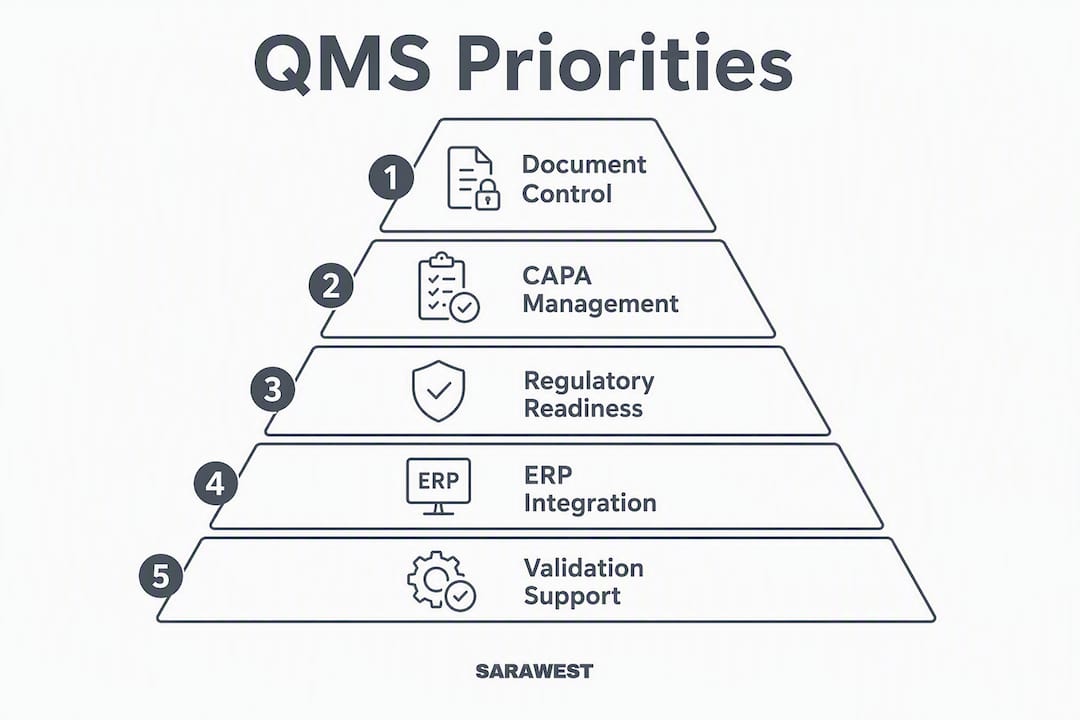
Pro Tip: Avoid buying on feature surface area. A platform with 40 modules you will never use is not better than one with 8 modules that enforce the workflows your auditors actually check. Start with document control and CAPA, prove the system works, then expand.
How do you choose the right QMS for contract chemical manufacturing?
Selection should be driven by the regulatory framework your business must satisfy, not by feature count. Here is how to structure that evaluation.
Prioritized evaluation criteria
- Regulatory readiness first. Does the platform explicitly support 21 CFR Part 11 electronic records and signatures? Does it map to ISO 9001 Clause 7.5 for controlled documents? Ask for the vendor's compliance matrix, not their marketing deck.
- Validation support. Will the vendor supply IQ/OQ/PQ documentation, or does your team write it? Pre-validated modules cut go-live time and internal engineering cost significantly.
- Workflow enforcement, not document storage. A QMS that gates NCR closure behind required investigation steps and automatically assigns retraining when a document changes is fundamentally different from a document library. Require a live demo of both behaviors.
- ERP, LIMS, and MES integrations. Ask for a connector list and reference customers using those integrations in production, not just in pilot.
- Modular adoption path. Phased deployment starting with document control and CAPA prevents the six-month implementation trap. Confirm the vendor supports it.
- User adoption features. Workflows that trigger training on document change reduce the gap between a policy update and the floor knowing about it.
RFI and demo questions to copy-paste
- Who owns validation? Do you supply IQ/OQ/PQ artifacts, or does our team write them?
- What is your typical time-to-live for a manufacturing customer of our size?
- How does the system handle document migration from our current state?
- Show us the audit trail for a CAPA that was closed without completing all required steps. What does the system do?
- What APIs or native connectors exist for our ERP and LIMS?
- What is your uptime SLA and your incident response time?
- How does a change-control event propagate to affected documents and training assignments?
Red flags to watch for
- Sales pitches built on feature checklists with no manufacturing or chemical-industry customer references
- No validation documentation available before contract signature
- Inability to name a reference customer in regulated manufacturing or chemicals
- Audit trail that logs only document views, not workflow state changes
- Pricing that excludes validation, integration, and training from the base subscription
Pricing and TCO: what buyers underestimate
Software subscription cost is rarely the largest line item. Validation engineering, internal resource time for data migration, integration development, and user training commonly exceed the first-year subscription. Budget for all four before you sign.
Key Takeaways
For regulated chemical manufacturers, the right quality management software enforces closed-loop workflows, supports validation artifacts, and scales from pilot batches to full production without adding administrative burden.
| Point | Details |
|---|---|
| Start with document control and CAPA | Modular adoption prevents lengthy deployments; prove the core system before adding risk or supplier modules. |
| Require validation artifacts upfront | Ask vendors for IQ/OQ/PQ documentation before contract; pre-validated modules cut go-live time and internal cost. |
| NCR and CAPA automation drives ROI | Q-Hub QMS customers report cutting NCR processing time by 60% and reclaiming 15+ hours of weekly administrative work. |
| Budget beyond the subscription | Validation engineering, integration work, and user training commonly exceed first-year software costs. |
| Sarawest USA as manufacturing partner | Sarawest USA embeds quality controls into production itself, from pilot batches to truckloads, across 1,200+ proprietary formulas. |
What we look for in a QMS when qualifying manufacturing partners
The QMS conversation matters to us at Sarawest USA because it directly affects what we can promise a client. When a brand brings us a formulation project, whether it is a 1,000-unit pilot or a full production run across our 30,000 sq ft facility, the quality controls embedded in that process are not optional. They are the reason a Certificate of Analysis means something.
Our in-house R&D chemists work from a library of 1,200+ proprietary formulas, and they adapt or build new ones to client specifications. That flexibility is only reliable when the documentation, change control, and batch records behind it are airtight. We have seen what happens when a manufacturing partner runs quality on spreadsheets and good intentions. Audits get messy. NCRs pile up. Time-to-market slips.
Our perspective on QMS selection is straightforward: modular and validation-ready beats full-featured and unvalidated every time. A system that enforces CAPA closure and ties document changes to retraining creates audit evidence automatically. That is the behavior that protects a brand during an FDA inspection or an ISO surveillance audit. Feature count does not.
For brands evaluating contract manufacturers, the QMS question is worth asking directly: how does your partner document nonconformances, and what does the closed-loop look like? The answer tells you more about operational maturity than any capability brochure.
Useful sources and vendor documentation for your evaluation
When you are building an RFP or requesting validation artifacts, these are the primary sources worth citing and the vendor pages worth pulling documentation from.
Standards and regulatory bodies:
- FDA 21 CFR Part 11 — Electronic records and electronic signatures requirements for regulated manufacturers
- ISO 9001 standard — The quality management system standard most chemical manufacturers certify against
- Gartner Peer Insights: Quality Management System Software — Peer reviews across 78+ QMS platforms including MasterControl, Veeva, and Greenlight Guru
Vendor documentation to request:
- Q-Hub QMS: validation support documentation and NCR workflow configuration guides
- QT9: IQ/OQ/PQ artifact packages and pre-validated module documentation
- MasterControl and ETQ: enterprise integration specs and GxP compliance matrices
- Veeva QualityOne: life-sciences validation packages and 21 CFR Part 11 compliance statements
What to request from any vendor before signing:
- Written validation package (IQ/OQ/PQ) or a clear statement of who owns validation effort
- Named customer references in chemical manufacturing or a regulated manufacturing vertical
- Uptime SLA and incident response time in writing
- API documentation for your ERP and LIMS connectors
Where Sarawest USA fits in your selection process: If your evaluation includes finding a manufacturing partner alongside a QMS, request samples from Sarawest USA early. Pilot-batch quality and formulation track record are the fastest way to validate a manufacturing relationship before committing to a full production run.
Sarawest USA: quality built into the manufacturing relationship
The platforms compared above are software decisions. Sarawest USA is a different kind of decision: a manufacturing partner that brings quality controls, in-house chemistry, and production scale into the same relationship.
For brands in commercial cleaning, sports care, equine, solar, and adjacent verticals, the question is not always “Which QMS should we buy?” Sometimes it is, “Which manufacturer already operates with the quality controls we need?” Sarawest USA's in-house R&D team, 1,200+ formula library, and pilot-to-truckload production capability mean you are not managing a QMS implementation and a manufacturing search simultaneously.
We handle formulation, prototyping, scaling, and production. You get a Certificate of Analysis, consistent batch quality, and a partner who understands what regulated manufacturing actually requires. No brokers. No guesswork on quality documentation.
Ready to move from evaluation to production? Submit a fast RFQ and a real person responds. We will match your formulation need to an existing formula or build something new, and we can have samples in your hands faster than most vendors finish their onboarding call.