
Most brands should start with private label. It gets a horse-care product to market in weeks, not months, at a fraction of the development cost. Choose custom formulation only when you need owned IP, a differentiated claim, or exclusivity that a shared formula can't give you. Either way, the next move is the same: write a one-page spec and request a pilot quote. A contract manufacturer runs both paths under one roof, with in-house chemists and pilot-to-scale production ready the same week you send the brief.
TL;DR:
- Private label formulations are faster and less expensive but do not grant ownership or exclusivity, whereas custom formulas require a longer development process and offer formula ownership.
- Ingredient choices must consider horse-specific risks like ingestion, skin sensitivity, and the impact of fragrance or biodegradability, influencing formulation safety and labeling claims.
- Development time generally ranges from a few weeks for private label to several months for custom builds, involving multiple sample rounds and stability testing before production.
- Required documentation includes safety data sheets, technical data sheets, stability reports, and preservative efficacy tests, with clear responsibility for safety testing outlined in the contract.
- Minimum order quantities depend on the level of formula customization, with private label projects accepting lower MOQs and custom formulations requiring larger volume commitments due to testing and complexity.
Table of Contents
- What Does Equine Shampoo Formulation Mean for Your Brand?
- What Safety Constraints Should You Brief Into the R&D Process?
- Private Label or Custom Formulation: Which Fits Your Timeline and Budget?
- How Long Does It Take to Go From Brief to Bottled Product?
- What Documentation and Testing Should You Require in Any Contract?
- What Should You Expect on MOQs and Manufacturing Logistics?
- What Quality Control Standards Protect Your Launch?
- How Do We Approach Equine Shampoo Projects for Brands?
- Ready to Move From Brief to Bottle?
- Sources
- FAQ
What Does Equine Shampoo Formulation Mean for Your Brand?
For a brand or distributor, equine shampoo formulation is the process of developing a wash or coat-care product through a contract manufacturer's own chemists, either by licensing an existing formula or building one from scratch. It is not a DIY recipe you mix in a bucket. It is a manufacturing relationship with defined deliverables, testing gates, and ownership terms.
A competent partner hands you more than a bottle of product. Expect:
- A technical data sheet (TDS) covering pH, viscosity, and active concentrations
- Safety data sheets (SDS/MSDS) for handler and regulatory reference
- A stability report from accelerated and real-time sample testing
- Packaging compatibility guidance for your chosen containers and closures
- An optional IP assignment clause if you're paying for a custom build
The decision signal is simple: tight budget or fast timeline points to private label; a strategic claim or long-term brand equity points to custom.
What Safety Constraints Should You Brief Into the R&D Process?
Horses aren't small humans, and their skin, coat, and grooming habits change what a formulator can safely put in the bottle. A horse licks its own coat, noses a stablemate, and stands in direct sun for hours after a bath, so ingredient risk analysis has to account for ingestion and skin exposure that a human shampoo brief never touches. Skin pH and metabolic pathways differ from ours too, which is why a formula that's gentle on human scalp can still irritate equine skin at the same concentration.
Brief your chemist on these ingredient classes specifically:
- Certain essential oils, which can trigger sensitivity or toxicity at concentrations considered safe for people
- Benzalkonium chloride and similar quaternary compounds, which need careful dosing given licking and ingestion risk
- Certain glycols, where preservative choice matters as much as the active itself
Fragrance strategy deserves its own line item. Horses have a far more sensitive sense of smell than we do, so a fragrance load that reads as "clean and fresh" to a barn manager can be aversive to the animal. Biodegradability also affects what claims you can print on the label, especially if runoff into pasture or waterways is part of your environmental story.
Pro Tip: Send your chemist the actual use environment, not just the ingredient wish list. A wash used in an open paddock in July behaves differently than one used in a climate-controlled show barn, and that changes preservative and stability requirements.
Private Label or Custom Formulation: Which Fits Your Timeline and Budget?
The trade-off comes down to four variables: cost, speed, ownership, and how differentiated your claims need to be.
- Private label pulls from a manufacturer's existing formula library. Development cost is low, launch timelines are short, but the manufacturer retains the underlying formula and may sell it to other brands. You're buying speed, not exclusivity.
- Custom formulation builds a recipe from your brief. It typically carries a development fee and a longer timeline, often with multiple sample rounds before signoff. In exchange, you can negotiate formula ownership and a claim no competitor can copy.
- Ownership terms vary by deal type. Custom projects usually transfer the formulation IP to the brand; private label keeps the recipe with the manufacturer and open to resale.
Before signing anything, negotiate five specific line items: the total development fee, whether it's credited against your first production order, who funds stability and safety testing, exclusivity terms if any, and the minimum order quantity tied to each formula tier.
How Long Does It Take to Go From Brief to Bottled Product?
A gated process protects you from surprises, and it looks roughly the same whether you're building custom or tweaking a base formula.
- Brief and spec. You define target claims, budget, and packaging intent. This is also where you flag species-safety concerns and desired fragrance direction.
- Prototyping. The chemist returns one or more sample formulas, often faster if pulled from an existing formula library rather than built from zero.
- Sample rounds and in-house stability checks. Expect at least one revision cycle here; this is the stage where fragrance, foam texture, and rinse feel get dialed in.
- Preservative and microbial testing. This confirms shelf stability under real storage conditions, not just lab ideal ones.
- Pilot batch. A small production run validates the formula at scale before committing to a full order.
- Scale-up. Full production begins once pilot results and packaging fit are both approved.
Private label projects can be completed relatively quickly, while fully custom builds take longer due to sample rounds and testing requirements. Parallel testing and rapid prototyping shave real time off either path.
What Documentation and Testing Should You Require in Any Contract?
Animal-care and hygiene products don't sit under one clean regulatory umbrella the way human cosmetics do. Whether your shampoo counts as a biocidal product, falls under veterinary framing, or is treated as a general hygiene item depends on the function you claim, so brief that function clearly and early.
Regardless of classification, require these documents before you place a production order:
- SDS/MSDS covering handler exposure
- A full technical data sheet (TDS)
- A stability summary from accelerated and real-time testing
- Preservative efficacy test results
- Any data substantiating specific label claims
Safety evaluation should cover both the horse and the human applying the product, since exposure profiles for each are different. Put contractual responsibility for these tests in writing. Don't assume it's included.
What Should You Expect on MOQs and Manufacturing Logistics?
Minimum order quantities shift depending on how far you push customization. Private label formulas, already qualified and stable, tend to carry lower MOQs than a brand-new custom build, where formulation complexity and testing overhead push minimums higher.
Packaging is where a lot of launches quietly stall. A surfactant-heavy wash or one with a stronger preservative system needs a container material and closure type that won't react with the formula over a full shelf-life cycle. Confirm compatibility before you commit to bottle tooling.
Lead times are driven by three things:
- Raw-material sourcing, especially for actives with longer supplier lead times
- Whether your run needs a dedicated production line
- Testing hold times for stability and microbial results
Forecast early, build a small safety stock, and stagger production runs rather than betting everything on one large batch.
What Quality Control Standards Protect Your Launch?
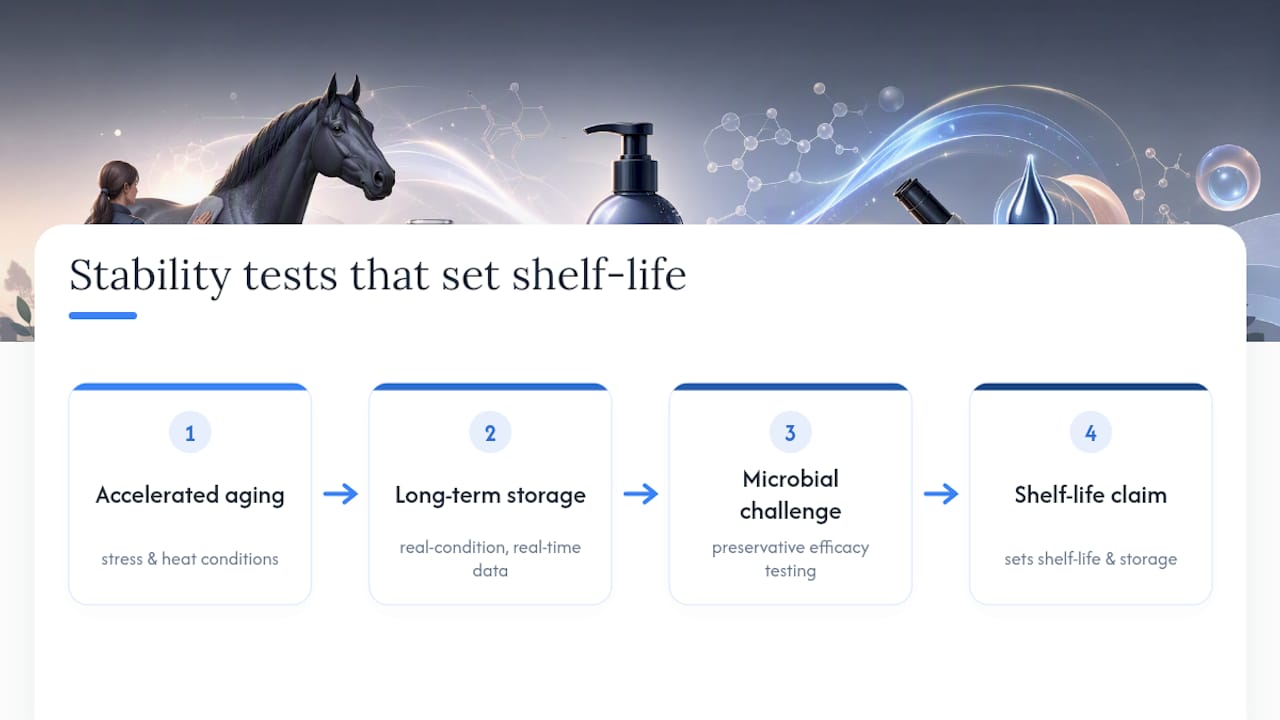
Stability testing tells you how a formula holds up over time and under stress, and it should cover accelerated aging, long-term real-condition storage, and microbial challenge testing. Results from all three set your shelf-life claim and storage instructions on the label.
At batch release, require test results for pH, viscosity, microbial limits, and preservative assay, plus a visual and packaging inspection. Ask for traceability records and standing access to the certificate of analysis (COA) and TDS for every batch, not just the first one. Build audit rights and basic vendor performance metrics into the contract from day one, before volume makes renegotiation harder.
How Do We Approach Equine Shampoo Projects for Brands?
We built our library past 1,200 formulas because most brands don't want to start from a blank page. When a horse-care brand calls, our chemists pull the closest match, adapt it to the brief, and move to a pilot run without a broker adding weeks to the process.
The first question we ask isn't about budget. It's about the claim you want to make and who's applying the product. Get that spec tight before you call, and prototyping moves fast.
— Faisal Mansur
Ready to Move From Brief to Bottle?
A contract manufacturer runs private label and fully custom equine shampoo formulation under one roof, so you're not juggling a broker between your brief and the lab bench. This allows faster answers, no middleman markup, and chemists who can pull from a library or build new formulas, whichever your timeline and budget call for.
Before you reach out, prepare three things: your spec (target claims, coat type, use environment), your estimated volume, and your preferred packaging format. Have a look at our Horse Care division for examples of formulated products already in market, including the EcoWash Horse Shampoo and ProCoat Equine Wash. If you're planning a full retail launch, our guide on planning an equine product line launch is worth a read first.
When you're ready, request a pilot quote through our contract chemical manufacturing page, or start with white label manufacturing if speed to shelf matters most. A real chemist reviews every brief we receive.
Sources
For technical or regulatory due diligence, review species-specific formulation risk guidance, the custom cosmetic formulation process, and custom formulation cost and fee structures.
- Formulating products for animals — Coptis
- What Is Custom Formulation in Cosmetics Manufacturing? · OEMHallmark
- Why we use human-grade ingredients in our formulas — HiForm
FAQ
What's the difference between private label and custom equine shampoo formulation?
Private label uses an existing formula from the manufacturer's library, so it launches faster and costs less upfront. Custom formulation builds a new recipe from your brief, which usually means a development fee and a longer timeline in exchange for potential formula ownership.
Who owns the formula in a custom equine shampoo project?
Ownership depends on what your contract states, but custom projects typically transfer formulation IP to the brand while private label keeps the recipe with the manufacturer. Confirm this in writing before development starts, along with any exclusivity terms.
What documents should a manufacturer provide for an equine shampoo formula?
At minimum, expect an SDS/MSDS, a technical data sheet, a stability summary, and preservative efficacy test results. Safety evaluation should also account for both animal and human handler exposure.
How long does it take to develop a custom equine shampoo?
Private label projects can move in a few weeks since the base formula already exists. Fully custom builds take longer, since they run through prototyping, multiple sample rounds, and stability and microbial testing before a pilot batch.
Does Sarawest USA offer both private label and custom equine shampoo formulation?
Yes. Sarawest USA provides both routes through in-house R&D chemists and a formula library of over 1,200 recipes, with pilot-to-scale production for horse-care projects. Pricing depends on project scope and is available on request through the contract chemical manufacturing page.