
The fastest reliable way to run a fast track product launch is to work with a chemist-led contract manufacturer that offers ready-to-brand private-label formulas plus in-house pilot-to-scale capability. A chemist-led contract manufacturer can build a process around this model, aiming to resolve regulatory checkpoints early rather than discovering them late. Speed comes at a cost: the more you lean on an existing base formula, the less exclusive your final product becomes.
TL;DR:
- Having clear decisions on claims, packaging, and regulatory classifications before requesting a quote is essential to avoid delays in formulation and certification.
- Accelerated stability testing with your actual packaging can support a tentative shelf-life, but full stability testing must run in parallel post-launch.
- EPA antimicrobial claims require pesticide registration under FIFRA, which can delay a launch if not classified early in the process.
- Locking manufacturing terms, including lead times and ownership rights, before production minimizes risks and keeps the launch on schedule.
Table of Contents
- What Fast Track Manufacturing Looks Like in Practice
- What Do You Need Ready Before Requesting a Fast Quote?
- How Long Does a Fast Track Launch Actually Take?
- Which Regulatory Steps Actually Slow Down a Launch?
- Why Packaging and Stability Testing Can't Wait
- What Contract Terms Protect a Fast Launch Timeline?
- What We've Learned About Rapid Manufacturing Partnerships
- How Sarawest USA Gets You to Shelf Faster
- Sources
- FAQ
What Fast Track Manufacturing Looks Like in Practice
Brands accelerate a launch through one of two paths, and picking the wrong one costs weeks you don't have.
Private-label adaptation starts from an existing, proven formula. You add your branding, adjust scent or color within tested ranges, and ship. Timelines shrink because the chemistry is already validated. Rapid custom formulation starts closer to scratch: a chemist builds or substantially reworks a formula against your specific performance targets, claims, and cost ceiling.
The trade-offs break down like this:
- Private-label bases move faster and cost less upfront, but the formula isn't exclusive to you.
- Custom formulation takes longer and costs more, but you own something competitors can't simply reorder.
- Hybrid paths exist: many brands launch on a private-label base to capture the market window, then commission a custom variant once sales data justifies the R&D spend.
If your launch date is fixed and your differentiation lives in branding or go-to-market, start with a base formula. If your entire pitch depends on a unique performance claim, custom formulation is worth the extra time.
What Do You Need Ready Before Requesting a Fast Quote?
A manufacturer can only quote fast and hit a tight schedule when you arrive with decisions already made, not questions still open. Contract Pharma's analysis of sponsor readiness makes the same point across pharmaceutical and chemical manufacturing alike: experienced partners surface technical and regulatory risk early, but only if you give them enough to work with.
Before you request a quote, resolve these:
- Product definition. Intended use, on-label claims, and specific performance targets (kills 99.9% of bacteria, restores leather flexibility, removes soiling in one wash).
- Regulatory class. Decide claims first. A "disinfectant" claim triggers an entirely different pathway than a "general cleaner" claim.
- Packaging format. Bottle, pouch, drum, or aerosol, and whether that container is compatible with your formula chemistry.
- Target volumes and MOQs. Know your realistic pilot batch size and your first full production run.
- SDS and label ownership. Confirm in writing who prepares the Safety Data Sheet and label copy.
- Raw-material lead times. Flag any single-source ingredient before it becomes a bottleneck mid-project.
Pro Tip: Decide your primary claim before your first call with any manufacturer. A "disinfects surfaces" claim versus a "cleans surfaces" claim can add months to your timeline, and no formulator can quote accurately until that's settled.
How Long Does a Fast Track Launch Actually Take?
A condensed fast-track timeline usually runs through five gated stages, and each gate has to close before the next one opens.
- Bench prototype (days to 2 weeks): the chemist builds or adapts a formula against your stated targets.
- Pilot batch (1 to 3 weeks): a small production run, often in the 1,000-unit range, validates the formula at scale rather than in a beaker.
- Stability check (2 to 4 weeks minimum): accelerated testing gives you a tentative shelf life before waiting on full real-time data.
- Label and SDS finalization (parallel, 1 to 2 weeks): this can run alongside stability testing if claims were locked early.
- Pilot validation and full production (variable): final sign-off, then scale to your target volume.
The most common bottlenecks aren't chemistry problems. They're regulatory review dragging on because claims weren't fixed, packaging lead times running longer than the formula development itself, and third-party testing labs with their own queues. A pilot batch checklist built around batch manufacturing records versus batch production records catches most of these before they cost you a week.
Which Regulatory Steps Actually Slow Down a Launch?
Three federal frameworks determine how fast you can legally ship, and each one hits a different product category.

OSHA's Hazard Communication Standard requires whoever manufactures or imports a hazardous chemical to classify its hazards and produce a compliant Safety Data Sheet and label. Under 1910.1200, this responsibility sits with the manufacturer of record, so confirm early whether that's you or your contract partner.
EPA antimicrobial and disinfectant claims change everything about your timeline. Any product claiming to kill germs, sanitize, or disinfect typically needs pesticide registration under FIFRA, and that process runs on a different clock than a standard cleaner launch. Classifying the product's claim early, before formulation is locked, avoids registration rework later.
FDA MoCRA applies to cosmetic-type products. Facilities must register and renew every two years, and product listings update annually, a cycle that affects when a cosmetic-adjacent product can legally hit shelves.
Certification programs like EPA Safer Choice/DfE sit outside your core timeline entirely. They require full formulation disclosure and a signed partnership agreement, which makes certification a parallel workstream, not a box you check the week before launch.
Why Packaging and Stability Testing Can't Wait
Packaging isn't a downstream decision. It's part of the formulation itself, because container-closure interactions like migration, permeability, and orientation can change how a product performs before it ever reaches a shelf.

Accelerated stability testing, run against representative packaging rather than a generic lab container, can justify a tentative shelf-life claim fast enough to support a launch window. Guidance on nonprescription OTC product stability confirms this: accelerated data supports a tentative expiry period, but full production-scale stability testing still needs to run in parallel after launch, not instead of it.
Pro Tip: Test your formula in the exact bottle, pouch, or drum you plan to ship in, not a lab beaker. A formula that's stable in glass can fail in plastic within weeks if permeability wasn't checked.
What Contract Terms Protect a Fast Launch Timeline?
Speed without the right paperwork just moves your risk from the lab to the invoice. Lock these terms before production starts:
- MOQ and pilot pricing. A 1,000-unit pilot batch usually carries a per-unit premium over full production runs, and that math should be explicit in the quote.
- Lead-time and substitution clauses. Get written commitments on raw-material lead times, plus a pre-approved substitution list if a single-source ingredient goes on backorder.
- IP and ownership terms. A private-label base stays the manufacturer's formula under license; a custom formula's ownership terms need to be spelled out, not assumed.
- QA acceptance gates. Define what passes and what triggers rework before the first batch ships, not after a failed one arrives.
Manufacturers with in-house R&D and integrated production tend to reduce these risks structurally, since formulation, compatibility testing, and production sit under one roof instead of being split across a broker and three subcontractors. For deeper procurement diligence, five formulation-support qualification tests from Astra Chemical are worth running against any manufacturer before you sign.
What We've Learned About Rapid Manufacturing Partnerships
In-house R&D removes handoffs, and handoffs are where fast launches die. Every time a formula crosses from a broker to a lab to a packaging vendor, someone re-explains the brief, and something gets lost. A chemist who owns the formula from bench to pilot batch simply moves faster, and Sarawest USA's formulation track record reflects that structural advantage: a library of over 1,200 base formulas, in-house chemists, and same-day turnarounds on straightforward requests.
My honest guidance to brands: launch private-label first, invest in custom formulation once sales justify it. And never promise a launch date to your team or retailers before your claims and packaging are locked. Everything else can move fast. That decision can't move at all.
— Faisal Mansur
How Sarawest USA Gets You to Shelf Faster
Some manufacturers address the bottleneck brands face by providing direct access to in-house chemists with large libraries of base formulas across multiple industries, streamlining the quoting and manufacturing process.
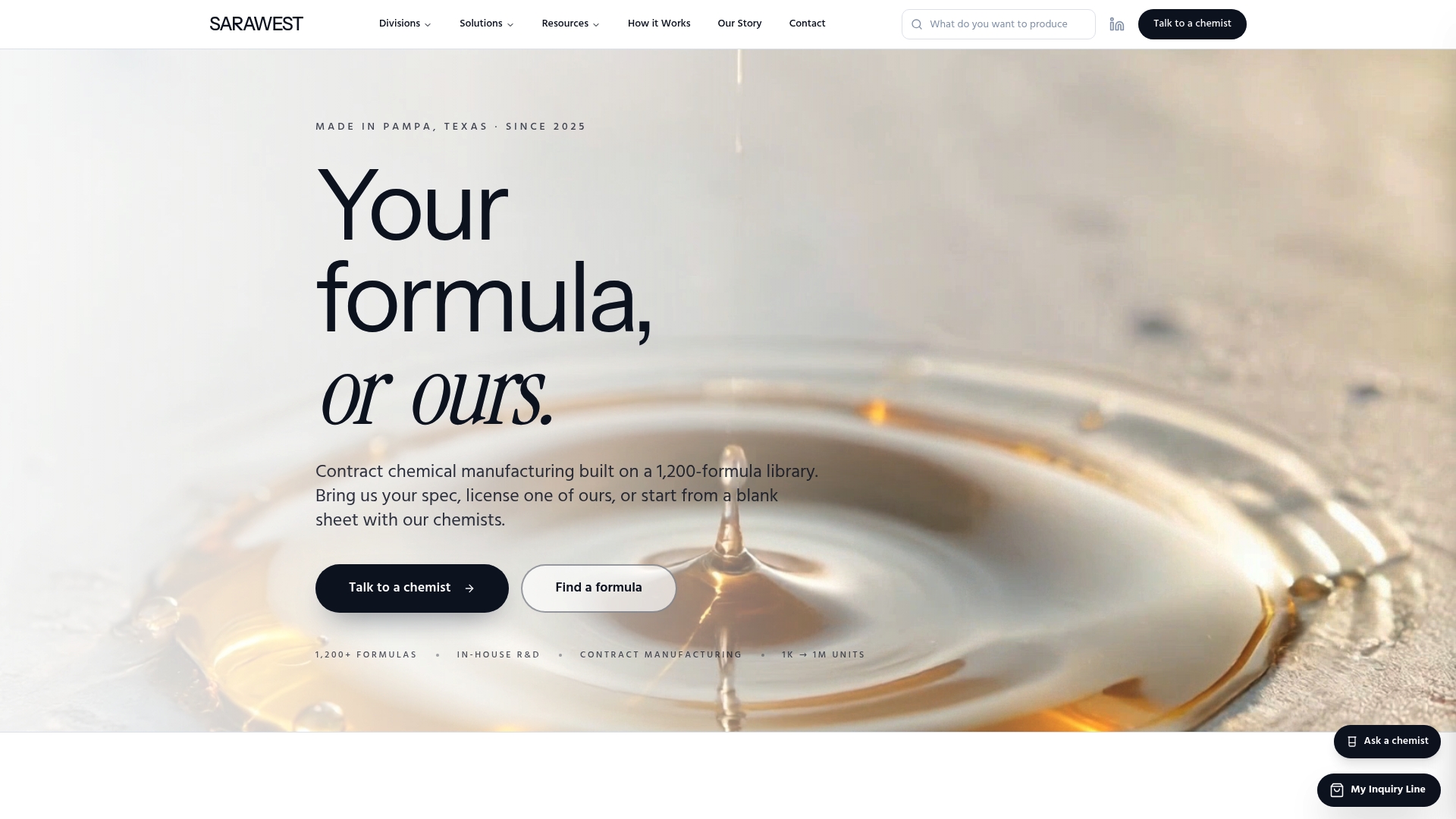
Private-label launches in categories like cleaning or leather care can often start from proven formulas, reducing development time. Orders can range from pilot batches to larger volumes, accommodating different demand levels. If you're deciding between a base formula and a custom build, the fastest way to find out is to send Sarawest USA your intended claims, target volume, and packaging format for a contract manufacturing quote, or browse the white-label manufacturing options built for exactly this kind of fast-track decision.
Sources
- HCS | Occupational Safety and Health Administration
- FDA MoCRA registration and listing guidance
- EPA antimicrobial pesticides guidance
FAQ
What Is the Fastest Way to Launch a Chemical Product?
The fastest reliable path is a private-label base formula from a chemist-led contract manufacturer, since the chemistry is already validated and only branding and minor adjustments remain. Sarawest USA's proprietary formula library is built specifically for this route, cutting bench development time almost entirely.
How Long Does EPA Antimicrobial Registration Add to a Launch?
Any product claiming to disinfect or sanitize needs pesticide registration under FIFRA, which runs on a separate and often lengthy timeline from standard product development. Classifying your claim before formulation begins, rather than after, is the single biggest lever for avoiding delay, according to EPA's antimicrobial guidance.
What Stability Data Do I Need Before Launch?
Accelerated stability testing on your actual packaging can support a tentative shelf-life claim strong enough to justify a launch window. Full production-scale stability testing still needs to continue after launch, according to nonprescription product stability guidelines.
Who Is Responsible for Preparing the Safety Data Sheet?
Whoever is designated the manufacturer of record under OSHA's Hazard Communication Standard is responsible for classifying hazards and producing a compliant SDS and label. This should be settled contractually before production starts, not assumed by either party.
Does a Lower MOQ Mean a Slower Launch?
Not necessarily. Lower minimum order quantities, sometimes as low as 1,000 units, let you validate a formula at production scale without committing to a full truckload, which often speeds up your path to market by reducing financial risk during the pilot stage.