
A pilot batch is a production-intent run, usually a small fraction of commercial scale, built to prove a manufacturing process is reproducible, stable, and ready to scale. Its core job is validation: confirming the process holds up outside the lab, that the product survives real packaging, and that every step gets documented for regulators. Pilot volumes vary by industry, but they typically sit well below full commercial output, giving teams a controlled dress rehearsal before committing to a full run.
TL;DR:
- A pilot batch must mimic commercial conditions closely, including equipment and process parameters, to accurately predict scale-up challenges.
- Non-linear scale effects like dead zones or heat transfer issues can cause failures at full scale, even if the pilot run appears successful.
- Proper documentation, including SOPs, deviation logs, and QC results, is essential for regulatory readiness and efficient tech transfer.
- Running iterative pilots with production-intent equipment and defining parameter targets upfront helps mitigate representativeness and scale-up risks.
- Early collaboration with manufacturing partners and comprehensive pre-run planning reduce surprises and streamline transition from pilot to full production.
Table of Contents
- Why Pilot Batches Matter and When to Run One
- Pilot Batch Manufacturing Steps and a Practical Checklist
- Representativeness and Scale-Up Pitfalls: Non-Linear Scaling and Mitigations
- Documentation and Records: BMR vs BPR and Regulatory Readiness
- Stability and Packaging Compatibility Testing to Run During a Pilot
- Sarawest USA's Practical Capabilities and Case Evidence
- Common Pilot Pitfalls, Red Flags, and a Readiness Checklist
- What Sequencing and Ownership Actually Look Like in Practice
- Ready to Move Your Formula From Bench to Pilot?
- Where to Go for Deeper Regulatory Guidance
- Sources
- FAQ
Why Pilot Batches Matter and When to Run One
A pilot batch answers a question a lab batch cannot: does this formula behave the same way when mixed, heated, filled, and packaged at something closer to real production conditions? Formulation verification tells you the chemistry works in a beaker. Process validation tells you the chemistry survives a pump, a filler, and a warehouse. Those are different claims, and conflating them is where a lot of scale-up plans go sideways.
You need a pilot run when any of the following applies:
- You're preparing a regulatory submission that requires process data beyond bench scale.
- You're transferring a formula between sites, chemists, or equipment types.
- You're finalizing packaging and need real fill, seal, and shelf-life data.
- You're moving from a contract lab to a manufacturing partner and need proof the process transfers cleanly.
The operational payoff is concrete: a validated batch production testing record, a defined set of critical process parameters, and enough data to negotiate commercial terms with confidence instead of hope.
Pilot Batch Manufacturing Steps and a Practical Checklist
A pilot run succeeds or fails based on what gets defined before the batch ever starts. Planning comes first: set objectives, pick a batch size that's large enough to stress the process but small enough to control, and lock down your critical process parameters (CPPs) and critical quality attributes (CQAs) before a single raw material is weighed out.
From there, the sequence looks like this:
- Confirm sourcing and specs. Lock raw material lots, supplier certificates, and equipment calibration before scheduling the run.
- Verify equipment readiness. Confirm mixers, fillers, and sensors match production-intent conditions, not lab-scale substitutes.
- Run in-process controls. Sample at defined intervals for pH, viscosity, fill weight, or whatever CQAs govern your product.
- Execute QC testing. Pull finished samples for the full test panel, not a shortened version.
- Review data and log deviations. Every out-of-spec result gets documented, investigated, and closed out.
- Allocate stability samples. Pull enough units in final packaging to support your stability protocol.
- Complete the batch production record and release. No release without a signed, reviewed record.
Pro Tip: Write your acceptance criteria and deviation-handling rules before the run starts, not after you see the first out-of-spec result. Deciding thresholds mid-run invites bias.
Representativeness and Scale-Up Pitfalls: Non-Linear Scaling and Mitigations
Representativeness means the pilot mimics the mixing intensity, shear, residence time, heat transfer, and fill/packaging conditions of the eventual commercial line. When those variables aren't matched, a pilot can pass beautifully and still fail at scale.
Scale-up rarely behaves in a straight line. A mixer that blends a formula evenly at pilot volume can create dead zones at ten times the size. Heat transfer that looked adequate in a jacketed pilot vessel can lag badly once wall-to-volume ratio changes at commercial scale. These are non-linear effects, and they surface exactly where teams least expect them: at the handoff between pilot and full production.
Practitioner guidance treats the pilot as a dress rehearsal, not a formality, and pushes teams toward equipment that mirrors production conditions rather than lab shortcuts, according to pilot plant design coverage focused on bridging R&D and manufacturing.
Mitigation strategies worth building into your plan:
- Use production-intent equipment for the pilot whenever the budget allows it.
- Run iterative pilots rather than betting everything on one pass.
- Define parameter equivalence targets (mixing speed, shear rate, dwell time) up front, not after a failure.
Dosage-form-specific guidance from ISPE's oral solid dosage documents reinforces this: representativeness requirements shift depending on whether you're validating a tablet, a liquid fill, or a cleaning concentrate.
Documentation and Records: BMR vs BPR and Regulatory Readiness
The Batch Manufacturing Record (BMR) is the approved master procedure. The Batch Production Record (BPR) is the executed record of what actually happened during a specific run, filled in real time by the operators who ran it. One is the recipe; the other is the proof you followed it.
During a pilot, you should generate:
- Standard operating procedures (SOPs) for every unit operation performed.
- A deviation log capturing anything that fell outside spec, with root-cause notes.
- Full QC test results tied to sample IDs and timestamps.
- Cleaning and equipment-use logs showing the line was qualified before the run.
Teams that treat this paperwork as an afterthought pay for it later, usually during tech transfer when a partner asks for records that don't exist. Solid batch manufacturing records shrink validation timelines because reviewers aren't reconstructing history from memory. WHO's technical guidance on manufacturing and quality practices, laid out in TRS986 annex 2, sets useful benchmarks for what a complete pilot documentation package should contain.
Stability and Packaging Compatibility Testing to Run During a Pilot
Lab-scale stability data can mislead you. Differences in mixing intensity, air exposure, and thermal history between a benchtop batch and a pilot run mean a formula that looked stable in a beaker can shift once it's exposed to real production handling. That's why pilot-scale stability testing in final packaging, not a lab surrogate, gives you the most predictive read on shelf life.
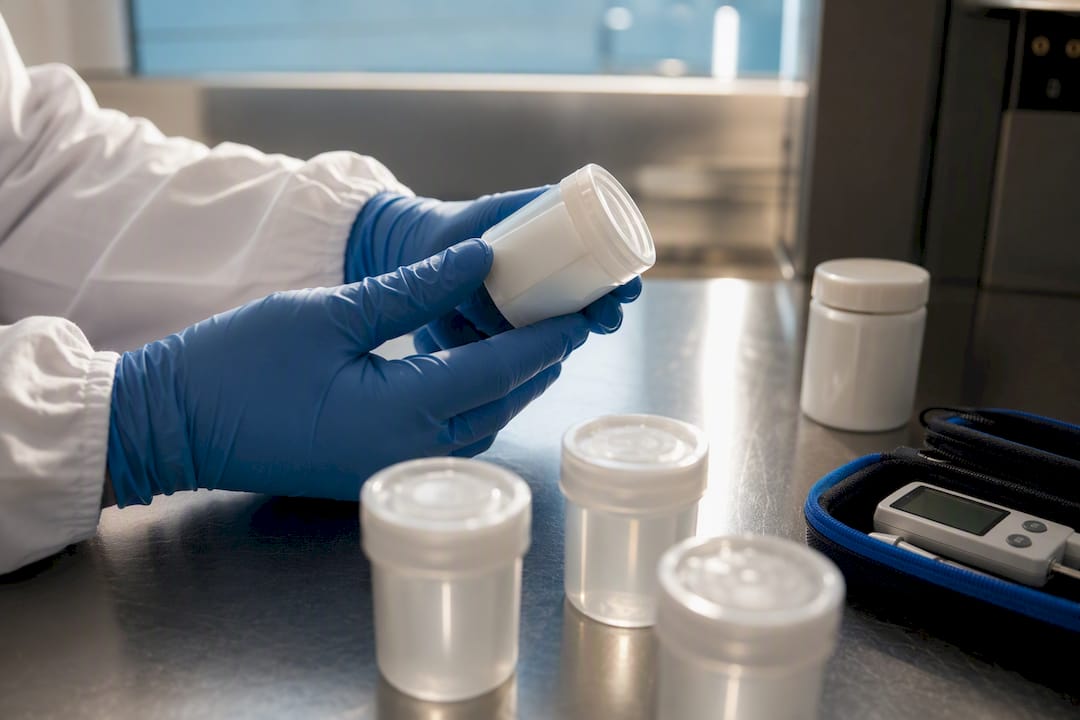
Typical pilot stability protocols pull samples at defined intervals (commonly a small number of lots with multiple pull points) and store them under both accelerated and real-time conditions. A shelf-life protocol built around pilot and small production runs shows how this looks in practice for cleaning formulations.
Packaging compatibility deserves equal attention. Prioritize:
- Extractables and leachables testing for anything touching the final container.
- Barrier performance under real storage conditions.
- Headspace and fill-level checks.
- Sealing integrity across the full batch, not a handful of spot checks.
A structured packaging compatibility testing approach catches problems before they become field complaints.
Sarawest USA's Practical Capabilities and Case Evidence
Pilot manufacturing works best when the partner running it has done it enough times to know where the process usually breaks. Pilot and scale-up work often involves in-house R&D chemists utilizing a library of proprietary formulas across multiple industries, which means most pilot projects start from a proven base instead of a blank page.
Engineers moving a formulation from lab to pilot scale routinely reach production-ready confidence after three successful runs, once iterative adjustments and documentation are locked in.
That pattern held in a real case tracked in Sarawest USA's lab-to-pilot analysis. A separate example, a 1,000-unit pilot for a liquid filling process, walked through fill accuracy, sealing consistency, and QA sampling at a volume large enough to expose real production risk.
What a pilot project with Sarawest USA typically includes:
- Batch production records maintained from the first run onward.
- QC testing aligned to the client's acceptance criteria.
- Documentation formatted to support tech transfer and regulatory review.
- Turnaround fast enough that pilot results inform commercial decisions within weeks, not quarters.
Common Pilot Pitfalls, Red Flags, and a Readiness Checklist
Most pilot failures trace back to three habits: skipping equipment qualification, changing more than one variable at a time, and treating documentation as paperwork instead of proof. Fix those three and most scale-up surprises disappear.
Watch for these red flags mid-run:
- Sampling results that drift steadily rather than sitting flat. That signals equipment fatigue, not random noise.
- Operators improvising steps not written in the SOP. Stop and document, don't proceed and explain later.
- Packaging seals that pass visually but fail under pressure testing. That gap shows up in returns, not in the pilot report.
Pro Tip: If two things go wrong in the same run, don't rush to blame one root cause. Non-linear scale effects often produce compound failures that look related but aren't.
Before you schedule a pilot, confirm: documentation templates exist, final packaging is sourced, analytics are qualified and ready, and acceptance criteria are written down and signed off by QA. A scale-up playbook is worth reviewing alongside your own checklist before committing dates.
What Sequencing and Ownership Actually Look Like in Practice
Speed tempts every team running a pilot, but reproducibility has to win that argument every time. A process that looks fast because it skipped documentation isn't fast. It's a liability with a delay attached. R&D should own formulation intent, the process engineer owns parameter equivalence, QA owns acceptance criteria and sign-off, and supply chain owns sourcing timelines before the run starts. Talk to your manufacturing partner early. The earlier they see your specs, the fewer surprises show up at scale.
— Faisal Mansur
Ready to Move Your Formula From Bench to Pilot?
Sarawest USA runs pilot batch manufacturing the way it should work: real in-house chemists, a formula library built across eight industries, and production under one roof so your pilot doesn't stall waiting on a broker to relay questions. Companies working with a traditional contract lab often wait weeks for a quote and longer for a revision. Some contract manufacturers offer fast prototype request turnarounds because the chemist involved can directly communicate with clients.
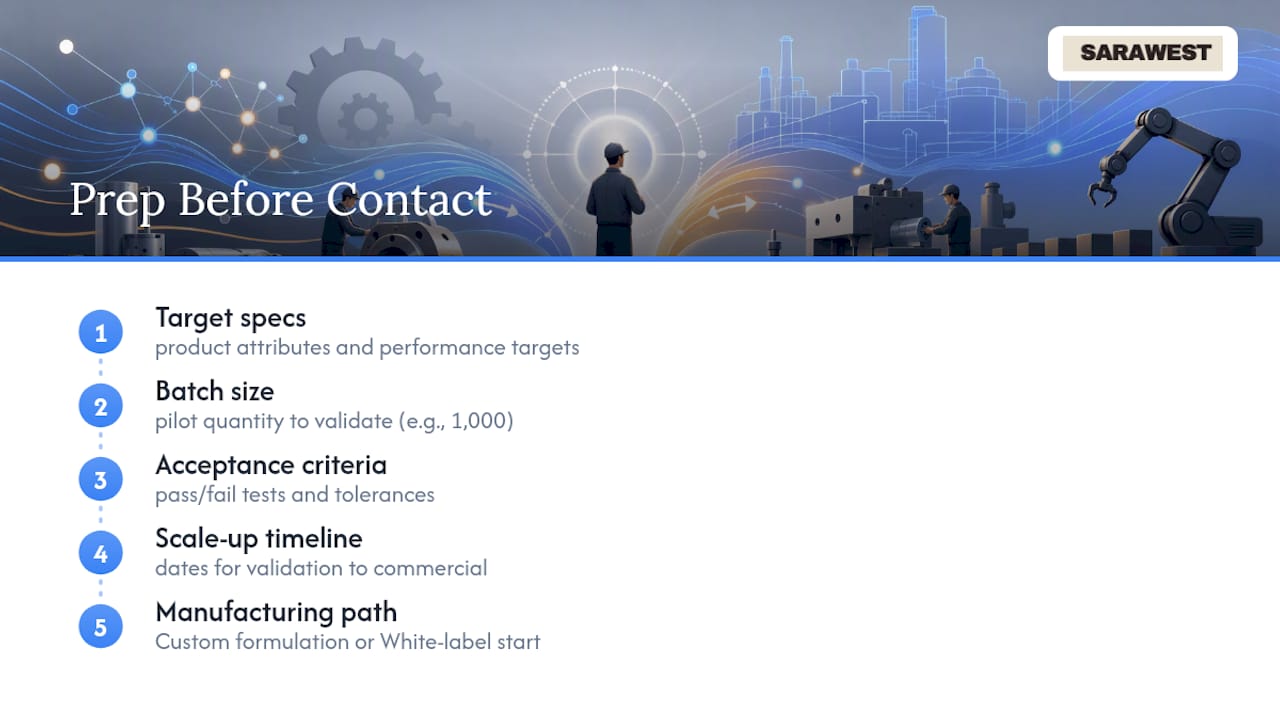
Before reaching out, gather your target specs, the batch size you're planning to validate, your acceptance criteria, and your timeline for scale-up. That prep turns a first call into a real quote instead of a discovery conversation.
Whether you need a 1,000-unit pilot to validate a liquid filling process or a full custom formulation built from scratch, Sarawest USA's contract manufacturing team can scope the run and tell you what it takes to get from pilot to commercial. If you already know the formula and just need it produced under your own brand, the white label manufacturing path skips formulation entirely and starts at production.
Where to Go for Deeper Regulatory Guidance
For teams building out a formal validation package, three references are worth keeping on hand: the WHO technical report series, TRS986 annex 2 for manufacturing and quality expectations, ISPE's oral solid dosage guidance for dosage-form-specific validation practices, and industry coverage on pilot plant design for equipment and layout considerations. Teams outside pharma exploring adjacent processes may also find value in a small-batch CNC machining guide covering equipment selection principles that carry over to pilot-scale process design.
Sources
- WHO technical report series, TRS986 annex 2
- ISPE guidance documents: oral solid dosage
- Pilot plant design: Bridging the gap between R&D and manufacturing
FAQ
What Is Pilot Batch Production?
Pilot batch production is a reduced-scale manufacturing run, produced under production-intent conditions, used to confirm a process is reproducible, stable, and ready for full commercial scale-up.
What Is the Difference Between BMR and BPR?
A Batch Manufacturing Record (BMR) is the approved master procedure showing how a product should be made, while a Batch Production Record (BPR) is the executed, filled-in record of what actually happened during a specific run.
What Does "Pilot" Mean in Manufacturing?
In manufacturing, "pilot" refers to an intermediate-scale production run, larger than a lab batch but smaller than a full commercial batch, used to validate a process before committing to full-scale output.
Why Are Only Three Batches Typically Used for Process Validation?
Three successful runs are commonly used because they demonstrate consistency across repeated executions rather than a single result, giving teams enough data to confirm the process reliably reproduces the same outcome, a pattern reflected in real lab-to-pilot transitions.
Can Sarawest USA Run a 1,000-Unit Pilot Batch?
Pilot batch manufacturing at scales including 1,000-unit runs is commonly supported by contract manufacturing firms that provide R&D and documentation support from the first batch onward.