
A qualified contract manufacturer can supply premixed validation and calibration liquids complete with a Certificate of Analysis (COA), validated recovery methods, and full batch traceability. That's the direct answer. The next move is putting together a request for quote (RFQ) that forces vendors to show their work instead of just quoting a price.
Your RFQ needs three things at minimum:
- Target analytes and acceptance limits — what the liquid needs to detect or challenge, and at what threshold.
- Intended use — cleaning validation challenge fluid, calibration standard, or general QC reference liquid.
- Batch size and pilot needs — whether you need a lab batch to prove the concept or a pilot run sized for scale-up.
Watch for vendors who dodge questions about recovery studies, can't describe a pilot process, or get vague about how they issue a Master Manufacturing Record (MMR) or COA. Those gaps show up in an audit long before they show up in a sales call.
Key Takeaways
A reliable premixed validation liquid depends on documented recovery studies, a defensible worst-case rationale, and traceable batch records, not just a competitive price quote.
| Point | Details |
|---|---|
| Lead with the RFQ | Specify target analytes, intended use, and batch size before requesting quotes. |
| Demand documented recovery studies | A method without validated LOD/LOQ can't confirm pass or fail results reliably. |
| Require lifecycle-style documentation | COAs, MMRs, and change-control triggers should be contract deliverables, not extras. |
| Set realistic timelines | Custom formulation runs longer than private-label due to R&D rounds and stability testing. |
| Consider Sarawest USA for scale-up | Its in-house R&D and 1,200-plus formula library support pilot-to-truckload production with full batch traceability. |
Table of Contents
- What Does the Mixing Validation Liquids Process Look Like From Feasibility to Full Scale?
- How Do You Evaluate a Contract Manufacturer for Validation Liquids?
- What Documentation Should You Require in the RFQ and Contract?
- Why Do Worst-Case Rationale and Lifecycle Verification Matter So Much?
- How Long Does It Take, and What Are Realistic Minimum Order Quantities?
- What Actually Separates a Reliable Validation-Liquid Supplier From a Risky One
- How Do You Start a Project With Sarawest USA for Premixed Validation Liquids?
- Frequently Asked Questions
- Sources
What Does the Mixing Validation Liquids Process Look Like From Feasibility to Full Scale?
A real contract manufacturing partner moves through four distinct stages, and a vendor who skips any of them is cutting corners you'll inherit later.
- Feasibility and formulation review. The chemist checks compatibility between your target analyte, the base liquid, and your packaging or storage conditions before anything gets mixed.
- Lab-batch development. Small-batch runs establish the method, and recovery studies confirm the analytical technique can actually detect what it's supposed to detect at the concentration that matters.
- Pilot-scale run. The formula moves onto real manufacturing equipment to prove it scales without drifting from the lab result, per the FDA's inspection guidance on documented process consistency.
- Full-scale production. Every batch ships with a COA and a traceable batch record tying raw materials to the finished liquid.
Pro Tip: Ask for a sample COA and a pilot batch record before you sign anything. If a vendor hesitates to show you what a finished document actually looks like, that's your answer.
How Do You Evaluate a Contract Manufacturer for Validation Liquids?
Score bidders against four categories, not just price per liter.
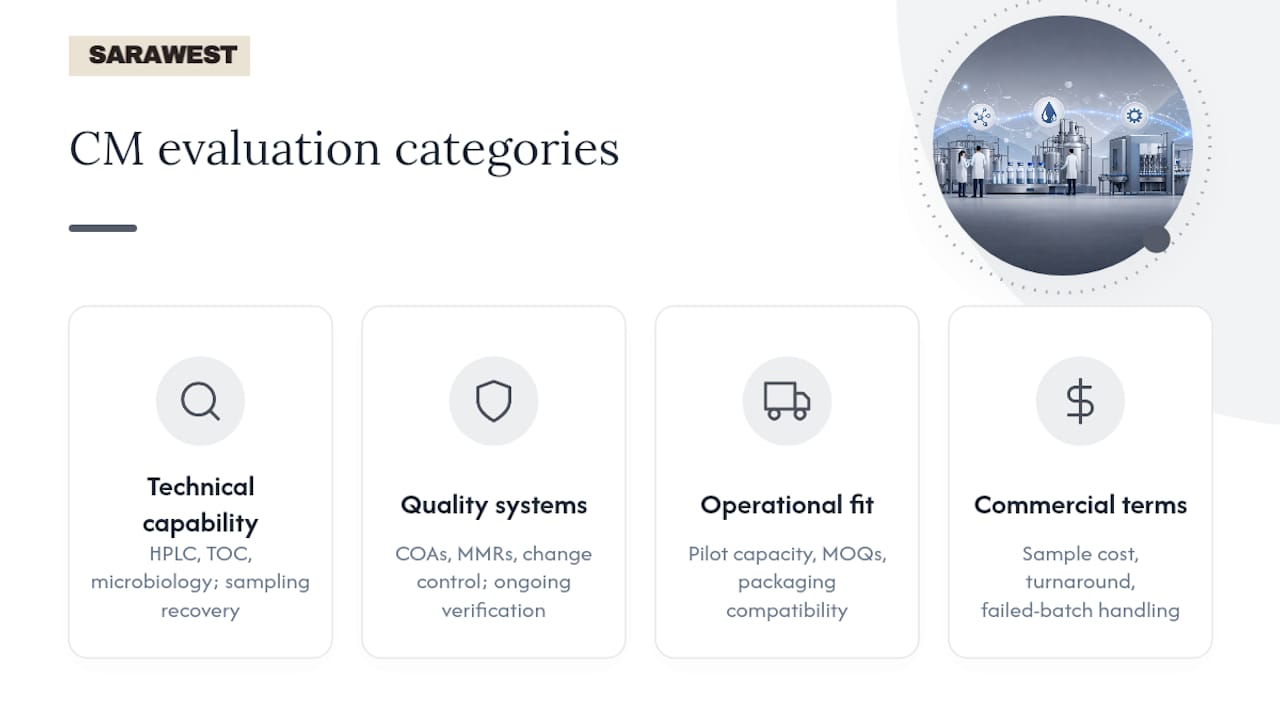
Technical capability. Confirm in-house access to HPLC, TOC analysis, and microbiology testing, plus documented recovery studies for the sampling method you'll actually use, whether that's swab, rinse, or product-contact sampling.
Quality systems. Ask how they generate COAs and MMRs, how change control works when a formula shifts, and whether their approach reflects the lifecycle model for cleaning validation that ISPE and PDA guidance both point toward. One-and-done validation is an outdated model; regulators expect ongoing verification.
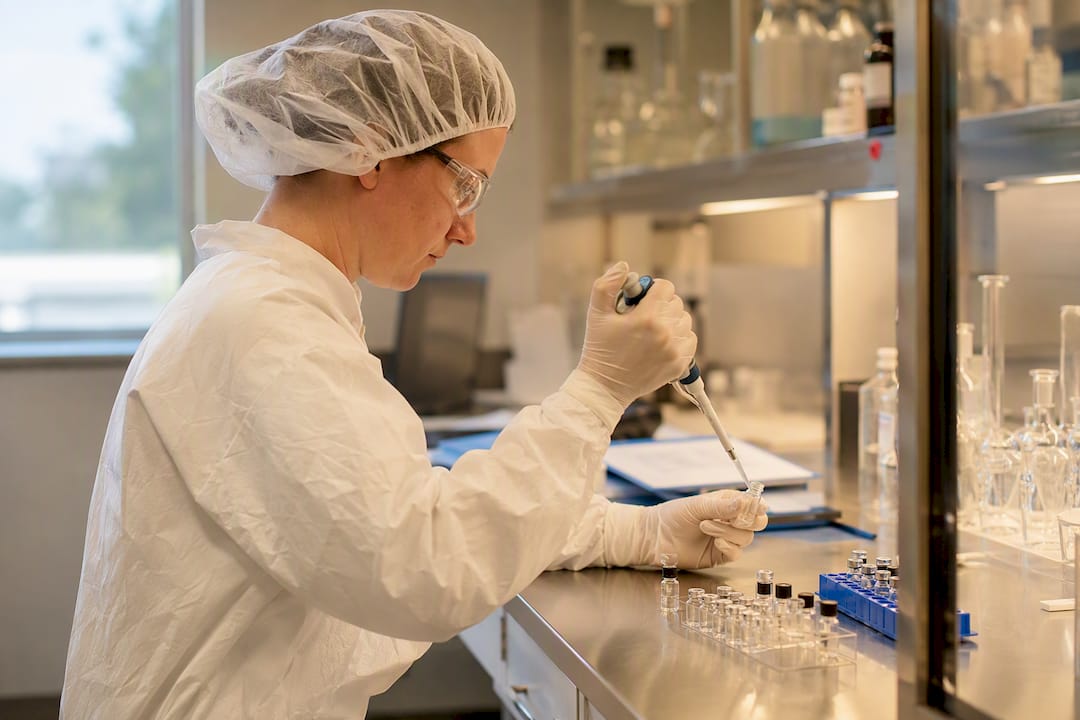
Operational fit. Pilot capacity, minimum order quantities, and packaging compatibility all determine whether this vendor can actually grow with you or just fill your first order.
Commercial terms. Sample program cost, turnaround time, and what happens if a batch fails release testing.
Cleaning validation programs that skip validated sampling methods run into a documented and specific problem: analytical detection limits that sit above the acceptance criteria they're supposed to measure against. A method with a limit of detection higher than your acceptance limit doesn't just underperform. It can't tell you whether you passed or failed.
Before shortlisting anyone, request their audit history, their standard operating procedure for out-of-specification results, and a redacted sample of a real batch record. A supplier audit checklist built for contract chemical manufacturing gives you a structured way to score these answers instead of relying on gut feel.
What Documentation Should You Require in the RFQ and Contract?
Specify these deliverables in writing, not as an assumption.
- COA per batch, listing every analyte tested, the acceptance limit, and the actual result, tied to a batch number you can trace back to raw materials. A Certificate of Analysis that lacks traceable batch data is a marketing document, not a quality record.
- MMR access, including ingredient-level supplier COAs, so you can verify what actually went into the mix rather than trusting a label.
- Method validation evidence, meaning documented recovery studies, limit of detection and limit of quantitation (LOD/LOQ) values, and current calibration certificates for the instruments used to test your liquid.
- Stability and storage specs, covering shelf life, container compatibility, and labeling requirements so the liquid performs the same on day 200 as it did on day one.
None of this is bureaucratic overhead. It's the paper trail that turns a "we tested it once" claim into evidence an inspector will actually accept.
Why Do Worst-Case Rationale and Lifecycle Verification Matter So Much?
Selecting a worst-case fluid isn't a formality. It's the mechanism that lets one validated liquid stand in for a whole family of products or equipment, and inspectors take that shortcut seriously only when the reasoning behind it is documented and defensible.
Without data-backed reasoning behind the worst-case selection, inspectors can reject the entire bracketing approach and force validation of every individual product. That single gap can undo months of otherwise solid work.
A few failure patterns show up again and again in audits:
- Stale toxicological limits. A minor ingredient swap changes the permitted daily exposure (PDE) or acceptable daily exposure (ADE) value, but nobody revalidated the challenge fluid against the new number.
- Recovery studies that don't match reality. A study run on stainless steel gets applied to a facility with plastic or gasketed contact surfaces, and the assumption doesn't hold.
- No revalidation trigger. A formula, supplier, or dirty-hold time changes, and nothing in the contract forces a review.
Regulatory guidance increasingly frames cleaning validation as a continuous verification process rather than a checkbox exercise, which is exactly the standard your contract manufacturer's documentation should reflect. A case study on cleaning validation for injectable manufacturing shows what this looks like in practice: multiple runs, TOC and bioburden acceptance criteria set in advance, and swab and rinse sampling executed to a written protocol rather than improvised on the floor.
How Long Does It Take, and What Are Realistic Minimum Order Quantities?
Timelines depend on how much method development your project needs, not just how fast the mixing tanks run. Analytical method development and recovery studies usually take longer than the mixing itself, and stability testing adds weeks you can't compress without cutting corners.
- Feasibility to lab batch typically runs on the shorter end of the timeline, especially if you're adapting an existing formula rather than starting from scratch.
- Custom formulation projects commonly involve an R&D deposit and multiple revision rounds, which stretches timelines well beyond a private-label order, according to documented custom formulation workflows.
- Pilot batches often run in the range of roughly 1,000 units before scaling to full production, though exact minimums vary by facility and formula complexity.
Pro Tip: If a vendor offers to compress your timeline for a fee, get the trade-off in writing. Ask specifically what testing step gets shortened, because "faster" almost always means something got skipped.
What Actually Separates a Reliable Validation-Liquid Supplier From a Risky One
Most procurement teams treat contract manufacturers for validation liquids the same way they'd treat a bulk chemical supplier: get three quotes, pick the middle one, move on. That instinct causes more audit pain than any other single procurement mistake I've seen discussed in this space.
The real differentiator isn't price. It's whether a vendor treats recovery studies and worst-case rationale as a documentation exercise or as engineering work. Sarawest USA approaches it the second way, drawing on a library of more than 1,200 proprietary formulas and in-house R&D chemists who can adapt an existing formula or build one from scratch without routing your project through a broker. That matters because rapid prototyping only helps you if the chemist doing it can also defend the recovery study behind it.
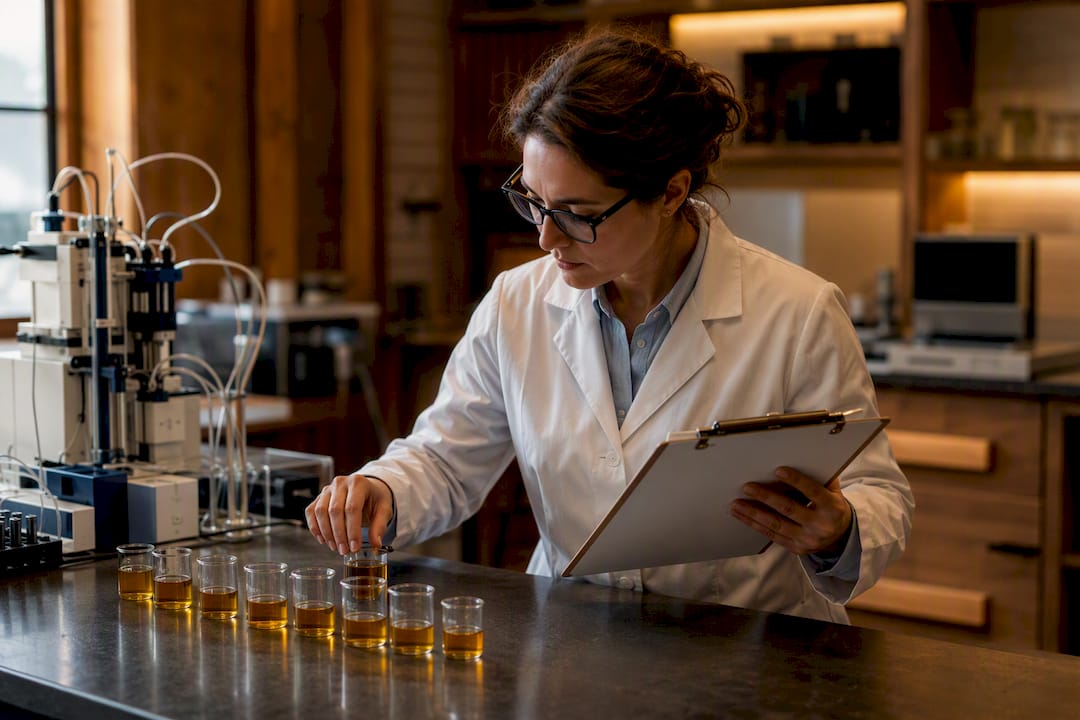
The operational advice worth taking seriously: lock in recovery study data before you commit to a full-scale order, require pilot-run data as a contract deliverable rather than a nice-to-have, and write explicit change-control triggers into the agreement so a supplier or formula swap automatically forces revalidation. Transparent documentation, meaning sample COAs and MMR excerpts shared before you sign, does more to shorten audit prep than any amount of vendor reassurance.
How Do You Start a Project With Sarawest USA for Premixed Validation Liquids?
Sarawest USA is the alternative to working through a broker or a slow-moving generalist manufacturer: you get direct access to in-house chemists, a library of over 1,200 proprietary formulas to adapt instead of starting from zero, and pilot-to-truckload capacity under one roof.
That combination shows up in the numbers that matter to a quality team: rapid prototyping that can turn a sample around fast, pilot runs sized to prove scale-up before you commit to a full production order, and a COA with full batch traceability on everything that ships. Our 30,000 sq ft manufacturing facility handles pilot batches starting around 1,000 units up through full truckloads, so you're not locked into a minimum that doesn't fit your validation program.
To get a fast, accurate quote, send us your target analytes and acceptance limits, the intended use case, and your desired batch size. You can see how past formulation projects scaled in our case studies, or skip straight to requesting product samples to start testing against your own protocol this week.
Frequently Asked Questions
What is the difference between a standard formulation and a custom-formulated validation liquid? A standard formulation draws on an existing, previously validated recipe from the manufacturer's library, which usually means faster turnaround and a lower minimum order. Custom formulation involves R&D work to build or heavily modify a formula for your specific analyte or use case, which typically adds development time and cost but gives you a liquid tailored to your exact acceptance criteria.
What questions should I ask a supplier about recovery studies? Ask which materials of construction and analyte classes the recovery study covered, since a recovery percentage established on stainless steel doesn't automatically apply to plastic or gasketed surfaces. Also ask for the actual recovery percentage and how it factors into the acceptance limit calculation, not just a pass or fail statement.
How often should a validation liquid formula be reviewed or revalidated? Revalidation should happen any time the formula, a raw material supplier, or a process parameter like dirty-hold time changes. Contracts should name these triggers explicitly rather than leaving revalidation timing to informal judgment.
What size batch should I request for an initial pilot run? Pilot batches often start around 1,000 units, though the right size depends on your facility's full-scale MOQ and how much data you need before committing to production. Discuss your target full-scale volume upfront so the pilot batch is genuinely representative.
Can a contract manufacturer supply both cleaning validation fluids and calibration standards? A manufacturer with in-house analytical capability and a broad formula library can typically support both, but confirm they have validated methods and acceptance criteria specific to each use case. Calibration standards and cleaning challenge fluids have different documentation and stability requirements, so don't assume one validation package covers both.
Sources
- ISPE — Guide: Cleaning validation lifecycle
- APIC/Cefic — Cleaning validation guide (2021)
- Performance Validation — Case study: cleaning validation for injectables (2025)
- AuroraCos — The custom formulation (OEM) process