
For most businesses that need reliable, site-specific odor control, contract manufacturing with a partner that runs in-house R&D and rapid prototyping is the fastest, lowest-risk route to a working product. Building an in-house lab rarely pencils out below serious volume, and off-the-shelf formulas can't be tuned to your specific gas profile. The checklist below shows exactly what to look for when you vet a manufacturer.
TL;DR:
- A reputable manufacturer should conduct site-specific gas sampling and provide a documented pilot batch before full-scale production begins.
- Activated carbon, especially impregnated variants, remains the primary raw material for efficient odor absorption, but regulatory handling and lead times vary by treatment.
- Quality control requires lab verification with GC/MS testing, comprehensive documentation, and stable batch records, especially under strict regulations.
- Manufacturers with in-house R&D teams can swiftly adapt formulas based on real-world odor data, reducing troubleshooting time and increasing success rates.
- Conducting gas sampling, pilot testing, and requesting detailed documentation are essential steps to avoid relying on unproven formulas and to ensure product efficacy.
Table of Contents
- What Types of Industrial Odor Eliminators Get Manufactured?
- How Is an Odor Eliminator Actually Manufactured?
- What Raw Materials Go Into Odor Eliminator Formulas?
- What Quality and Compliance Standards Should You Require?
- How Do You Choose the Right Contract Manufacturer?
- Why In-House R&D Changes the Risk Math
- Getting the Trade-offs Right in 2026
- How Sarawest USA Fits Into Your Manufacturing Plan
- Sources
What Types of Industrial Odor Eliminators Get Manufactured?
Odor eliminator manufacturing splits into five main product formats, each with its own production demands. Knowing which one fits your facility narrows your search before you ever request a quote.
- Sprays and aerosols: fast-acting, used in food processing and fleet cleaning, requiring precise emulsion and fill-line work.
- Liquid concentrates: diluted on-site for wastewater plants and rendering operations, favored for bulk shipping economics.
- Impregnated carbon cartridges: built for HVAC integrators and continuous air-handling systems, requiring specialized carbon impregnation.
- Powder bags and sachets: used in enclosed spaces like lockers, vehicles, and storage units, built around activated charcoal or silica gel in breathable pouches.
- Microbial and bio-based blends: applied where odors originate biologically, such as manure or slurry handling, and need live-culture stability rather than simple absorption.
Sprays, concentrates, and bio-blends demand real formulation chemistry and specialty chemical sourcing. Cartridges and sachets lean more on packaging engineering once the active media is sourced correctly.
How Is an Odor Eliminator Actually Manufactured?
Production runs through five stages, and each one carries its own cost and timing pressure.
- Gas sampling and prototyping. A qualified manufacturer collects samples from your actual site and identifies the chemical culprits before touching a formula. Effective odor-control projects pair field gas sampling with lab testing so the treatment matches the odor's chemistry rather than guessing at a generic fix.
- Small-batch validation. Chemists build a lab-scale batch, test it against the sampled gases, and adjust concentration ratios before anyone commits to a production run.
- Blend and batch operations. Once validated, the formula moves to batch tanks for homogenization, where active ingredients get dispersed evenly and preservatives are added for shelf stability.
- Filling and packaging. Depending on format, product goes into drums, totes, sachets, or cartridges. Filling-line speed and packaging choice are usually the biggest swing factors in unit cost.
- Process controls and stabilization. Mixing tolerances, pH checks, and shelf-life stabilization steps run throughout, not just at the end.
Pilot runs typically move faster than full production simply because there's less equipment changeover involved, while full-scale runs are slowed most by filling-line scheduling and packaging sourcing rather than the chemistry itself.
Pro Tip: Ask any prospective manufacturer how many gas-sampling-to-pilot-batch cycles they've run in the last year. A high number signals real production throughput, not just a lab full of beakers.
What Raw Materials Go Into Odor Eliminator Formulas?
Activated carbon anchors most industrial odor control work. It's the most widely used adsorbent because of its enormous internal surface area, and impregnated versions target specific gases rather than odor in general.
- Activated carbon: base-grade for general VOCs; impregnated variants (acid-washed, amine-treated) target ammonia, hydrogen sulfide, and acid gases specifically.
- Absorbent matrices: zeolite, silica gel, and charcoal fill sachets and cartridges, chosen for pore size and moisture tolerance.
- Biological agents and enzyme blends: living microbial consortia that biodegrade compounds rather than trap them, requiring cold-chain handling and stability testing that inert adsorbents never need.
- Fragrance carriers and solvent systems: alcohol or glycol-based carriers that keep scent compounds stable and evenly dispersed in sprays and concentrates.
One internal surface area figure worth knowing: activated carbon can carry roughly 1,000 square meters of surface area per gram, which is why small quantities handle large odor loads. Specialty impregnated carbons often run longer lead times than standard grades, and certain amine or acid treatments carry their own regulatory handling limits, so build sourcing lead time into your production calendar early.
What Quality and Compliance Standards Should You Require?
Quality control separates a manufacturer you can trust with a full truckload from one you should walk away from after a pilot batch. The paperwork matters as much as the chemistry.
- Lab verification: GC/MS or mass-spec testing that confirms the formula actually neutralizes the sampled gases, not just masks them.
- Documentation: SDS/MSDS sheets, certificates of analysis, batch records, and shelf-life data should arrive with every order, not on request after a problem surfaces.
- QA processes: batch traceability, stability testing under heat and humidity, and third-party audits where the manufacturer allows them.
- Scale indicators: pilot batch minimums, tiered MOQs, and stated capacity for continuous production runs.
Regulatory context matters here too. The EPA doesn't regulate "odor" as a standalone metric; it regulates the hazardous constituents that often cause it under the Clean Air Act. That distinction should shape which documentation you ask for, particularly if your facility already tracks emissions. Tighter QA and third-party testing add cost and sometimes a week or two to delivery, but they're the difference between a formula that works in the lab and one that holds up on your production floor.
How Do You Choose the Right Contract Manufacturer?
Run every candidate through the same checklist, and don't skip the operational questions just because the chemistry sounds impressive.
- Technical capability. Do they have in-house R&D chemists, on-site or partner lab testing, and prototyping support, or are they reselling someone else's formula?
- Packaging range. Can they fill sachets, cartridges, drums, and totes, or only one format?
- Regulatory readiness. Will they hand over SDS sheets, COAs, and batch records without a fight?
- Commercial terms. What are the MOQ tiers, is there a sample program, and are pricing breaks tied to volume or to formula complexity?
- Operational resilience. What are stated lead times, do they carry backup suppliers for specialty carbon or enzyme cultures, and can they handle logistics to your dock?
A useful red flag: any manufacturer who quotes a price before requesting a gas sample or asking about your specific odor source is skipping the step that actually determines whether the product works. On your RFQ, ask for a sample turnaround date, a documented pilot batch size, and one reference case with a similar odor profile. Vague answers to any of those three should end the conversation.
Why In-House R&D Changes the Risk Math
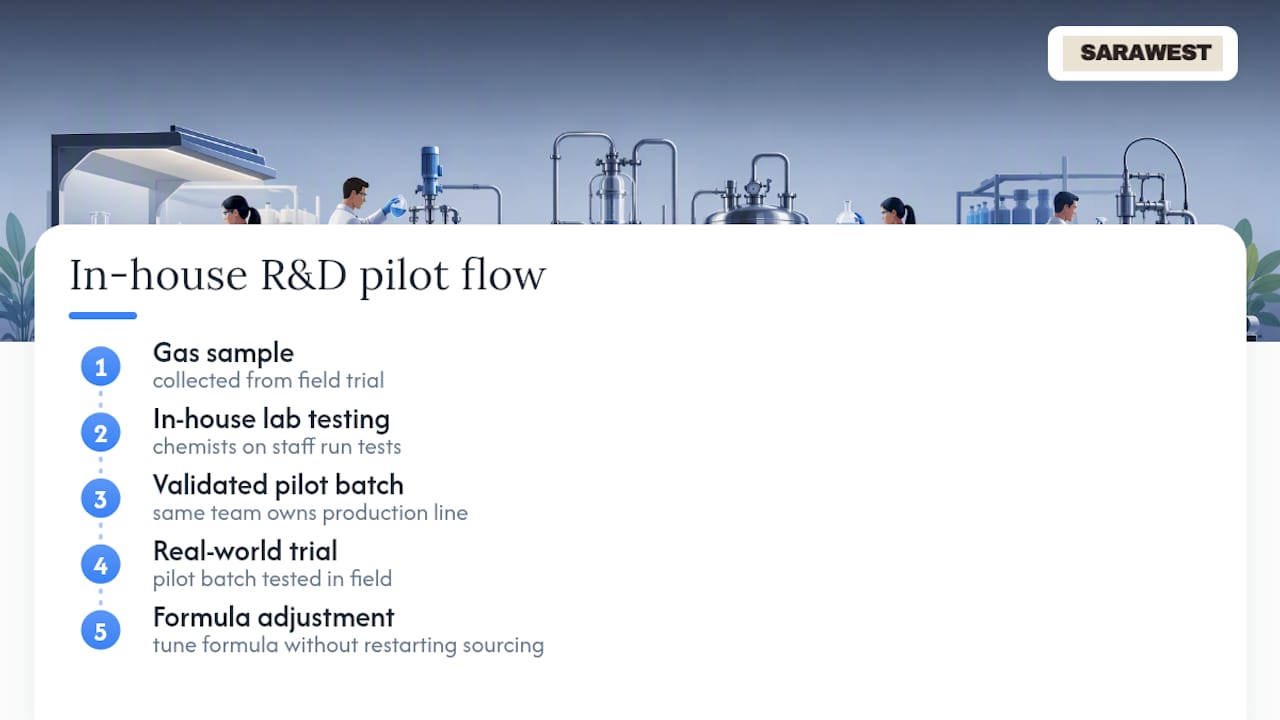
A manufacturer with chemists on staff, rather than a broker reselling stock formulas, troubleshoots faster when a pilot batch underperforms in the field. They can tune a formula after a real-world trial instead of restarting the sourcing process from scratch.
A manufacturer running this model offers a library of proprietary formulas across multiple industries and an in-house team that adapts or builds formulas to spec. That structure shortens the distance between a gas sample and a validated pilot batch, because the same team that ran the lab test also owns the production line. The formulation track record shows how that plays out across past contract projects, and it's worth reviewing before you commit to a vendor with less transparency about their process.
Getting the Trade-offs Right in 2026
Speed and unit cost pull in opposite directions, and most procurement teams pick wrong by defaulting to whichever budget line they're watching that quarter. If your facility has a genuinely unusual odor profile, rendering byproducts, specific wastewater compounds, custom formulation earns its cost every time a generic spray fails on-site. If your odor load is standard and your volume is high, a large MOQ on a proven formula beats paying for R&D you don't need.
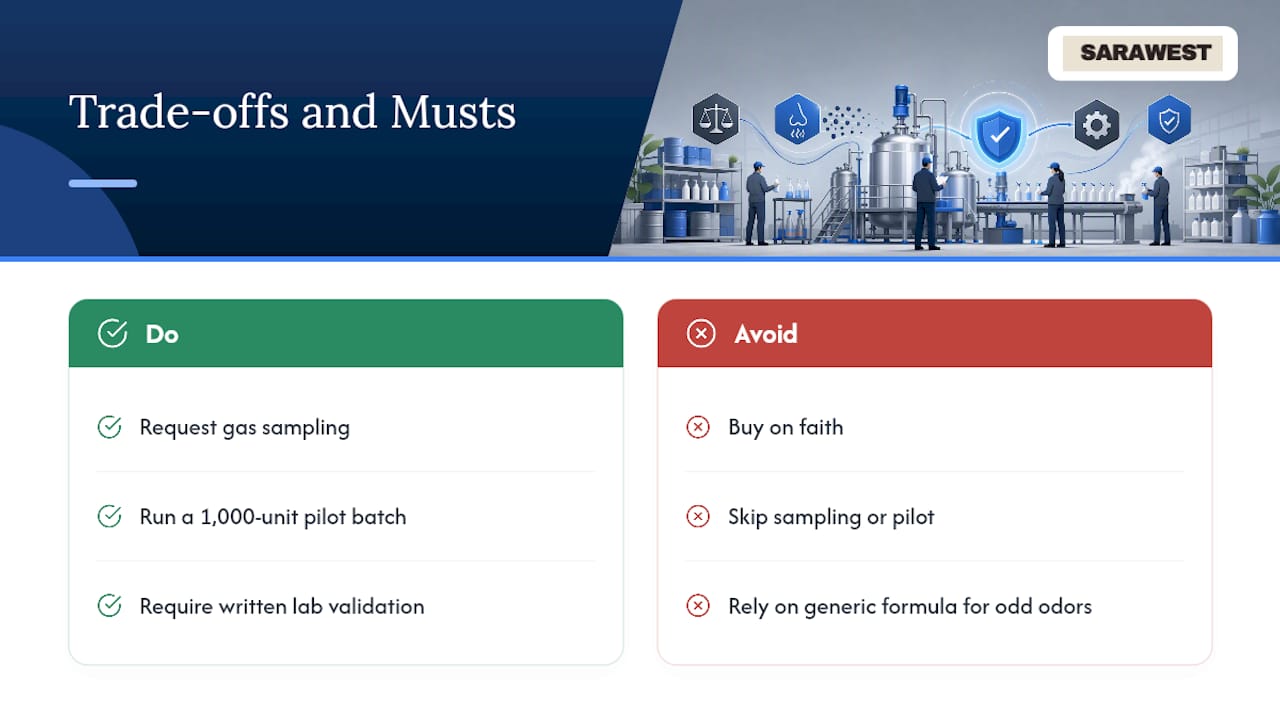
The practical move either way: request gas sampling before any formula discussion, run a pilot batch in the 1,000-unit range before committing to a truckload, and require lab validation in writing. Skip any of those three, and you're buying on faith.
— Faisal Mansur
How Sarawest USA Fits Into Your Manufacturing Plan
If you're comparing contract manufacturers, the real question isn't who has the biggest catalog. It's who can turn a gas sample into a validated formula without three rounds of email back-and-forth through a broker. Sarawest USA works directly with your team, no middleman, on formulas pulled from an existing library of over 1,200 proprietary chemistries or built from scratch for your exact odor profile.
Pilot programs often start at around 1,000 units, allowing validation of a formula on site before committing to a full production run. In-house R&D chemists handle reformulation work directly, so the same team that runs the lab tests can adjust the batch after field trials. Whether you need a private-label sports odor spray, a bulk drum solution for commercial cleaning, or a fully custom formula for a wastewater application, the contract manufacturing team can quote a fast RFQ and get a pilot batch moving. Start there, tell us what your odor problem actually is, and we'll tell you what it takes to fix it.
Sources
- Industrial Odor Control Solutions: A Complete Guide | RoboVent
- Air Freshener Power Bag Manufacturing Plant Project Report | Expert Market Research
- Industrial Odor Control Systems & Solutions | Ecosorb by OMI