
Dual sourcing is the right move for any product where a supply outage would hurt revenue or trigger a compliance failure, and the model that works in practice is a primary/secondary allocation, commonly allocating the majority volume to the primary and a smaller share to the secondary. That split keeps your primary partner's volume discounts largely intact while a qualified secondary stays warm and ready. For chemical and formula-based brands, a direct manufacturer like Sarawest USA can serve either role without the delay a broker adds.
TL;DR:
- Qualifying a secondary manufacturer early reduces costs and delays by ensuring readiness during a crisis and avoiding resource-intensive qualification during outages.
- An allocation split of 70/30 or 80/20 is common, but selection should be based on quality system alignment, scalability, and logistics fit rather than solely on cost or volume.
- Legal agreements including clear quality technical and master service agreements are essential to assign responsibilities and protect against deviations, change control, and liability disputes.
- Regular communication, shared documentation, and dedicated ownership prevent operational drift and keep both manufacturing sites aligned with specifications and KPIs.
- Maintaining steady production volumes at both sites, even at low levels, ensures the secondary remains qualified and ready to respond rapidly during supply disruptions.
Table of Contents
- What Is Dual Sourcing Contract Manufacturing, and When Does It Pay Off?
- Designing the Strategy: Allocation, Contracts, and Who Gets the Business
- How Do You Actually Onboard a Second Contract Manufacturer?
- Costs, Risks, and Governance Tradeoffs: Does Dual Sourcing Actually Pay?
- How Does Dual Sourcing Change Product Lifecycle Planning?
- What Do Real Dual-Sourcing Programs Get Right and Wrong?
- What Contract Terms Actually Protect You in a Dual-Sourcing Agreement?
- How Do You Keep Two Manufacturers and Your Own Team in Sync?
- What Risks Does Dual Sourcing Miss If You Only Focus on Cost and Supply?
- How Do You Compare Single Sourcing Against Dual Sourcing Before You Commit?
- Publisher Perspective: How Sara West USA Supports Dual Sourcing for Chemical Brands
- Ready to Qualify a Secondary Manufacturer? Here's How to Start
- Sources
What Is Dual Sourcing Contract Manufacturing, and When Does It Pay Off?
Dual sourcing contract manufacturing means qualifying two manufacturers to produce the same product, then splitting volume between them so a disruption at one site never stops your production line entirely. It is not the same as multi-sourcing raw materials or backup logistics. It is a deliberate manufacturing strategy: two qualified plants, one formula, one set of specs, and a governance structure that keeps both sites aligned.

The trigger list is short and specific. Revenue-critical SKUs that a single outage could meaningfully dent belong at the top. Products with heavy regulatory exposure, where a shutdown means requalification delays rather than a quick swap, come next. Launch ramps carry their own risk profile because early production volumes are unstable and a first-run failure can stall a whole go-to-market plan. Finally, any supplier that has already shown a pattern of quality deviations or late deliveries is telling you something about the next twelve months, not just the last one.
Timing matters more than most procurement teams assume. Qualifying a secondary partner during a calm stretch, while volumes are still ramping, is far cheaper than qualifying one during a crisis, when freight is expedited, allocation is scarce, and your primary's competitors know you have no leverage. Practitioners consistently recommend onboarding early rather than waiting for a failure to force the decision.
A simple threshold helps decide fast:
- Estimated cost of a full outage exceeds a few percent of the product line's annual revenue.
- Lead time to prequalify a new manufacturer from scratch would exceed your customers' patience.
- The category faces regulatory, tariff, or geopolitical exposure that a single site can't absorb.
- Your current supplier's yield or deviation trend has moved in the wrong direction for two consecutive quarters.
Designing the Strategy: Allocation, Contracts, and Who Gets the Business
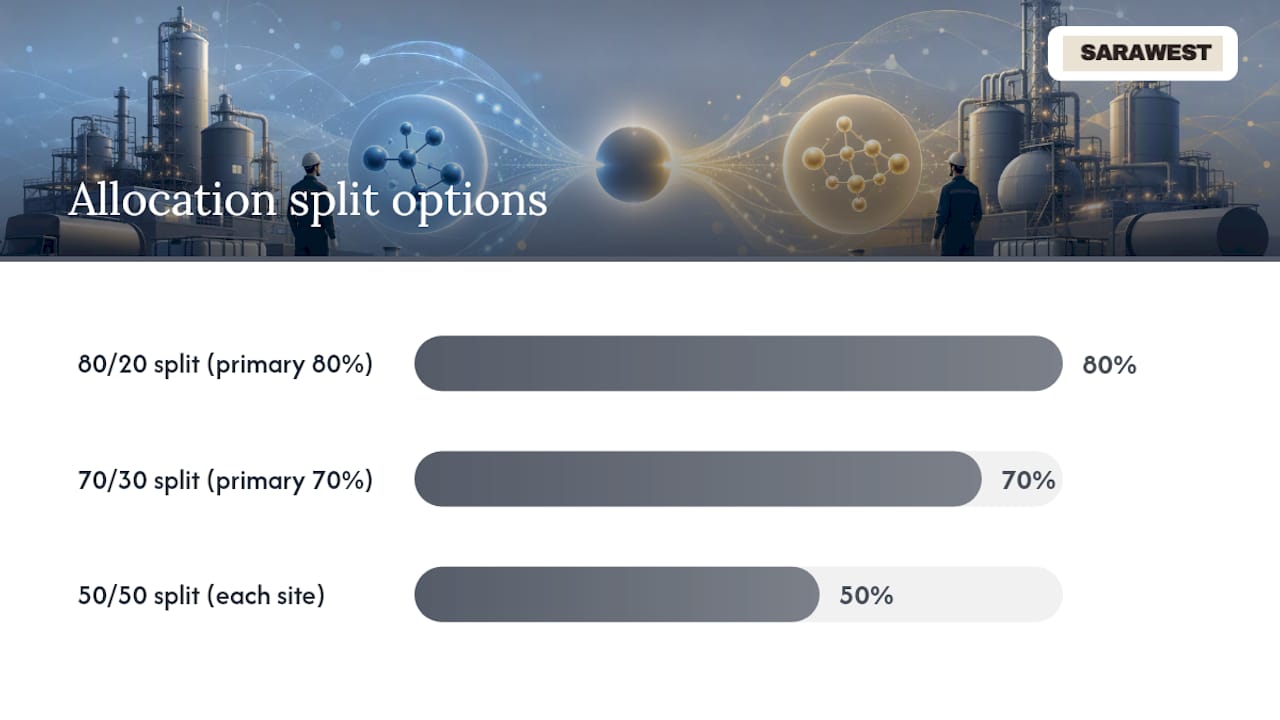
The allocation split you choose sets the tone for the whole relationship, so following quality control best practices for manufacturing pros ensures consistency across sites. A 50/50 split gives you the most resilience and the strongest negotiating position, but you pay for it: neither site gets enough volume to unlock its best pricing tier. An 80/20 split protects your primary's economics while keeping a secondary genuinely production-ready rather than just qualified on paper. A 70/30 split sits in between and is the most common choice for mid-size brands that want real leverage without giving up meaningful cost savings.
Selection criteria matter more than the split itself. Before signing anything, run every candidate through the same checklist:
- Does its quality management system align with your specs, or will you spend a year reconciling two different QMS platforms?
- Can it scale from pilot batch to full truckload without a second qualification round?
- Does it have in-house lab and audit capability, or will every deviation require a third-party lab and a two-week wait?
- Is it financially stable enough to survive a slow quarter without cutting corners on your account?
- Does its location and lead time actually fit your logistics plan, or does it just look good on a map?
Commercial terms decide whether your secondary stays ready or quietly drifts out of qualification. Minimum volume guarantees keep the relationship worth the manufacturer's time. Ramp schedules that step up gradually, rather than jumping straight to full allocation, give both sides room to catch quality issues early. Performance incentives, tied to on-time delivery and deviation rates, keep a secondary sharp instead of complacent.
Pro Tip: Tell both manufacturers you're running a dual-sourcing program from day one. Hiding split volumes rarely improves pricing and it damages trust the moment either side finds out, which they usually do.
How Do You Actually Onboard a Second Contract Manufacturer?
Onboarding a secondary partner follows a sequence, and skipping steps to save time is exactly how dual sourcing backfires.
- Build the RFP with a scorecard, not a wish list. Score candidates on quality certifications, lab capability, financial stability, and named references, not just quoted price per unit.
- Require documented evidence before you move forward. Ask for certifications, a sample analytical report, and at least two references from clients running comparable volumes.
- Sequence the tech transfer deliberately. Analytical methods and release specifications need to transfer and cross-validate before the master batch record moves, since mismatched lab methods are usually the single hardest part of a tech transfer.
- Validate through IQ, OQ, and PQ in order. Installation qualification, operational qualification, and performance qualification each confirm a different layer of readiness. Skipping to PQ to save time is how a "qualified" secondary fails its first real production run.
- Lock quality governance before the first commercial batch ships. A master service agreement sets commercial terms; a quality technical agreement assigns who owns what deviation, and regulated categories require both sites to meet harmonized standards with clear QTA ownership.
Beyond the sequence itself, a few operational habits keep the program running:
- Set an audit cadence, not a one-time qualification visit, and revisit it quarterly for the first year.
- Track KPIs at both sites on the same dashboard so numbers are directly comparable.
- Split safety stock rather than routing all inventory through one warehouse.
- Track purchase orders at the SKU level across both suppliers, not just at the program level.
A structured audit checklist makes the qualification visit faster and catches gaps before they become production problems, and batch record standards keep documentation consistent enough that a QA reviewer can't tell which site produced a given lot.
Costs, Risks, and Governance Tradeoffs: Does Dual Sourcing Actually Pay?
Dual sourcing isn't free, and pretending otherwise leads to budget surprises six months in. Direct costs include duplicate qualification effort, duplicate safety stock sitting in two warehouses, and reduced volume discounts because neither site gets your full order. Hidden costs run deeper: someone has to manage two audit calendars, two change-control queues, and two sets of KPI reports, and that person's time isn't free either.
The benefit side is harder to put a number on but easier to reason through. Onboarding a secondary early, even at modest volume, typically costs far less over a three-year horizon than the emergency freight, lost sales, and expedited requalification triggered by an unplanned outage. Run that comparison for your own product line before deciding the split is worth it.
Governance determines whether the math stays favorable:
- Name one dual-sourcing manager or steering committee owner, not a shared responsibility that nobody actually owns.
- Track on-time delivery, yield, and deviation rate at both sites monthly.
- Review the allocation split annually, not just when something breaks.
How Does Dual Sourcing Change Product Lifecycle Planning?
A product's lifecycle looks different once two manufacturers are producing it, and the differences show up earliest at launch and scale-up, not at maturity.
During launch, dual sourcing forces you to lock specifications tighter than a single-source program would. Both sites need identical release criteria from day one, which means the formulation has to be genuinely transferable rather than dependent on one plant's specific equipment quirks. That discipline pays off later: a formula that transfers cleanly between two manufacturers is also easier to scale, reformulate, or move again if either relationship ends.
Scale-up is where the secondary earns its qualification cost back. Instead of racing to find and validate new capacity when demand spikes, you shift volume to a manufacturer that's already running your specs. That shortens the time between a demand forecast and shipped product from months to weeks in many cases.
Late in a product's life, dual sourcing gives you an exit ramp that single sourcing doesn't. If your primary manufacturer raises prices, changes ownership, or drops your category, you already have a validated alternative producing at scale rather than starting a qualification process from zero while your shelf space erodes.
The tradeoff is flexibility for complexity. Every formula change, ingredient substitution, or packaging update now needs to roll out at two sites through a coordinated change-control process rather than one. Brands that treat that coordination as a real workstream, not an afterthought, are the ones who scale without quality drift between sites.
What Do Real Dual-Sourcing Programs Get Right and Wrong?
The pattern across industries that have run dual sourcing for years, from automotive to electronics to specialty chemicals, is consistent: programs succeed when the secondary is treated as a real production partner and fail when it's treated as an insurance policy nobody actually maintains.
When a tariff shift or a plant shutdown hits the primary, the brand shifts volume within weeks instead of months, because the secondary's tooling, specs, and lab methods were already validated and running.
The common failure pattern is just as consistent: a brand qualifies a secondary, runs one pilot batch, and then never orders from it again for two years. When a crisis hits, the "qualified" secondary needs a full requalification anyway, because its equipment, staff, and even raw material lots have changed since that first pilot. The paperwork said dual sourced. The operational reality was single sourced with an expensive backup plan sitting unused.
The lesson isn't complicated: a secondary that doesn't produce regularly isn't really qualified, it's just documented. Keeping even a small, steady volume flowing to the secondary is what separates a program that works under pressure from one that only works on paper.
What Contract Terms Actually Protect You in a Dual-Sourcing Agreement?
The legal structure of a dual-sourcing program does more work than most brands expect, and the two documents that matter most are the master service agreement and the quality technical agreement.
The MSA covers commercial terms: pricing, minimum order commitments, payment terms, and what happens if either party wants to exit the relationship. Build exit clauses into this document from the start, not after a dispute. A brand that can't leave a bad manufacturer relationship without a lengthy notice period has effectively re-created the single-source risk it was trying to avoid.
The QTA is where dual sourcing gets its teeth. It assigns specific responsibility for deviations, change control, and specification ownership between your team and each manufacturer. Without a clear QTA, a deviation at one site can trigger finger-pointing instead of a fix, and regulated categories require this responsibility to be explicit and auditable at both sites.
A few contractual details deserve specific attention. Intellectual property clauses need to state clearly who owns formulation IP when two manufacturers both have access to it, especially if either site contributes formulation adjustments. Confidentiality terms should extend to any subcontractors either manufacturer uses. And liability allocation should specify which party covers a recall or quality failure traced to a specific site, not a shared, ambiguous liability clause that gets contested only after something goes wrong.
Getting legal counsel to review both agreements before either manufacturer starts commercial production is worth the delay. Retrofitting a QTA after a deviation has already happened is a much harder negotiation.
How Do You Keep Two Manufacturers and Your Own Team in Sync?
The operational failure point in most dual-sourcing programs isn't the manufacturing. It's communication drift between two sites and the internal team managing them.
Start with a single source of truth for specifications. If your QA team updates a release spec and only tells one manufacturer, you've created a mismatch that won't surface until a batch fails at the other site. A shared change-control process that notifies both partners simultaneously, with a required acknowledgment, closes that gap.
Set a recurring cadence for cross-site reviews, not just individual site audits. A quarterly call that puts both manufacturers' KPI data side by side, even if they never speak to each other directly, catches drift early. If one site's deviation rate creeps up while the other stays flat, that's a signal worth investigating before it becomes a shortage.
Internally, assign ownership clearly. A dedicated dual-sourcing manager or PMO function prevents the common failure where quality, procurement, and operations each assume someone else is tracking the secondary's readiness. Without a named owner, the secondary quietly drifts out of qualification because nobody's job depends on keeping it current.
Communication with the manufacturers themselves matters just as much. Neither site should feel like the "backup" in a way that damages the relationship. Sharing forecasts, being upfront about the allocation split, and giving both partners visibility into your broader plans keeps both invested in your success rather than treating you as a client they might lose.
What Risks Does Dual Sourcing Miss If You Only Focus on Cost and Supply?
Cost and supply disruption get most of the attention in dual-sourcing planning, but several other risks matter just as much and rarely make the initial business case.
Logistics complexity multiplies fast once two sites are shipping product, often from different regions with different tariff exposure. Multi-corridor logistics planning, including pre-negotiated transshipment capacity and tariff optimization, needs to happen before a disruption forces a scramble, not during one.
Intellectual property exposure grows with every additional site that has access to your formulation. A broker-mediated relationship adds another layer that can leak specs or slow communication when speed matters most, which is one reason more brands prefer working directly with a manufacturer that keeps formulation work in-house.
Cultural and communication mismatch between sites, especially across regions, causes real delays that never show up in a cost model. A site that interprets "urgent" differently than your primary can quietly slow your entire response during an actual crisis.
Financial risk to the secondary itself deserves ongoing attention, not just a one-time check during qualification. A secondary manufacturer that runs into financial trouble two years into the relationship can fail exactly when you need it most, so periodic financial health reviews belong in your audit cadence alongside quality metrics.
How Do You Compare Single Sourcing Against Dual Sourcing Before You Commit?
Building a real comparison means scoring both models against the same criteria rather than assuming dual sourcing wins by default.
Start with resilience: estimate the cost of a full outage under single sourcing, including lost sales, expedited freight, and emergency requalification time. Compare that to the ongoing cost of keeping a secondary qualified and running modest volume under dual sourcing.
Next, score cost efficiency. Single sourcing usually wins on unit price because full volume unlocks better discounts. Dual sourcing gives up some of that margin in exchange for negotiating leverage, since a manufacturer that knows it could lose volume to a qualified alternative tends to hold pricing and service levels more carefully.
Then score operational complexity honestly. Single sourcing is simpler to manage: one audit calendar, one change-control queue, one relationship. Dual sourcing adds real management overhead that needs a named owner, not a side project.
Finally, score strategic flexibility. Single sourcing locks you into one manufacturer's roadmap, capacity limits, and pricing decisions. Dual sourcing keeps a second, production-ready option live, which matters most for categories facing regulatory change, tariff exposure, or fast growth.
Weight these four categories against your own product's revenue criticality and risk exposure, and the decision usually becomes clear without needing a complicated model.
Publisher Perspective: How Sara West USA Supports Dual Sourcing for Chemical Brands
Most dual-sourcing advice was written for pharma and electronics, where qualification timelines run eighteen months and pilot batches cost more than most chemical brands make in a quarter. That advice isn't wrong, but it's often the wrong scale for a cleaning products startup or an equine care brand trying to build resilience without freezing half a year of cash in a backup supplier that might never ship a single order.
Here's what the conventional guidance underestimates: the biggest barrier to dual sourcing for smaller chemical brands isn't cost or complexity. It's finding a second manufacturer willing to run a pilot batch small enough to actually validate the relationship without demanding a six-figure commitment first. Sarawest USA runs pilot production from 1,000 units, which completely changes the math. A brand can qualify a genuine secondary source, run real product through it, and confirm the formula transfers cleanly, all before committing meaningful volume.
The in-house R&D chemist model matters more here than most procurement checklists give it credit for. When a formula needs adjustment to run cleanly on a second manufacturer's equipment, a broker-mediated relationship adds weeks of back-and-forth. Working directly with chemists who can adapt a formula in-house closes that gap fast, and it's the difference between a secondary that's ready in a quarter versus one that's still stuck in email threads a year later.
— Faisal Mansur
Ready to Qualify a Secondary Manufacturer? Here's How to Start
If you've decided a second manufacturer belongs in your supply chain, the fastest path is a real pilot batch, not another round of vendor calls. Sarawest USA runs contract chemical manufacturing across eight industries with over 1,200 proprietary formulas already validated, which means a secondary qualification doesn't have to start from a blank formula sheet.
Getting started takes three steps: submit an RFQ with your target volumes, specs, and timeline; request pilot samples to confirm the formula performs the way your primary's does; and schedule a technical call to align on QTA responsibilities and MSA terms before scaling. Have your current specifications, target order volumes, any required certifications, and your ramp timeline ready before that call. It shortens the qualification cycle considerably.
Sarawest USA's contract manufacturing page walks through the RFQ process in detail, and the request-samples page is the fastest way to get product in hand and start validating a secondary source on your own timeline, not on a manufacturer's calendar.
Sources
- What Is Dual Sourcing? Definition, Benefits, and Risks | NetSuite
- Dual sourcing for supply chain resilience | C.H. Robinson
- Managing Dual Sourcing with CDMOs