
That's the core of a stainless steel cleaner formulation rebuilt from patent literature and adapted for modern low-VOC practice.
- 5 kg lab batch: roughly a quarter glycol ether co-solvent by weight, low single-digit percentages of fatty acid and alkanolamine, and solvent phase near 10%, with water to the full batch weight.
- Mixing order: water first, then amine, then fatty acid (in situ soap), then glycol ether, then solvent phase last
- Final form: low-viscosity liquid for trigger spray, or thicken to >200 cps for a polish format
Pro Tip: Run this at room temperature first. Heat speeds dissolution but also drives off your co-solvents faster than you'd expect during scale-up trials.
Flag the acids and halogenated solvents now, not later. VOCs and corrosivity dictate your PPE, your wastewater plan, and whether you can even legally ship the finished product. More on that below.
Key Takeaways
A production-ready stainless steel cleaner formulation balances glycol ether solvents, fatty acid amine soaps, and controlled acid content to solve both oily and mineral soils without pitting the metal.
| Point | Details |
|---|---|
| Pilot batch ratio | Use 27% glycol ether, 4% fatty acid, 4% alkanolamine, 10% solvent phase, balance water for a 5 kg trial. |
| Match acid to soil | Reserve phosphoric or oxalic acid phases for scale removal only when the alloy grade tolerates it. |
| Mixing order matters | Add water, amine, fatty acid, co-solvent, acid, and then anti-streak agents in that sequence. |
| Test before release | Run streak, pH, viscosity, and salt spray tests before signing off any batch record. |
| Scale with Sarawest USA | Sarawest USA's R&D chemists adapt patent-derived and low-VOC formulas into pilot-to-scale production runs. |
Table of Contents
- Three Reference Formulations for Stainless Steel Polish Composition
- What Ingredients Actually Do in a Stainless Steel Cleaner Formulation
- How Do You Manufacture a Stainless Steel Cleaner at Scale?
- Safety, VOCs, and Surface Compatibility Checklist
- Testing and QC Metrics That Actually Predict Field Performance
- What Sarawest USA's R&D Process Looks Like for This Category
- Where Formulators Get This Wrong
- Ready to Scale Your Stainless Cleaner Formula?
- Sources
Three Reference Formulations for Stainless Steel Polish Composition
Formulators rarely start from a blank page. Three reconciled recipes cover most stainless steel cleaning solution needs, and each solves a different problem.
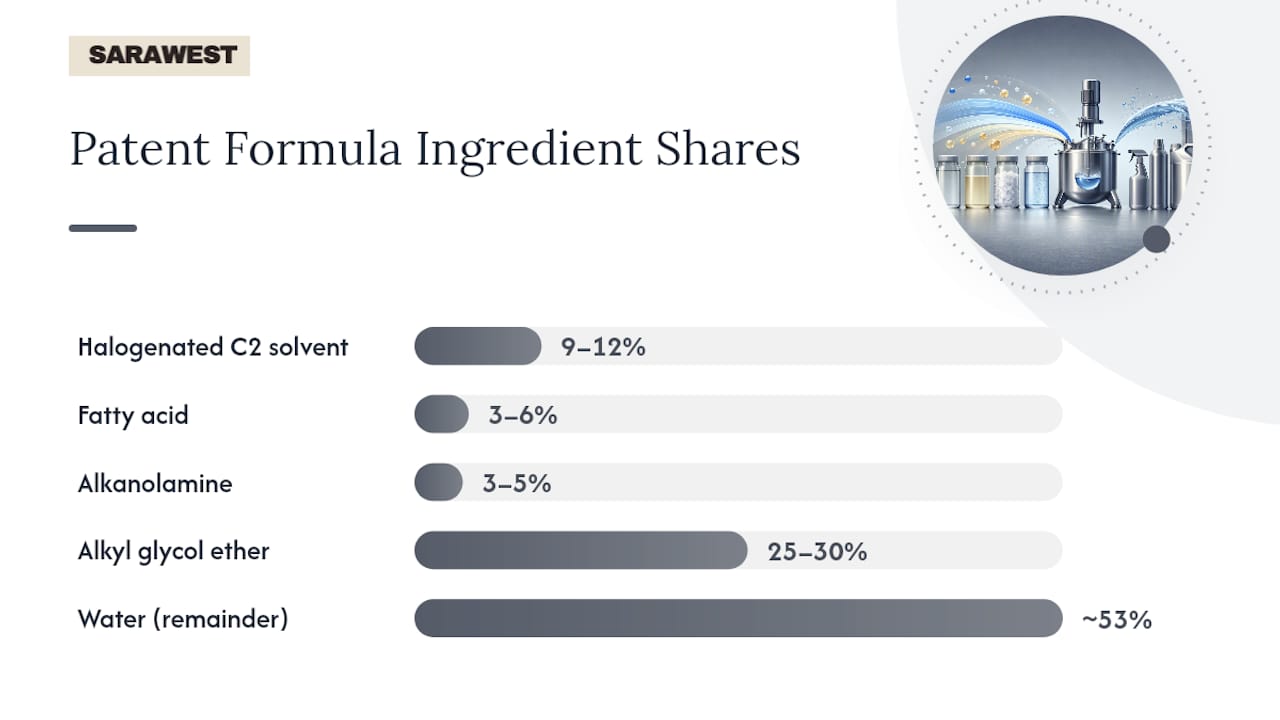
Patent-derived industrial formula. US Patent 4060496A describes a composition built on halogenated C2 hydrocarbon solvent between 9% and 12%, fatty acid between 3% and 6%, alkanolamine between 3% and 5%, and alkyl glycol ether between 25% and 30%, with water making up the rest. The fatty acid and amine react in place to form a soap that lifts oily residue, while the glycol ether handles polar, water-soluble grime the soap can't touch. That dual action is why the old formula still gets cited: it solves both soil types at once.
Neutral pH commercial formula. Formulary references from suppliers like Stepan target pH 6 to 8 and viscosity above 200 cps, built for trigger or pump sprayers rather than wipe-on application.
DIY reference point. A vinegar-and-mineral-oil recipe using roughly 5 to 6% acetic acid, popularized by BobVila, works fine for spot cleaning at home. It has no preservative system and no stability testing, which is exactly why it can't scale.
- Acid or chelant systems: best for mineral scale and hard-water spotting
- Neutral surfactant systems: safest broad-spectrum choice for finished appliances
- Solvent-heavy systems: best where grease and oily fingerprints dominate the soil load
What Ingredients Actually Do in a Stainless Steel Cleaner Formulation
Every ingredient class earns its spot by solving a specific soil problem, and swapping one without understanding its function is how batches fail streak testing.
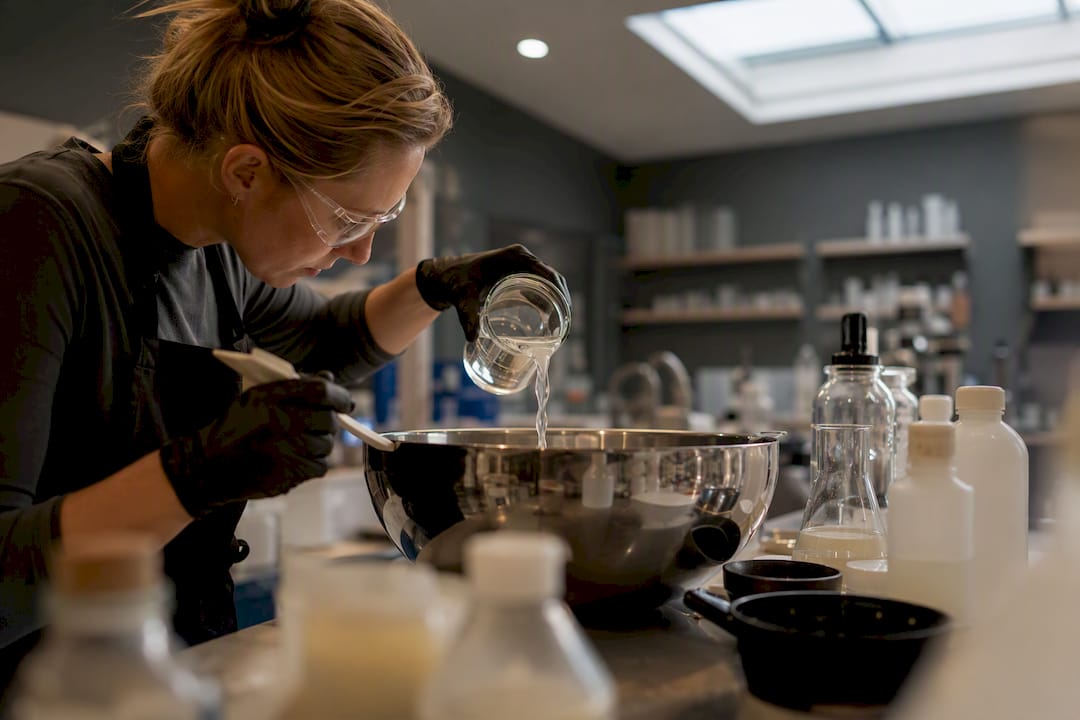
Solvents and co-solvents. Glycol ethers and short-chain alcohols dissolve oily, nonpolar residue that water alone can't touch. Secondary summaries of US4060496A point to butoxyethanol and tripropylene glycol methyl ether as workable substitutes for the original halogenated solvent, with far less handling risk.
Acids and chelants. Phosphoric acid at 10 to 40% and oxalic acid at 2 to 10% appear in CN101768746A for scale and mineral removal, but both attack certain welds and lower-grade alloys if left in contact too long.
Surfactants and amine soaps. Nonionic surfactants dominate neutral formulas for their broad compatibility; cationic types risk streaking on brushed finishes.
Anti-streak agents. Long-chain alcohols and nonvolatile oils leave the sheen consumers expect, but every drop of residual oil is a trade-off against a fingerprint-free, non-tacky surface.
- Solvent phase: 20 to 30% total for oily soil removal
- Acid/chelant phase: 2 to 10% for scale, only when the alloy tolerates it
- Preservatives and buffers: under 1%, but non-negotiable for aqueous shelf stability
How Do You Manufacture a Stainless Steel Cleaner at Scale?
Moving from bench to pilot batch is where most formulas either hold up or fall apart.
- Inspect raw materials and water. Target low conductivity and controlled hardness before batching. Poor water quality shows up later as haze or reduced clarity.
- Mix in order. Water and wetting agents first, then co-solvent, then surfactant dispersion, then acid or chelant, then pH adjustment, then anti-streak agents, then final dilution to target viscosity.
- Control temperature and agitation. Most stainless steel cleaning solutions blend fine at 20 to 35°C under moderate agitation; reserve homogenization for polish-format products needing emulsion stability.
- Filter and deaerate. Remove particulates before filling, and confirm the batch tank and lines are alloy-compatible with your acid phase.
- Package to spec. Match container material to formula chemistry, since acidic formulas degrade certain plastics over time.
Pro Tip: Watch for viscosity hysteresis on scale-up. A formula that pours clean at 5 kg can turn stringy at 200 gallons if your agitation shear rate doesn't match the lab mixer.
Exotherms during acid addition and solvent flash-off during extended hold times are the two failure modes that catch first-time scale-up teams off guard. Water quality specifics deserve their own deep dive, covered in Sarawest USA's water quality guide.
Safety, VOCs, and Surface Compatibility Checklist
Acids, amines, and solvents all demand real handling protocols, not a warning label as an afterthought.
- Wear chemical-resistant gloves and eye protection when handling concentrated phosphoric or oxalic acid phases
- Ventilate work areas when using glycol ethers or halogenated solvents; both carry inhalation limits worth checking against current OSHA guidance
- Build a low-VOC variant by shifting toward water and short-chain alcohols, accepting slightly slower dry time as the trade-off
- Pretreat effluent before drain disposal if your acid load pushes pH below regulatory thresholds
- Never formulate with chlorides or abrasive grit; both drive pitting corrosion on passivated stainless
- Verify food-contact claims against your specific jurisdiction before printing them on a label
Testing and QC Metrics That Actually Predict Field Performance
A batch that looks right in the tank can still fail on a customer's countertop, so build these checks into your release protocol before your first commercial run.
- Streak and residue test. Apply to a brushed stainless panel, dry under standard lighting, and grade against a reference sample.
- pH and viscosity. Confirm against your target range (commercial neutral formulas typically sit at pH 6 to 8 with viscosity above 200 cps for spray formats).
- Accelerated stability. Hold samples at elevated temperature for two to four weeks and check for phase separation or odor drift.
- Corrosion compatibility. Salt spray testing catches pitting risk before a client's field complaints do.
- Preservative efficacy and retain samples. Keep a signed batch record and retained sample for every production run.
What Sarawest USA's R&D Process Looks Like for This Category
Bench-to-pilot work at Sarawest USA follows the same logic laid out above: confirm target pH and VOC ceiling, run a small batch, then scale once streak and stability tests clear.
- Bring a target spec sheet: pH range, VOC ceiling, and any ingredients to avoid
- Specify clean-label or low-VOC requirements early, since they change your solvent selection, not just your label copy
- Supply a sample volume and rough production forecast so a contract manufacturer can quote accurately
Pro Tip: A one-page spec beats a verbal description every time. It's the difference between a same-day quote and three rounds of clarifying emails.
Our chemists work from a formula library exceeding 1,200 proprietary formulas across eight industries, which is often faster than starting a stainless formula from zero.
Where Formulators Get This Wrong
Most teams over-invest in the acid phase and under-invest in stability testing. A formula that strips scale beautifully on day one but separates by week three isn't a finished product, it's an unfinished experiment with a nice streak test result.
Start with the neutral, glycol-ether-forward formula unless you have a documented scale problem the acid phase actually solves. Prioritize pH stability, viscosity retention, and preservative efficacy over polish gloss. Build your checklist around water quality, container compatibility, and batch retains before you call a contract manufacturer, not after.
Sarawest USA's own commercial cleaning capabilities exist for the moment you've validated the bench formula and need real production volume without rebuilding your process from scratch, leveraging expertise in stainless steel fabrication for unmatched precision.
— Faisal Mansur
Ready to Scale Your Stainless Cleaner Formula?
Formulators comparing patent-era recipes against clean-label targets face a real trade-off: rebuild a low-VOC version from scratch, or bring a working spec to a manufacturer who has already solved that substitution problem. Sarawest USA's in-house R&D chemists adapt existing chemistry, including glycol-ether and neutral-pH stainless steel cleaner formulation approaches, into a production-ready batch, often the same day you submit specs.
To get a fast quote, send your target pH, VOC ceiling, sample volume, and any surface-compatibility requirements. Our proven formulation track record covers pilot batches through full truckloads, and our contract manufacturing page walks through the RFQ process step by step. Submit your spec sheet and get a same-day response on feasibility and turnaround.
Sources
The core claims in this guide trace back to two primary patents and one widely cited consumer resource. US Patent 4060496A and CN101768746A, along with its full patent PDF, supply the composition tables referenced above. For a consumer-level comparison point, see BobVila's DIY stainless steel cleaner recipe.
- Stainless steel cleaner (US Patent 4060496)
- Make Your Appliances Sparkle With This DIY Stainless Steel Cleaner — BobVila