
Your final-rinse water needs to meet USP Purified Water limits or a facility-defined equivalent: conductivity ≤1.3 μS/cm, TOC ≤500 ppb, bacteria ≤100 CFU/mL. Wash and formulation water targets follow the table below. This week, measure your feed water hardness and run one baseline full-parameter test, then log it.
- Reference USP, AOAC hard water recipes, and EN hard water guidance when writing your spec
- Test actual plant feed water, not just lab DI water
- Bring in a partner like Sarawest USA when you need help translating a spec into a working production line
Pro Tip: Pull your baseline sample from the point of use, not the utility meter. The line between the meter and your mix tank picks up scale and biofilm that changes the numbers you actually formulate against.
Key Takeaways
Cleaning-product quality depends on matching final-rinse and formulation water to a documented spec, verified against USP, AOAC, and EN reference points, and monitored continuously enough to catch drift before it reaches finished product.
| Point | Details |
|---|---|
| Set numeric targets | Use USP Purified Water limits (conductivity ≤1.3 μS/cm, TOC ≤500 ppb, and bacteria ≤100 CFU/mL) as your baseline. |
| Verify hardness rigorously | Prepare and check hardness against AOAC or EN recipes using a digital titrator, not a visual estimate. |
| Match rinse to process | Final-rinse water quality should equal or exceed whatever grade the next process step requires. |
| Monitor continuously where it counts | Combine periodic lab TOC and microbial testing with continuous conductivity and turbidity checks. |
| Partner for scale-up support | Sarawest USA profiles feed water and validates formulas through pilot runs before committing to full production. |
Table of Contents
- How Water Quality Affects Cleaner Formulation and Production
- Which Water Quality Parameters Belong in Your Spec?
- What Water Grade Do You Need at Each Process Step?
- How Do You Test and Monitor Water Quality Over Time?
- How Do You Fix Water That Doesn't Meet Spec?
- What Should Your Water Spec Document Look Like?
- How SaraWest Builds Water Specs Into Formulation
- How Sarawest USA Turns a Water Spec Into a Working Product
- Frequently Asked Questions
- Sources
How Water Quality Affects Cleaner Formulation and Production
Uncontrolled water variables (hardness, chlorine, TOC, microbial load) change how surfactants perform and how stable your finished product stays on the shelf. Builders and chelants exist specifically to lock calcium and magnesium ions and protect surfactant efficacy, but that protection only works if you know what hardness level you're formulating against. Municipal water shifts seasonally, so a formula validated in March against low-hardness spring runoff can behave differently in August when the source water changes.
The failure modes are specific and expensive:
- Cloudy or gritty finished product from calcium carbonate precipitating at high pH
- Reduced surfactant activity, meaning weaker cleaning claims than your lab data promised
- Microbial contamination that shows up as preservative failure months after batch release
- Chlorine reacting with fragrance or dye components, altering scent and color
- Audit findings when a regulated client discovers your water spec was never formally documented
Pro Tip: Test the plant's actual feed water quarterly, not just your lab's DI water once at formulation. The gap between those two data sets is where most scale-up surprises live.
Which Water Quality Parameters Belong in Your Spec?
Seven parameters materially affect how cleaners perform and how consistently they manufacture: hardness, conductivity/TDS, pH, TOC, microbial load, residual chlorine, and turbidity. Each one maps to a specific failure mode, and each has an established test method you can hand straight to a lab tech.
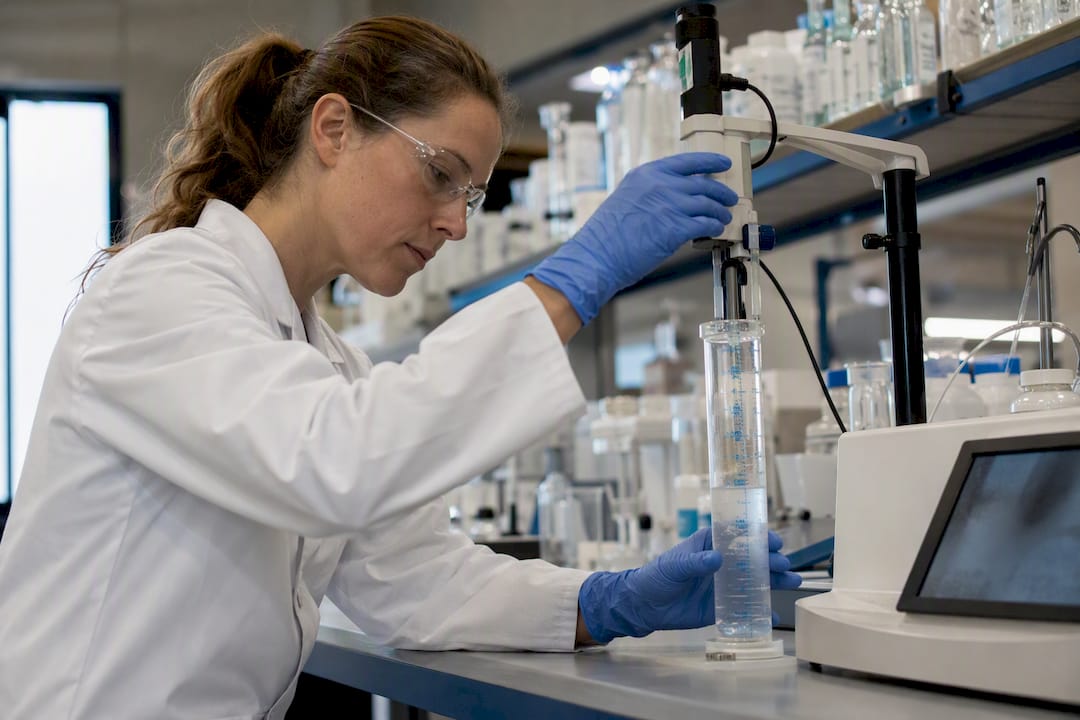
Hardness deserves special attention because it's the parameter most likely to drift by season and by source. The AOAC and EN methods give you standardized hard-water recipes for validation testing: AOAC hard water is prepared across 100 to 500 ppm CaCO3 depending on the test, while EN hard water is commonly prepared at 375 ppm CaCO3 with an acceptable range of negative 10% to positive 5%. Verify prepared hard water with a digital titrator, like the Hach hardness titration kits labs commonly use, rather than trusting the recipe alone.
Conductivity, pH, TDS, and turbidity follow general industrial water guidance, with typical targets around pH 6.5 to 8.5 and TDS under 500 mg/L for general process water, tightening considerably for final rinse.
| Parameter | Test method | Target range | Test frequency |
|---|---|---|---|
| Hardness | AOAC/EN titration, digital titrator | Facility-defined; validation water per AOAC/EN recipe | Daily (production), per lot (validation) |
| Conductivity | Conductivity meter | ≤1.3 μS/cm for Purified Water grade | Continuous or daily |
| pH | pH meter | 6.5–8.5 for process water | Daily |
| TOC | TOC analyzer | ≤500 ppb for Purified Water grade | Weekly or per lot |
| Microbial load | Plate count | ≤100 CFU/mL (Purified Water) | Weekly |
| Residual chlorine | Free-chlorine test kit | Non-detect for formulation water | Daily |
| Turbidity | Turbidimeter | <1 NTU for high-purity uses | Daily |
Pro Tip: Set your internal alarm thresholds tighter than your action limits. If your action limit is 500 ppb TOC, alarm at 400 ppb. That gap buys your team time to investigate before you're staring at an out-of-spec batch.
What Water Grade Do You Need at Each Process Step?
Final-rinse water should match or exceed the water quality required by whatever comes next in your process. If your product formulates with Purified Water, your final rinse needs Purified Water too, not just utility water that "looks clean."
A practical grade map for most commercial cleaning lines:
- Pre-rinse: Utility water or RO is usually acceptable, with regular monitoring for gross contamination
- Wash and formulation: RO plus polishing to Purified Water grade, or a facility-specific TDS ceiling, depending on the product's sensitivity to hardness
- Final rinse: Purified Water at minimum, WFI-equivalent grade only if the downstream product genuinely demands it
Piping multiple water loops into a facility is a real capital cost, and it's not always the right call. For many production lines, tightening formulation controls (more robust chelant systems) costs less than installing a second RO loop. Recycling pre-rinse water back into utility use is often acceptable, but never recycle it into final rinse without testing it fresh each time.
How Do You Test and Monitor Water Quality Over Time?
Combine periodic lab verification with continuous parameter checks. TOC analyzers and microbial plate counts run weekly or per lot; conductivity, turbidity, and residual chlorine get checked daily or continuously; hardness gets verified daily in production runs where it matters to the formula.
Recommended instrumentation:
- Conductivity meter at the point of use
- Digital titrator for hardness verification, following AOAC titration procedures
- TOC analyzer, run on a weekly or per-lot schedule
- Plate count method for bacterial load
- Turbidimeter and free-chlorine test kits for daily checks
Sample from three points: raw feed, post-polish (after RO/DI treatment), and point-of-use at the mix tank or rinse manifold. Handle samples in sterile containers, test within the method's specified holding time, and log every result against your spec, not just the ones that fail.
Real-time monitoring changes what "catching a problem" means. Instead of finding contamination in next Tuesday's lab batch, continuous sensors on conductivity and turbidity flag the deviation the hour it happens, before it reaches your mix tank.
| Sample point | Method | Frequency | Escalation trigger |
|---|---|---|---|
| Feed water | Conductivity, turbidity | Continuous | significant shift from baseline |
| Post-polish | TOC, hardness | Daily/per lot | Exceeds action limit |
| Point-of-use | Full panel | Weekly | Any parameter out of spec |
Manual sampling still has a place in smaller pilot operations, but production lines running multiple shifts benefit from continuous, sensor-based monitoring the way KETOS-style platforms do it, catching contamination events that a once-a-shift grab sample would miss entirely.
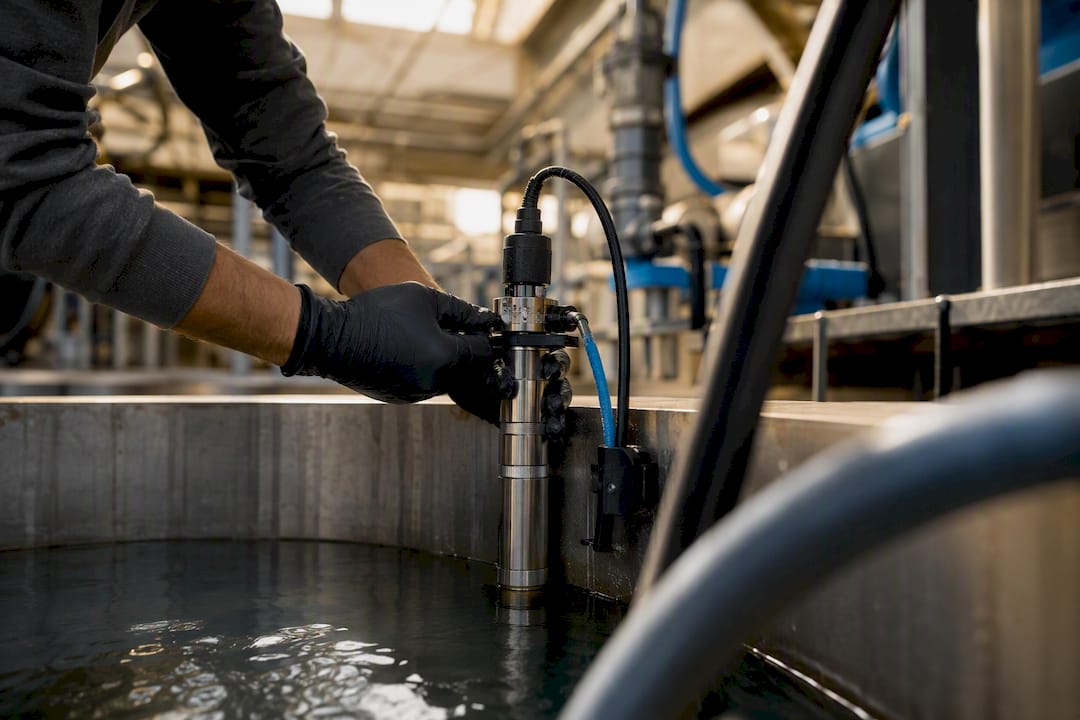
Pro Tip: Trend your conductivity and TOC data over weeks, not just check them against a pass/fail line. A slow upward creep in either number usually means something upstream (a failing softener resin, a cracked RO membrane) before it ever triggers a hard alarm.
How Do You Fix Water That Doesn't Meet Spec?
Combine engineering controls with formulation controls rather than choosing one or the other. Softening handles hardness at the source. RO plus DI gets you to Purified Water grade for wash and rinse steps. UV knocks down microbial load without adding chlorine chemistry that can interfere with fragrance or actives. Point-of-use polishers catch the drift that happens between your treatment system and your mix tank.
On the formulation side:
- EDTA and GLDA bind hardness ions directly in the finished product, protecting performance even when end users dilute with variable tap water
- Sodium citrate and STPP serve as builders in specific formulation chemistries where EDTA isn't the right fit
- pH buffers stabilize formulas against shifts in source water alkalinity
If you're running a pilot, formulation controls are almost always the faster and cheaper fix. Capital upgrades like a second RO loop make sense once volume justifies the investment.
What Should Your Water Spec Document Look Like?
A usable spec fits in one table: parameter, target range, test method, frequency, sample point, responsible role, and corrective action. Anything more complex gets ignored on the plant floor.
| Field | Example entry |
|---|---|
| Parameter | Hardness |
| Target range | Per AOAC recipe, ±10%/+5% |
| Test method | Digital titrator |
| Frequency | Daily |
| Sample point | Mix tank feed |
| Responsible role | QA technician |
| Corrective action | Adjust softener, retest within 2 hours |
Ten steps to get a spec running: baseline test your feed water, define target ranges per parameter, choose test methods and instruments, write the SOP, install monitoring hardware, train the QA team, set up the logbook, define escalation roles, run a pilot batch against the spec, and store the finalized document with version control for audit access. Keep the spec and logs together in one system your auditors can pull without a scavenger hunt.
How SaraWest Builds Water Specs Into Formulation
We don't treat water quality as an afterthought once a formula is already locked. Baseline water profiling happens alongside R&D, using local feed-water testing so a formula built with builders and chelants matches the water it'll actually run on at scale. Pilot validation confirms the spec holds before we commit to a full production run. If you've got a spec already, hand it to us and we'll build the formulation around it.
How Sarawest USA Turns a Water Spec Into a Working Product
A water spec on paper is only as good as the manufacturing partner who can execute it without treating every parameter as a negotiation. Sarawest USA runs baseline water profiling and pilot batches from as few as 1,000 units, so you see how your formula performs against your actual facility water before you commit to a full truckload order.
Our in-house R&D chemists adapt existing formulas from a library of over 1,200 proprietary chemistries or build new ones around your hardness, TOC, and microbial targets, with QC documentation ready for the audits your clients will eventually ask for. If your commercial cleaning line needs a manufacturing partner who treats water specs as a starting point instead of a footnote, start with our commercial cleaning manufacturing page and request a pilot run to see how your spec performs at scale.
Frequently Asked Questions
What water quality standard should cleaning formulators use? Most formulators anchor their spec to USP Purified Water limits (conductivity ≤1.3 μS/cm, TOC ≤500 ppb, bacteria ≤100 CFU/mL) even outside pharmaceutical contexts, because it's a well-documented, testable numeric standard rather than a vague "clean water" claim.
Is deionized water the same as distilled water for manufacturing? No. Distilled water is purified by evaporation and condensation; deionized water passes through ion-exchange resin to strip dissolved minerals. Deionized water for manufacturing is typically cheaper to produce at scale and is the more common choice for RO/DI treatment trains feeding formulation and rinse water.
How often should production water be tested? Conductivity, turbidity, and residual chlorine work well as daily or continuous checks. TOC and microbial plate counts typically run weekly or per lot. Hardness gets verified daily in any process where hardness materially affects the formula.
Does water quality really affect cleaning efficiency that much? Yes. Hard water ties up surfactants before they ever reach the soil load, which is precisely why builders and chelants exist in formulation. Chlorine and TOC variability can also degrade fragrance and active ingredients over a product's shelf life.
What's the difference between AOAC and EN hard water preparation? AOAC methods allow a range of hardness levels depending on the specific test protocol, typically 100 to 500 ppm CaCO3.
Sources
- ATMP - MB-30 -03 Preparation of Hard Water and Other Diluents for Preparation of Antimicrobial Products — EPA
- Understanding products: About cleaning product ingredients — The American Cleaning Institute
- Key water quality parameters for industrial use — Ion Exchange
- Cleaningvalidation
- 5 reasons water quality analysis is important for the chemical manufacturing industry — KETOS
- Water quality standards guide — MECO