
Anti redeposition polymers keep soils suspended in wash liquor and stop them from resettling on fabric, which is the mechanical reason clothes stay bright instead of graying wash after wash. If you're formulating today, the fastest working rule is this: match the polymer class to the soil type first, then confirm compatibility with your surfactant chassis. Polycarboxylates and modified polyamines handle particulate and clay soils well. Cellulose derivatives and tailored polysaccharide derivatives tend to perform better against oily and body soils, depending on how your formula is built around anionic or nonionic surfactants.
That's the whole decision tree in miniature, but it's worth unpacking because the wrong polymer choice doesn't just underperform. It can actively deposit soil back onto fabric, which is the opposite of what you're paying for.
Selection rules that actually hold up in formulation work:
- Match adsorption behavior to soil type. Charged clay particles need electrostatic stabilization. Oily body soils often need steric stabilization from a bulkier polymer layer.
- Check surfactant compatibility early. A polymer that performs beautifully in an anionic system can flocculate or lose efficacy in a nonionic-heavy chassis.
- Verify biodegradability claims against the actual datasheet, not marketing copy. "Readily biodegradable" has a specific testing basis behind it, and not every vendor shows the data.
Formulators evaluating options today are weighing established names like BASF's BVERDE GP 790 L, a polycarboxylate positioned as readily biodegradable, against legacy workhorses like Sokalan PA30C1, Sokalan HP22, and the benchmark dispersant ACUSOL™ 445N referenced repeatedly in patent literature. Carboxymethyl cellulose (CMC) and ethoxylated polyethyleneimine (EPEI) round out the toolkit as representative cellulosic and modified-polyamine chemistries, respectively.
Pro Tip: Don't screen a new anti redeposition polymer candidate against only one soil type. Clay and carbon black soils expose electrostatic weaknesses that oily soils never touch, and vice versa. Run both in your first pass.
Pro Tip: If a vendor cites a biodegradability claim without a test standard attached, ask which protocol produced it before you build a formulation around that number.
Key Takeaways
Anti redeposition polymer selection succeeds when formulators match adsorption mechanism to soil type first, then verify surfactant compatibility and biodegradability claims before scaling.
| Point | Details |
|---|---|
| Soil type drives selection | Match electrostatic polymers to clay/particulate soils and steric polymers to oily/body soils. |
| Chassis compatibility comes second | Confirm anionic vs. nonionic surfactant compatibility before locking in a polymer class. |
| Dosage has a ceiling | More polymer past an optimum concentration can cause stability issues instead of better suspension. |
| Verify biodegradability claims | Ask which OECD-style standard produced any "readily biodegradable" claim before trusting it. |
| Scale with a manufacturing partner | Sarawest USA supports ARD projects from pilot batch through production scale with in-house formulation chemists. |
Table of Contents
- What Do Anti Redeposition Polymers Do in a Laundry Formulation?
- What Are the Common Anti Redeposition Chemistries?
- How Do Anti Redeposition Polymers Actually Prevent Soil From Resettling?
- How Should You Test Anti Redeposition Polymer Performance?
- What Dosage and Molecular Weight Should You Target?
- What's Driving the Shift Toward Biodegradable Anti Redeposition Polymers?
- What Should You Know About the Anti Redeposition Patent Landscape?
- How Can a Contract Manufacturer Support Your ARD Development Work?
- How We Approach Anti Redeposition Polymer Selection for Client Projects
- Ready to Move an ARD Formulation From Concept to Production?
- Where to Read Further on Anti Redeposition Polymer Chemistry
- Sources
What Do Anti Redeposition Polymers Do in a Laundry Formulation?
The mechanism is simple to describe and hard to get right in practice. Soil lifts off the fabric during the wash cycle, courtesy of surfactant action and mechanical agitation. Once that soil is suspended in the liquor, it's genuinely in motion, floating freely, colliding with fibers, and looking for somewhere to land. An anti redeposition polymer's job is to keep it suspended long enough that it exits with the rinse water instead of settling back onto the fabric surface it just left, or worse, onto a different garment in the same load.
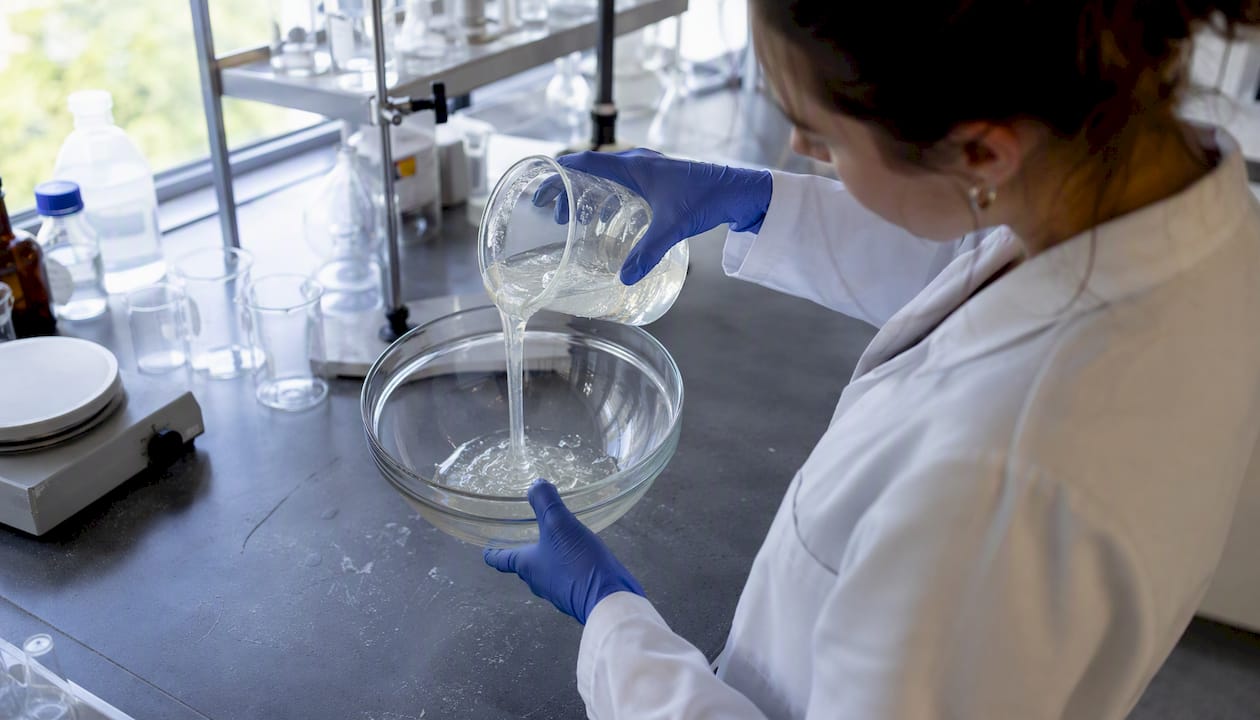
Without that polymer doing its job, you get graying. Not immediately, and not dramatically. It's cumulative, showing up after a dozen or two dozen wash cycles as a dinginess that consumers notice even if they can't articulate why their whites look tired.
Where this matters in real product development:
- Household liquid and powder detergents, where consumer whiteness perception drives repurchase.
- Industrial and institutional laundry, where soil loads are heavier and cycle counts per garment are far higher.
- Denim and textile wet processing, where back-staining during indigo removal is a distinct and costly failure mode.
- Fabric-care adjuncts and boosters sold as standalone additives to existing detergent routines.
Low-liquor-ratio washing, the trend toward high-efficiency machines that use less water per load, has made this job objectively harder. Less water means higher soil concentration per unit volume, which means your anti redeposition polymer has to work against a more crowded, more collision-prone environment than it did a decade ago. The EPA's own Function Category 12 classification defines anti-redeposition agents as water-soluble substances that prevent dirt or grease from resettling during washing, and notes that most of the chemicals in this category carry a negative charge. That's not an academic detail. It's the reason electrostatic repulsion is such a dominant mechanism in this polymer class.
A polymer that suspends clay beautifully in a Terg-o-Tometer test can still fail in a real machine if the water hardness in your target market is high enough to collapse its electrostatic charge before the rinse cycle even starts.
For manufacturers, the practical fallout is dosage decisions and SKU positioning. A formula tuned for whiteness retention in a premium SKU might carry double the anti redeposition polymer loading of a value-tier product, and that cost difference has to justify itself on the shelf.
What Are the Common Anti Redeposition Chemistries?
Five chemistry classes dominate current formulation work, and each brings a distinct trade-off profile that's worth knowing cold before you start screening.
Polycarboxylates (polyacrylates, acrylic acid/maleic acid copolymers) are the incumbent workhorses. Built on anionic carboxylate groups, they stabilize particulate soils through electrostatic repulsion and have decades of formulation history behind them. Patent US5789369A describes hydrophilic copolymers using unsaturated hydrophilic monomers and oxyalkylated sidechains specifically engineered for improved clay redeposition performance, with usage ranges spanning 0.01% to 20% of total surfactant weight, though the patent's preferred band narrows to 5% to 10%.
Modified polyamines, particularly ethoxylated polyethyleneimine (EPEI), work differently. Their nitrogen-rich backbone and ethoxylated appendages give them a dual character: part cationic anchor, part steric barrier. U.S. Patent 11,326,133 discloses anti redeposition polymers built from nitrogen-containing ethylenically unsaturated monomers at 5% to 40% by weight, combined with carboxylic acid monomers at 60% to 95%, a composition window that shapes how the polymer balances charge and steric bulk.
Cellulose derivatives, chiefly CMC and HPMC, bring a biobased backbone to the table. CMC has long-standing regulatory familiarity and works reasonably well across soil types, though its performance against pure oily soils tends to lag behind purpose-built synthetics.
Polysaccharide derivatives are the newer entrants generating real research attention. A 2025 Wiley review on polysaccharide-based laundry additives makes a point that deserves more attention than it gets: unmodified polysaccharides don't deposit onto fabric well at all. You need hydrophobic or anionic substituents grafted on, and the degree of substitution becomes the single biggest lever for both performance and biodegradability.
Polyester-specific blockers round out the list, used almost exclusively in denim and textile wet processing to prevent back-staining during indigo strip and rinse cycles. A technical bulletin from GCL documents these as a distinct product category from general-purpose ARDs, tuned for a narrower job.
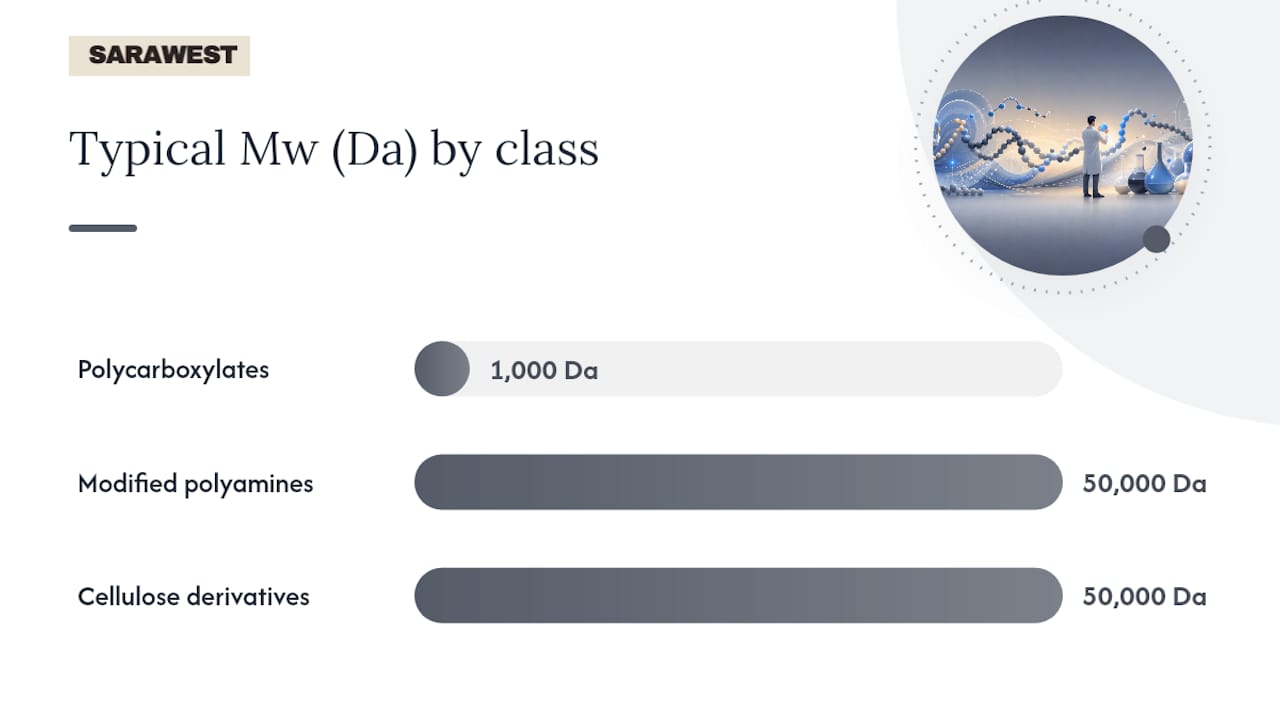
| Chemistry class | Best soil type | Typical Mw range | Viscosity impact | Biodegradability profile |
|---|---|---|---|---|
| Polycarboxylates | Clay, particulate | 1,000 Da | Moderate at higher dose | Traditional grades limited; newer biobased grades improving |
| Modified polyamines (EPEI) | Mixed particulate and oily | 50,000 Da | Low to moderate | Generally limited without modification |
| Cellulose derivatives (CMC, HPMC) | Broad, moderate on oily | 50,000 Da | High, thickening risk | Favorable, cellulosic backbone |
| Polysaccharide derivatives | Oily, body soils | Varies by substitution level | Low to moderate | Favorable, tunable via degree of substitution |
| Polyester blockers | Dye/indigo back-staining | Product-specific | Low | Varies by product line |
Pro Tip: When you're triaging chemistry classes for a new formulation, sort by soil first, not by cost or supplier relationship. A cellulose derivative that's cheap and familiar will still underperform against clay if your target market has hard, particulate-heavy soiling.
How Do Anti Redeposition Polymers Actually Prevent Soil From Resettling?
Two mechanisms explain nearly everything you need to know about why one polymer works and another doesn't: electrostatic stabilization and steric stabilization.
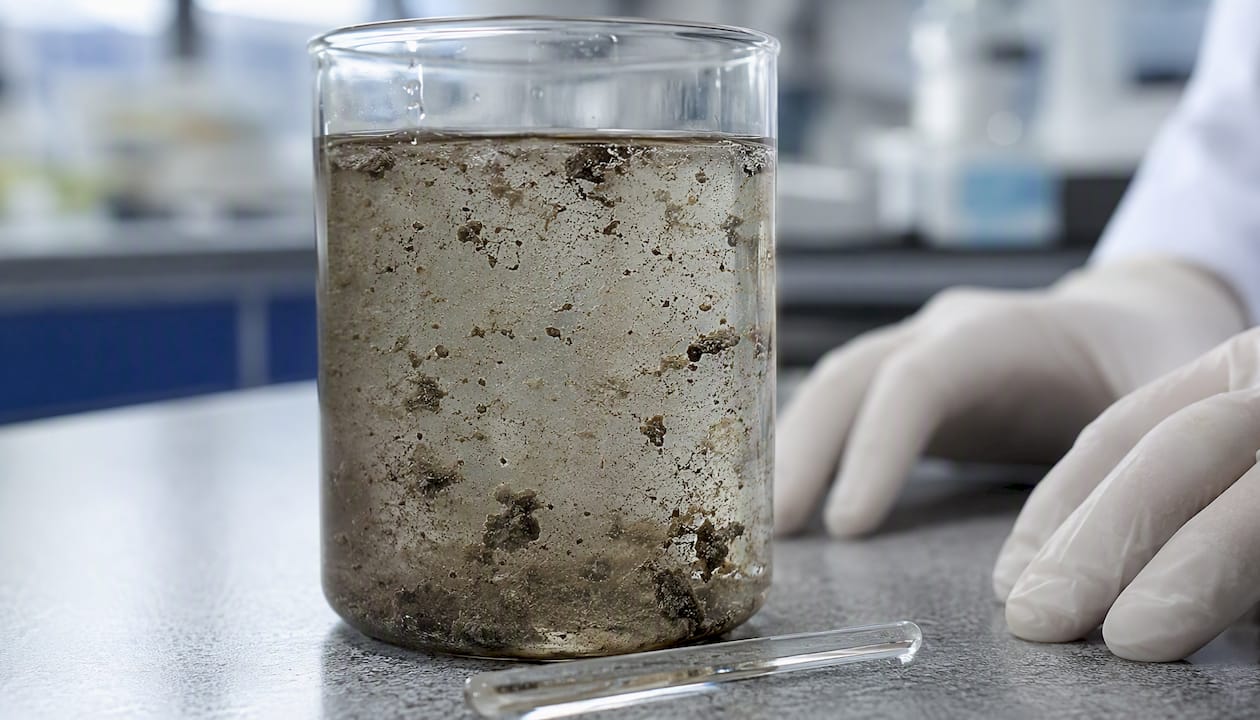
Electrostatic stabilization happens when a negatively charged polymer adsorbs onto a soil particle's surface and gives it a matching negative charge. Two similarly charged particles repel each other, and that repulsion keeps them from clumping together and dropping onto fabric. This is the dominant mechanism for clay and other particulate soils, which already carry some surface charge that the polymer can amplify.
Steric stabilization works through bulk instead of charge. The polymer adsorbs onto the soil particle and forms a physical layer around it, a kind of molecular cushion that keeps other particles and fabric surfaces at arm's length purely through spatial crowding. This mechanism matters more for oily and body soils, which often lack the surface charge that electrostatic stabilization depends on.
The distinction isn't academic. It's the reason a single anti redeposition polymer rarely handles every soil type equally well, and why formulators building a general-purpose detergent often blend two polymer classes rather than relying on one.
Practical implications this creates for formulation work:
- pH swings can shift a polycarboxylate's ionization state, weakening electrostatic performance in acidic or near-neutral formulations.
- Water hardness introduces calcium and magnesium ions that can shield or collapse the charge an electrostatic polymer relies on, which is why performance claims tested in soft water don't always transfer to hard-water markets.
- Ionic strength from other formulation additives, particularly builders and chelants, changes how tightly a polymer can adsorb onto a soil particle before it even reaches the fabric.
- Hydrophobic appendages on a polymer backbone, common in modified polyamines and substituted polysaccharides, extend performance into steric territory even when the base chemistry is primarily electrostatic.
Wash temperature adds another variable. Higher temperatures generally improve soil release from fabric but can also destabilize some polymer conformations, particularly with thermally sensitive cellulose derivatives that lose solution viscosity as temperature climbs.
Pro Tip: If your target market skews toward hard water, weight your screening panel toward steric-dominant chemistries or blends. Pure electrostatic polymers are the first mechanism to degrade when calcium and magnesium ions flood the wash liquor.
How Should You Test Anti Redeposition Polymer Performance?
The Terg-o-Tometer remains the industry-standard apparatus for benchmarking anti redeposition polymers in a controlled, repeatable way. It simulates a washing machine's mechanical action at bench scale, letting you run multiple candidate polymers side by side under identical soil load, water hardness, and cycle conditions.
Patent literature gives concrete starting parameters. US5789369A specifies a 10-minute wash cycle followed by a 5-minute rinse at 95°F, a protocol repeated across multiple anti redeposition polymer studies because it produces consistent, comparable results. Standard practice pairs this with matched soil loads across three wash and rinse cycles, using carryover swatches to track soil accumulation across cycles rather than relying on a single-pass measurement.
Common challenge soils and what they exercise:
- Clay soils test electrostatic stabilization directly, since clay particles carry an inherent surface charge that polymer adsorption can amplify or neutralize.
- Carbon black soils are a harsher, more aggressive particulate challenge often used to separate strong candidates from mediocre ones.
- Mixed organic and oily soils test steric stabilization and reveal whether a polymer that excels on clay actually transfers to body soil performance.
- Combination soil loads, blending particulate and oily components, most closely mimic real household laundry conditions.
Reflectance measurement, typically via Hunter colorimetry, is how you turn visual whiteness into a number. You measure swatch reflectance before soiling, after soiling and washing, and calculate a ΔR value that quantifies how much whiteness was retained or lost. Visual scoring by trained panelists provides a useful cross-check, but reflectance data is what gives you statistical repeatability across replicate runs.
| Test parameter | Typical range or setting | Notes |
|---|---|---|
| Wash cycle time | 10 minutes | Per patent-documented protocols |
| Rinse cycle time | 5 minutes | Follows wash immediately |
| Water temperature | 95°F (patent baseline) | Adjust to match target market conditions |
| Wash/rinse cycle count | 3 cycles minimum | Enables carryover tracking |
| Measurement method | Reflectance (Hunter), ΔR calculation | Pair with visual scoring for validation |
U.S. Patent 11,326,133 uses ACUSOL 445N as a benchmark dispersant in its examples, a practice worth adopting in your own screening. Running a known reference polymer alongside every new candidate gives you a fixed point of comparison across different testing sessions, which matters more than it sounds like it should when you're trying to detect small ΔR differences between similar candidates.
Pro Tip: Always run triplicate at minimum, and always include your incumbent polymer as a positive control. A ΔR difference of two or three units can be real performance or it can be noise, and you can't tell which without a control run in the same batch.
What Dosage and Molecular Weight Should You Target?
Dosage guidance in patent literature clusters around a few consistent bands, though the right number for your formulation depends heavily on chassis and soil target.
Molecular weight matters just as much as raw dosage, and the relationship isn't linear. Lower molecular weight polycarboxylates, often in the 1,000 to 10,000 Da range, tend to disperse more readily and cause less viscosity drag, but can underperform on pure suspension power compared to higher Mw grades. Cellulose derivatives run much higher, often 50,000 Da and up, which is exactly why they carry a thickening risk that polycarboxylates generally don't.
More polymer is not automatically better. Deposition efficiency for most anti redeposition polymers reaches an optimum concentration, and pushing dosage past that point can introduce formulation stability problems or, counterintuitively, increase unwanted fabric deposition instead of preventing it. This is the single most common mistake in early-stage screening: assuming a linear dose-response curve when the real curve plateaus and then reverses.
Compatibility checklist before you commit to a chassis:
- Anionic surfactant systems generally pair well with anionic polycarboxylates, since charge compatibility is straightforward.
- Nonionic-heavy systems sometimes need a modified polyamine or a polysaccharide derivative instead, since pure electrostatic mechanisms have less to grip onto.
- Cationic polymers and additives, including some fabric softeners, are a common incompatibility source and can flocculate an anionic anti redeposition polymer on contact.
- Enzymes and optical brighteners rarely interact directly with ARD polymers, but high-viscosity cellulose derivatives can slow enzyme diffusion in concentrated liquid formulations.
Excessive anti redeposition polymer loading rarely fails quietly. Watch for phase separation on standing, a viscosity spike that shows up days after batching rather than at mix time, and reduced foam stability if you're running a foaming formulation alongside the ARD.
Formulation red flags worth screening for early: phase separation after accelerated aging, unexpected thickening beyond target viscosity, enzyme activity loss in liquid formulations, and any drop in optical brightener fluorescence when the ARD polymer is added at full target dose.
What's Driving the Shift Toward Biodegradable Anti Redeposition Polymers?
The pressure toward biobased, readily biodegradable anti redeposition polymers isn't a marketing trend layered on top of the category. It's a structural shift in what buyers and regulators are asking for. Recent Green Chemistry research documents a real transition away from petrochemical terephthalate-based polymers toward sustainable alternatives driven by both consumer demand and corporate sustainability commitments that formulators can no longer treat as optional.
BASF's BVERDE GP 790 L is one of the clearest commercial signals of this shift, launched explicitly as a readily biodegradable anti redeposition polymer positioned to replace traditional polyacrylates without giving up suspension performance. When you evaluate a claim like that, the datasheet should tell you which standard was used, since "readily biodegradable" is a defined test outcome, not a marketing adjective. OECD biodegradability protocols are the common reference point, and a vendor unwilling to name the standard behind their claim is a vendor whose claim you should treat as unverified.
Polysaccharide derivatives are the other major front in this shift. The Wiley review on polysaccharide-based additives is direct about the trade-off. The same hydrophobic and anionic substituents that make a polysaccharide deposit effectively onto fabric are also the variables that determine how readily it biodegrades. Push substitution too far in the direction of performance, and you can compromise the biodegradability story you were trying to build. It's a genuine tension, not a solved problem, and any vendor claiming otherwise is oversimplifying.
A verification checklist before you trust a biodegradability claim:
- Ask which test standard produced the number, not just the percentage or pass/fail outcome.
- Check whether the test was run on the pure polymer or the finished formulation, since surfactant systems can change biodegradation kinetics.
- Compare biobased carbon content claims against actual sourcing documentation, not just a marketing statement.
- Run your own performance screening in parallel rather than accepting biodegradability as a substitute for anti redeposition data.
The mistake formulators make most often here is treating sustainability and performance as a single axis, where you either sacrifice one for the other or you don't. In practice they're two separate screening tracks that happen to intersect at the polymer's degree of substitution, and testing them together, in the same panel, is the only way to see that intersection clearly.
Pro Tip: Run your biodegradability and performance screens side by side, on the same candidate list, in the same testing cycle. Evaluating them sequentially, months apart, almost guarantees you'll anchor too hard on whichever metric you tested first.
What Should You Know About the Anti Redeposition Patent Landscape?
Patent claims in this space cluster around a handful of recurring structural themes, and recognizing them will save you time before you commit lab resources to a candidate that's already fenced in by existing IP.
Amphoteric copolymers, carrying both positive and negative functional groups, show up repeatedly as a way to claim broader soil-type coverage in a single molecule. Nitrogen-containing monomers, particularly in modified polyamine claims like those in U.S. Patent 11,326,133, define specific weight-percent windows, in that case 5% to 40% nitrogen-containing monomer paired with 60% to 95% carboxylic acid monomer, that narrow the design space competitors can freely occupy. Oxyalkylated sidechains, central to the US5789369A claims, are another recurring structural lever, often tied tightly to specific molecular weight ranges and usage rate windows.
WO2021102080A1 is worth reading for a different reason: it benchmarks its claimed redeposition-inhibiting polymers directly against commercial anti redeposition standards, including CMC, using standard laundry test protocols. That comparative framing is a useful model for how you might document your own internal screening data.
A practical freedom-to-operate checklist:
- Search on composition windows (specific monomer weight-percent ranges), not just chemistry class names, since that's where most claims actually narrow.
- Check claimant jurisdictions carefully. A patent filed and enforced in one region may not restrict manufacturing or sale in another.
- Watch commercial launch announcements from major suppliers as an early signal of where new IP activity is concentrating.
- Document your own formulation's composition, Mw, and usage rate internally as you develop it, creating a dated record that supports both FTO defense and later regulatory submissions.
- Consult IP counsel before finalizing a formulation that sits close to a specific claimed composition window, rather than after you've already scaled production.
Key patents worth reading directly, in order of practical relevance:
- US5789369A, for concrete Terg-o-Tometer protocol parameters and dosage windows still referenced in current work.
- U.S. Patent 11,326,133, for nitrogen-content composition claims and ACUSOL 445N benchmarking methodology.
- WO2021102080A1, for direct performance comparison against commercial anti redeposition standards.
What is the difference between an anti redeposition polymer and a soil release polymer?
Anti redeposition polymers work primarily in the wash liquor, keeping soil suspended so it doesn't resettle on any fabric. Soil release polymers typically function on the fiber surface itself, modifying it so soil releases more easily on the next wash. The two roles overlap in practice, and some polymers, including several polysaccharide derivatives, do both jobs to varying degrees.
Do anti redeposition polymers work the same way in powder and liquid detergents?
The underlying mechanism is the same, but delivery differs. Powder formulations need a polymer that dissolves reliably and doesn't cake or dust excessively, while liquid formulations need to watch viscosity contribution closely, since some polymer classes, particularly high molecular weight cellulose derivatives, thicken liquid bases considerably at even modest dosage.
How Can a Contract Manufacturer Support Your ARD Development Work?
Getting an anti redeposition polymer from a promising lab result to a shelf-ready product involves steps that most in-house R&D teams don't have the bandwidth or equipment to run efficiently on their own. That gap is exactly where a contract chemical manufacturer earns its place in the process.
What a capable manufacturing partner should bring to an ARD project:
- Rapid prototyping capability, so a candidate formulation can move from concept to test batch in days rather than weeks.
- In-house R&D chemists who can adapt an existing formula base rather than starting from a blank page every time.
- Pilot-to-scale production, letting you validate at a meaningful batch size before committing to a full production run.
- Sampling and analytical support, including access to the reflectance and stability testing equipment your screening protocol depends on.
- Packaging and supply-chain flexibility, since an ARD-containing product still needs to survive freeze-thaw cycling and transit before it ever reaches a washing machine.
A typical workflow looks like this in practice:
- Lab-scale evaluation of candidate polymers against your target soil profile and detergent chassis.
- Pilot batch production at a scale large enough to catch stability issues that bench-top mixing masks.
- Stability and performance testing, including freeze-thaw and accelerated aging alongside anti redeposition benchmarking.
- Scale manufacturing once the formulation clears both performance and stability gates.
The time savings compound at each step. A team running this sequence entirely in-house often loses weeks to equipment scheduling and analytical bottlenecks that a manufacturer with dedicated capacity simply doesn't hit. Access to a formulation library built from prior projects also means you're rarely starting completely from scratch, since chassis compatibility questions for anionic versus nonionic systems have usually already been mapped for a similar application.
How We Approach Anti Redeposition Polymer Selection for Client Projects
The pattern I keep seeing in formulation work, and the one that trips people up most, is starting with the polymer and working backward to the soil, instead of the other way around. Someone falls in love with a chemistry, usually because it's cheap, familiar, or trending, and only then goes looking for a soil profile it can justify handling. That sequence produces mediocre formulations more often than it produces good ones.
The framework that actually works is soil-first, every time. What's the dominant soil type this product will face in real use? Is the target market's water hard or soft? What's the detergent chassis already locked in, and how much room is there to change it? Only after those three questions have real answers does polymer selection become a narrowing exercise instead of a guessing game. Sustainability checks come last in the sequence, not because they matter less, but because a biodegradable polymer that fails on performance was never a viable candidate to begin with.
A few things worth testing first, based on where projects tend to go wrong:
- Run your soil-type screening panel before your dosage optimization panel. Optimizing dosage against the wrong soil wastes real lab time.
- Test water hardness sensitivity early, ideally in the first round of screening, not as an afterthought once a candidate looks promising.
- Document Mw, dosage, and test conditions for every candidate you screen, even the ones that fail, since that failure data has real value for freedom-to-operate documentation and for the next project that resembles this one.
Keeping a clean experimental record isn't bureaucratic overhead. It's what lets you go back six months later, when a client asks why a formulation was built the way it was, and give a specific, defensible answer instead of a shrug.
Ready to Move an ARD Formulation From Concept to Production?
Reading the patent literature and running your own Terg-o-Tometer screens gets you a validated formulation on paper. Turning that formulation into a real product, at a batch size that matters, is a different problem, and it's the one Sarawest USA exists to solve. We're set up for exactly the kind of iterative screening this category demands: in-house chemists who can adapt a formula around your specific soil target and chassis constraints, pilot batches sized for real stability testing instead of guesswork, and turnaround fast enough that a promising lab result doesn't sit idle for months waiting on production scheduling.

If you've got a candidate anti redeposition polymer formulation that's cleared your internal screening, our contract manufacturing team can take it from pilot batch to full production run without routing through a broker or losing weeks to unfamiliar equipment. Formulators considering a private label or white label path can also review our commercial cleaning capabilities directly. Before reaching out, have your target fabric types, dominant soil challenges, water hardness range, and detergent chassis constraints written down. It shortens the conversation considerably. When you're ready for hands-on evaluation, request samples and get a real batch into your own lab.
Where to Read Further on Anti Redeposition Polymer Chemistry
Formulators building out a deeper technical foundation should work through the primary literature directly rather than relying on secondary summaries, since dosage windows and test protocols carry real formulation weight.
- US5789369A: the clearest source for concrete Terg-o-Tometer parameters and dosage ranges for polycarboxylate ARDs.
- U.S. Patent 11,326,133: composition windows for nitrogen-containing polymers and ACUSOL 445N benchmarking methodology.
- WO2021102080A1: direct performance comparisons against commercial ARD standards using standard test protocols.
- Wiley review on polysaccharide-based laundry additives: the most complete current summary of degree-of-substitution effects on performance and biodegradability.
- Green Chemistry (2025) on sustainable, biobased polymers: the strongest source on dosage-optimum behavior and the broader sustainability transition in this category.
- EPA comptox Function Category 12: the regulatory-facing definition useful for labeling and functional classification work.
Cross-check any vendor datasheet claim against these sources directly. A biodegradability percentage or a dosage recommendation that can't be traced to a named test standard in the literature should be treated as unverified until the vendor produces one.
What molecular weight range should I start screening for a new anti redeposition polymer?
Start in the 1,000 to 10,000 Da range for polycarboxylates if suspension without excess viscosity is your priority, and expect cellulose derivatives to run considerably higher, often 50,000 Da or more, which brings a real thickening risk you'll need to test for early.
Can I combine two anti redeposition polymer classes in one formulation?
Yes, and it's common practice specifically because no single chemistry class handles both particulate and oily soils equally well. Blending an electrostatic-dominant polycarboxylate with a steric-dominant polysaccharide derivative is a standard way to cover broader soil profiles in one formulation.
Sources
- Green Chemistry article (2025) on sustainable, biobased polymers
- EPA comptox — Function Category 12: Anti‑redeposition agent
- US5789369A - Modified polyacrylic acid polymers for anti‑redeposition performance
- U.S. Patent 11,326,133 — Anti‑redeposition additive for laundry detergent
- Wiley review on polysaccharide-based laundry additives (2025)