

A Batch Manufacturing Record (BMR) is the executed, batch-specific document that proves exactly what happened during production — every ingredient weighed, every step performed, every deviation noted, every signature collected. Under 21 CFR § 211.188, the single non-negotiable compliance requirement is this: QA must review and approve the completed BMR before any batch is released for distribution. No exceptions, no shortcuts.
Three things to hold onto before you read further:
- A BMR is a legal record. Treat it as contemporaneous, attributable, legible, and controlled from the moment the first operator touches it (ALCOA+ principles apply throughout).
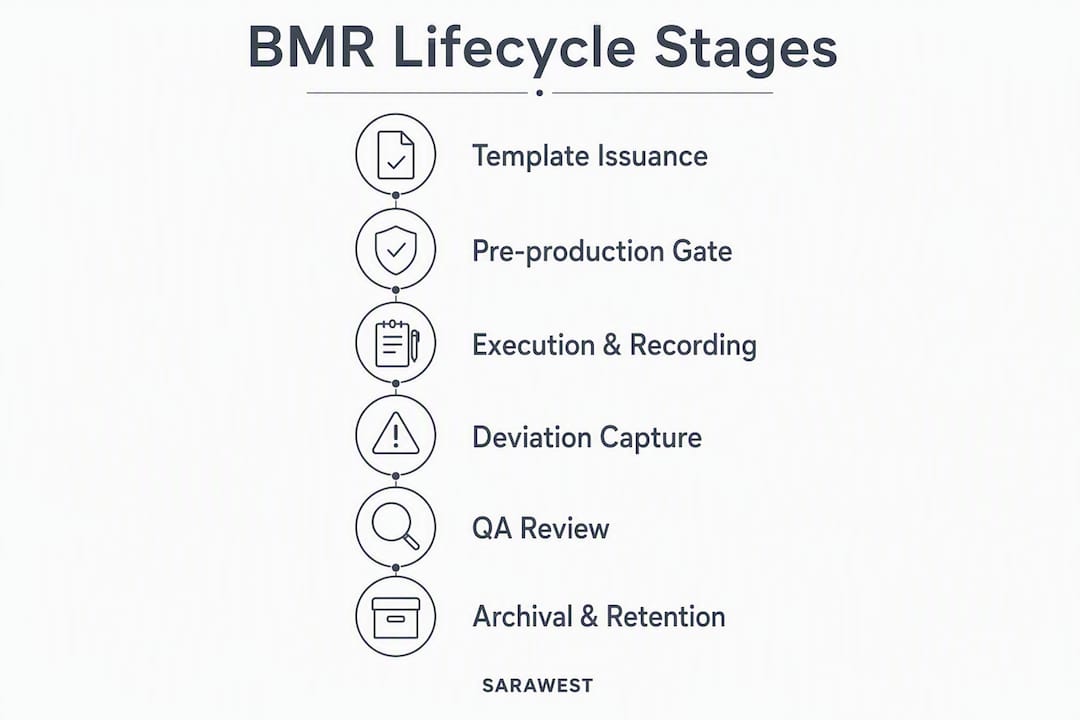
- The BMR lifecycle runs six stages — from controlled template issuance through archival — and QA sign-off is the mandatory gate before release.
- If it isn't written down, it didn't happen. That phrase isn't a cliché in regulated manufacturing; it's the standard inspectors apply.
Table of Contents
- What do batch manufacturing records actually cover?
- Key components every compliant BMR must include
- How does the BMR lifecycle work from start to finish?
- What do FDA inspectors look for in batch records?
- Paper vs. electronic batch records: which is right for your operation?
- How to create a compliant BMR step by step
- Top audit findings and how to fix them before an inspector does
- How excellent BMRs become a commercial asset for contract manufacturers
- Key Takeaways
- The record is the product
- Sarawest USA brings documentation discipline to every production run
- Authoritative sources and further reading
What do batch manufacturing records actually cover?
The BMR and its parent document, the Master Manufacturing Record (MMR), are not the same thing. The MMR is the approved recipe and instruction set. The BMR is the executed evidence — the record of actual inputs, actual equipment, actual personnel, and any deviations from the plan. Confusing the two is one of the most common novice mistakes in regulated manufacturing, and it matters because auditors treat them as legally distinct documents.
A compliant BMR must document:
- Dispensing and weighing — actual quantities of each raw material, with lot numbers and supplier COA references
- Stepwise process execution — each manufacturing step with actual parameters (temperature, time, speed), not just the target ranges
- In-process controls (IPCs) — results of checks performed during production (pH, viscosity, appearance, fill weight)
- Equipment identification and status — equipment IDs, cleaning status, and calibration evidence at the time of use
- Sampling and laboratory links — sample IDs, lab request numbers, and COA references for finished product testing
- Yield calculations — theoretical yield, actual yield, and percentage yield with any reconciliation notes
- Deviations — any departure from the MMR, with a reference to the deviation report and CAPA number
- Signatures and timestamps — operator initials, supervisor sign-offs, and QA review signature with dates and times
- Final disposition — QA release or rejection decision with rationale
Industry scope matters. Pharmaceutical manufacturers follow 21 CFR Part 211 and ICH Q7 for APIs. Dietary supplement manufacturers work under 21 CFR Part 111, which requires documentation at the time of performance for every manufacturing and packaging step. Food manufacturers reference 21 CFR Part 110/117 (cGMP for food). Cosmetics and specialty chemical contract manufacturers may not face the same statutory mandate, but defensible batch records are standard practice for any client-facing quality system.
A BMR is required for every discrete batch or lot — including pilot runs, scale-up batches, rework lots, and partial batches. When packaging operations are separate from manufacturing, a Batch Packaging Record (BPR) captures those activities independently, though many facilities integrate both into a single controlled document.
Key components every compliant BMR must include
A standard BMR organizes information into predictable sections. The table below maps each component to its required fields and the audit reason it matters.
| Component | Required Fields | Why It Matters |
|---|---|---|
| Product & batch identifiers | Product name, batch/lot number, manufacturing date, batch size, MMR version | Links the executed record to the approved master; enables lot traceability |
| Bill of materials | Each raw material name, item code, lot number, supplier, quantity dispensed, unit of measure | Supports raw material traceability and recall readiness |
| Equipment IDs and status | Equipment ID, cleaning log reference, calibration certificate number and expiry | Proves equipment was fit for use at the time of production |
| Stepwise instructions with actuals | Each step number, target parameter, actual result, operator initials, date/time | Demonstrates the process was followed as approved |
| In-process checks | IPC parameter, specification, actual result, pass/fail, operator and date | Provides real-time evidence of process control |
| Sampling and lab links | Sample ID, lab request number, COA reference, test results summary | Connects production data to analytical release data |
| Yield calculations | Theoretical yield, actual yield, % yield, reconciliation notes | Detects losses, contamination, or diversion; required for release |
| Deviations and CAPA references | Deviation report number, description, impact assessment, CAPA number | Ensures departures from the MMR are captured and investigated |
| Signatures and timestamps | Operator, supervisor, QC, QA — each with printed name, signature, date, time | Establishes accountability and contemporaneous capture |
| Final disposition | QA release/reject decision, signature, date, batch disposition statement | The legal authorization for distribution |
QA review checklist (pre-release):
- All fields completed — no blank spaces without an N/A justification
- Every signature matched to an authorized, trained individual
- All IPC results within specification or deviation raised
- Yield within acceptable limits or reconciliation documented
- All deviations linked to open or closed CAPA records
- Equipment calibration and cleaning status confirmed for each piece of equipment used
- Lab results and COA referenced and attached
- MMR version used matches the currently approved version
How does the BMR lifecycle work from start to finish?

The lifecycle has six stages, and each one has a clear owner. Errors cluster at the handoff points — knowing where those are is half the battle.
Stage 1 — Controlled template issuance. The QA-approved MMR is the source document. Before a batch starts, a controlled copy of the MMR is issued as the blank BMR. Version control is critical here: using an outdated MMR version is a direct audit finding. The issued BMR gets a unique batch number assigned before it leaves QA's hands.

Stage 2 — Pre-production gating. Before the first operator touches a raw material, the BMR requires confirmation of equipment calibration status, cleaning verification, and personnel training records. These are not formalities — listing an equipment ID without proof of calibration at the time of use is insufficient for auditors. Step gates built into the BMR (a required sign-off before proceeding to the next step) prevent operators from skipping this check.
Stage 3 — Real-time execution and contemporaneous recording. Operators record data as they perform each step. "Contemporaneous" means at the time of performance, not reconstructed afterward. This is where most data-integrity failures originate — entries filled in at the end of a shift rather than at the moment of action.
Stage 4 — Deviation capture and linkage. Any departure from the MMR — a parameter out of range, a material substitution, an equipment failure — triggers a deviation report. The BMR must reference the deviation report number. The deviation stays open until an impact assessment is complete and a CAPA is raised if needed. A BMR with an unlinked deviation is incomplete.
Stage 5 — Formal QA review and batch release. QA reviews the complete BMR against the MMR, checks all signatures, confirms IPC results, reviews deviation status, and verifies lab results. Only after this review does QA sign the disposition statement. The lifecycle requires this QA gate before distribution — no batch ships without it.
Stage 6 — Archival and retention. The released BMR is archived in a controlled, retrievable system. Retention periods under 21 CFR Part 211 run at least one year past the product's expiration date, or at least three years after distribution, whichever is longer. For dietary supplements under 21 CFR Part 111, records must be retained for at least one year beyond the product's shelf life.
Role matrix:
| Stage | Production | QC/Lab | QA | Maintenance/Calibration |
|---|---|---|---|---|
| Template issuance | Receives controlled BMR | — | Issues and controls | — |
| Pre-production gating | Confirms equipment status | — | Verifies training records | Confirms calibration status |
| Real-time execution | Records all steps contemporaneously | Collects samples | Spot-checks in progress | — |
| Deviation capture | Initiates deviation report | Performs impact testing | Reviews and approves deviation | — |
| QA review and release | Available for queries | Provides COA/lab results | Reviews, signs disposition | — |
| Archival | — | Archives lab records | Archives BMR | Archives calibration records |
What do FDA inspectors look for in batch records?
The primary U.S. regulatory anchor for pharmaceutical batch production records is 21 CFR § 211.188, which requires an accurate reproduction of the master production record, documentation of each significant step, dates, the identity of persons performing or supervising steps, major equipment used, component identities and weights, and labeling control records. For dietary supplements, 21 CFR § 111.260 requires documentation at the time of performance for every manufacturing and packaging step, including quality control activities.
When electronic records are used, 21 CFR Part 11 applies: electronic signatures must be linked to their respective records, audit trails must be computer-generated and tamper-evident, and the system must be validated. Multiple regulatory frameworks — Part 211, Part 11, Part 111, and ICH Q7 for APIs — apply across regulated industries, and the BMR must align to the framework governing the specific product category.
Inspector focus areas:
- Completeness — no blank fields, no unsigned steps, no missing dates
- Contemporaneous entries — timestamps consistent with production sequence; no evidence of backdating
- Signature attribution — every initial or signature traceable to a named, trained individual with authority to perform that step
- Linkage to test results — COA and lab data attached or referenced with retrievable cross-references
- Deviation documentation — all deviations raised, impact-assessed, and linked to CAPA records
- Equipment evidence — calibration certificates and cleaning logs referenced and current at time of use
- Version control — BMR generated from the currently approved MMR version
Pre-audit internal checklist:
- Pull the last five BMRs and verify all fields are complete and signed
- Confirm every equipment ID in those records has a current calibration certificate on file
- Check that every deviation reference links to a closed or actively managed CAPA
- Verify the MMR version used matches the version approved at the time of manufacture
- Confirm retention periods are being met and archived records are retrievable within a reasonable timeframe
- Review training records for every operator who signed a BMR in the last review period
Paper vs. electronic batch records: which is right for your operation?
Paper batch records remain the default in many smaller operations and contract manufacturers. They work — but they carry real risk. Late entries, illegible handwriting, unauthorized corrections, and missing signatures are the most common audit failure modes, and all of them are inherently harder to prevent on paper.
Electronic Batch Records (EBR) consolidate execution data, supporting documents, e-signatures, and audit trails into a single framework. EBR platforms enable real-time data capture from connected devices (scales, barcode scanners, process instruments), enforce step gating, and generate tamper-evident audit trails automatically. The tradeoff is upfront validation cost and system complexity.
Validation checklist for EBR implementations:
- Complete Installation Qualification (IQ) — confirm the system is installed per vendor specifications and site requirements
- Complete Operational Qualification (OQ) — verify all functions operate as intended under normal and edge-case conditions
- Complete Performance Qualification (PQ) — demonstrate the system performs consistently under production conditions
- Implement Part 11 controls: unique user credentials, role-based access, automatic session timeouts
- Configure a secure, computer-generated audit trail that captures who changed what, when, and why
- Implement electronic signature controls — signatures must be linked to their records and cannot be repudiated
- Document record retention and exportability — confirm records can be retrieved and exported in a human-readable format for the required retention period
- Validate all integrations (ERP, LIMS, calibration management) as part of the system boundary
ALCOA+ data integrity checklist:
- Attributable — every entry linked to the person who made it
- Legible — readable at the time of entry and for the full retention period
- Contemporaneous — recorded at the time of performance
- Original — first capture, not a transcription
- Accurate — correct and truthful
- Complete — all required fields populated
- Consistent — data sequence and timestamps are logical
- Enduring — durable for the retention period
- Available — retrievable on demand
Pro Tip: During an inspection, demonstrate audit-trail integrity by pulling a specific batch record, showing the inspector the audit trail for one corrected entry (single line through the error, initial, date, reason), and confirming the original value is still readable. Inspectors want to see that your correction process is controlled, not that you never make mistakes.
Vision-based inspection systems, such as those used in automated quality inspection cells, can feed device-captured data directly into an EBR, eliminating manual transcription errors at the point of measurement. For hybrid paper-EBR operations, the highest-risk path is transcribing paper data into a digital system after the fact — that practice undermines contemporaneous capture and is a known inspection trigger.
How to create a compliant BMR step by step
Start with the controlled template. The MMR must be version-controlled, QA-approved, and distributed in a way that prevents unauthorized copies from reaching the production floor. Every BMR issued from that MMR carries the MMR version number and a unique batch number assigned at issuance.
Execution checklist for operators:
- Verify the BMR batch number matches the batch number on the production order
- Confirm equipment IDs, calibration status, and cleaning verification before recording any data
- Confirm all raw materials match the bill of materials — item code, lot number, and supplier
- Weigh and dispense each component; record actual quantity dispensed, not the target
- Initial and date each step immediately upon completion — never at end of shift
- Record all IPC results as they occur, with pass/fail against specification
- If a parameter falls outside specification, stop, raise a deviation, and do not proceed until QA authorizes continuation
- Complete yield calculation at the end of the batch before submitting for QA review
- Attach or reference all sample IDs and lab request numbers
- Submit the completed BMR to QA with all supporting documents indexed
Sample yield calculation entry:
| Field | Value |
|---|---|
| Status | Within specification — no deviation required |
| Operator / Date | J. Rivera / March 2026 |
Allowable correction notation: Draw a single line through the incorrect entry so the original value remains legible. Write your initials, the date, and a brief reason (e.g., "transcription error — corrected to actual weight"). Never use correction fluid. Never overwrite. This applies to both paper and hybrid records.
For pilot runs and small-batch production, route the BMR between departments with a cover sheet that tracks each reviewer's name, role, and sign-off date. Small batches often move faster than the review process expects — building a routing log into the BMR prevents the record from sitting unsigned on someone's desk while the batch waits for release. Linking lab results and COA references is covered in detail in our certificate of analysis guide, which walks through how COA data maps back to batch record entries.
Top audit findings and how to fix them before an inspector does
Data integrity failures drive the majority of FDA observations related to batch records. Here are the findings that appear most often, with concrete fixes.
Missing or unsigned entries. An operator skips a signature on a critical step. Fix: implement step gating in the BMR so the next step cannot begin until the prior step is signed. Preventive control: periodic in-process QA spot-checks during production.
Post-dated or backdated entries. Timestamps don't align with the production sequence. Fix: retrain the operator on contemporaneous recording; raise a CAPA. Preventive control: EBR with system-generated timestamps removes this risk entirely.
Incomplete IPC data. An in-process check was performed but the result wasn't recorded, or the check was skipped. Fix: raise a deviation, assess impact on batch quality, and document the investigation. Preventive control: step gates that require IPC entry before proceeding.
Yield mismatches without justification. Actual yield falls outside the acceptable range and no deviation was raised. Fix: raise a deviation immediately, perform a material reconciliation, and investigate the discrepancy. Preventive control: automated yield calculation fields that flag out-of-range results.
Missing equipment calibration evidence. An equipment ID is listed but no calibration certificate is referenced or attached. Fix: retrieve the calibration record and attach it retroactively with a documented explanation. Preventive control: link the BMR equipment field to the calibration management system so calibration status is confirmed at step start.
Disconnected ERP/LIMS data. Lab results exist in the LIMS but aren't referenced in the BMR. Fix: add the lab request number and COA reference to the BMR and attach the COA. Preventive control: integrate LIMS with the BMR system so results populate automatically.
Unlinked deviations. A deviation was raised but the BMR doesn't reference the deviation report number. Fix: add the reference and confirm the deviation is under active investigation. Preventive control: a mandatory deviation reference field in the BMR that cannot be left blank if a deviation flag is raised.
CAPA entry example: A yield of 91.2% (below the 95.0% minimum) was recorded for Batch 2026-047. Deviation DEV-2026-112 was raised. Root cause investigation identified a calibration drift in the dispensing scale (Equipment ID: SC-04). CAPA-2026-089 was opened: recalibrate SC-04, review all batches manufactured with SC-04 in the prior 30 days, and retrain operators on pre-batch equipment verification. CAPA closure criteria: three consecutive batches with yields within specification following recalibration.
Pro Tip: Build an inspection-readiness index for each BMR: a one-page cover sheet listing the batch number, MMR version, all deviation references, all equipment IDs with calibration certificate numbers, lab request numbers, and the QA release signature. When an inspector asks for a batch record, hand them the index first. It signals control and saves time.
For supplier-related traceability issues, our supplier audit checklist covers how to verify raw material lot numbers against vendor documentation — a step that feeds directly into the BMR's bill of materials section.
How excellent BMRs become a commercial asset for contract manufacturers
A well-executed batch record isn't just a compliance document. For a contract manufacturer, it's evidence. It's the thing that tells a client's regulatory team, "Yes, we made exactly what we said we'd make, exactly the way we said we'd make it."
High-quality BMRs speed client onboarding and shorten review cycles. When a client's QA team receives a pilot-run BMR that's complete, indexed, and linked to a COA, they can approve the batch and authorize scale-up in days rather than weeks. That speed is a real commercial differentiator — it's the difference between a client who returns for their next production run and one who looks elsewhere.
Consider the pilot-to-scale path. A client brings a new formulation for a 50-liter pilot run. The executed BMR from that pilot captures every raw material lot, every process parameter, every IPC result, and the final yield. When the client's regulatory team reviews it, they have everything they need to write their own internal approval memo. The scale-up run starts faster because the documentation foundation is already solid.
BMRs also support formulation claims and warranty handoffs. If a client's product fails in the field and they need to demonstrate that the manufacturing process was followed correctly, the BMR is the primary evidence. A clean, complete record protects both parties. A gap-filled record creates liability for everyone.
The BMR as a single source of truth — integrated with QMS modules including training logs, calibration records, and deviation management — is what separates a contract manufacturer that clients trust from one they tolerate. At Sarawest USA, our contract manufacturing process is built around this principle: every pilot batch, every scale run, and every white-label production order generates a complete, defensible record that clients can take directly into their own regulatory submissions.
For small-batch and white-label clients, that documentation discipline matters from the first 1,000 units. Our white-label manufacturing capabilities include full batch documentation from pilot through full-scale production, so clients aren't starting from scratch when they need to demonstrate compliance.
Key Takeaways
A compliant batch manufacturing record is the legal history of a production batch — QA review and sign-off before release is mandatory under 21 CFR, and ALCOA+ data integrity principles govern every entry from the first operator signature to final archival.
| Point | Details |
|---|---|
| BMR is the legal batch history | Every entry must be attributable, contemporaneous, and complete — gaps trigger non-conformance findings. |
| QA sign-off is a hard gate | No batch may be released for distribution until QA reviews and approves the completed record under 21 CFR § 211.188. |
| ALCOA+ governs every entry | Attributable, Legible, Contemporaneous, Original, Accurate, Complete, Consistent, Enduring, and Available — apply these to every field. |
| EBR reduces human-error risk | Electronic Batch Records with step gating and system-generated timestamps eliminate the most common audit failure modes. |
| Sarawest USA builds defensible records | Pilot-to-scale documentation, in-house QA workflows, and full batch records are standard on every production order. |
The record is the product
Here's what years of working through audits and client handoffs teaches you: most BMR failures aren't failures of knowledge. People know they're supposed to sign the step. They know the deviation needs a reference number. The failure is operational — a shift that ran long, a supervisor who wasn't available, a form that was designed for a different batch size. The record breaks down at the edges of the process, not the center.
The fix isn't more training on what ALCOA+ means. It's building the record so that doing it wrong is harder than doing it right. Step gates that won't advance without a signature. Yield fields that flag automatically when the number is out of range. Equipment ID fields linked to the calibration system so a lapsed certificate stops the batch before it starts. That's the operational discipline that actually holds up under inspection.
Cross-functional alignment matters just as much. QA can't catch what manufacturing doesn't surface. Maintenance can't support a calibration gate that nobody told them was in the BMR. Training records need to reflect the actual version of the procedure the operator used, not a generic SOP from two years ago. The BMR is where all of that comes together — or falls apart.
One habit that consistently separates compliant operations from struggling ones: enforce contemporaneous electronic capture wherever the infrastructure supports it. Not because paper is inherently wrong, but because the moment data leaves the production floor and gets transcribed somewhere else, you've introduced a gap that an inspector will find.
Sarawest USA brings documentation discipline to every production run
Compliant batch records require more than a good template. They require a manufacturing partner who treats documentation as part of the product — not an afterthought.

Sarawest USA's contract manufacturing operation runs on exactly that standard. Our in-house R&D chemists build formulations with traceability in mind from day one. Every pilot batch generates a complete executed record — raw material lots, process parameters, IPC results, yield calculations, and QA sign-off — that clients can use directly in their own regulatory submissions. We handle production runs from 1,000-unit pilots through full truckload volumes across eight industries, including commercial cleaning and specialty chemical manufacturing.
If you're evaluating a contract manufacturer and documentation quality is part of your criteria, we'd welcome the conversation. Request a sample executed BMR or start an RFQ at sarawestusa.com. A real person reads every inquiry.
Authoritative sources and further reading
Primary U.S. regulatory texts:
- 21 CFR § 211.188 — Batch production and control records — the core pharmaceutical cGMP requirement for BMR content
- 21 CFR § 111.260 — What must the batch record include? — dietary supplement batch record requirements
- eCFR Title 21, Part 211, Subpart J — current regulatory text for pharmaceutical manufacturing records
- FDA.gov — FDA guidance documents, warning letters, and inspection databases
Industry guidance:
- WHO GMP guidelines — applicable to international regulatory submissions
- ISO 9001:2015 quality management systems — document control and record management principles applicable to BMR governance
Sarawest USA resources:
- Contract manufacturing capabilities — pilot-to-scale production with full batch documentation
- Certificate of analysis practices — how COA data links to batch record entries
- Supplier audit checklist — raw material lot verification and vendor traceability