
Lab scale proves the science works. Pilot scale proves the process works, under conditions that resemble a real production line instead of a controlled bench. Skip that second proof and you inherit its cost later, usually in the form of mixing failures, separations that never showed up in a beaker, or a batch that hardens differently than the one your chemist approved. Everything below is built to help you decide when you've outgrown the lab and what pilot work needs to deliver before you commit to full production.
TL;DR:
- Pilot scale runs from a few gallons to several hundred gallons, focusing on reproducibility and downstream process evaluation, not throughput.
- Heat transfer and mixing behaviors do not scale linearly, increasing the risk of surprises like hot spots or uneven reagent dispersion at larger volumes.
- Consistent sampling during pilot runs, including multiple points in the vessel, is essential for process validation and detecting mixing issues.
- Skipping pilot validation can lead to overbuilt systems, rework, and failures caused by unanticipated physical property shifts like viscosity and pH.
- Outsourcing pilot production offers rapid, small batches, detailed reporting, and reproducibility testing, but requires clear sample, scale-up, and quality expectations.
Table of Contents
- Lab Scale vs Pilot Scale: Volumes, Equipment, and Goals
- What Pilot Scale Means: Volumes, Equipment, and Objectives
- The Technical Differences That Actually Bite You at Scale
- When to Move From Lab to Pilot: A Checklist
- Common Scale-Up Pitfalls and How to Avoid Them
- What a Contract Manufacturer Delivers at Pilot Scale
- Three Principles I'd Hold to on Any Scale-Up Project
- Ready to Move From Lab Notes to a Real Pilot Batch?
- Sources
Lab Scale vs Pilot Scale: Volumes, Equipment, and Goals
Lab scale is where formulation chemistry gets built and interrogated. Work happens in milliliters to a few liters, on a bench, with glassware, magnetic stirrers, and small jacketed reactors doing most of the heavy lifting. Nobody at this stage cares how a pump handles 500 gallons. They care whether the chemistry holds together at all.
The goals at lab scale are narrow by design:
- Screening candidate formulas against performance and cost targets
- Confirming reaction mechanism and identifying byproducts
- Building the first stable prototype for internal review
- Developing analytical methods you'll reuse at every later stage
Lab data proves feasibility, not manufacturability. A formula that mixes cleanly in a 2-liter beaker can separate, foam, or overheat the moment you move it into a vessel with real thermal mass and slower agitation. The best labs plan for that translation from day one: they document exact mixing sequences, hold times, and temperature ramps rather than "add and stir," because those details are exactly what a pilot team will need to reproduce the result at 50 times the volume.
What Pilot Scale Means: Volumes, Equipment, and Objectives
Pilot scale sits between lab curiosity and commercial output, typically running anywhere from a few gallons to several hundred, depending on the industry and equipment train involved. There's no single universal number here. A pilot plant is deliberately sized and configured for learning, not throughput, and its scale varies as widely as the products it's built to test.
Equipment shifts accordingly. You're now looking at:
- Jacketed reactors with real temperature control loops, not hot plates
- Modular skids that can be reconfigured as the process changes
- Semi-automated dosing and mixing instead of manual addition
- Basic in-line sensors for pH, temperature, and viscosity tracking
Pilot plant design specialists argue that a pilot unit should be built as a reduced-scale version of the eventual commercial plant, not an oversized version of lab glassware, because facility needs like overhead utilities and slab loading simply don't exist in a typical R&D lab. The objectives reflect that shift: reproducibility across multiple runs, evaluation of downstream steps like filtration or drying, and systematic collection of process data your commercial engineering team will actually use. Flexibility still matters more than efficiency here. You're not optimizing for output yet; you're finding out where the process breaks.
The Technical Differences That Actually Bite You at Scale
Heat transfer and mixing don't scale linearly, and this is where most surprises originate. A reaction that dissipates heat easily through a small glass vessel's high surface-area-to-volume ratio can run hot in a pilot reactor, where that ratio drops and heat has fewer paths to escape. Mixing time often increases with vessel size too, changing how evenly a reagent disperses before it reacts.
Watch these axes closely once you move past the bench:
- Heat transfer: monitor jacket temperature differential and cooling capacity, not just bulk temperature
- Mixing and mass transfer: track impeller speed, blend time, and shear versus the lab's magnetic stirrer behavior
- Separations and materials handling: filtration, centrifugation, and solids handling frequently reveal problems invisible at bench scale
- Instrumentation: pilot control loops close automatically on sensor feedback; lab control is mostly manual and reactive
Sampling discipline separates useful pilot programs from wasted ones. A lab run might get sampled once at completion. A pilot run needs samples at defined intervals across the batch, plus samples from multiple points in the vessel, because uneven mixing means a sample from the top may not match one from the bottom. That data is what eventually supports formal process validation planning under FDA guidance.
When to Move From Lab to Pilot: A Checklist
Move to pilot once your lab formula has survived at least three independent repeat runs with consistent results, once you have a complete mass and energy balance, and once material specifications are locked well enough that a supplier could actually quote them. Business triggers matter too. A signed customer commitment, a regulatory filing deadline, or a straightforward volume forecast are all valid reasons to start pilot work even before every lab question is answered.
- Confirm reproducibility across at least three lab batches.
- Lock raw material specs and confirm supplier availability at pilot volumes.
- Loop in your commercial engineering team before finalizing pilot scope, since including them early avoids costly rework down the line.
- Choose pilot size based on which unit operations actually need testing, not on convenience.
- Define your sampling plan and data targets before the first pilot run starts.
Pro Tip: Size your pilot batch around the unit operation that worries you most, not the one that's easiest to run. If separations or filtration are your real unknown, a small pilot batch that stresses those steps teaches you more than a larger one that skips them.
Common Scale-Up Pitfalls and How to Avoid Them
Skipping pilot validation entirely is the most expensive mistake in this whole process. Teams that jump straight from lab to commercial routinely end up with overbuilt systems, unplanned rework, or outright project failure once real production conditions expose what the lab never could.
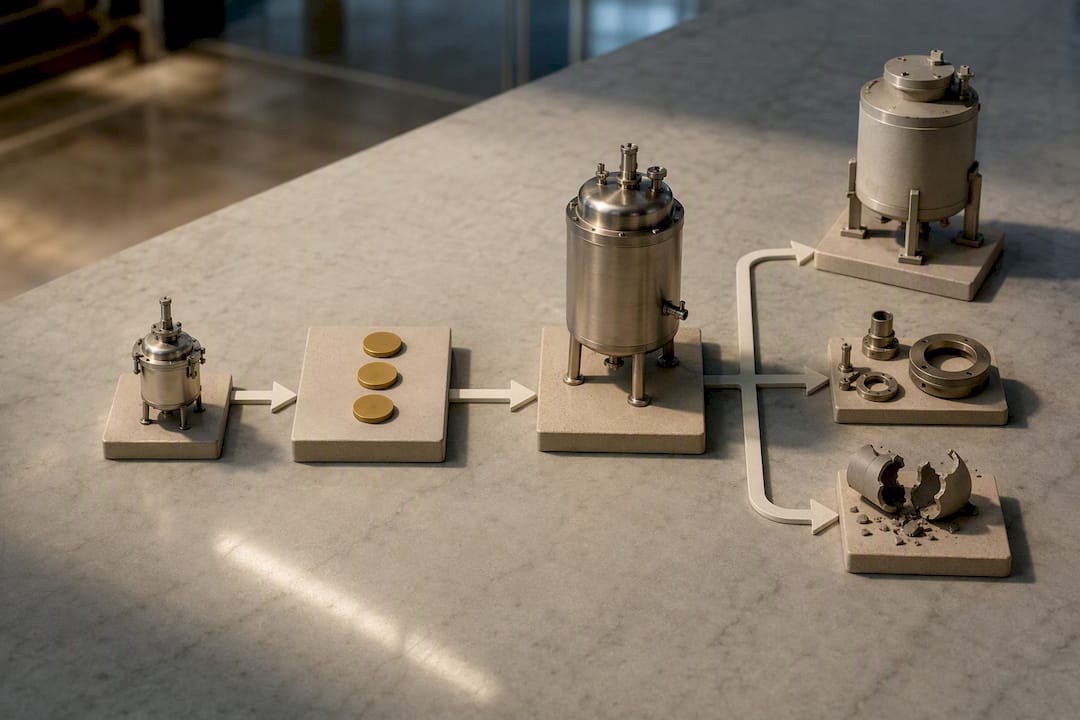
Physicochemical properties shift more than most teams expect. A peer-reviewed comparison of lab-scale and pilot-scale food production found statistically significant changes in hardness, viscosity, and soluble solids between the two scales, and broader research confirms pH, viscosity, and hardness can all shift measurably once a formula leaves bench conditions. That's not a rare edge case. It's close to the default outcome when a scale-dependent step gets ignored.
Mitigate it with a few concrete habits:
- Build pilot equipment as modular skids so you can adjust one unit operation without rebuilding the whole line
- Run extended pilot campaigns, not single batches, to catch drift over time
- Include separations and filtration tests even when the lab version looked trivial
- Check materials compatibility with pilot-scale equipment, not just lab glassware
A prototype-versus-pilot production overview from outside the chemicals world makes a similar point: the jump from prototype to pilot is where design assumptions get tested against real equipment, not just intent.
What a Contract Manufacturer Delivers at Pilot Scale
Outsourcing pilot work is common when a team needs speed without building a pilot facility from scratch. A capable partner typically offers pilot batches sized to your actual test needs, access to an existing formulation library so you're not starting from a blank page, and rapid prototyping turnaround measured in days rather than months.
What you should expect back from that engagement:
- A pilot batch report covering yield, key parameters, and observed deviations
- Sample panels sized for internal QA and, if relevant, customer evaluation
- Suggested scale-up parameters based on what the pilot run actually showed
- A clear reproducibility campaign if the first run raised questions
Evaluate any partner on turnaround speed, minimum order quantities, how transparent they are with raw process data, and whether they'll run a second or third batch to confirm reproducibility rather than treating one pilot run as proof enough.
Three Principles I'd Hold to on Any Scale-Up Project
Treat pilot as a learning exercise, not a small production line. Collect the data your commercial engineering team needs, not just the endpoints that satisfy a lab notebook. And design the pilot to expose failure modes early, because a pilot that hides problems only delays the bill for finding them.
— Faisal Mansur
Ready to Move From Lab Notes to a Real Pilot Batch?
A contract manufacturing partner is an alternative to building your own pilot line from scratch, offering access to proprietary formulas and in-house R&D chemists who can adapt formulations or create new ones, with pilot batches starting at 1,000 units.
When you reach out, come with a target batch size, sample needs, and any regulatory context your product falls under. That's enough for the team to scope a realistic pilot run and turnaround estimate, sometimes with prototypes ready the same day. Review the contract manufacturing capabilities page and submit an RFQ to get pilot-to-scale planning started on your specific formula.
Sources
- PMC article on scale-dependent physicochemical changes (2024)
- Process Validation: General Principles and Practices — FDA
- Pilot plant — Wikipedia
- Scaleup issues from bench to pilot — Hazen Research (case study PDF)