

Contract manufacturing lead time is the total elapsed time from the moment you place an order to the moment finished goods arrive at your dock, spanning procurement, scheduling, production, and logistics. According to the Wikipedia decomposition of lead time, that full span breaks into preprocessing, processing, and postprocessing stages. For U.S. buyers, "on time" typically means delivery within the confirmed date, not the quoted date. Those two numbers are rarely the same.
Three things to lock before anything else:
- Get a stage-by-stage lead-time breakdown in writing, not a single delivery estimate.
- Confirm whether the quoted date is a confirmed supplier commitment or a best-guess estimate.
- Identify your longest-lead item (specialty ingredient, custom packaging, regulatory test) and start that clock first.
Typical U.S. ranges vary sharply by product type. Industry data from Wonnda puts quick-turn beauty prototypes at 3–8 weeks, supplements and regulated products at 8–16 weeks for first runs, and complex custom chemical projects at 16 weeks or more. A commodity reorder with locked specs and stock packaging can move in days. The gap between those extremes is almost always explained by procurement and scheduling, not production time itself.
Key Takeaways
Contract manufacturing lead time is controlled by procurement and scheduling far more than by production floor time. Lock specs and packaging first, confirm slots in writing, and measure OLT Confirmed against OLT Actual to build a reliable launch calendar.
| Point | Details |
|---|---|
| Lead time has four stages | Total lead time spans preprocessing, procurement, scheduling, production, postprocessing, and transit. |
| Confirmed beats quoted | OLT Confirmed is the only date worth building a launch calendar around; OLT Quoted is an estimate. |
| Packaging is a hidden delay | Custom packaging adds multiple weeks to lead times; in contrast, stock packaging and locked artwork can significantly reduce the schedule. |
| Predictability over speed | A reliable 20-day lead time delivers more value than an unreliable 12-day promise that slips to 18. |
| Sarawest USA shortens upstream phases | In-house R&D, a 1,200+ formula library, and turnkey packaging reduce pilot-to-production timelines to 12–30 days for locked programs. |
Table of Contents
- How to calculate lead time for a contract manufacturing program
- Procurement phase: what drives material lead times and how to fix them
- Scheduling phase: converting material availability into a real production date
- Production phase: floor-level risks and how to control them
- Logistics phase: packaging, shipping, and final delivery for U.S. buyers
- What changes for chemical contract manufacturing specifically
- Phase-mapped tactics to shorten manufacturing lead times
- How to measure and monitor lead times across your programs
- Key questions to ask a contract manufacturer about lead times
- How Sarawest USA manages and shortens lead times for U.S. chemical buyers
- The lead-time tradeoff most procurement teams get wrong
- Sarawest USA: fast RFQ, real chemists, and confirmed production dates
- Authoritative U.S. standards and guidance to consult
- Sources
How to calculate lead time for a contract manufacturing program
The core formula, as Investopedia frames it, is straightforward:
Total Lead Time = Preprocessing + Procurement + Scheduling/Queue + Production + Postprocessing + Transit
For make-to-order (MTO) programs, preprocessing includes spec review, DFM sign-off, and artwork approval. For make-to-stock (MTS) reorders with locked specs, preprocessing compresses to near zero. Engineer-to-order (ETO) programs add a formulation or engineering phase before procurement even begins.
Four terms govern how lead time moves from a wish to a commitment:
- OLT Requested: the date the buyer needs delivery.
- OLT Quoted: the date the contract manufacturer estimates based on current capacity.
- OLT Confirmed: the date the CM formally commits to after reviewing materials, queue, and capacity.
- OLT Actual: the date goods physically arrive.
Governance lives in the gap between OLT Quoted and OLT Confirmed. A CM that never moves from quoted to confirmed is a red flag.
Worked example: prototype to pilot to first production run
A brand launching a new commercial cleaning concentrate walks through three stages:
These are illustrative ranges based on industry norms for a mid-complexity liquid chemical product with stock packaging. Custom packaging, regulatory testing, or single-source ingredients extend every row. MRPEasy's manufacturing lead-time guide recommends feeding these stage durations directly into an ERP or MRP system so the calculation updates automatically when a supplier acknowledgment changes.
Procurement phase: what drives material lead times and how to fix them
Procurement is where most programs lose weeks before a single unit is produced. The drivers are predictable, which means they are also preventable.
Common procurement lead-time drivers:
- Long-lead specialty ingredients: Custom surfactants, active compounds, or certified raw materials often carry 6–10 week supplier lead times with no domestic alternative.
- Custom packaging: Wonnda's packaging data puts custom packaging lead times at 6–12 weeks, with artwork and label approval loops adding multiple additional weeks on top.
- MOQ effects: A supplier's minimum order quantity may force you to wait for a consolidated batch, adding queue time you did not plan for.
- Single-source suppliers: One supplier for a critical ingredient means one point of failure. Any disruption cascades directly into your confirmed date.
- Seasonal availability: Agricultural-derived ingredients and some specialty chemicals have seasonal supply windows that compress your ordering flexibility.
Practical mitigations:
- Blanket purchase orders with quarterly releases lock pricing and reserve supplier capacity without committing to a single delivery date.
- Supplier lead-time SLAs, written into the contract, give you a documented escalation path when a vendor slips.
- Dual sourcing for your top three longest-lead items eliminates single-point risk without requiring you to dual-source everything.
- Vendor-managed inventory (VMI) agreements shift the replenishment burden to the supplier and keep safety stock at the CM's facility.
- Long-lead-item forecasting, even a rough 90-day rolling forecast, lets suppliers pre-position materials before you place a firm order.
U.S. regulatory note for chemical buyers: TSCA screening, SDS documentation, and DOT/HAZMAT classification can add 2–4 weeks to a new ingredient's procurement cycle if the CM has not previously sourced it. Build that buffer into your first-run timeline, not as a contingency, but as a planned phase.
Pro Tip: Lock artwork and choose stock packaging for your first pilot run. Custom packaging is the single most common source of multi-week delays that buyers discover too late to fix without expediting.
Scheduling phase: converting material availability into a real production date
Material arriving at the CM's dock does not mean production starts the next morning. Queue time, the gap between material availability and the first production slot, is often the least visible and most underestimated phase of the entire program.
Scheduling policies vary by facility. Some CMs run first-come, first-served queues. Others batch similar formulations together to reduce changeover time, which benefits their efficiency but may push your run to the next batch cycle. High-mix, low-volume shops frequently prioritize larger orders, meaning a 1,000-unit pilot competes with a 50,000-unit reorder for the same line time.
Negotiating a confirmed slot requires more than a handshake. Ask specifically whether your date is "penciled in" or formally scheduled in the CM's production system. A penciled-in date disappears the moment a larger customer calls. A confirmed slot, ideally backed by a scheduling acknowledgment in writing, is the only date worth building your launch calendar around.
Priority fees exist at many facilities. Paying a modest premium to move your run ahead in the queue is often cheaper than the cost of a delayed product launch. Ask about it directly during RFQ, not after you have already signed.
Production phase: floor-level risks and how to control them
Once your run is scheduled, the floor introduces its own set of variables. Setup time, cycle time, changeover frequency, and rework loops each add calendar days that a quoted lead time may not fully account for.
Floor-level risk drivers:
- Long setup and tooling: Specialized mixing equipment, temperature-controlled reactors, or custom fill heads require setup time that scales with complexity, not batch size.
- Cycle time variability: Emulsification, curing, or reaction time for chemical products is chemistry-dependent. A CM quoting a flat production time without accounting for batch chemistry is guessing.
- High-mix, low-volume changeovers: Facilities running many SKUs across shared lines spend significant time on cleaning, validation, and changeover between runs. Lean manufacturing principles identify wait time between operations, not processing time itself, as the dominant lead-time driver in most production environments.
- Rework and QA loops: A batch that fails in-process inspection goes back to the line. If the CM's QA process is not documented and agreed upon in advance, you find out about rework after it has already consumed days.
Operational controls to request from your CM:
- Pilot runs with documented acceptance criteria before committing to a full production order.
- In-process inspection checkpoints with defined pass/fail criteria, not just a final QC check.
- SMED (Single-Minute Exchange of Die) or equivalent changeover reduction practices for high-mix lines.
- Written rework procedures that define what triggers a rework, who authorizes it, and how it is tracked against the confirmed delivery date.
Pro Tip: A CM promising a 10-day lead time when your category average is 20 days deserves more scrutiny, not a faster signature. Predictable lead times often deliver better quality and lower total cost than aggressive promises that mask poor planning or capacity overcommitment.
Logistics phase: packaging, shipping, and final delivery for U.S. buyers
A completed production run is not finished goods until it is packaged, labeled, palletized, and moving toward your facility. Logistics adds real calendar time, and for chemical products, it adds regulatory complexity that most buyers underestimate.
- Packaging preparation: Even with stock containers, filling, capping, labeling, and palletizing take 2–5 days for a typical chemical run. Custom packaging or kitting adds more.
- DOT/HAZMAT compliance: Chemical shipments classified as hazardous materials require UN-approved packaging, proper labeling, SDS documentation, and carrier-specific handling. A CM that does not have this process documented adds days of prep time every single run.
- Carrier transit variability: Domestic ground transit for chemical freight runs 3–7 business days depending on origin and destination. LTL shipments add pickup consolidation time. Refrigerated or temperature-sensitive products narrow your carrier options and extend transit windows.
- Customs and import steps: If any component or finished product crosses a border, add 5–15 business days for customs clearance, depending on product classification and documentation completeness.
- Expedite options and tradeoffs: Air freight compresses transit from days to hours but typically costs 4–6 times the ground rate for chemical freight. Door-to-door DDP (Delivered Duty Paid) pricing simplifies your accounting but builds the carrier's margin into the rate. FOB origin pricing gives you carrier control but shifts transit risk to your team. For U.S. domestic programs, nearshoring production to a domestic CM eliminates customs entirely and cuts transit to 1–3 days.
- Final-mile warehouse handling: If goods route through a 3PL before your dock, add 1–3 days for receiving, inspection, and put-away. Build this into your confirmed delivery date, not your production completion date.
What changes for chemical contract manufacturing specifically
Chemical contract manufacturing carries lead-time risks that do not exist in electronics or metal fabrication, and buyers who treat all contract manufacturing timelines as equivalent consistently underestimate their programs.
Chemical-specific lead-time drivers:
- Regulatory testing: Stability testing, efficacy testing, and compatibility testing for new formulations can run 4–12 weeks depending on the product category and the claims being made.
- Hazardous materials handling: Specialty raw materials classified as hazardous require specific storage, handling, and disposal protocols that affect scheduling and throughput.
- Specialty raw materials: Many active ingredients in cleaning, sports care, and equine products come from a short list of global suppliers. Lead times for these materials can be 8–14 weeks with no domestic substitute.
- Shelf-life and stability testing: Products with label claims about efficacy or shelf life require accelerated stability data before commercial release, adding weeks to the postprocessing phase.
Brief sector comparison:
- Beauty and personal care: 3–8 weeks for prototypes; regulatory burden is moderate; packaging is often the longest lead item.
- Supplements: 8–16 weeks for first runs; cGMP compliance, third-party testing, and label review add significant time.
- Food and beverage: 10–16 weeks for first production; FDA registration, allergen controls, and co-packer scheduling drive the calendar.
- Electronics: Component procurement dominates; lead times for specialized ICs can run 26–52 weeks in constrained markets.
- Metal fabrication: Tooling and material certification drive first-article lead times; repeat orders are typically faster once tooling is proven.
What U.S. chemical buyers should require up front:
- cGMP evidence or equivalent quality system documentation.
- Certificates of Analysis (COAs) for all raw materials used in your formulation.
- TSCA screening confirmation for any new chemical substance.
- OSHA SDS for all hazardous materials handled in your production run.
- A documented stability testing protocol with timelines before you sign the production agreement.
Phase-mapped tactics to shorten manufacturing lead times
Reducing lead time is not one action. It is a set of targeted interventions mapped to the phase where the delay actually lives. Applying a procurement fix to a scheduling problem wastes time and money.
| Phase | Reduction Tactic | Speed Gain | Cost Impact |
|---|---|---|---|
| Procurement | Blanket orders, dual sourcing, VMI | High | Low to moderate |
| Procurement | Stock packaging, plate reuse | High | Low |
| Scheduling | Priority/confirmed slots, batch rationalization | Moderate | Low to moderate premium |
| Production | Pilot runs, SMED, in-process inspection | Moderate | Low |
| Production | DFM integration from the prototype stage | High | Low |
| Logistics | Domestic CM (nearshoring), DDP terms | High | Variable |
| Logistics | Air freight expedite | Very high | High |
Implementation checklist for your first 30 days:
- Internally: assign one owner for lead-time governance; map your longest-lead item for every active program.
- From the CM: request a stage-by-stage lead-time breakdown, a historical on-time delivery rate, and a sample production schedule for a comparable run.
- Lock first: formulation spec, packaging spec, and artwork approval. These three items gate every downstream phase.
The cost-versus-speed tradeoff is real. Air freight expedites and priority scheduling fees are legitimate tools, but they are most valuable when used to recover a slipping program, not as a substitute for planning. A well-structured program with confirmed slots and locked specs rarely needs them.
How to measure and monitor lead times across your programs
Measurement is what converts a quoted date into a managed commitment. Without it, you are relying on the CM's goodwill rather than your own data.
KPIs to track:
- OLT Requested vs. OLT Quoted vs. OLT Confirmed vs. OLT Actual (the four-term framework from Investopedia's lead-time definition)
- Supplier on-time delivery percentage, measured against OLT Confirmed, not OLT Quoted
- Schedule adherence rate: percentage of production runs that hit their confirmed start date
- Change-order frequency: how often spec changes reset the clock
- Days in queue: average time between material availability and production start
Data sources:
- ERP/MRP outputs for procurement and production scheduling data, as MRPEasy recommends for automated lead-time calculation
- Supplier acknowledgments and advance ship notices (ASNs) for procurement phase tracking
- EDI feeds from carriers for transit visibility
- Dock-receipt timestamps for OLT Actual measurement
- Lab test completion dates for postprocessing phase tracking
Mini governance checklist:
- Weekly lead-time review for active programs within 30 days of confirmed delivery date.
- Escalation threshold: any program more than 5 business days behind OLT Confirmed triggers a written recovery plan from the CM.
- SLA penalties and incentives documented in the contract, not negotiated after a miss.
- RACI: procurement owns OLT Confirmed tracking; supply chain owns transit; product owns spec-change freeze dates.
Key questions to ask a contract manufacturer about lead times
The RFQ stage is your best opportunity to surface calendar risk before it becomes a launch delay. These questions separate CMs with real process discipline from those with optimistic sales teams.
Vendor question checklist:
- What is your current quoted lead time for a run of this type, and when can you convert that to a confirmed date?
- What is your historical on-time delivery rate against confirmed dates for the past 12 months?
- How do you define lead time internally? Does it include preprocessing and postprocessing, or only production floor time?
- What is your sample-to-scale timeline for a new formulation, and what gates that transition?
- How does MOQ affect scheduling priority? Does a 1,000-unit pilot compete with larger runs for line time?
- What is your documented change-control process, and how does a spec change affect the confirmed date?
- Which of your raw material suppliers are single-source, and what is your contingency if one slips?
- What is your QA timeline for a batch of this complexity, and where does rework fit in your schedule?
A thorough supplier audit checklist covers many of these questions in structured form and is worth running before any new CM relationship.
Red flags to watch for:
- A CM that defines lead time as production floor time only, excluding procurement and QA.
- No documented change-control process, or a verbal assurance that "changes are easy."
- Single-source long-lead ingredients with no named backup supplier.
- Inconsistent QA timelines across similar products, suggesting QA is reactive rather than planned.
- Vague answers about scheduling priority for pilot orders.
Documents to request before signing:
- Stage-by-stage lead-time breakdown for a comparable run.
- Historical on-time performance data (12 months minimum).
- Sample production schedule showing queue, production, and postprocessing phases.
- SOPs for change control, rework, and QA release.
How Sarawest USA manages and shortens lead times for U.S. chemical buyers
Sarawest USA's model is built around the specific friction points that extend lead times in chemical contract manufacturing: sourcing delays, formulation restarts, packaging bottlenecks, and handoff gaps between R&D and production.
Capability highlights relevant to lead-time management:
- In-house R&D chemists who adapt existing formulas or develop new ones without outsourcing the formulation phase, eliminating a common 2–4 week external handoff.
- A library of 1,200+ proprietary formulas across eight industries, including commercial cleaning, sports care, equine, solar, and leather care, meaning many programs start from a proven base rather than from scratch.
- Pilot runs starting at approximately 1,000 units, with scale-up to full truckloads from the same facility, eliminating the CM transition that often resets the procurement and scheduling clock.
- Turnkey packaging and fulfillment handled in-house, removing the external packaging vendor from the critical path.
- Same-day production capability for programs where formulation is locked and packaging is confirmed, demonstrating what is possible when the upstream phases are managed correctly.
Worked scenario: pilot to first production run
A commercial cleaning brand brings a new concentrate to Sarawest USA with a locked formulation spec and a stock container selected from the existing packaging inventory. Because the formulation matches an existing proprietary base, preprocessing compresses from the typical 5–7 days to 1–2 days. Procurement draws from pre-positioned raw materials rather than a fresh supplier order. The pilot run ships in approximately 15 business days from signed order. The first full production run, with confirmed scheduling and no spec changes, follows in roughly 25 business days. That is 8–10 days faster than the industry norm for a comparable new-product first run, driven by DFM integration, in-house packaging, and consolidated sourcing rather than expediting.
| Program Stage | Typical Industry Range | Sarawest USA Range | Key Driver |
|---|---|---|---|
| Prototype | 10–20 days | 3–7 days | In-house R&D, existing formula library |
| Pilot (1,000 units) | 20 days | 12–18 days | Pre-positioned materials, in-house packaging |
| First Production Run | 30–50 days | 20–30 days | Locked spec, consolidated sourcing |
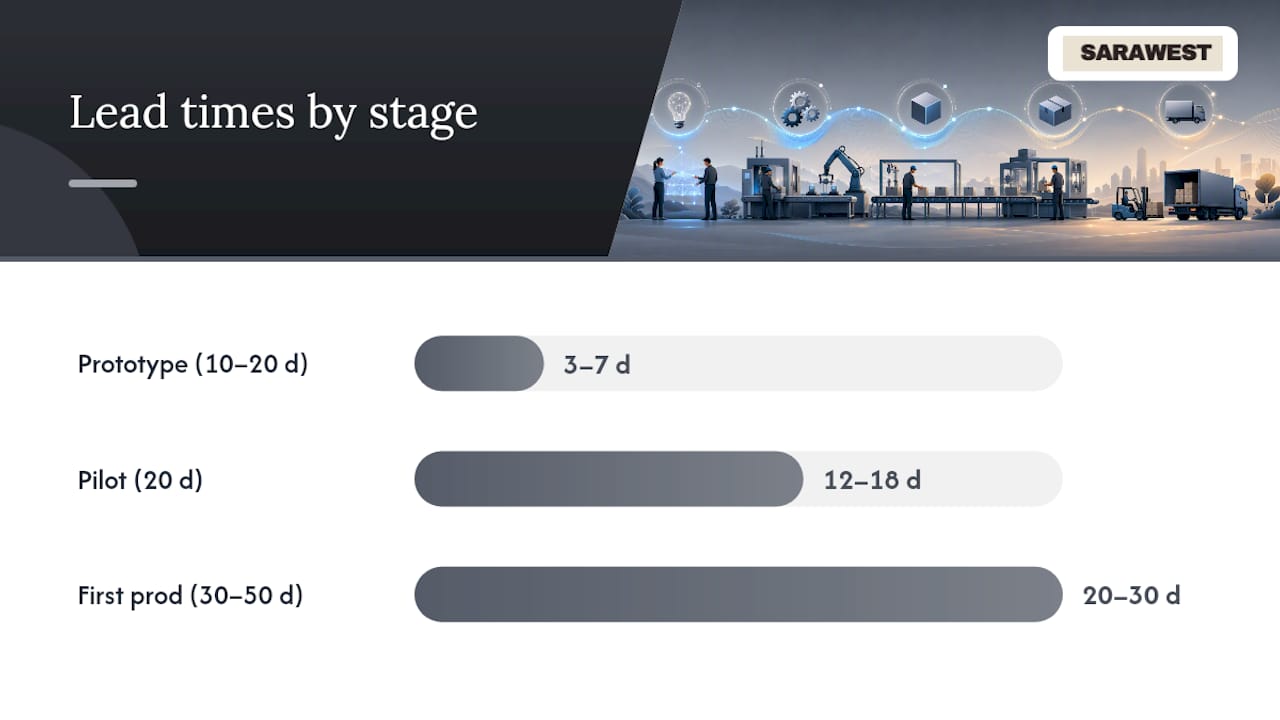
These ranges apply to programs with locked formulation and stock or existing packaging. Custom packaging or new regulatory testing adds time to any program, regardless of the CM.
The lead-time tradeoff most procurement teams get wrong
The conventional wisdom in procurement is that shorter is always better. Push the CM for the fastest possible date, expedite if needed, and treat any delay as a failure. That framing is understandable, but it consistently produces worse outcomes than the alternative.
The real question is not "how fast can you go?" but "how reliably can you commit?" A CM that quotes 12 days and delivers in 18 has cost you six days of planning buffer and forced a reactive scramble. A CM that quotes 20 days and delivers in 19 has given you something more valuable: a number you can build a launch calendar around.
This matters most in chemical manufacturing, where non-manufacturing tasks can account for 30–50% of total program time. Regulatory testing, QA release, and packaging prep do not compress under pressure. They take the time they take. A CM that promises to compress them is either skipping steps or absorbing the risk on your behalf without telling you.
The procurement teams that consistently hit their launch dates are not the ones who push hardest for short lead times. They are the ones who lock specs early, confirm slots in writing, and build their calendars around OLT Confirmed rather than OLT Quoted. Speed is a byproduct of that discipline, not a substitute for it.
Sarawest USA: fast RFQ, real chemists, and confirmed production dates
Most contract chemical manufacturers quote a lead time and leave the confirmation to chance. Sarawest USA works differently. With in-house R&D chemists, a 1,200+ formula library, and turnkey packaging under one roof, the upstream phases that typically consume weeks are compressed by design, not by expediting.
For U.S. brands in commercial cleaning, sports care, equine, solar, and adjacent categories, Sarawest USA offers pilot runs from 1,000 units, white-label and private-label options, and custom formulation without broker intermediaries. When your spec is locked and your packaging is confirmed, production can move fast. When it is not, the in-house team helps you get there.
RFQ checklist to send with your inquiry:
- Formulation status: locked, needs adaptation, or new development required.
- Packaging spec: stock container or custom, with artwork status.
- Target confirmed delivery date and acceptable expedite budget.
- Order quantity and whether this is a pilot, first production run, or reorder.
Submit your RFQ or request samples from three SKUs to see production quality and turnaround before committing to a full run.
Authoritative U.S. standards and guidance to consult
These sources govern lead-time documentation, quality systems, and chemical compliance for U.S. contract manufacturing programs. Reference them when drafting contracts, SOPs, and supplier agreements.
- PMI/PMBOK: Defines lead time in project scheduling contexts and provides the framework for OLT terminology and schedule governance. Relevant for procurement teams building formal program plans.
- ASCM/APICS (SCOR model and CPIM body of knowledge): The authoritative U.S. supply chain standards body for procurement lead time, supplier performance metrics, and inventory management practices. APICS definitions of manufacturing lead time and cumulative lead time are the industry standard for contract language.
- ISO 9001: The international quality management standard most U.S. contract manufacturers reference for QA systems, change control, and nonconformance procedures. Require ISO 9001 certification or equivalent documented QMS from any CM handling regulated products.
- EPA/TSCA (Toxic Substances Control Act): Governs new chemical substances and significant new uses in the U.S. TSCA screening is a required step for any new ingredient not previously listed, and the review timeline should be built into your procurement phase, not treated as a contingency.
- OSHA Hazard Communication Standard (HazCom/GHS): Requires SDS documentation and proper labeling for all hazardous materials handled in production. Non-compliance adds time to shipping and can trigger carrier refusals that extend your logistics phase.
Sources
- Lead time - Wikipedia
- Lead times (Wonnda)
- Lead Time in Manufacturing: A Complete Guide to Types, Strategies, and Optimization
- What Most Get Wrong About Manufacturing Lead Times — and What You Can Do About It
- Understanding Lead Time: Definition, Process, and Impact on Business