
A pH neutral cleaner is formulated close to pH 7, the point on the scale that's neither acidic nor alkaline, so it lifts light soil without eating into finishes. Use it for daily maintenance on sealed floors, natural stone, and metal fixtures where an acidic or alkaline product would dull, etch, or corrode the surface over time. It won't touch heavy grease or mineral scale, and neutral doesn't mean disinfecting. Those are two different jobs.
TL;DR:
- pH neutral cleaners are best suited for daily maintenance on sealed, natural stone, and metal surfaces to prevent damage from acidic or alkaline formulas.
- They effectively remove light soils like dust, spills, and grime but are not suitable for heavy grease, mineral scale, or deep cleaning tasks.
- Proper dilution, application method, and water quality are crucial to ensure effective cleaning without leaving residues or damaging surfaces.
- Neutral cleaners are not disinfectants and require separate products with active biocides for pathogen control.
- Custom formulations or private-label options are available from specialists to meet specific surface, allergen, or branding needs.
Table of Contents
- What "pH Neutral" Means and How pH Affects Cleaning Chemistry
- What pH Neutral Cleaners Clean Well, and Where They Fall Short
- How to Choose and Use a pH Neutral Cleaner the Right Way
- Neutral Cleaner vs. Neutral Disinfectant: They're Not the Same Product
- Commercial Uses and Procurement: Concentrate, Ready-to-Use, or Custom-Built
- Storage and Shelf Life: What Actually Shortens a Neutral Cleaner's Life
- Allergens and Sensitivities: What to Check on the Label
- What Facility Managers and Small Businesses Should Actually Do Next
- Getting a Custom or White-Label Neutral Cleaner Built for Your Facility
- Sources
What "pH Neutral" Means and How pH Affects Cleaning Chemistry
The pH scale runs from 0 to 14. Zero is highly acidic, 14 is highly alkaline, and 7 sits dead center as neutral. A pH neutral cleaner is formulated to land right around that midpoint, which is why it earns its name rather than being just a marketing label.
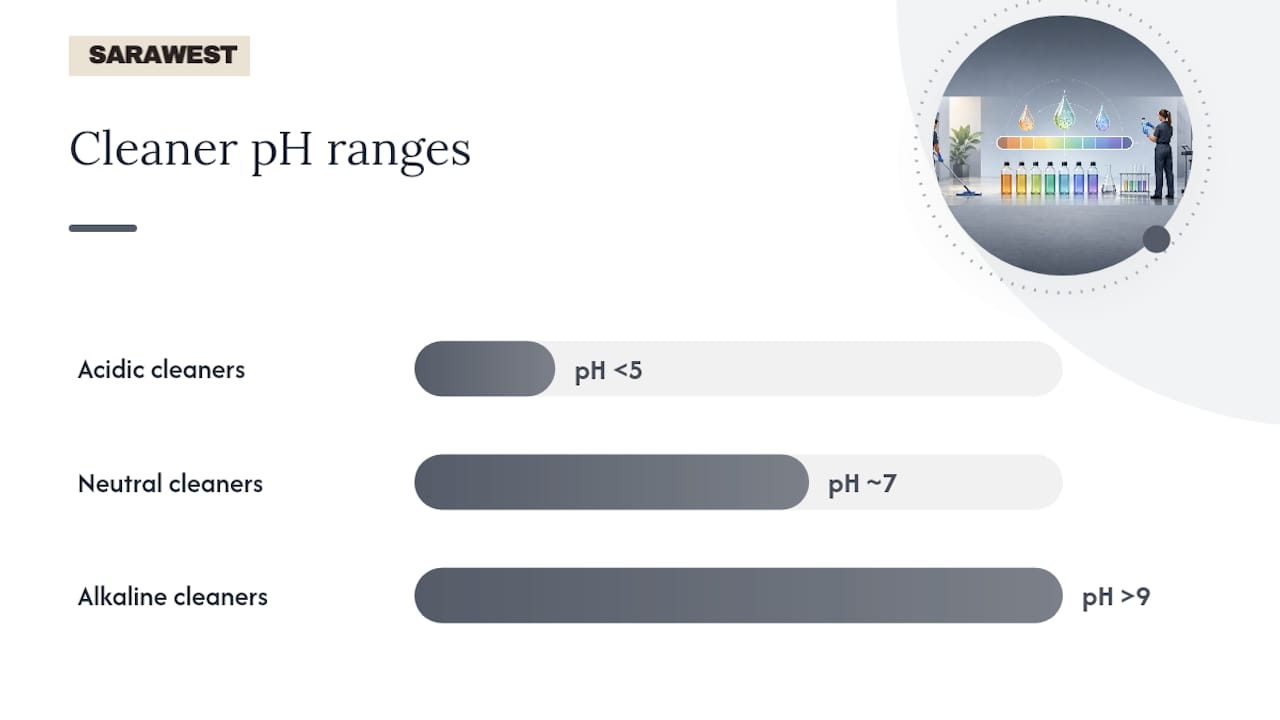
Acidic cleaners, typically below pH 5, cut through mineral deposits, rust, and hard water scale. They're the right call on a lime-scaled shower or a rust-streaked sink. Alkaline cleaners, usually above pH 9, break down grease, oils, and protein residue. That's why degreasers skew alkaline. Neutral pH cleaners are formulated around pH 7 specifically to clean without damaging finishes such as stone, tile, sealed wood, and certain metals that acidic or alkaline chemistry would degrade over repeated use.
That protective quality is the entire point. A few things happen to sensitive surfaces exposed to the wrong end of the pH scale:
- Natural stone like marble and travertine etches under acid, leaving permanent dull spots.
- Finished hardwood loses its sealant sheen when alkaline cleaners strip the topcoat repeatedly.
- Aluminum and softer metals pit and discolor from sustained acid or high-alkaline exposure.
- Rubber and vinyl flooring can yellow or degrade under harsh alkaline chemistry over months of use.
What pH Neutral Cleaners Clean Well, and Where They Fall Short
Neutral cleaners earn their keep on the jobs that happen every day, not the ones that happen once a quarter. Light dust, foot traffic soil, spilled coffee, and general grime on finished floors are exactly what this product class was built for.
Here's where a pH neutral cleaner performs reliably:
- Daily damp-mopping on sealed hardwood, laminate, and vinyl composition tile
- Routine maintenance cleaning on polished or honed natural stone
- Light-duty spray-and-wipe on stainless steel and other metal-finished surfaces
- General glass and countertop upkeep where finish preservation matters more than aggressive soil removal
But neutral cleaners are effective for daily maintenance and light soils, and they typically don't remove heavy grease or mineral scale that requires alkaline degreasers or acidic descalers instead. A commercial kitchen floor caked in fryer grease needs an alkaline degreaser first. A bathroom with heavy hard-water buildup needs an acid-based descaler. Neutral cleaner is the daily habit, not the deep-clean fix.
The operational upside runs deeper than surface protection. Because neutral formulas skew toward lower toxicity than strong acids or caustics, many facilities cut back on required personal protective equipment for routine mopping, and finish warranties on stone and wood floors often stay intact longer with consistent neutral-pH maintenance.
Pro Tip: Keep one alkaline degreaser and one neutral daily cleaner in rotation rather than trying to make one product do both jobs. You'll use less product overall and protect your finish longer.
How to Choose and Use a pH Neutral Cleaner the Right Way
Getting dilution right matters more than most buyers realize. Too weak, and you're mopping with water. Too strong, and you're leaving residue that actually attracts more dirt.
- Match dilution to soil load. Industry guidance typically runs from a few ounces per gallon for light duty up to several ounces per gallon for heavy duty cleaning. Measure with a marked dosing cup rather than eyeballing it. Overdosing is the single most common mistake in facility mopping programs.
- Pick the right application method. Damp mop for daily foot-traffic floors, autoscrubber for large retail or warehouse footprints, and spray-and-wipe for counters, fixtures, and vertical surfaces. Most neutral formulas need little to no dwell time on light soil. Let it sit 30 to 60 seconds on heavier residue before wiping.
- Account for your water supply. Hard water can shift how a diluted cleaner behaves, sometimes leaving mineral film that reads as "residue" even though the product itself performed correctly. Some commercial formulas include buffering agents to hold pH steady across different water sources; a quick pH test strip in your diluted solution confirms you're actually working near neutral before you commit to a full-floor job.
- Run a surface test first. Treat a small, inconspicuous area, let it dry fully, and check for dulling, discoloration, or residue before rolling the product out across an entire floor. This is especially critical on stone with a manufacturer warranty, since many warranties specify approved cleaning chemistry.
Neutral Cleaner vs. Neutral Disinfectant: They're Not the Same Product
This is where a lot of buyers get tripped up. A neutral pH tells you a cleaner won't damage your floor. It tells you nothing about whether it kills germs.
A neutral disinfectant is a different formulation entirely: it starts from that same gentle pH base but adds an active biocide, commonly a quaternary ammonium compound, to actually kill pathogens. pH alone doesn't determine disinfectant efficacy; the active ingredient and proper dwell time do. A neutral pH cleaner with no biocide, no matter how well it's marketed, doesn't disinfect anything.
Use each product for the job it's built for:
- Standard neutral cleaner: daily floor and surface maintenance, general offices, retail floors, hospitality common areas.
- Neutral disinfectant: restrooms, healthcare-adjacent areas, food-contact surfaces, and any space with infection-control requirements.
- Check the label dwell time. A disinfectant only works if it stays wet on the surface for the manufacturer's stated contact time, often one to ten minutes depending on the pathogen claim.
Commercial Uses and Procurement: Concentrate, Ready-to-Use, or Custom-Built
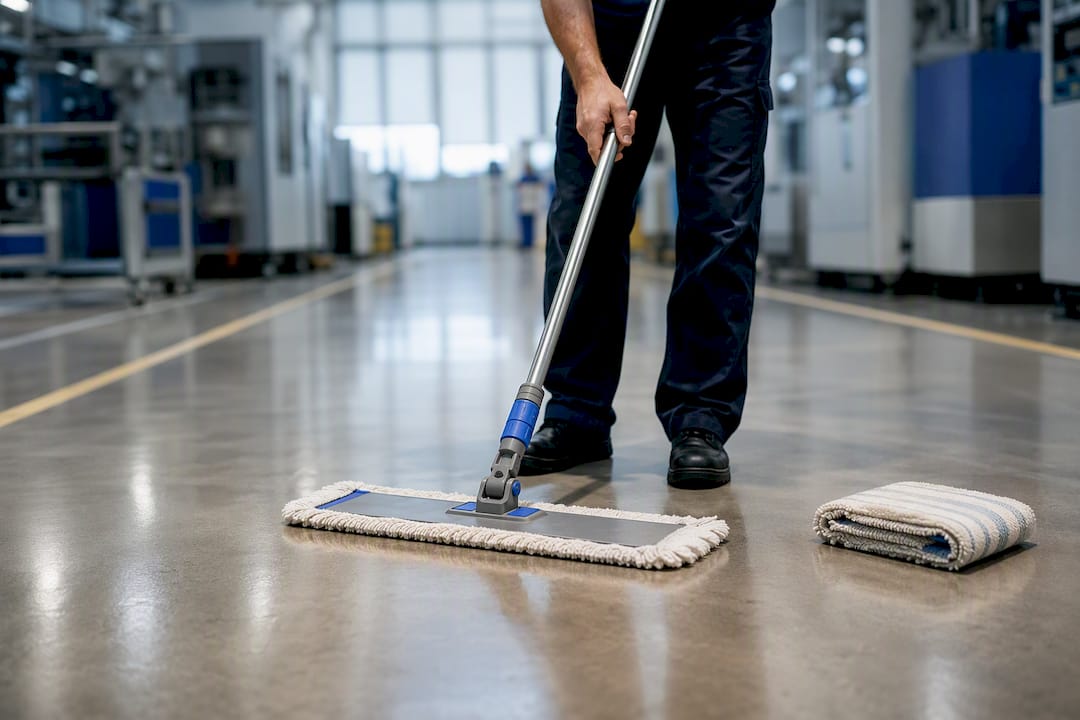
Facility buyers run into pH neutral cleaner needs across a wide range of settings: retail floors that see thousands of footsteps a day, hospitality lobbies with natural stone underfoot, manufacturing floor aisles that need daily upkeep without corroding equipment bases, and stone-care contractors maintaining polished terrazzo or marble in office lobbies.
For most operations, the procurement decision comes down to concentrate versus ready-to-use. Concentrate costs less per gallon of finished solution and ships more efficiently, but it requires accurate dilution equipment. Ready-to-use costs more but removes the measuring-error risk entirely, which matters for smaller crews without dedicated janitorial training. Larger facilities often add metered dispensers to get concentrate accuracy without the manual guesswork.
When an off-the-shelf neutral cleaner doesn't fit your surfaces, your allergen policy, or your brand, a contract formulator can build to spec. Sarawest USA works from a library of more than 1,200 proprietary formulas across eight industries, including commercial cleaning, with in-house chemists who adapt an existing neutral cleaner base or build a new one around fragrance-free, enzyme-active, or clean-label requirements.
A facility with sensitive stone, a no-fragrance policy, and a private-label goal doesn't need to compromise on any of the three. That's exactly the kind of brief in-house R&D chemists are built to solve, often with pilot batches turning around fast enough to test before a full production run.
Before committing to any supplier, run through a short checklist: request the safety data sheet, run an on-site sample against your actual surfaces, confirm shelf life against your storage conditions, and check that the dilution rate works with your existing dispensing equipment.
Storage and Shelf Life: What Actually Shortens a Neutral Cleaner's Life
Most pH neutral concentrates hold their stability for one to two years unopened when stored correctly, though the exact window depends on the formula's specific additives. Enzyme-active variants tend to run shorter, since the enzymes themselves degrade faster than a straight surfactant blend, which is a trade-off worth knowing before you order a year's supply of an odor-control formula.
Temperature swings do more damage than time alone. Freezing can separate a formula's surfactant and buffering components, and once separated, some products don't fully re-emulsify even after thawing and shaking. Direct sunlight and heat above roughly 90°F can also degrade fragrance compounds and, in some formulations, shift the pH balance the product was built around in the first place.
A few storage habits protect your investment:
- Keep concentrate in its original, sealed container away from direct sunlight and exterior walls that see temperature swings.
- Store diluted solution for no more than the timeframe listed on the label. Once mixed with water, most neutral cleaners lose potency within days, not months.
- Label opened containers with the date, so nobody's mopping with a six-month-old diluted batch.
- Rotate stock on a first-in, first-out basis if you're buying in bulk drums or totes.
If you're procuring at volume, ask your supplier directly about shelf life under your specific storage conditions rather than relying on a generic label claim. A facility in a non-climate-controlled warehouse in Phoenix has different storage realities than one in a temperature-controlled office building, and a formulator can adjust preservative systems accordingly.
Allergens and Sensitivities: What to Check on the Label
Neutral pH doesn't mean hypoallergenic. Those are two entirely separate properties, and a product can be gentle on your floor while still triggering a reaction on someone's skin or airways.
Fragrance is the most common culprit. Added scent compounds, even the mild ones marketed as "fresh linen" or "citrus," are a leading cause of contact dermatitis and respiratory irritation among janitorial staff who use these products daily. If your facility has staff or visitors with known sensitivities, a fragrance-free formulation removes that variable entirely rather than trying to find a "milder" scented version.
Surfactants themselves can also cause irritation with repeated skin contact, which is part of why formulators lean on nonionic surfactants in many neutral cleaner lines. Nonionic surfactants provide detergency while reducing residue risk compared to some ionic alternatives, and avoiding inorganic builders like phosphates or silicates lowers the odds of leaving a film that itself becomes an irritant over time.
Preservatives used to extend shelf life are another area worth checking, since certain preservative classes are known skin sensitizers for a small percentage of users. If your workforce or customer base includes people with documented chemical sensitivities, request the full ingredient disclosure and safety data sheet before standardizing on a product across multiple sites. A clean-label or reduced-ingredient formulation, built specifically around your sensitivity concerns, is often worth the conversation with a formulator rather than settling for a generic retail product and hoping nobody reacts to it.
What Facility Managers and Small Businesses Should Actually Do Next
Neutral cleaners are the right call whenever daily maintenance protects an expensive finish. Stone lobbies, sealed hardwood, metal fixtures. That's where they earn their cost. Commission a custom formula the moment you hit a real constraint: an allergen policy, a clean-label mandate, or a substrate a stock product wasn't built for.
Start small. Order samples, run a spot test on your actual floor, and check results visually or with an ATP swab before committing to a full order. That sequence catches problems before they become a warranty dispute.
— Faisal Mansur
Getting a Custom or White-Label Neutral Cleaner Built for Your Facility
Sarawest USA gives facility buyers and cleaning brands a direct path around the broker markups and slow turnarounds that come with sourcing a stock neutral cleaner through a distributor. You work straight with the people mixing the formula, which means changes to fragrance, dilution strength, or clean-label ingredients happen in days, not weeks.
Start by requesting samples and telling the team your surface types, any allergen or fragrance restrictions, and your target dilution rate. From there, in-house chemists build or adapt a formula and provide a full safety data sheet, pilot packaging, and a realistic scale-up timeline before you commit to a full production run. Ask up front about shelf life under your storage conditions and whether the dilution rate matches your existing dispensing equipment, since that's the detail that trips up most first-time orders. If you're ready to test a formula against your own floors, request product samples and get pilot quantities moving this week.
Sources
- What is a neutral cleaner? A ProfitMax Chemical Cleaning FAQ
- Understanding Neutral Cleaners and How They Work
- Neutral pH Cleaner - All Purpose Degreaser | Biokleen