

Toll manufacturing means you buy the raw materials and ship them to a processor, who provides the equipment, labor, and expertise for a processing fee. Contract manufacturing means the partner sources everything and delivers finished goods at a turnkey price. The short answer: choose toll when you need to protect a proprietary formulation or control input quality; choose contract when you need speed, simplicity, and a single vendor managing the full supply chain.
- Protect a formula or IP-sensitive product → toll manufacturing keeps your inputs in your hands
- Launch fast or enter a new retail channel → contract manufacturing handles procurement, production, and delivery
- Scale from pilot to full production with minimal overhead → contract manufacturing reduces internal staffing burden
Authoritative accounting guidance from PwC and transfer-pricing advisors reinforces that the two models carry different inventory, tax, and risk profiles, which means the decision is operational and financial at the same time.
Key Takeaways
The single most important decision criterion is material responsibility: toll manufacturing keeps your inputs and IP in your control; contract manufacturing trades that control for speed, simplicity, and lower internal overhead.
| Point | Details |
|---|---|
| Material ownership defines the model | Toll = you own and supply inputs; contract = manufacturer sources and owns inputs until delivery. |
| IP protection favors tolling | Controlling your own raw materials limits formulation exposure; contract manufacturing requires strong NDA and approved-supplier clauses. |
| Hidden costs close the price gap | Tolling's processing fee looks lower, but inbound logistics, QA staff, and inventory carrying costs often match or exceed a bundled contract price. |
| Accounting treatment differs | Tolling may be consigned inventory or trigger ASC 470-40 financing treatment; contract manufacturing is a straightforward finished-goods purchase. |
| Sarawest USA offers turnkey contract manufacturing | In-house R&D, pilot-to-scale production, and 1,200+ proprietary formulas for brands that need speed without sacrificing quality. |
Table of Contents
- What toll manufacturing and contract manufacturing actually mean
- Toll vs contract manufacturing: a side-by-side comparison
- Pros and cons of each model
- What your tolling or contract manufacturing agreement must cover
- How pricing works and what drives total cost
- Protecting quality, IP, and your supply chain
- How to choose: a decision checklist
- Operational steps to start or switch manufacturing models
- A real example of contract manufacturing in action
- How we advise clients choosing between toll and contract manufacturing
- Sarawest USA brings contract chemical manufacturing to your spec
- Sources
What toll manufacturing and contract manufacturing actually mean
Toll manufacturing (also called tolling) is a processing arrangement. You purchase and own the raw materials, then ship them to a toll processor who uses their facility, equipment, and labor to convert those inputs into a finished or semi-finished product. You pay a processing fee. Title to the materials stays with you throughout.
Contract manufacturing is a turnkey arrangement. The manufacturer sources raw materials, manages production planning, handles quality control, and delivers finished goods. You pay a per-unit or project price that bundles materials, labor, packaging, and often logistics.
Two quick examples that fit the chemical and formulation space: a sports-care brand with a proprietary enzyme blend ships its active ingredients to a toll processor to fill and package under spec. A startup launching a commercial cleaning line contracts a manufacturer to source surfactants, package, and deliver retail-ready SKUs. Same industry, opposite models, different priorities.
Toll vs contract manufacturing: a side-by-side comparison
The tradeoff framework is control vs convenience, flexibility vs standardization, and internal responsibility vs external ownership. Here is how those tradeoffs map to the decision dimensions that matter most.
| Decision dimension | Toll manufacturing | Contract manufacturing |
|---|---|---|
| Who supplies raw materials | Client purchases and ships all inputs | Manufacturer sources all inputs |
| Ownership and liability | Client retains title to materials throughout | Manufacturer owns inventory until delivery |
| Pricing model | Processing fee + client-borne material and freight costs | Bundled unit price or turnkey project fee |
| Control over inputs and formulation | High — client specifies and supplies every ingredient | Lower — manufacturer selects approved suppliers |
| IP and confidentiality risk | Lower — client controls proprietary inputs | Higher — manufacturer sees full formulation |
| Quality control responsibilities | Client manages inbound QA; processor manages in-process QC | Manufacturer manages end-to-end QC |
| Logistics and scalability | Client manages inbound freight; scaling requires more procurement capacity | Manufacturer manages full logistics; easier to scale volume |
| Accounting and transfer-pricing | Consigned inventory or potential financing treatment under ASC 470-40 | Treated as purchase of finished goods; cleaner balance-sheet |
| Best for | IP-sensitive, low-to-mid volume, proprietary formulations | Speed-to-market, high volume, commodity or standard formulations |
The accounting row deserves a closer look. Under PwC's inventory accounting guidance, tolling arrangements can be treated as consigned inventory, a sale, or, depending on title transfer and economics, a secured financing arrangement under ASC 470-40. Contract manufacturing is generally treated as a straightforward purchase of finished goods, which simplifies balance-sheet treatment considerably.
Pros and cons of each model
Toll manufacturing
Pros:
- Full control over raw material sourcing and supplier relationships
- Lower IP exposure because the processor never sees your complete formulation
- Capital-efficient processing: you pay for capacity, not a bundled margin on materials
- Ability to leverage existing supplier contracts and volume pricing
- Easier to switch processors without losing your material supply chain
Cons:
- You carry all inventory risk and inbound freight costs
- Requires dedicated internal procurement and inbound QA staff — a hidden cost many teams underestimate
- Administrative burden: coordinating material shipments, lead times, and processor scheduling falls on your team
- Minimum batch sizes at the processor may not align with your material purchase quantities
- Scaling up requires proportionally more internal logistics capacity
Pro Tip: Before signing a tolling agreement, map every inbound cost: freight, insurance, storage at the processor's facility, and the staff hours to manage vendor coordination. Those costs often close the gap between a tolling processing fee and a bundled contract price.
Contract manufacturing
Pros:
- Single point of accountability for materials, production, QC, and delivery
- Faster time-to-market because the manufacturer manages the full supply chain
- Lower internal overhead — no procurement team required for raw materials
- Easier to scale volume without proportional increases in your own staffing
- Manufacturer's buying power on commodity inputs can reduce per-unit material cost
Cons:
- Less visibility into raw material sourcing and supplier quality
- Higher IP exposure — the manufacturer sees your complete formulation and process
- Bundled pricing makes it harder to isolate and negotiate individual cost components
- Switching manufacturers means rebuilding the full supply chain from scratch
- Quality issues at the manufacturer's supplier level can be harder to detect early
Pro Tip: If you choose contract manufacturing for a proprietary formula, require a separate, signed NDA before sharing any formulation data, and specify approved raw material suppliers by name in the contract rather than leaving sourcing entirely to the manufacturer's discretion.
What your tolling or contract manufacturing agreement must cover
A signed contract is your primary risk management tool regardless of which model you choose. Legal outsourcing guidance is clear that manufacturing agreements must address delivery and transfer of ownership, service levels, IP rights, audit rights, and liability allocation.
Contract checklist:
- Scope of work and product specifications (formulation, packaging, labeling)
- Material ownership and title transfer (critical for tolling — state when and where title passes)
- QC specifications, acceptance testing criteria, and rejection procedures
- IP confidentiality, limited disclosure, and ownership of any process improvements
- Liability caps, indemnities, and product recall responsibilities
- Insurance requirements (product liability, property, cargo)
- Audit and inspection rights with notice periods
- Lead times, delivery schedules, and penalties for late delivery
- Change control procedures for formulation or packaging modifications
- Pricing terms, adjustment mechanisms, and payment schedules
For tolling arrangements specifically, the accounting treatment depends heavily on how the contract handles title and risk of loss. Consult accounting counsel before signing any long-term tolling commitment.
Sample clause language (illustrative, not legal advice):
From a transfer-pricing perspective, toll manufacturing is typically structured as the rendering of a production service, while contract manufacturing is treated as the supply of finished goods. That distinction affects how intercompany transactions are priced and reported for tax purposes, particularly for companies operating across multiple U.S. entities or internationally.
How pricing works and what drives total cost
The fee structures look simple on paper but diverge significantly when you account for all cost layers.
- Tolling cost structure: processing fee + your raw material purchase price + inbound freight + inbound QA + inventory carrying costs + any storage fees at the processor's facility
- Contract manufacturing cost structure: bundled unit price or project fee covering materials, labor, packaging, overhead, and the manufacturer's margin on inputs
- Minimum order quantities: contract manufacturers often set MOQs that bundle material procurement efficiency; toll processors set MOQs based on equipment run economics
- Set-up and tooling fees: both models may charge for initial tooling, line changeovers, or custom packaging equipment — confirm whether these are one-time or recurring
- Certification and compliance costs: clean-label, organic, or industry-specific certifications add cost in both models, but in tolling, you may need to certify your own materials separately
Conceptual cost comparison: On a small pilot run, tolling often looks cheaper because the processing fee is lower than a bundled unit price. But add inbound freight, QA staff time, and inventory carrying costs, and the gap narrows or reverses. At higher volumes, the manufacturer's bulk purchasing power in a contract model can drive per-unit material costs below what you can achieve independently. The crossover point depends on your volume, your existing supplier relationships, and your internal staffing capacity.
Protecting quality, IP, and your supply chain
Quality control responsibilities split differently under each model, and that split has real consequences for product consistency and liability.

Under tolling: you are responsible for incoming materials inspection before they reach the processor. The processor manages in-process QC. Final acceptance testing is typically shared, with criteria defined in the contract. If a batch fails because of a material defect, the liability question turns on whether your QA process caught it before processing began.
Under contract manufacturing: the manufacturer manages end-to-end QC, including incoming materials, in-process checks, and final release. Your leverage is in the contract specifications and your audit rights, not in hands-on material control.
IP protection steps by model:
- Tolling: supply proprietary actives yourself; share only processing parameters with the toll processor; require separate storage areas for your materials; use manufacturing-by-spec rather than disclosing the full formulation
- Contract manufacturing: execute a standalone NDA before sharing any formula data; specify approved raw material suppliers by name; require formula encryption in digital systems; include a clause prohibiting the manufacturer from producing substantially similar products for competitors
Supply-chain risk: tolling concentrates supply risk on your side — if your raw material supplier fails, production stops. Contract manufacturing transfers that risk to the manufacturer, but you lose visibility into their sourcing decisions. Require audit rights and alternate-sourcing approval clauses in either model.
Pro Tip: Request a supplier audit before committing to any manufacturing partner. A facility visit reveals quality system maturity, material segregation practices, and whether the partner's actual operations match their written procedures.
How to choose: a decision checklist
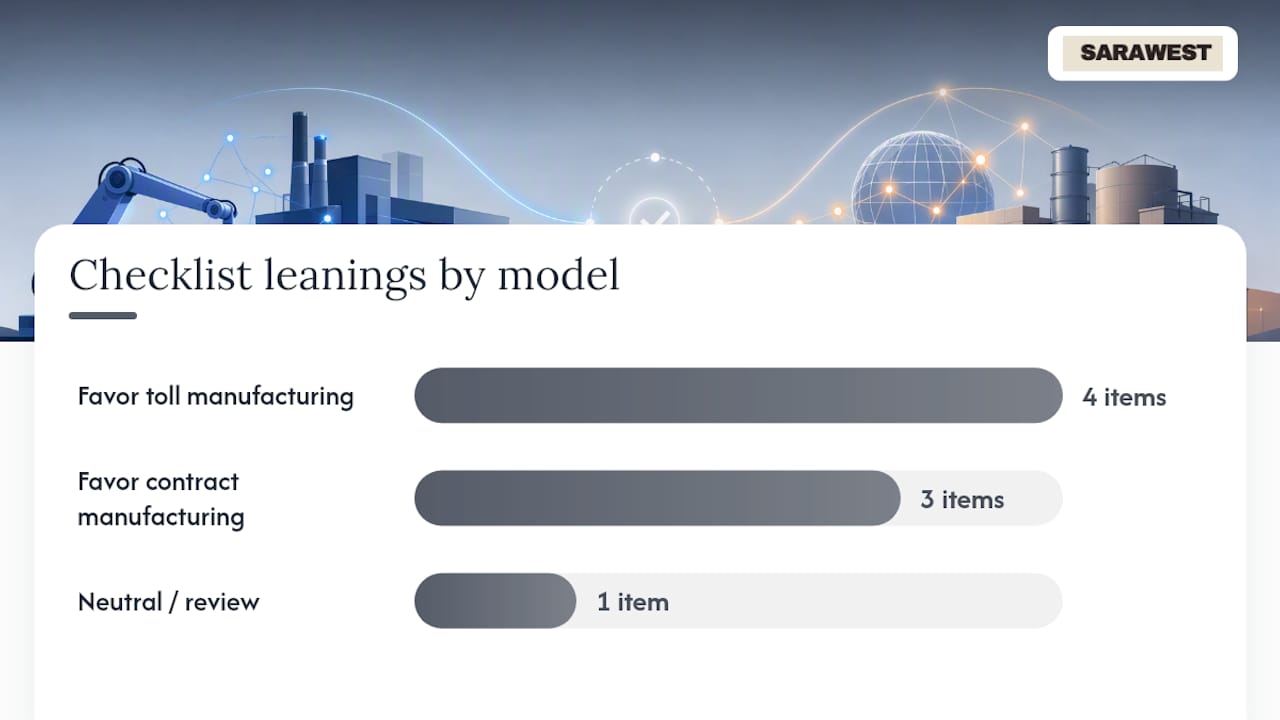
Map your business situation to the model that fits, then use the questions below in any RFQ or partner meeting.
Decision checklist:
- Proprietary formulation or active ingredients → toll manufacturing; keep inputs in your control
- Commodity or standard formulation → contract manufacturing; let the manufacturer's buying power work for you
- Early-stage, low-volume pilot run → toll manufacturing for flexibility and lower commitment
- Fast retail channel launch with tight timeline → contract manufacturing handles the full supply chain
- Limited internal procurement staff → contract manufacturing reduces your operational burden
- Strong existing supplier relationships → toll manufacturing lets you leverage them
- Multi-entity or international structure → review transfer-pricing implications before choosing either model
- Clean-label or certified ingredient requirements → toll manufacturing gives you direct control over certified inputs
Top 10 questions to ask a prospective partner:
- What are your MOQs for pilot runs and full production?
- Who are your approved raw material suppliers, and can we specify our own?
- What is your standard lead time from order to delivery?
- Describe your quality management system and certifications.
- What insurance coverage do you carry, and what are the limits?
- Have you managed a product recall? Walk us through the process.
- Do you subcontract any part of the production process?
- How do you protect client formulation data in your digital systems?
- What is your change control process for formulation or packaging modifications?
- Can you provide three client references in a similar product category?
Red flags that should pause negotiations:
- Reluctance to allow facility audits or inspection visits
- Vague answers on subcontracting (undisclosed third-party processors)
- No written QC procedures or certifications
- Resistance to specifying approved raw material suppliers in the contract
- No product liability insurance or coverage below industry norms
Operational steps to start or switch manufacturing models
Getting the partnership right operationally is as important as getting the contract right. Here is a practical onboarding sequence.
- Execute NDA and letter of intent — share formulation data only after the NDA is signed and countersigned
- Conduct a facility audit — review quality systems, material segregation, equipment condition, and certifications before committing
- Finalize and sign the manufacturing agreement — include all checklist items from Section 5
- Submit formulation and specifications package — written specs, approved raw material list, packaging requirements, and acceptance criteria
- Run a pilot batch — require a minimum of one trial run before committing to full production; define acceptance criteria in advance (yield, appearance, viscosity, pH, or relevant spec)
- QC acceptance review — test pilot output against spec; document any deviations and agree on corrective actions before scaling
- Confirm logistics and inbound supply chain — for tolling, confirm material delivery schedules; for contract, confirm finished-goods delivery terms and carrier requirements
- Set production schedule and scale plan — agree on ramp volumes, lead times, and reorder triggers
- Establish KPIs for the first 90 days: yield rate, defect or rejection rate, on-time delivery, material variance (tolling), and cost variance against budget
When scaling from pilot to full production, document every deviation from the pilot batch and require written sign-off before the manufacturer changes any input or process parameter.
A real example of contract manufacturing in action
A personal-care brand with a proprietary conditioning formula needed to move from a 50-unit lab batch to a 1,200-unit commercial run in under eight weeks. The brand's internal team had no procurement infrastructure and no packaging supplier relationships.
Working with a contract manufacturer that had in-house R&D chemists, the brand submitted its formulation spec and approved raw material list. The manufacturer adapted the formula for commercial-scale mixing equipment, sourced compliant packaging, and ran a pilot batch in week three. The brand approved the pilot against its written acceptance criteria, and full production shipped in week seven.
What made the partnership work:
- Written formulation specs and an approved-materials list submitted at project kickoff
- A standalone NDA signed before any formula data was shared
- Shared QA criteria agreed in writing before the pilot run
- Direct access to the manufacturer's in-house chemists for rapid spec adjustments
- Clear change control: no ingredient or process change without written client approval
The outcome was a retail-ready product in market eight weeks after the first conversation. That kind of speed is only possible when the manufacturer owns the full supply chain and has the R&D depth to adapt formulas without external consultants.
How we advise clients choosing between toll and contract manufacturing
We recommend tolling when a client has a genuinely proprietary active ingredient, an existing supplier relationship they want to protect, or a regulatory reason to control the exact source of every input. For chemical formulations where the active is the product, giving a manufacturer full sourcing discretion is a real IP risk.
We recommend contract manufacturing when a client needs to move fast, lacks internal procurement capacity, or is working with a formulation from our library of over 1,200 proprietary formulas that does not require client-supplied inputs. The turnkey model removes friction from the supply chain and lets the brand focus on sales and distribution.
A few operational pitfalls we see repeatedly:
- Underestimating tolling overhead: teams choose tolling for the lower processing fee and then discover the inbound logistics and QA coordination costs more than the fee savings
- Over-sharing formulation data too early: brands share full formulas before an NDA is signed because they want a quick quote — a costly habit
- Skipping the pilot run: scaling directly from a lab spec to a full production run without a pilot batch is the single most common cause of first-batch failures
- Vague acceptance criteria: "looks right" is not a spec; define viscosity, pH, color, and fill weight in writing before the pilot
Many clients start with tolling for an IP-sensitive, low-volume product and move to contract manufacturing as volumes grow and the procurement overhead becomes inefficient relative to the scale. That phased approach is often the right answer.
Sarawest USA brings contract chemical manufacturing to your spec
When you need a turnkey partner who can move from formulation to finished product without a broker in the middle, Sarawest USA is built for that. Our in-house R&D chemists work directly with your spec, adapting existing formulas from our library or building new ones from scratch. Pilot batches, private-label production, and full truckload runs all come from the same 30,000 sq ft facility in Pampa, Texas.
We serve brands in commercial cleaning, sports care, equine, solar, leather care, and more. If you have a formulation to protect, we can structure a contract that keeps your IP secure. If you need speed, we can quote from an existing formula and have samples in your hands fast. The white-label and private-label options start at 1,000-unit MOQs, and our RFQ process is direct: a real person reads every request.
Ready to move from spec to shelf? Request samples or submit an RFQ and we will respond with a concrete plan, not a form letter.
Sources
For accounting and balance-sheet treatment of tolling arrangements, the PwC Inventory Accounting Guide on tolling and manufacturing services is the primary U.S. reference. It covers consigned inventory, ASC 470-40 financing characteristics, and title transfer language.
For transfer-pricing and tax structuring, the analysis at Transfer Pricing Web explains how toll and contract models are classified differently as a production service vs. a supply of goods, which affects intercompany pricing and risk allocation.
For operational tradeoffs and a practical decision framework, the General Assembly Manufacturing comparison and the US Packaging tradeoffs guide both provide grounded, non-vendor-specific analysis useful for procurement and operations reviews.
For legal contract drafting, Myerson Solicitors' outsourcing guidance covers the core clauses manufacturing agreements must address, including IP rights, audit provisions, and liability allocation.
For white-label and private-label product decisions that intersect with the toll vs contract choice, the Sarawest USA guide to white label vs private label explains how finished-goods sourcing decisions connect to manufacturing model selection.
- Toll manufacturing vs contract manufacturing
- Toll Manufacturing vs Contract Manufacturing Tradeoffs
- Tolling and manufacturing services arrangements (PwC accounting guide)
- Outsourcing in the manufacturing sector | Myerson Solicitors
- Contract manufacturing vs toll manufacturing