
Change control in manufacturing is a structured, documented process for proposing, assessing, approving, implementing, and closing any change that touches product, process, equipment, materials, suppliers, or computerized systems. The first thing you do when a change surfaces — before anything else — is file a Manufacturing Change Request (MCR). Stop the informal fix. Get it in writing.
Here is the immediate sequence:
- File the MCR — capture the change in a formal request before any action is taken
- Classify the change — decide major, minor, or standard based on risk and scope
- Run a quick impact assessment — identify what could break: quality, safety, regulatory filings
- Pause production only if safety or product quality is at risk — not every change requires a line stop
Prosci research shows that change initiatives with a structured approach significantly improve their likelihood of meeting or exceeding their goals. The FDA expects a formal, documented system. ICH Q7 sets the bar for API manufacturers specifically. And at Sarawest USA, we have built a checklist for contract chemical manufacturers that maps directly to these expectations — covered in full in Section 10.
Key Takeaways
Effective change control in manufacturing requires a documented MCR/MCO process, cross-functional approval gates, and post-implementation verification — not just paperwork, but a traceable system that connects every change to its outcome.
| Point | Details |
|---|---|
| File the MCR first | Every change starts with a written Manufacturing Change Request — no informal fixes, no exceptions. |
| Classify before you assess | Major, minor, or standard classification determines your approval gate, timeline, and revalidation requirements. |
| Quality Unit is non-delegable | For major changes, the Quality Unit must sign the MCO — this is an ICH Q7 and FDA expectation, not a preference. |
| Link change control to CAPA | Every CAPA requiring a process change must generate an MCR; every post-change deviation must link back to the originating change record. |
| Measure cycle time and deviation rate | Track change cycle time and post-change deviation rate monthly — these two KPIs tell you whether your process works or just generates records. |
Table of Contents
- What is change control, and how does it differ from change management?
- Why does change control matter so much in manufacturing?
- How does the change control process work, step by step?
- Who signs off, and how do you build an approval matrix?
- What do FDA inspectors and ICH Q7 actually expect to see?
- How do you classify changes correctly, and what types of changes need tracking?
- Should you automate change control, and where do you start?
- What are the best practices, and where do manufacturers go wrong?
- Practical MCR/MCO checklist for contract chemical manufacturers
- How do you handle emergency or urgent changes?
- How do you get your team to actually adopt the change?
- How do you audit change control and drive continuous improvement?
- How does change control connect to CAPA and deviation management?
- Sources
What is change control, and how does it differ from change management?
These two terms get used interchangeably. They are not the same thing, and confusing them creates real gaps in your process.
Change control is the procedural gate. It governs whether a change is technically sound, documented, approved, and verified before it reaches the production floor. The artifacts are formal: MCR, Manufacturing Change Order (MCO), risk assessment, validation or requalification plans, test protocols, and release criteria. PTC describes the MCR/MCO pair as the backbone of any manufacturing change process, and recommends digitizing these workflows for traceability and faster cycle times.
Change management is the human side. It addresses how people adopt the change — training, communication, resistance, and organizational readiness. Prosci's ADKAR model (Awareness, Desire, Knowledge, Ability, Reinforcement) is the most widely used framework for this side of the equation.
| Dimension | Change Control | Change Management |
|---|---|---|
| Scope | Technical and regulatory gatekeeping | Human adoption and organizational readiness |
| Primary owners | Quality Unit, Regulatory Affairs, Engineering | Operations leadership, HR, Training |
| Core artifacts | MCR, MCO, risk assessment, validation plan | Communication plans, training records, ADKAR assessments |
| Success measure | Change implemented within spec, verified, closed | Workforce adoption rate, deviation rate post-change |
Both are necessary. A technically perfect MCO that nobody on the floor understands is a compliance record waiting to generate a deviation.
Core documents you must have in every change-control system:
- Manufacturing Change Request (MCR)
- Manufacturing Change Order (MCO)
- Risk assessment or impact analysis
- Validation or requalification plan (when triggered)
- Test protocols and acceptance criteria
- Release criteria and batch record evidence
Why does change control matter so much in manufacturing?
The short answer: unmanaged changes cause quality escapes, product recalls, failed batches, and FDA 483 observations. The longer answer involves money, reputation, and the compounding cost of rework.
Prosci's research puts it plainly — structured change management greatly increases your chances to hit your goals. That gap between structured and unstructured is not a soft metric. It shows up in cycle time, first-pass yield, and inspection outcomes.
The risks of skipping or shortcutting change control are concrete:
- Product recalls from undocumented formula or process changes that alter safety or efficacy
- Failed batches when process parameters shift without revalidation
- FDA 483 observations for changes made without documented justification or Quality Unit approval
- Rework and downtime when changes are reversed because verification was skipped
- Regulatory filing gaps when a change triggers a prior-approval supplement that was never filed
The benefits of doing it right are equally concrete: faster validated rollouts because the evidence is collected once and reused, full traceability from request to close, reduced rework because the impact is assessed before implementation, and a clean inspection record.
A single unmanaged equipment change at a contract manufacturer can trigger a site-level revalidation. One informal supplier swap can void a customer's regulatory filing. These are not hypothetical risks.
How does the change control process work, step by step?
The canonical process runs six steps: Request, Triage/Classification, Impact Assessment, Approval/MCO, Implementation, and Verification/Close. Each step has a responsible party, a set of artifacts, and a minimum evidence threshold.

| Step | Responsible Party | Key Artifacts | Minimum Evidence | Typical Timeline |
|---|---|---|---|---|
| 1. Request (MCR) | Process Owner / Requester | MCR form | Change description, reason, urgency flag | Same day |
| 2. Triage/Classification | Quality Unit | Classification decision | Major/minor/standard designation, preliminary risk flag | 1–2 days |
| 3. Impact/Risk Assessment | Quality, Engineering, RA | Risk matrix, impact checklist | Severity × likelihood scores, affected systems list | 3–5 days (minor); 1–3 weeks (major) |
| 4. Approval/MCO | Quality Unit, RA, Management | Signed MCO | Approval signatures, implementation plan, revalidation actions | 1–5 days (minor); 2–4 weeks (major) |
| 5. Implementation | Engineering / Operations | Updated SOPs, batch records | Training records, updated documents, change log | Per project plan |
| 6. Verification/Close | Quality Unit | Verification report | Test results vs. acceptance criteria, post-change monitoring data | 1–4 weeks post-implementation |
Standard and minor changes move through Steps 1–6 with a lighter approval gate: fewer signatories, shorter assessment timelines, and often a pre-approved pathway. Major changes require full cross-functional review, revalidation planning, and sometimes regulatory filing before implementation begins.
MCR template outline (minimum fields):
- Requester name, department, date
- Change summary (what is changing and where)
- Reason and justification
- Classification (major/minor/standard — preliminary)
- Preliminary impact checklist (product quality, safety, regulatory filings, supplier, equipment)
- Urgent/expedite flag with justification
- Attachments: current SOP, batch records, supplier documentation
MCO template outline (minimum fields):
- Approval block (signatures by role and date)
- Implementation plan with milestones and responsible parties
- Verification tests and acceptance criteria
- Requalification or revalidation actions required
- Post-implementation monitoring plan and duration
For risk assessment, use a simple 3×3 matrix. Score each potential impact on Severity (1 = low, 2 = moderate, 3 = high) and Likelihood (1 = unlikely, 2 = possible, 3 = probable). Multiply the scores. Anything at 6 or above triggers mandatory revalidation or regulatory review before implementation.
Pro Tip: For complex or high-risk changes, define your rollback criteria in the MCO before implementation starts. Write exactly what test result or observation triggers a rollback, who has authority to call it, and what the rollback procedure is. A change that cannot be safely reversed needs a higher approval gate and a longer pilot window.
Who signs off, and how do you build an approval matrix?
Every change touches multiple functions. The mistake most manufacturers make is routing the MCR only to Quality — and then scrambling when Regulatory Affairs or EHS surfaces a concern after implementation.
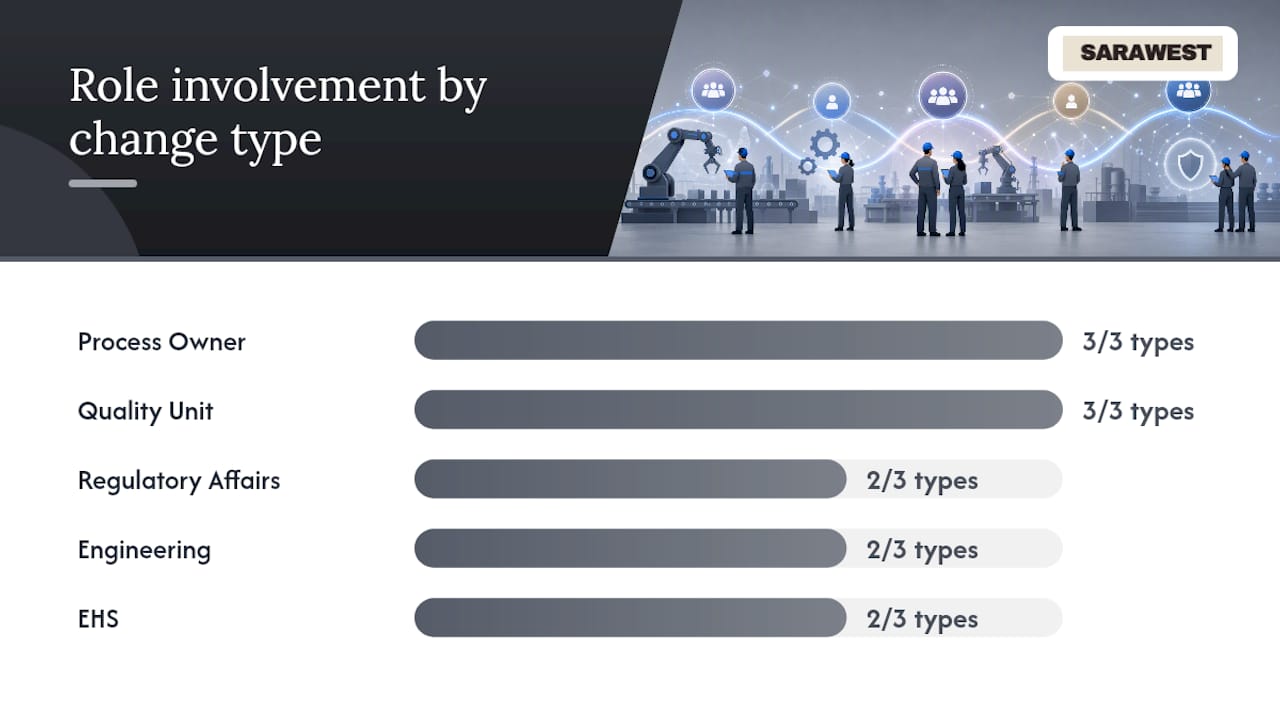
The core roles that must be represented on every change:
- Process Owner: Initiates the MCR, owns implementation, and confirms that the change achieves its stated objective
- Quality Unit: Classifies the change, approves the risk assessment, signs the MCO, and verifies closure — this role is non-delegable for major changes under ICH Q7/APIC guidance
- Regulatory Affairs: Evaluates impact on regulatory filings, determines whether a prior-approval supplement or notification is required
- Technical/Engineering: Assesses equipment, process parameter, and utility impacts; owns requalification planning
- EHS: Reviews safety data, SDS changes, and environmental permit implications
- Supplier Management: Engaged when the change involves a supplier, raw material, or site transfer
| Role | Standard Change | Minor Change | Major Change |
|---|---|---|---|
| Process Owner | Initiates | Initiates, implements | Initiates, implements |
| Quality Unit | Pre-approved pathway | Reviews and approves | Full review, signs MCO |
| Regulatory Affairs | Not required | Notified | Full review required |
| Engineering/Technical | Not required | Consulted | Full review required |
| EHS | Not required | Consulted if applicable | Required if safety impact |
| Senior Management | Not required | Not required | Required for site-level changes |
Pre-approved standard changes deserve their own list. Compile the changes your Quality Unit has already assessed as low-risk and repeatable — routine cleaning agent swaps within a validated range, for example — and document them with pre-set acceptance criteria. When a change matches an entry on that list, the MCR routes directly to implementation without a full review cycle. This is not a shortcut. It is a deliberate risk decision, documented in advance.
What do FDA inspectors and ICH Q7 actually expect to see?
Regulators expect a formal, documented change-control system that evaluates impact on product quality and regulatory filings before implementation. That sentence is the standard. What inspectors actually check is more specific.
The APIC guideline based on ICH Q7 requires:
- A formal change control system covering all changes that may affect production or control of intermediates and APIs
- Categorization of changes as major or minor, with documented rationale for the classification
- Involvement of the Quality Unit and Regulatory Affairs in evaluating and approving changes
- Documented revalidation triggers and evidence when major changes are implemented
For computerized systems, FDA guidance sets the expectation that every change be justified, risk-assessed, and supported by verification evidence and a complete audit trail. A software update to a PLC or DCS that is not documented as a change is an inspection finding waiting to happen.
Site transfers are treated as major changes by default. Formal change control is required, including risk assessment and approvals, because transfers routinely trigger revalidation and supplier qualification steps. A manufacturing transfer checklist that skips the change-control gate is not a checklist — it is a liability.
Inspection readiness checklist for change-control records: Every closed change should have a complete MCR with classification rationale, a signed risk assessment, an approved MCO with implementation plan, training records for affected personnel, verification test results against documented acceptance criteria, evidence of regulatory filing impact review, and a Quality Unit closure signature. If any of these are missing, the change is open in the eyes of an inspector — regardless of what your system shows.
How do you classify changes correctly, and what types of changes need tracking?
The classification decision drives everything downstream: approval gates, timelines, revalidation requirements, and regulatory notifications. Get it wrong and you either over-engineer a routine change or under-resource a critical one.
The decision rule: A change is major if it could affect product safety, efficacy, identity, strength, purity, or quality — or if it triggers a regulatory filing obligation. A change is minor if it is within a validated range and has a low probability of affecting product quality. A change is standard if it has been pre-assessed and pre-approved as a repeatable, low-risk action.
Types of changes that must flow through your system:
- Product/formula changes: Raw material substitutions, formula adjustments, concentration changes, new excipients or actives
- Process parameter changes: Temperature, pressure, mixing time, fill speed — any parameter outside the validated range
- Equipment changes: New equipment, equipment modifications, replacement with a different model or manufacturer
- Utilities: HVAC, water systems, compressed air — changes that affect environmental controls or product contact
- Computerized systems: PLC/DCS software updates, ERP configuration changes, laboratory information management system (LIMS) upgrades
- Suppliers: New supplier qualification, supplier site changes, raw material source changes
- Packaging: Container closure changes, label changes that affect regulatory filings, packaging material substitutions
- Test methods: New analytical methods, method modifications, reference standard changes
- Site transfers: Moving production between facilities, tech transfer manufacturing from development to commercial scale
A 2026 Springer study describes an algorithm that maps change attributes — urgency, technical complexity, supplier impact, regulatory scope — to tailored process steps and digital tool recommendations. The practical takeaway: not every change needs the same depth of analysis. A formula change in a pharmaceutical API requires a different assessment than a cleaning agent swap in a commercial cleaning product, even if both are classified as minor. Map your change attributes to your process steps deliberately, not by habit.
At Sarawest USA, a formula change request for a commercial cleaning product triggers a different checklist than one for an equine care product — because the regulatory exposure, microbial risk profile, and packaging compatibility considerations differ by vertical. The classification logic is the same; the depth of analysis is not.
Should you automate change control, and where do you start?
Automation should eliminate manual handoffs and build traceability into the process by default. The question is not whether to automate — it is where to start and what to leave alone.
The steps that benefit most from automation are MCR capture and routing, approval notifications, audit trail generation, and linking change records to CAPA and deviation records. These are high-volume, repetitive handoffs where manual processes create delays and gaps. PTC's guidance recommends starting with MCR routing and document linkage before automating downstream verification and analytics — and that sequencing is right. Get the front end of the process clean before you build complexity into the back end.
When evaluating a QMS or PLM tool for change control, check for:
- Native integration with your ERP and PLM systems
- Configurable workflows that match your approval matrix
- Electronic signature capability that meets 21 CFR Part 11 requirements (for FDA-regulated manufacturers)
- Role-based access controls
- Automatic audit trail generation
- Bi-directional linking between change records, CAPA records, and deviation reports
The trade-off is real. Automation shortens cycle time and reduces transcription errors, but it requires disciplined data governance and upfront configuration. A poorly configured workflow routes the wrong approvers or skips required fields — and that is worse than a paper form, because it looks complete when it is not.
Pro Tip: Start your automation with MCR routing and document linkage. Once that is stable and your team trusts the system, layer in automated approval escalation and verification evidence linking. A Springer study on change-specific methodology confirms that tailoring digital tools to change attributes outperforms generic one-size-fits-all implementations.
What are the best practices, and where do manufacturers go wrong?
The highest-impact practices are not complicated. They are disciplined.
Best practices:
- Maintain a pre-approved standard-change list, reviewed and updated annually by the Quality Unit
- Define rollback criteria in every MCO for changes with moderate or high risk scores
- Run pilot batches before full-scale implementation of major process or formula changes
- Hold cross-functional triage reviews — even a 10-minute daily standup — to screen incoming MCRs and allocate resources
- Set documented timelines for each change class and track adherence as a KPI
- Capture MCRs digitally from the first entry, not after the fact
Common pitfalls:
- Informal fixes that bypass the MCR entirely — the single most common FDA 483 trigger for change-control deficiencies
- Late involvement of Quality and Regulatory Affairs, discovered only at the approval gate
- Incomplete validation evidence: the change is implemented, but the verification tests were never documented against acceptance criteria
- Unclear ownership: the MCO lists a department, not a named individual, so nobody acts
- Treating the MCO closure as the end of the process, with no post-implementation monitoring
Communication and training checklist for adoption:
- Brief all affected personnel before implementation, not after
- Update SOPs and work instructions before the change goes live on the floor
- Document training completion in the change record
- Assign a named point of contact for questions during the transition period
- Schedule a post-implementation review at 30 days to capture deviations and lessons learned
Practical MCR/MCO checklist for contract chemical manufacturers
Here is the Sarawest USA checklist for contract chemical manufacturing, built for pilot-to-scale changes. Adapt it to your QMS.
MCR template fields:
- Requester name, title, date, and contact
- Product name, formula ID, and batch record reference
- Description of the proposed change (what, where, why)
- Classification (major/minor/standard) with preliminary rationale
- Impact checklist: formula integrity, microbial risk, packaging compatibility, storage/stability, regulatory filings, customer notification required
- Urgent/expedite flag: yes/no, with written justification if yes
- Attachments: current formula card, relevant batch records, supplier documentation, SDS if applicable
MCO template fields:
- Approval block: Quality Unit, Regulatory Affairs, Process Owner (signatures and dates)
- Implementation plan: milestones, responsible parties, target dates
- Verification tests: specific tests, methods, and acceptance criteria
- Requalification or revalidation actions: what triggers them, who owns them
- Post-implementation monitoring: duration, frequency, responsible party, escalation criteria
Industry-specific checklist entries for chemical contract manufacturing:
- Formula change history: document all prior versions and the delta from current to proposed
- Batch records to compare: pull at least three representative batches from the current formula before approving the change
- Microbial challenge testing: required when formula changes affect preservative system, pH, or water activity — see microbial challenge testing guidance for protocol specifics
- Packaging compatibility: confirm container closure compatibility with the revised formula, especially for pH-sensitive or solvent-containing products — finish-code changes alone can break production, as detailed in this technical example
- Storage and stability: confirm shelf-life data supports the change; flag if accelerated stability studies are needed
- Supplier qualification: if the change involves a new raw material source, complete supplier audit steps before the MCO is approved
KPIs to monitor post-change:
- Change cycle time (MCR filed to MCO closed)
- First-pass yield on first post-change batch
- Deviation rate in the 30 days following implementation
- Time-to-release for the first post-change batch
- Number of MCRs reopened due to incomplete verification
How do you handle emergency or urgent changes?
Urgent changes do not bypass change control. They move through an accelerated pathway that compresses timelines without eliminating required steps.
The trigger for an emergency change is typically a safety risk, a critical supply disruption, or a regulatory deadline. When one of those conditions exists, the MCR is filed immediately with an urgent flag, and a same-day triage meeting convenes the minimum required approvers: Quality Unit and the Process Owner at minimum, Regulatory Affairs if a filing impact is possible.
The risk assessment is abbreviated but not skipped. Document what you know, what you do not know, and what monitoring you will put in place to catch what you missed. The MCO is approved with explicit conditions: the change is implemented under heightened monitoring, and a full retrospective assessment is completed within a defined window — typically 30 days.
What you cannot do is implement first and document later. That is not an emergency pathway. That is an uncontrolled change with paperwork attached after the fact, and it reads exactly that way during an inspection. For contract manufacturers managing same-day production scenarios, the emergency pathway must be pre-defined in your SOP so the team knows the sequence before the pressure hits.
How do you get your team to actually adopt the change?
A signed MCO means nothing if the people running the line do not understand what changed or why. Adoption is where most change-control programs lose their value.
The foundation is training that is specific, not generic. "We updated the SOP" is not training. Show the operator exactly what is different, why it matters, and what to do if something looks wrong. Tie the training to the specific change record so it is traceable.
Prosci's ADKAR model gives you a practical adoption sequence: build Awareness of why the change is happening, create Desire by connecting it to outcomes the team cares about (fewer rework cycles, cleaner batches), deliver Knowledge through targeted training, confirm Ability through observation or a brief competency check, and sustain Reinforcement through post-implementation reviews and visible leadership support.
The practical mechanics: update work instructions before the change goes live, not after. Assign a named floor champion for the first two weeks post-implementation. Run a 30-day post-change review and share the results with the team — including deviations, because transparency builds trust in the process. Organizations that treat change management as a parallel discipline to change control, rather than an afterthought, consistently see lower deviation rates in the weeks following a change.
How do you audit change control and drive continuous improvement?
Audit is not a once-a-year exercise. The most effective change-control programs treat the change record as a living data source.
Monthly, review your open MCR log: how many changes are past their target closure date, and why? Stalled changes are a leading indicator of resource gaps or unclear ownership. Quarterly, pull your KPIs: cycle time by change class, first-pass yield on post-change batches, deviation rate in the 30 days following implementation. These numbers tell you whether your process is working or just generating paperwork.
Annual internal audits of the change-control system should verify that every closed change has a complete record — MCR, risk assessment, signed MCO, training evidence, verification results, and Quality Unit closure. Spot-check five to ten closed changes against your SOP requirements. Gaps in closed records are the same gaps an FDA inspector will find.
Continuous improvement comes from the data. If your cycle time for minor changes consistently runs twice the target, the bottleneck is either the approval routing or the impact assessment step. Fix the process, not the people. If your post-change deviation rate spikes for a specific change type, that type needs a deeper risk assessment template or a longer pilot window.
How does change control connect to CAPA and deviation management?
Change control, CAPA, and deviation management are three distinct processes that must be linked in your QMS. Running them in silos is one of the most common structural failures in manufacturing quality systems.
A deviation triggers an investigation. If the investigation finds a systemic root cause, a CAPA is opened. If the CAPA requires a process, formula, equipment, or system change to prevent recurrence, that change must flow through change control. The CAPA record and the MCR should be linked by reference number in both systems, so an auditor can trace the full chain from deviation to root cause to corrective action to verified change.
The reverse is also true. A change that is implemented and then generates an unexpected deviation should trigger a deviation record linked back to the originating MCR. This bi-directional traceability is what turns your change-control system from a compliance exercise into an actual quality improvement tool.
In practice, configure your QMS so that closing a CAPA with a process-change action automatically generates a draft MCR. And configure your change-control closure step to check for open deviations linked to the change before the Quality Unit signs off. These two workflow connections eliminate the most common traceability gap in manufacturing quality systems.
What one practice actually cuts change cycle time
The single most effective thing we have seen reduce change cycle time is a daily 10-minute MCR triage standup. Not a committee. Not a weekly meeting. A brief, standing review of every open MCR: classification confirmed, impact assessment assigned, blocker identified, next action named.
Most change-control delays are not technical. They are coordination failures. The right person did not know the MCR was waiting. The risk assessment sat in someone's queue for a week because nobody flagged it as urgent. A 10-minute standup eliminates that. It forces visibility and accountability without adding bureaucracy.
The second practice: a one-page MCR template, pre-loaded in your QMS, with required fields that cannot be skipped. When the form is easy to complete correctly, people complete it correctly. When it is a 12-page document with optional sections, people fill in what they feel like and leave the rest blank. Start with the minimum viable MCR — requester, change description, classification, impact checklist, urgent flag — and add fields only when an audit finding proves they are needed.
Sources
The sources below back the guidance in this article. Each is worth reading directly for the depth it provides.
- Manufacturing Change Management
- Mastering the Manufacturing Change Management Process
- Manufacturing change management – an AI- and data-enhanced Delphi study and algorithm to support change process tailoring and the identification of suitable methods and digital tools | Production Engineering | Springer Nature Link
- APIC Guideline: Technical Change Control (revised Nov 2018)
- FDA guidance (computerized systems assurance and quality system software)
- Manufacturing transfer checklist — what to include (Legal Clarity)
If you are managing formula change requests, scaling a new product, or navigating a tech transfer, Sarawest USA's in-house R&D chemists and production team work within a documented change-control framework from pilot batch to full truckload. We handle the chemistry, the documentation, and the accountability.

See what we build and how we manage it — or request samples to validate your next change before it goes to scale.