
Total contract manufacturing cost is the sum of three buckets: direct materials, direct labor, and manufacturing overhead, then adjusted by whatever pricing model your supplier uses. Volume and pricing model are the two levers that swing per-unit cost the most — see this step-by-step migration guide for insights on managing supplier changes and cost implications. Get either one wrong and a quote that looked competitive on paper turns into a margin problem six months into production.
TL;DR:
- Raw material costs must be verified with actual invoices, and a high burden rate can significantly increase the true labor cost beyond wages.
- Fixed pricing offers predictability but exposes you to raw material spikes, whereas tolling shifts raw material risk to you for lower per-unit costs if sourcing is reliable.
- Tooling and NRE costs should be amortized over a clear production volume and period to prevent hidden expenses from inflating unit costs.
- Landed cost, including freight, duties, and inventory fees, can increase initial quotes by 8% to 25% and is critical for accurate cost comparisons.
- Manufacturers with pre-existing formulation libraries and in-house R&D can reduce NRE and lead times, lowering overall project costs and enabling faster prototyping.
Table of Contents
- What Makes Up Contract Manufacturing Costs?
- Which Pricing Model Should You Choose?
- How Do NRE, Tooling, and MOQs Affect Unit Cost?
- What Is Landed Cost and Why Does It Matter?
- How Do You Calculate Per-Unit Manufacturing Cost?
- What Are the Best Ways to Cut Manufacturing Costs?
- How Existing Formulas Cut Prototyping Costs
- What Procurement Teams Get Wrong About Manufacturing Quotes
- Get a Fast Quote on Custom Formulation
- Sources
What Makes Up Contract Manufacturing Costs?
Every quote you get, no matter how polished the pricing sheet looks, breaks down into the same three components. Direct materials, direct labor, and overhead. Understanding what belongs in each bucket is how you tell a fair quote from a padded one.
Direct materials cover everything in the bill of materials, plus freight-in, import duties, and expected scrap. A supplier quoting raw resin at $2.10 per pound should be able to show you the actual invoice, not a rounded estimate. If they can't, that's a red flag worth raising before you sign anything.
Direct labor is the burdened rate, not the wage on a paycheck. Burdened labor includes wages, benefits, payroll taxes, and workers' compensation. A line operator earning $22 an hour might carry a burdened rate closer to $30 once you add those costs. Ask for the burden multiplier your supplier uses. A reasonable range runs 1.25 to 1.5 times base wage, depending on the state and the benefits package.
Manufacturing overhead covers the facility costs that don't attach to a single unit: utilities, equipment depreciation, maintenance, and plant management. Suppliers allocate overhead using a labor-hour basis, a machine-hour basis, or activity-based costing (ABC) that assigns cost by the actual process a product moves through. The standard manufacturing cost formula treats overhead as additive to materials and labor, but the allocation base you choose can shift per-unit cost by a meaningful margin depending on how labor-intensive versus machine-intensive the process is.
Before accepting a quote, ask three questions:
- Can you see a sample raw-material invoice tied to the quoted material cost?
- What burden rate applies to the labor line, and what's included in it?
- What allocation base determines the overhead charge, and why?
Pro Tip: If a supplier hesitates to answer any of those three questions, treat the quote as a placeholder, not a real number.
Which Pricing Model Should You Choose?
Contract manufacturers typically offer three pricing structures, and all shifts risk differently between you and the plant floor.
It's the most transparent model, since raw material swings pass through to you directly. That transparency is also the catch: you carry the raw-material volatility, so a spike in resin or surfactant pricing hits your invoice next quarter.
Fixed price per unit locks the number regardless of input cost swings. Manufacturers build a risk premium into that price to cover their own exposure. Watch for escalation clauses that let the supplier revisit pricing if a named raw material index moves past a set threshold. Fixed pricing works best when order volume is stable and you want predictable unit economics for financial planning.
Tolling, or job work, has you supply the raw materials while the manufacturer charges purely for conversion labor and overhead. This shifts raw-material risk to you but often produces the lowest per-unit conversion cost, especially at volume. It only makes sense if you have reliable sourcing relationships of your own.
Whichever model you pick, put these terms in the contract:
- A price index tied to a named raw material benchmark, not a vague "market conditions" clause.
- Audit rights to review actual cost documentation annually.
- A defined notice period before any escalation takes effect.
The risk trade-off between cost-plus and fixed pricing comes down to who absorbs raw-material volatility, and that choice should match your own cash-flow tolerance.
How Do NRE, Tooling, and MOQs Affect Unit Cost?
Non-recurring engineering (NRE) and tooling are one-time costs tied to setup: mold fabrication, custom fixtures, line programming, and initial validation runs. Tooling and NRE can account for 5% to 25% of first-year project cost, and in some processes tooling alone represents 20% to 30% of total manufacturing cost.
Here's how to manage that expense:
- Amortize tooling over a defined unit count, not an open-ended timeframe. A common rule of thumb spreads tooling cost across the first 12 to 24 months of production or the first full production run, whichever comes first.
- Negotiate a shared-tooling arrangement if your minimum order quantity (MOQ) is small. Some manufacturers will split tooling cost across multiple smaller brands running similar formats.
- Phase your tooling investment. Start with a lower-cost pilot tool for validation, then invest in production-grade tooling once demand is proven.
- Cap the amortization period in writing and tie any remaining balance to cumulative volume rather than a flat calendar date, so a slow sales quarter doesn't leave you holding a bigger unamortized balance than expected.
What Is Landed Cost and Why Does It Matter?
Landed cost is the real number: piece price plus freight, duties, insurance, and inventory carrying cost until the product sits in your warehouse ready to ship. It's the only honest way to compare an offshore quote against a domestic one.
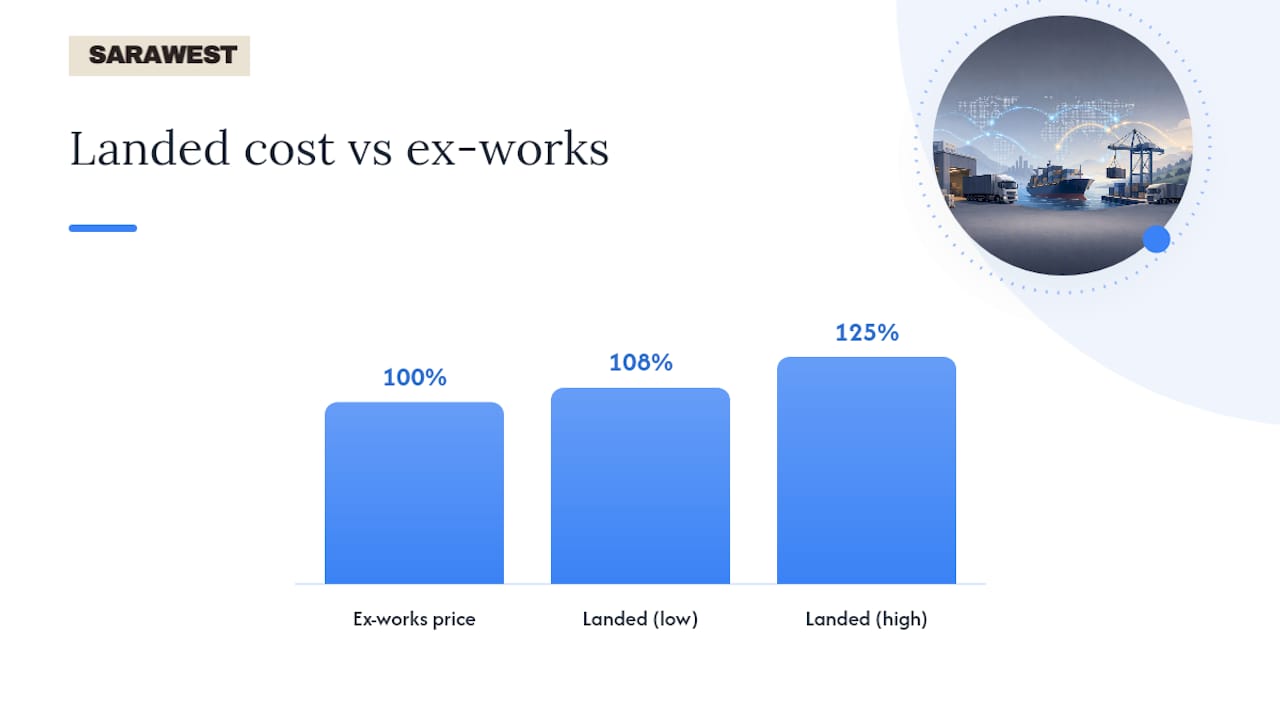
An attractive ex-works price routinely looks worse once landed. Total landed cost typically increases an ex-works quote by 8% to 25% once freight, duty, and inbound carrying cost are added. That's a wide enough swing to flip a make-versus-buy decision entirely.
Longer lead times compound the problem. Every extra week of transit or safety stock ties up working capital that could fund other parts of the business, and unreliable lead times force you to carry more buffer inventory as insurance.
Before comparing quotes side by side, check:
- Freight mode (ocean versus air) and typical transit time to your distribution point.
- Duty classification and rate for your specific product category.
- Insurance and customs brokerage fees, which rarely appear on the initial quote.
A blended sourcing strategy, mixing domestic, nearshore, and offshore suppliers, often outperforms a single-region approach once landed cost and supply resilience both get weighed.
How Do You Calculate Per-Unit Manufacturing Cost?
The formula procurement teams should run on every quote:
Direct Materials + Direct Labor + Allocated Overhead + Amortized NRE/Tooling + Logistics + Quality/Reserve = Total Per-Unit Cost
- Total your direct material cost per unit, including freight-in and expected scrap.
- Calculate burdened labor cost per unit based on cycle time and burden rate.
- Allocate overhead using whichever base best reflects the process (labor-hour for hands-on assembly, machine-hour for automated lines).
- Divide amortized tooling and NRE across your committed volume window.
- Add landed logistics cost per unit and a small reserve for quality and rework.
Here's a worked example for a single SKU, a 32-ounce cleaning concentrate, at two volume levels:
If the total swings more than a dime per unit, you've found your real negotiation lever.
What Are the Best Ways to Cut Manufacturing Costs?
Cost reduction rarely comes from beating up a supplier on price. It comes from removing complexity before the quote ever gets written.
- Simplify the design. Fewer components, standard fasteners, and simpler part geometry reduce both material cost and labor time.
- Consolidate purchasing across product lines to unlock volume discounts on shared raw materials.
- Commit to longer production windows in exchange for locked-in conversion margins, especially under cost-plus pricing.
- Pool tooling across similar SKUs or with other brands running the same base formula.
- Invest in quality control up front. A stronger QC process cuts rework and scrap, which quietly eats into overhead more than most procurement teams realize.
- Write clear escalation language into every contract so raw-material swings don't become a renegotiation fight every quarter.
Pro Tip: Ask your supplier for a cost breakdown at three different volume tiers before you sign. If they can't produce one quickly, they probably haven't modeled their own overhead allocation carefully enough to give you a trustworthy number.
How Existing Formulas Cut Prototyping Costs
Sara West USA runs a library of more than 1,200 proprietary formulas across eight industries, backed by in-house R&D chemists who can adapt a formula rather than build one from scratch. That structure changes the cost math in three concrete ways:
- Lower NRE. Starting from an existing formula skips the development cycle that normally drives up non-recurring engineering cost.
- Faster lead time, lower carrying cost. Same-day turnaround on some formulations means less inventory sitting idle waiting on validation.
- Fewer iterations. In-house chemists working directly with a client cut the back-and-forth that usually inflates engineering spend on a new product.
Manufacturers with in-house formula libraries and R&D staff tend to reduce NRE and iteration expense substantially, which is exactly why small-batch chemical pilots often pencil out better than teams expect.
What Procurement Teams Get Wrong About Manufacturing Quotes
Most procurement mistakes trace back to piece-price fixation. A team locks onto the lowest number on the page and ignores landed cost, weak escalation language, and overhead assumptions buried in the fine print. The quote that looks cheapest on day one is often the most expensive by month six.
Before you sign, run every quote through this checklist:
- Does the quote separate materials, labor, and overhead, or bundle them into one number?
- Is the pricing model (cost-plus, fixed, tolling) clearly stated with its risk allocation?
- Are tooling and NRE amortized over a defined volume, not an open-ended timeline?
- Does landed cost, not ex-works price, drive your comparison?
- Is there an escalation clause tied to a named raw-material index?
- Can the supplier document their overhead allocation base on request?
— Faisal Mansur
Get a Fast Quote on Custom Formulation
Sarawest USA solves the exact problems this guide just walked through: high NRE, slow iteration, and rigid minimum order quantities. With a library of 1,200-plus proprietary formulas and in-house R&D chemists on staff, custom formulation starts from something proven, not a blank page, which is why prototypes can turn around in days rather than months.

Whether you need a pilot batch to test market fit or a full truckload for retail distribution, Sarawest USA's contract manufacturing services scale with you instead of forcing a volume commitment before you're ready. Private label and white label options let you launch under your own brand without carrying formulation risk. If you want to see the numbers before committing, request product samples and get a direct RFQ from a real chemist, not a broker relaying your specs to a third party.
Sources
- Understanding Manufacturing Costs in Contract Manufacturing — CustomPartNet
- Contract Manufacturing in India: Complete Guide for Brands — IMARC Engineering
- Make-Buy & Landed Cost Estimation Guide | MFG Calcs