
Development-only fees for a custom cosmetic or skincare formula typically run $500 to $10,000+, while a full launch budget, covering testing, packaging, and a first manufacturing run, usually lands between $15,000 and $50,000. Where you fall in that range depends almost entirely on complexity, testing requirements, and minimum order quantities. The sections below break each of those drivers into real numbers you can plug into a budget.
TL;DR:
- Development fees for custom skincare formulas range from $500 for simple tweaks to over $10,000 for fully bespoke designs, with total launch costs usually between $15,000 and $50,000.
- Costs increase significantly with formula complexity, active ingredient sourcing, testing scope, and packaging choices, especially when custom tooling or extensive claims are involved.
- Larger minimum order quantities reduce per-unit costs by spreading fixed setup and tooling expenses across more units, making small batches more expensive per item.
- Brands should request itemized quotes separating development, testing, and manufacturing to avoid unexpected costs and better control their budget.
- Using in-house or combined formulation and manufacturing processes can eliminate double costs and rework, offering clearer pricing and smoother scale-up.
Table of Contents
- What Does Custom Formulation Cost Look Like at Each Complexity Level?
- What Actually Drives the Price of a Custom Formula?
- How Do You Keep a Custom Formulation Project on Budget?
- What Changes When Development and Manufacturing Sit Under One Roof?
- The Real Gap Between What Formulators Quote and What Founders Budget
- Ready to Get an Itemized Custom Formulation Quote?
- Sources
- FAQ
What Does Custom Formulation Cost Look Like at Each Complexity Level?
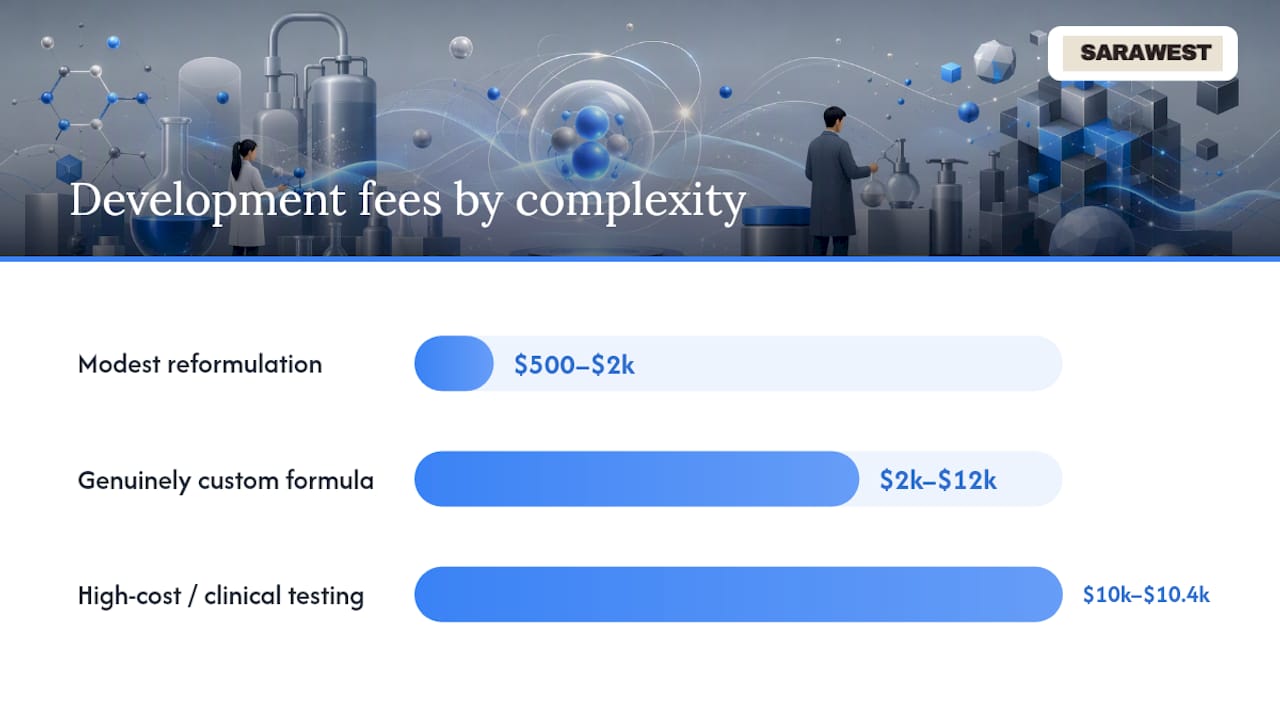
The spread between a light tweak and a fully bespoke formula is enormous, and most first-time brand owners underestimate it. A modest reformulation, swapping a preservative system or adjusting fragrance load in an existing base, tends to run $500 to $2,000 in development fees. A genuinely custom formula built from scratch, with a unique texture, novel active combination, or a claim you want to own, usually falls between $2,000 and $12,000 in development fees alone. Push into heavily active-loaded formulas, or ones requiring extensive clinical or claim-support testing, and development fees alone can clear $10,000 to $10,400 or more, separate from manufacturing.
Development fees are only one line on the invoice. Total startup outlay, once you add packaging, testing, and your first production run, commonly lands in the $15,000 to $50,000 range, and premium packaging or a large minimum order quantity can push that higher.
Here's how MOQ changes the math on a mid-complexity moisturizer, assuming a $6,000 development fee and $2.50 per-unit manufacturing cost:
- 1,000-unit pilot run: $6,000 development + $2,500 manufacturing = $8,500 total, or $8.50 per unit before packaging
- 5,000-unit run: $6,000 development + $12,500 manufacturing = $18,500 total, but per-unit development cost drops to $1.20, cutting your effective unit cost to roughly $3.70
Notice what's fixed and what's variable. Development fees, testing, and tooling are largely one-time, sunk costs, paid once regardless of how many units you eventually sell. Manufacturing, packaging components, and fill costs scale with volume. Separating those two categories early is the single most useful thing you can do before requesting quotes, because it tells you which numbers shrink as you scale and which ones don't move at all.
What Actually Drives the Price of a Custom Formula?
Most quotes look mysterious until you know what's inside them. Formulators price per project, and the biggest swing factors are the number of active ingredients, whether you're using branded or commodity actives, the dosage or delivery format, and how much stability work the formula requires. A serum with three peptide complexes and a patented delivery system costs more to develop than a basic body lotion, not because the chemistry is harder to mix, but because sourcing, testing, and documenting those ingredients takes real time.
The main cost levers, in order of how often they blow up a budget:
- Ingredient complexity: branded actives carry licensing premiums that commodity versions don't
- Testing scope: stability testing, preservative challenge testing, and claim-support studies each add separate line items
- Revision rounds: a modified template formula might need one or two rounds; a bespoke build from zero often needs four or more
- Packaging tooling: stock jars and bottles ship in weeks; custom mold tooling adds lead time and cost before you produce a single unit
- Manufacturing complexity: anhydrous balms, cold-process emulsions, and formulas with specialty fillers require different equipment setups than a simple water-based gel
Pro Tip: Ask your formulator to quote testing as its own line item before you commit to development. Stability and microbial testing alone can add $1,000 to $3,000, and bundling that cost into a single "formulation fee" makes it impossible to know what you're actually paying for.
MOQs compound all of this. Providers commonly set minimums anywhere from 500 units up to 5,000 or 10,000 units for a fully custom project, and setup costs get spread across whatever quantity you commit to. A smaller MOQ almost always means a higher per-unit price, since the same fixed tooling and setup labor gets divided across fewer units.
How Do You Keep a Custom Formulation Project on Budget?
Cost control starts before the first sample ever gets mixed. Here's a sequence that keeps cash flow predictable without cutting corners that matter to the finished product.
- Start with digital or automated prototyping where the formulator offers it. Platforms that combine predictive screening with automated small-batch testing can shorten iteration cycles and cut material waste considerably compared to pure wet-lab trial and error, meaning fewer failed batches you pay to remake.
- Request an itemized quote broken into discovery, prototype, stability, and pilot run. Staged deliverables let you pay as you go instead of committing full capital before you know the formula works.
- Run a pilot batch before committing to a large MOQ. A 1,000-unit pilot costs more per unit than a 5,000-unit run, but it caps your downside if the formula needs another round of tweaks after market feedback.
- Stick with stock packaging components on your first run. Custom tooling adds real lead time and cost; defer it until sales data justifies the investment.
- Negotiate bundled or phased testing schedules, and build a contingency line of 10% to 20% of your development budget for the round of revisions nobody plans for but almost everyone needs.
- Rank your claims by what they cost to prove. A "dermatologist-tested" claim needs a clinical panel; a "97% natural" claim mostly needs an ingredient audit. Spend testing dollars on the claims that actually move sales, not every claim you'd like to make.
What Changes When Development and Manufacturing Sit Under One Roof?
Most brands don't realize how much of their budget disappears into the seams between vendors. Hand your formula off from an independent lab to a separate contract manufacturer, and you're paying twice for quality control, twice for technical transfer, and often absorbing a round of "why doesn't this scale the way it did in the lab" rework that nobody quoted upfront.
Sarawest USA runs formulation and manufacturing as one process, with in-house R&D chemists working from a library of 1,200-plus proprietary formulas across eight industries. That structure means the chemist who builds your prototype is the same team that scales it, so there's no formula handed between strangers and no surprise costs from a scale-up that behaves differently than the lab sample.
Before you sign with any formulator, ask three questions:
- Can you itemize development, testing, and manufacturing separately, instead of one bundled number?
- What are your MOQ breakpoints, and what's the per-unit cost at each tier?
- What's the guaranteed turnaround from prototype to pilot run to full production?
A vendor who answers all three without hedging is one worth trusting with your budget.
The Real Gap Between What Formulators Quote and What Founders Budget
Most advice on formulation cost treats the development fee as the whole story, and that's where budgets go wrong. The number a formulator quotes for building your formula is often the smallest piece of what you'll actually spend before launch. The bigger risk isn't the development fee at all. It's the founder who never asked for an itemized breakdown and finds out three months in that testing, tooling, and a jump in MOQ have doubled the number they mentally budgeted.
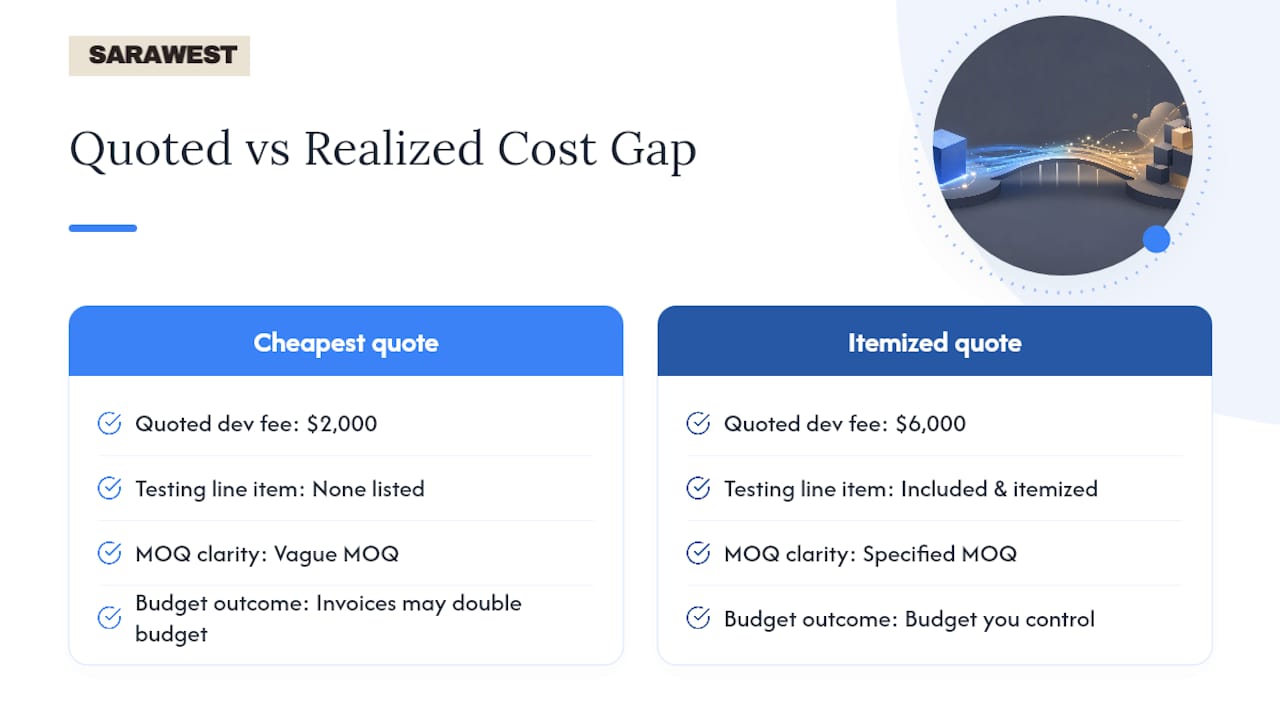
The conventional wisdom, get three quotes and pick the cheapest, misses the point entirely. A $2,000 quote with no testing line item and a vague MOQ is not cheaper than a $6,000 quote that itemizes everything. It's just cheaper, until the invoices start arriving separately. Prioritize the formulator who breaks down development versus testing versus manufacturing before you sign anything, over the one who quotes the lowest single number. That's the difference between a budget you control and one that controls you.
— Faisal Mansur
Ready to Get an Itemized Custom Formulation Quote?
Some contract manufacturers price custom formulation with development, testing, and manufacturing broken into separate, itemized numbers, helping clients understand what drives their total costs before committing capital.
That structure comes from running formulation and production under one roof. In-house chemists build your prototype, then scale it themselves, so there's no handoff cost, no duplicate quality control, and no surprise rework bill when a formula that worked in a small batch needs adjusting for a full production run. Flexible order sizes, from pilot batches to full truckloads, mean you can test the market with 1,000 units before locking into a larger commitment.
Before you request a quote, gather three things: your target per-unit cost, which claims you actually need tested versus which are nice to have, and your realistic launch timeline. Then head to the contract manufacturing page or the white label manufacturing page to start a conversation and get itemized numbers back for your specific project.
Sources
- Custom Supplement Formulation Services & R&D | LumaNutra
- Private Label vs Custom Formulation: Stop R&D Capital Waste
- Custom Skincare Formulation & Manufacturing Services | Lab Magenta
- Hovione: Accelerating oral drug development through rapid prototyping and integrated development strategies
FAQ
What Is a Realistic Total Budget for a Custom Skincare Launch?
Most brands should plan for $15,000 to $50,000 covering development, testing, packaging, and a first manufacturing run. Simple reformulations land at the low end; heavily active, custom-tooled products push toward the high end.
Why Do Custom Formulation Quotes Vary So Much Between Providers?
Pricing scales with the number of actives, whether ingredients are branded or commodity, the dosage format, and how much stability work the formula needs, which is why quotes are built per project rather than off a fixed price list. A simple gel and a peptide serum with clinical claims are not priced the same way.
How Much Does a Cosmetic Formulator Charge for a Full Custom Project?
Development fees for a fully custom formula typically run from $2,000 to $12,000, with heavily active or claim-heavy formulas sometimes starting near $10,400. That figure covers formulation work only, not manufacturing or packaging.
Can I Formulate My Own Skincare Products to Sell Legally?
You can develop your own formula, but selling it commercially generally requires proper stability testing, preservative challenge testing, and compliance documentation before it reaches store shelves or e-commerce customers. Most brand owners partner with a formulator or contract manufacturer specifically to handle that testing and documentation correctly the first time.
What's the Biggest Cost Mistake Brands Make When Budgeting for Formulation?
The most common mistake is treating the development fee as the entire budget instead of asking for an itemized quote that separates testing, tooling, and manufacturing. Sarawest USA structures quotes this way specifically so brands can see and control each cost category before committing.