
If you need custom formulation, lifecycle support, and predictable high volumes, sourcing direct from a manufacturer is usually the better path. If you need small, frequent orders and rapid emergency fulfillment, brokers and distributors usually win. That's the whole decision in one sentence, but the details are where brands lose money.
The nuance sits in total cost, not unit price. A manufacturer's per-gallon quote often looks cheaper on paper, but once you add storage, labor, and the cash tied up in inventory, that gap can shrink or disappear entirely. Your operational readiness matters as much as the invoice.
Before you go further, a quick filter:
- Skip to the checklist below if you already run high volumes, need custom formulation, or have in-house warehousing.
- Keep reading the comparison first if you're still weighing order size, lead times, or quality control against cost.
Key Takeaways
Direct manufacturer sourcing wins on custom formulation, lifecycle accountability, and total cost at volume, while brokers win on speed, flexibility, and lower commitment for small or irregular orders.
| Point | Details |
|---|---|
| Define the roles first | A manufacturer produces on its own premises; a broker or agent arranges transactions without production. |
| Compare total cost, not price | Add storage, labor, inventory, and freight, before trusting a per-unit quote. |
| Use decision triggers | High SKU count, heavy regulation, and first-batch risk favor a broker; concentrated SKUs and steady volume favor direct. |
| Demand independent verification | Any broker or agent should show a real path to proving supplier compliance, not just a claim. |
| Consider a manufacturer with in-house R&D | Sarawest USA pairs in-house chemists and a 1,200-plus formula library with pilot-to-truckload production for brands needing fast formulation changes. |
Table of Contents
- Broker vs Manufacturer Sourcing: The Real Trade-Offs
- How Do You Decide Between a Broker and a Manufacturer?
- Why Manufacturer Sourcing Changes the Calculus
- Does Sourcing Method Affect Your Negotiating Power?
- What About Communication and Language Barriers?
- How Do Payment Terms Differ Between the Two Methods?
- Who Protects Your Formula and Confidentiality Better?
- Which Method Scales Better as You Grow?
- What the Data Actually Supports
- Get a Fast Quote From a Manufacturer, Not a Middleman
- Frequently Asked Questions
- Sources
Broker vs Manufacturer Sourcing: The Real Trade-Offs
A manufacturer produces materials on its own premises for the principal purpose of its business. A broker, agent, or distributor arranges or expedites transactions without doing the production itself, according to the TxDOT distinction between manufacturers and regular dealers. That's the legal skeleton of the decision. Everything else, cost, speed, quality accountability, hangs off it.
Start with price. Direct purchasing typically lowers per-unit cost on large, consistent orders, but the total cost of ownership tells a fuller story. Storage, labor, inventory management, and the working capital locked into a full truckload can erase a discount that looked great in the quote. A distributor selling smaller quantities with safety stock on hand often wins on flexibility even when their sticker price is higher.
Where MOQs bite: manufacturers generally require higher minimum order quantities to make a production run worthwhile. That's fine if you have the warehouse space and the sales velocity to move product before it degrades. It's a problem if you're a startup testing a new SKU and don't want six pallets sitting in a rented unit.
Where lead time flips the math: distributors and brokers often solve urgent needs faster because they already hold inventory. Manufacturers usually win on turnaround only when they run dedicated production slots or have prototyping capacity built in, since a cold-start production run has to be scheduled, formulated, and quality-checked before it ships.

Where quality control becomes the deciding factor: manufacturers that control component sourcing, design, and testing directly tend to offer better lifecycle support and spares planning. A broker is a step removed from those decisions, which means when something goes wrong three years into a product's life, you're often waiting on someone else's answer to someone else's supplier.
Two quick scenarios illustrate the split:
- A regional cleaning brand needs 40,000 units of a new degreaser launched in six weeks with a formula tweak for a client's fragrance request. A manufacturer with in-house chemists handles the formula change and the schedule in one conversation. A broker would need to relay that request to a third party and wait.
- A sports-care retailer needs 200 units of an odor spray for a seasonal pop-up, with no repeat order guaranteed. A distributor's existing stock and lower order minimum beat a manufacturer's production minimum every time.
Manufacturers selling direct also tend to offer more accurate technical advice and product customization than a reseller can, since the people answering your questions are the same people who built the formula.
How Do You Decide Between a Broker and a Manufacturer?
Three questions tell you almost everything: how many SKUs are you running, how regulated is the category, and how exposed are you if the first batch fails? Agence Octo's sourcing framework recommends hiring an agent when you're juggling multiple SKUs, working in a regulated category, or facing high first-batch risk. Go direct when your SKUs are concentrated and the regulatory burden is light.
Decision triggers that point toward a broker or agent:
- You're running a wide product catalog and can't manage a dozen manufacturer relationships at once.
- The category carries heavy compliance documentation you don't have the staff to chase down.
- You're testing a new market and can't absorb the risk of a bad first production run.
Decision triggers that point toward a manufacturer:
- Your SKU count is small and stable, and volume justifies a dedicated production slot.
- You need formula changes on short notice, not just fulfillment.
- Regulatory documentation is straightforward enough that you can manage it directly.
If you're evaluating a broker or agent, ask these directly:
- How do you verify supplier compliance, and can you show documentation?
- Will you share the supplier's full legal name and factory address?
- What is your independent verification path if I ask for proof beyond your word?
A broker or trading company that can't answer question three is functioning as a reseller with a markup, not a value-added partner. Sourcing agents differ meaningfully from trading companies on exactly this point: agents typically represent your interests and disclose factory details, while trading companies often protect their margin by hiding both.
Run a quick TCO checklist before comparing quotes: storage cost per unit, labor hours to receive and manage inventory, equipment needs, stockout risk, cash tied up in on-hand product, and freight. Skip any one of these and your comparison is fiction.
Most established buyers end up running a hybrid model. High-volume, stable SKUs go direct to a manufacturer. Seasonal, low-volume, or urgent SKUs stay with a broker or distributor for flexibility. That split lets you capture manufacturer economics where volume supports it, without gambling on production minimums for products that might not repeat.
Pro Tip: Before signing with any sourcing agent, ask them to produce one supplier's export documentation and factory registration on request, not just a photo of a facility. If they hesitate or can't get it within a few business days, that's your answer about whether they add real verification value.
Why Manufacturer Sourcing Changes the Calculus
The comparison above assumes a generic manufacturer. Not all of them work the same way, and the gap matters most for brands that need speed and formulation flexibility in the same breath.
Sarawest USA runs on a library of more than 1,200 proprietary formulas across eight industries, sports care, commercial cleaning, solar, leather care, and equine products among them, backed by in-house R&D chemists rather than a sales desk relaying requests to a third-party lab. That structure removes the translation layer that slows brokers down.
What this looks like operationally:
- A formula tweak (fragrance, viscosity, pH adjustment) gets handled by the chemist who built the base formula, not routed through a middleman.
- Pilot batches and full-truckload runs both fit the same production infrastructure, so you don't switch partners as you scale.
- Same-day turnaround is achievable for certain requests because there's one accountable production team, not a chain of approvals.
- QC and lifecycle support live under one roof, so spare formulation records and reformulation history don't get lost between vendors.
Three use cases where this matters most:
- Private-label cleaning brands launching a new SKU need a formula that can be adjusted fast based on early customer feedback, not locked in for a full production cycle before anyone tests it.
- Sports-care brands entering a new category benefit from chemists who can adapt an existing formula from the library instead of starting from zero.
- Small-batch launches testing market fit need pilot-to-scale production without committing to distributor minimums before they know if the product sells.
Buyers weighing this route should still run their own supplier audit checklist regardless of how the manufacturer presents itself. Accountability works both ways.
Does Sourcing Method Affect Your Negotiating Power?
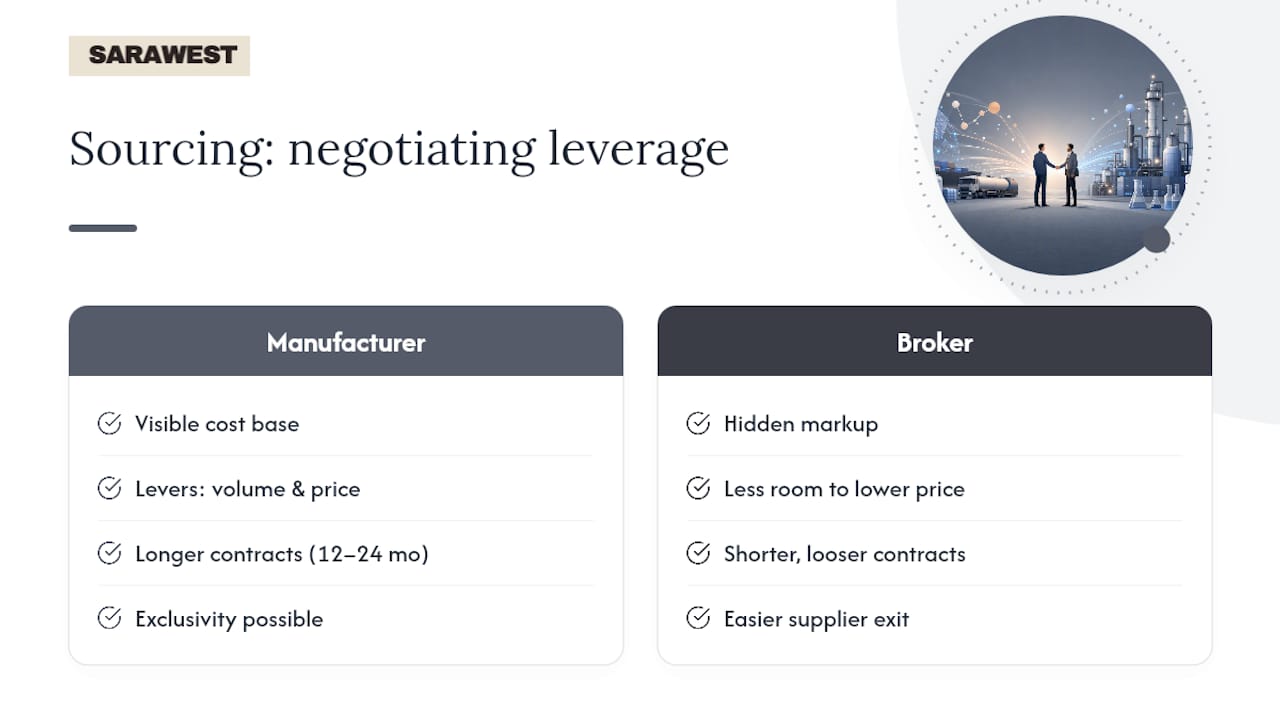
Negotiation leverage shifts almost entirely based on who you're actually negotiating with. With a manufacturer, you're negotiating directly against production cost, capacity, and formulation labor, which means volume commitments, longer contract terms, and exclusivity clauses all become real levers you can pull. A manufacturer that wants your repeat business will often trade a lower unit price for a 12 or 24 month commitment.
With a broker, you're negotiating against a markup layered on top of a cost structure you can't see. You have less room to move because the broker has their own margin to protect, and you often can't verify whether their "best price" reflects real cost pressure or just their comfort zone. Contract terms with brokers also tend to be shorter and looser, since they're managing relationships with multiple manufacturers behind the scenes and don't want to overcommit on your behalf.
The practical upshot: if long-term contract terms, price locks, or exclusivity matter to your business model, direct sourcing gives you a real seat at that table. If you need flexibility to switch suppliers quickly without renegotiating a master agreement, a broker's shorter, less binding terms can actually work in your favor. Neither leverage profile is universally better. It depends on whether you value price certainty or exit flexibility more.
What About Communication and Language Barriers?
Sourcing internationally through a broker often means the broker absorbs the language gap for you, translating specifications, negotiating in the local language, and interpreting cultural business norms you might not know to watch for. That's real value when you're working with an overseas factory for the first time.
The tradeoff is information loss. Every translation layer between you and the people mixing your formula is a place where a detail can get dropped, a tolerance can get misread, or a change request can arrive garbled. A domestic manufacturer removes that layer entirely. You're speaking directly with the chemist or production lead, in the same language, often on the same call where the question came up.
For chemical formulations specifically, this matters more than it does for generic goods. A pH tolerance, a fragrance load percentage, or a stability requirement is not the kind of detail you want passed through three parties before it reaches the person mixing the batch. If your product line depends on precise technical specifications, direct communication with the manufacturer's technical staff is worth more than it might seem on a org chart.
How Do Payment Terms Differ Between the Two Methods?
Manufacturers running production for you typically expect a deposit, often 30 to 50%, before a run starts, with the balance due on completion or shipment. That's standard because your production slot ties up their equipment and labor whether or not you pay on time, and formulation work has already happened before the batch is even mixed.
Brokers and distributors, by contrast, often extend more familiar net-30 or net-60 terms, because they're selling from existing inventory rather than financing a custom run on your behalf. If your cash flow depends on paying after you've received and possibly resold product, that flexibility has real value.
Financing options also diverge. Manufacturers running larger contract volumes sometimes offer volume-based pricing tiers or phased payment schedules tied to production milestones, especially once you've built a track record together. Brokers are more likely to offer standard trade credit terms, since they're managing risk across many smaller transactions rather than one large production commitment. Neither structure is inherently cheaper. It comes down to whether your business can absorb an upfront deposit in exchange for a custom formulation, or needs the payment flexibility that comes with buying off an existing shelf.
Who Protects Your Formula and Confidentiality Better?
This is where the intermediary layer becomes a real liability, not just an inconvenience. Every party that touches your formulation, specification sheet, or product roadmap is another point of potential leakage, whether through carelessness or through a broker representing a competing brand on the side.
A manufacturer working directly with you can sign a single non-disclosure agreement that covers the actual people formulating and producing your product. A broker relationship often means your NDA covers the broker, but the manufacturer they're sourcing from, the one actually holding your formula, may never have signed anything with you at all. You're trusting the broker's own confidentiality agreement with their supplier, which you likely haven't seen and can't enforce.
For chemical brands building proprietary formulations, this is not a minor detail. If your competitive advantage is a specific blend ratio or a novel active ingredient combination, every additional party in the chain is a chance for that information to travel further than you intended. Direct manufacturer relationships let you control exactly who has access to your formula, and let you negotiate IP ownership and non-compete terms with the one party actually holding the recipe.
Which Method Scales Better as You Grow?
Scalability depends on which direction you're growing. If you're adding volume on an existing, proven SKU, a manufacturer relationship scales cleanly: the same formula, the same QC process, larger batch sizes. You're not renegotiating a new supplier relationship every time demand grows.
If you're adding new SKUs or entering new categories quickly, a broker's network can flex faster, since they may already have relationships with manufacturers suited to categories you haven't touched yet. That flexibility comes at the cost of consistency. Different manufacturers behind the same broker can mean subtle differences in formulation quality or batch behavior that you won't notice until a customer does.
The hybrid approach solves most of this tension. Lock your core, high-volume SKUs into a direct manufacturer relationship where consistency and lifecycle support matter most. Use brokers or distributors to test new categories or handle demand spikes you're not ready to commit production capacity to yet. That split gives you the consistency and control direct sourcing provides on your bread-and-butter products, without locking you into production minimums on categories you're still validating.
What the Data Actually Supports
Most sourcing advice treats this as an ideological choice, brokers are convenient middlemen, manufacturers are the "real" way to do business, when the actual evidence points somewhere less tidy. The framework that holds up is triggers, not loyalty: SKU count, regulatory burden, and first-batch exposure should decide your route, not a general preference for cutting out the middleman.
Where conventional advice falls short is in treating unit price as the whole story. Buyers who chase the lowest quote per gallon routinely get burned by storage costs and tied-up cash they didn't model. The Inline Plastics research on total cost of ownership should be required reading before anyone signs a bulk purchase order.
What should come first, before cost, before lead time, is verification. Ask any broker for their independent path to proving supplier compliance before you ask about price. A broker who can't answer that question isn't offering you a service. They're offering you their word, with a markup attached. Manufacturers earn trust differently: you can see the facility, meet the chemist, and audit the process yourself.
Get a Fast Quote From a Manufacturer, Not a Middleman
Sarawest USA is the direct route for chemical brands tired of relaying formula changes through someone else's phone call. With in-house R&D chemists and a library of over 1,200 proprietary formulas across eight industries, requests that would take a broker days to route through a third-party lab get handled in one conversation, sometimes with same-day turnaround on the right request. Production scales from pilot batches to full truckloads without switching partners as your volume grows.
If your brand needs custom formulation, faster answers, or a partner who can grow with your SKU count instead of routing around it, Sarawest USA's contract manufacturing team can turn a request into a working quote fast. Review formulation track record and case studies to see how pilot-to-scale projects have played out for other brands, then submit your specifications for a direct RFQ.
Frequently Asked Questions
Is it always cheaper to buy directly from a manufacturer? Not once you factor in total cost of ownership. Direct orders often lower unit price on large volumes, but storage, labor, and tied-up working capital can offset that savings if you don't have the warehouse capacity to absorb a full production run.
When should a chemical brand use a broker instead of a manufacturer? Use a broker when you're managing many SKUs, working in a heavily regulated category, or facing high risk on an untested product where a manufacturer's production minimum would be too costly if the first batch doesn't sell.
How do I verify a broker or sourcing agent is trustworthy? Ask them directly how they verify supplier compliance and whether they'll share the supplier's full legal name and factory address. An agent who can't produce independent verification documents on request is functioning as a reseller, not a value-added partner.
Can I use both a broker and a manufacturer at the same time? Yes, and most established buyers do. A common approach is sourcing high-volume, stable products directly from a manufacturer while keeping a broker or distributor for seasonal, low-volume, or urgent needs.
Does sourcing method affect how well my formula stays confidential? It can. Every intermediary in a broker relationship is another party with access to your specifications. A direct manufacturer relationship lets you control your non-disclosure agreement with the one party actually holding your formula.
Sources
- Differences between a manufacturer & regular dealer (TxDOT)
- Purchasing directly from a manufacturer vs. through distribution · Inline Plastics
- Broker vs manufacturer — what's the difference? · Daktronics
- Multi-SKU Sourcing: When to Hire a Sourcing Agent and When to Go Direct in 2026 · Agence Octo