
First article approval is the government's formal sign-off that a contractor's initial production unit meets contract specifications before full production begins. It runs on FAR Subpart 9.3 and FAR clause 52.209-3, and until you get it, you carry the schedule and financial risk of producing without a guaranteed contract.
TL;DR:
- Most delays occur due to communication gaps between engineering and QA during inspection, causing repeated resubmissions and extending approval timelines.
- Producing a golden sample before submission and sealing it properly with tamper-evident tape can prevent disputes and ensure compliance.
- Contracting officers may waive first article testing if there is recent, relevant approval or low conformance risk, saving time and costs.
- In-house shop floor communication streamlines the process, enabling rapid adjustments and reformulations without waiting for external labs or brokers.
- Missing the submission deadline is the most common cause of delays, so calendar the notification date and maintain clarity on contract and testing clauses.
Table of Contents
- What First Article Approval Means for Your Production Line
- When Does FAR Require First Article Testing?
- Contractor Testing vs. Government Testing: Which Clause Applies
- Building a First Article Test Report That Passes the First Time
- What Happens to Your Costs and Schedule Before Approval
- Your Step-by-Step First Article Preparation Checklist
- The Integrated Shop Floor Wins the FAI Timeline
- Get Your First Article Right the First Time With Sarawest USA
- Where to Verify the Rules Yourself
- Sources
What First Article Approval Means for Your Production Line
Most QA teams know this process by several names: first article inspection (FAI), the FAIR (First Article Inspection Report), or simply the golden sample review. They all describe the same checkpoint: a formal comparison between your first production unit and the contract drawings, specs, and acceptance criteria before you scale.
FAI gets triggered by four common events:
- A brand-new part number entering production for the first time
- A design or process change substantial enough to affect form, fit, or function
- A new supplier or manufacturing site taking over an existing part
- A tooling change, mold swap, or equipment relocation
FAI differs from incoming inspection (which checks raw materials) and final inspection (which checks finished lots). It sits earlier, validating that your process itself, not just a sample, can reliably produce a conforming part. Get FAI wrong, and every downstream inspection inherits the problem.
When Does FAR Require First Article Testing?
FAR Subpart 9.3 gives contracting officers the framework for deciding when testing and approval apply, and it is not automatic on every contract. Per 9.303, testing and approval fit situations where:
- The contractor has never produced the item before, or has not produced it recently
- A significant design, material, or process change has occurred since the last approved article
- Prior production history raises quality or performance concerns
- The item is technically complex enough that drawings alone cannot verify manufacturability
Solicitations that require first article testing must specify how many units the government or contractor will test, tie that quantity to the overall contract volume, and lay out how first article activity affects the delivery schedule. The eCFR's codified text of Subpart 9.3 spells out this solicitation language in detail, and it is worth cross-referencing if your contracts team is drafting clause selections.
Waivers exist too. Contracting officers can waive testing when the contractor has a recent, relevant approval on file for a substantially similar item, or when the government determines that the risk of nonconformance is low enough to skip the step entirely. If your production history is clean, it is worth asking whether a waiver applies before you invest in a full FAI cycle.
Contractor Testing vs. Government Testing: Which Clause Applies
Two clauses drive the actual mechanics, and knowing which one governs your contract changes what your QA team has to deliver.
- FAR 52.209-3 (Contractor Testing). Under this clause, the contractor performs the testing, tests the specific unit count named in the contract, and submits a First Article Test Report to the government. The contracting officer then has a window, which the contract specifies, to notify the contractor of approval, conditional approval, or disapproval.
- FAR 52.209-4 (Government Testing). Here, the government performs or witnesses the testing itself, typically at a government facility or under government oversight, which shifts logistics and timing control away from the contractor.
- Notification outcomes. Approval means you proceed to full production. Conditional approval usually means you can proceed while correcting a specific, documented deficiency. Disapproval halts production authorization until you resubmit and pass.
Missing the submission deadline named in your contract is the single most common self-inflicted delay in this whole process. Calendar it the day the contract is signed, not the week the golden sample ships.
Building a First Article Test Report That Passes the First Time
Your FAIR is the document that proves your first unit matches the drawing, not just that it looks right on the shop floor. A complete package typically includes:
- Dimensional inspection data mapped to every drawing callout
- Material certifications and certificates of analysis for raw inputs
- Test protocols and raw results for functional or performance requirements
- Drawing revision references and stated acceptance criteria
- Engineering dispositions for any borderline or out-of-tolerance result
Industry teams working in aerospace and defense often structure this using the AS9102 FAIR format, which maps every inspected characteristic to a specific drawing balloon number. That traceability matrix is what separates a report evaluators approve on the first pass from one that comes back with a request for more data. A certificate of analysis that clearly ties lot numbers to test results does more to speed approval than any cover letter.
Pro Tip: Document engineering dispositions for borderline results in the FAIR itself, not in a separate email chain. Evaluators want to see the rationale attached to the data, not chase it down later.
What Happens to Your Costs and Schedule Before Approval
Producing ahead of approval is a real financial gamble, and FAR does not fully protect you from it. If you order materials or start tooling before the government signs off, and the article gets disapproved, those costs may not be recoverable the way they would be on an approved contract line.
A few things worth knowing before you commit resources:
- Allocable costs incurred prior to approval can still factor into progress payments, but only within the terms your contract's payment clause allows.
- Termination settlements before first article approval are calculated differently than for approved production, so read your termination clause closely.
- Government delay in notifying you of approval, conditional approval, or disapproval can support a request for equitable adjustment to your delivery schedule.
- Alternate II language, when written into your contract, can authorize limited production or long-lead procurement before final approval, cutting schedule risk substantially.
Understanding your lead time exposure before committing to material buys protects your margin if the timeline slips.
Your Step-by-Step First Article Preparation Checklist
A clean FAI submission comes down to sequencing. Rushing the golden sample step is where most resubmissions start.
- Before submission: Produce and seal a golden sample under representative production conditions, then have it signed by both engineering and QA leads with the PO number referenced directly on the sample tag.
- Compile supporting documents: Gather process routers, inspection plans, and any special process certifications (welding, plating, heat treat) that apply to the part.
- Run the inspection: Perform full dimensional and functional testing against every drawing characteristic, not a sampling shortcut.
- Collect traceability records: Pull certificates of analysis, lot numbers, and supplier certifications, and map each to the corresponding test result.
- Submit and track: Send the FAIR through your contracting officer's specified channel, log the submission date, and calendar the notification deadline named in your contract.
- Handle feedback: If conditional approval or disapproval comes back, route the corrective action through engineering immediately and log what triggered the resubmission so it doesn't repeat on the next part.
Pro Tip: Seal your golden sample with tamper-evident tape and a signed tag referencing the PO number before it ever leaves your facility. It is the cheapest insurance against a disputed evaluation later.
Keep an NDA in place whenever a golden sample or FAIR package goes to an outside evaluator or subcontractor. Proprietary formulations and process parameters are exactly the kind of detail that gets exposed in a rushed submission.
The Integrated Shop Floor Wins the FAI Timeline
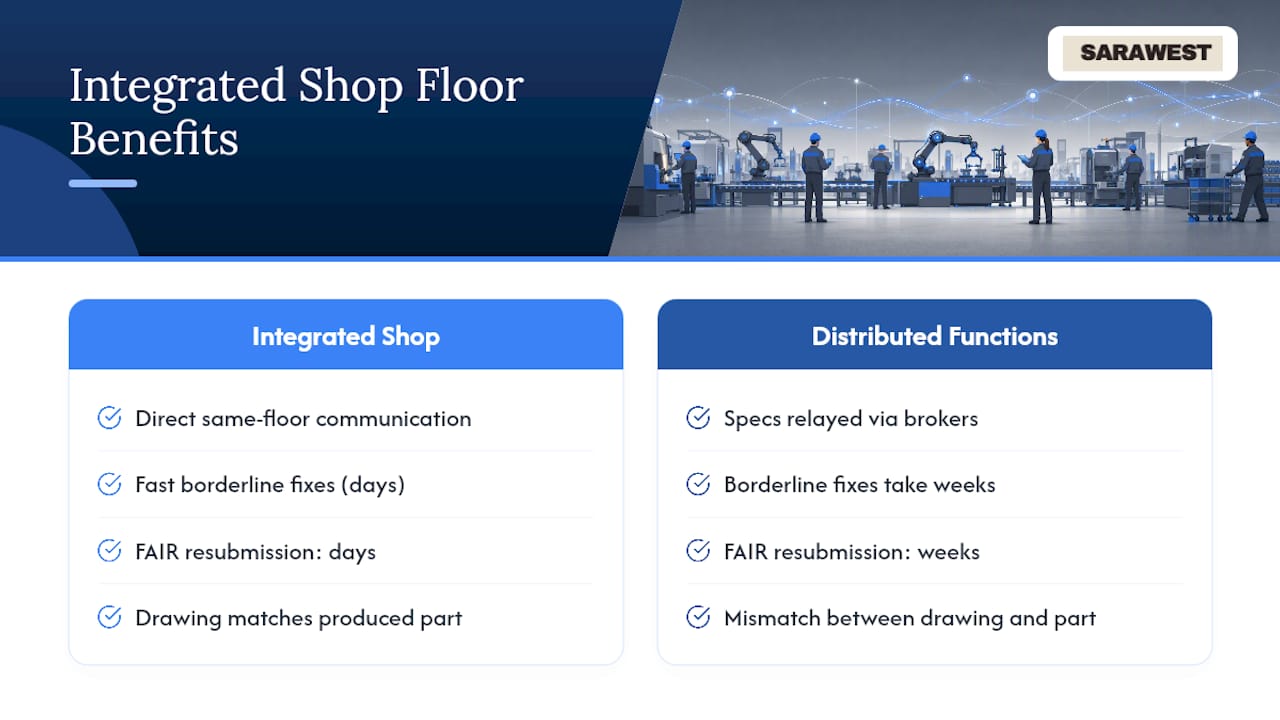
Most delays in first article approval trace back to a communication gap: engineering changes a tolerance, QA finds out during inspection, and the drawing package they submitted no longer matches the part in hand. Shops that keep R&D, formulation, and quality functions under one roof close that gap because the person adjusting the formula and the person writing the inspection report are on the same floor, sometimes the same call.
That structure matters most when a program engineer flags a borderline result. A contract manufacturer with in-house chemists can turn around a reformulated pilot batch and a fresh FAIR in days, not weeks, because there's no broker relaying specs back and forth. Practical communication with the contracting officer, meanwhile, is mostly about candor: tell them a resubmission is coming before the deadline passes, not after.
— Faisal Mansur
Get Your First Article Right the First Time With Sarawest USA
Sarawest USA runs its own in-house R&D chemistry team, which means a formula adjustment triggered by a borderline FAI result doesn't wait on a third-party lab or a broker relay. We handle pilot-to-scale production directly, so the golden sample you submit for approval comes from the same process and equipment that will run your full order, not a lab bench that never sees production volume.
That continuity matters because evaluators are comparing your FAIR against a real production process, not a one-off prototype. With over 1,200 proprietary formulas across eight industries, from commercial cleaning to sports care, we can adapt an existing base formula fast or build a new one to your spec, then document the batch for your submission. If you need a sample generated to start your own FAI package, request product samples directly, or reach out through our contract manufacturing page to scope a pilot run against your timeline.
Where to Verify the Rules Yourself
Read the primary text before you finalize any contract-specific interpretation: FAR Subpart 9.3 covers testing and approval criteria, and FAR 52.209-3 spells out contractor testing obligations and notification timing. For FAIR formatting, the AS9102 template guide is a solid working reference. When a clause's application to your specific contract is ambiguous, escalate to your contracting officer or legal counsel rather than guessing.