

This article covers a high-strength, water-dilutable floor cleaner concentrate built for both manual mopping and auto-scrubber fleets. Target a neutral pH of 7 to 9 for finish-safe daily maintenance, or a higher pH for grease-heavy environments, with dilution ranges typically running from 1:128 down to 1:32 depending on soil load and machine type. Production runs as a batch process: demineralized water first, chelants and surfactants staged in afterward, never dumped in all at once.
TL;DR:
- Correct water quality with TDS under 50 is essential to prevent cloudiness, reduce foaming issues, and extend shelf life during manufacturing.
- Mix builders and chelants before surfactants to effectively sequester hardness salts and avoid haze or foam problems in the final product.
- Maintain pH target ranges carefully: neutral (7-9) for finish safety or alkaline (9-11) for grease-heavy environments, depending on the application.
- Use a 10-hour maturation hold after blending to ensure full homogenization and prevent batch separation on storage.
- Follow strict acceptance criteria and QC protocols at key process points, with proper equipment and safety measures, to ensure batch consistency and stability.
Table of Contents
- Floor Cleaner Concentrate Manufacturing: The Formulation Spec Sheet
- How Do You Manufacture a Floor Cleaner Concentrate Step By Step?
- What Equipment and QC Checks Does a Concentrate Line Need?
- Packaging, Labeling, and Storage for Floor Cleaner Concentrates
- What Actually Breaks Floor Cleaner Batches at Scale?
- Get Your Floor Cleaner Concentrate Formulated and Scaled
- Sources
Floor Cleaner Concentrate Manufacturing: The Formulation Spec Sheet
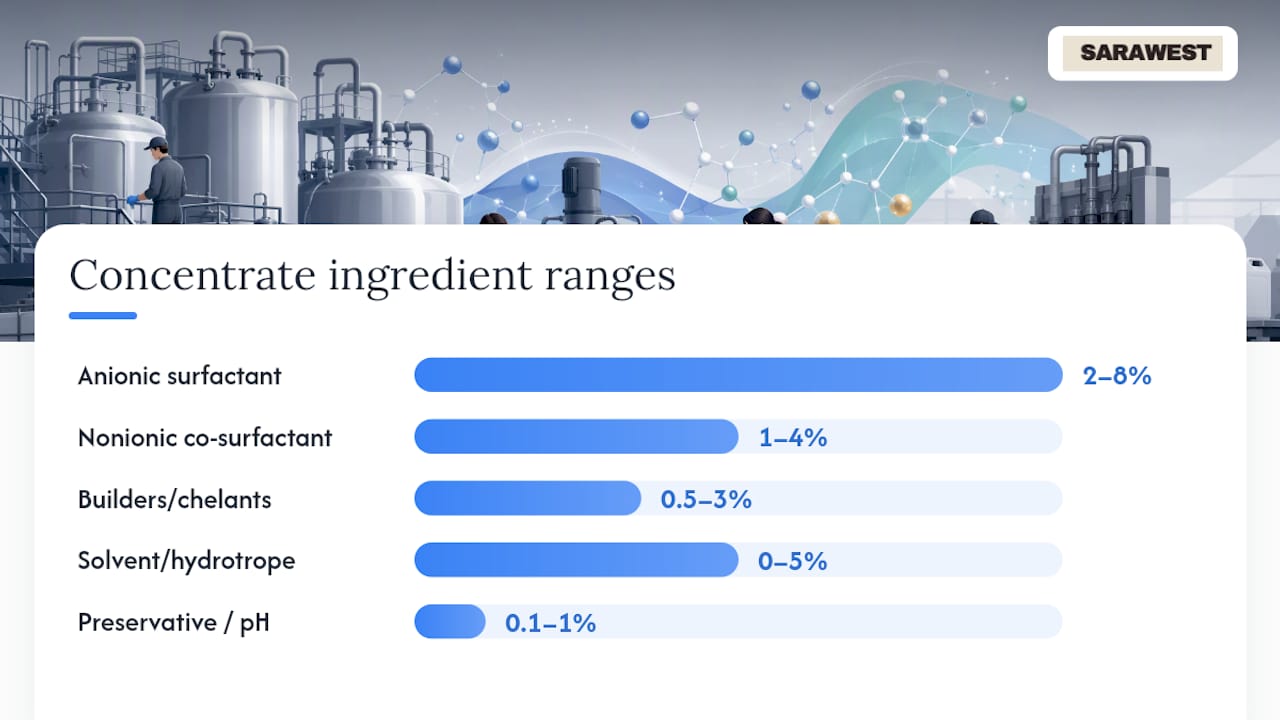
A working concentrate is built from six ingredient classes, each doing a distinct job. Get the ratios wrong and you either underperform on grease or blow your foam budget on a scrubber line that can't handle suds.
- Primary anionic surfactant (2% to 8% active in the concentrate): carries most of the cleaning load. Low-foam variants matter here, since Tennant's T16AMR scrubber documentation shows that machine dosing systems and 50-gallon solution tanks are engineered around minimal suds, not sink-side lather.
- Nonionic co-surfactant (1% to 4%): boosts grease-cutting power and keeps residue from dulling floor finish after repeated passes.
- Builders and chelants (0.5% to 3%): EDTA, GLDA, or a phosphonate alternative binds hardness minerals so surfactants aren't spent softening water instead of lifting soil.
- Solvents and hydrotropes (0% to 5%, glycol ethers where used): help solubilize oily residue and keep the formula clear at dilution.
- Fragrance and dye (trace to 0.3%): added last, after the base is stable, since heat and shear from earlier mixing can strip volatile notes.
- Preservative, corrosion inhibitor, and pH adjuster (0.1% to 1%): protects shelf stability and, in alkaline builds, keeps the formula metal-safe for aluminum floor equipment.
Your pH decision drives everything downstream. Neutral formulations (around pH 7 to 9) protect finished floors, marble, and wood, and Zep's concentrated neutral pH cleaner is built on exactly that logic, marketed to make up to 128 gallons of use-solution per gallon of concentrate without stripping finish. Push into alkaline territory, pH 9 to 11, when you're targeting heavy oil and grease in industrial bays. Kärcher's FloorPro RM 69 sits at roughly pH 10.2 for that reason, a slightly alkaline, low-foam formula built specifically for scrubber compatibility in grease-heavy plants.
Water quality is not a footnote. Formulators consistently point to demineralized water with TDS under 50 as the baseline requirement, because dissolved minerals cloud the concentrate, interfere with chelant performance, and shorten shelf life before the product ever reaches a customer's dosing tank.
How Do You Manufacture a Floor Cleaner Concentrate Step By Step?
Mixing order isn't a formality. Add surfactants before builders are dispersed, or dump fragrance into a hot, high-shear batch, and you'll fight foam, haze, or scent loss for the rest of the run.
- Verify vessel cleanliness and test incoming water. Confirm TDS is under 50 before charging the tank; anything higher risks cloudiness later.
- Charge the batch with demineralized water at roughly 70% to 80% of final batch volume, leaving room for later additions.
- Disperse builders and chelants first, under moderate agitation, so hardness is sequestered before surfactants go in.
- Add the primary anionic surfactant slowly, keeping agitation steady but not violent. Fast addition or excess shear at this stage is the most common cause of premature foaming during mixing.
- Blend in the nonionic co-surfactant and any low-foam modifiers, watching for early signs of haze.
- Introduce solvents or hydrotropes, which typically improve clarity rather than hurt it.
- Add fragrance and dye last, once the base has cooled and stabilized, to protect volatile components.
- Adjust pH and add preservative, checking against your target band (7 to 9 neutral, 9 to 11 alkaline).
- Top off with remaining water to final batch volume and run a final low-speed blend pass.
- Hold the batch for maturation. A roughly 10-hour rest period is standard practice to let the mixture fully homogenize before filling, and skipping it is a common reason batches separate weeks later on a warehouse shelf.
Run in-process checks at three points: after builder dispersion, after surfactant addition, and after maturation. Check pH, visual clarity, and density or refractive index as a concentration proxy. Cloudiness usually traces back to hard water, surfactant added too fast, or insufficient hold time. If you're moving from a pilot batch to production tanks, hold impeller tip speed constant rather than rpm. Tip speed governs shear, and shear governs how surfactants behave at scale, so matching rpm alone across different vessel sizes can quietly wreck a formula that worked fine in a five-gallon pail.
Pro Tip: Run your maturation hold with a sample pulled at hour zero and hour ten, side by side under the same light. If you can't see a visible difference in clarity between the two, your batch was probably ready sooner and you can tighten your production schedule.
What Equipment and QC Checks Does a Concentrate Line Need?
Production hardware and lab instruments work as a pair. Skip either and your batch records won't hold up to a client audit or a regulatory inspection.
On the floor, you need HDPE or stainless mixing vessels sized to your run (pilot batches in the 50 to 200 gallon range, production tanks scaling to several thousand), mechanical agitators with variable speed control, transfer pumps rated for viscous concentrates, static mixers for inline dosing during fill, and a filling line configured for drums, IBCs, or totes depending on your customer base.
In the lab, four instruments cover most of what you need:
- pH meter, calibrated daily against two-point buffer standards.
- TDS meter, used on incoming water before every batch, not just during setup.
- Turbidity check, either instrument-based or a consistent visual clarity standard held against a light source.
- Refractometer or density meter, giving a fast concentration proxy without running a full lab assay, and a Brookfield viscometer when the formula carries thickeners.
Acceptance criteria should be written down, not judged by eye alone: pH within ±0.2 of target, no visible haze after the maturation hold, density within your set tolerance, and no separation after a 24-hour rest check. PPE (gloves, splash goggles, and respiratory protection when handling concentrated alkaline adjusters) belongs at every mixing station, and pH adjusters should be stored separately from preservatives to avoid accidental reactions during handling.
Packaging, Labeling, and Storage for Floor Cleaner Concentrates
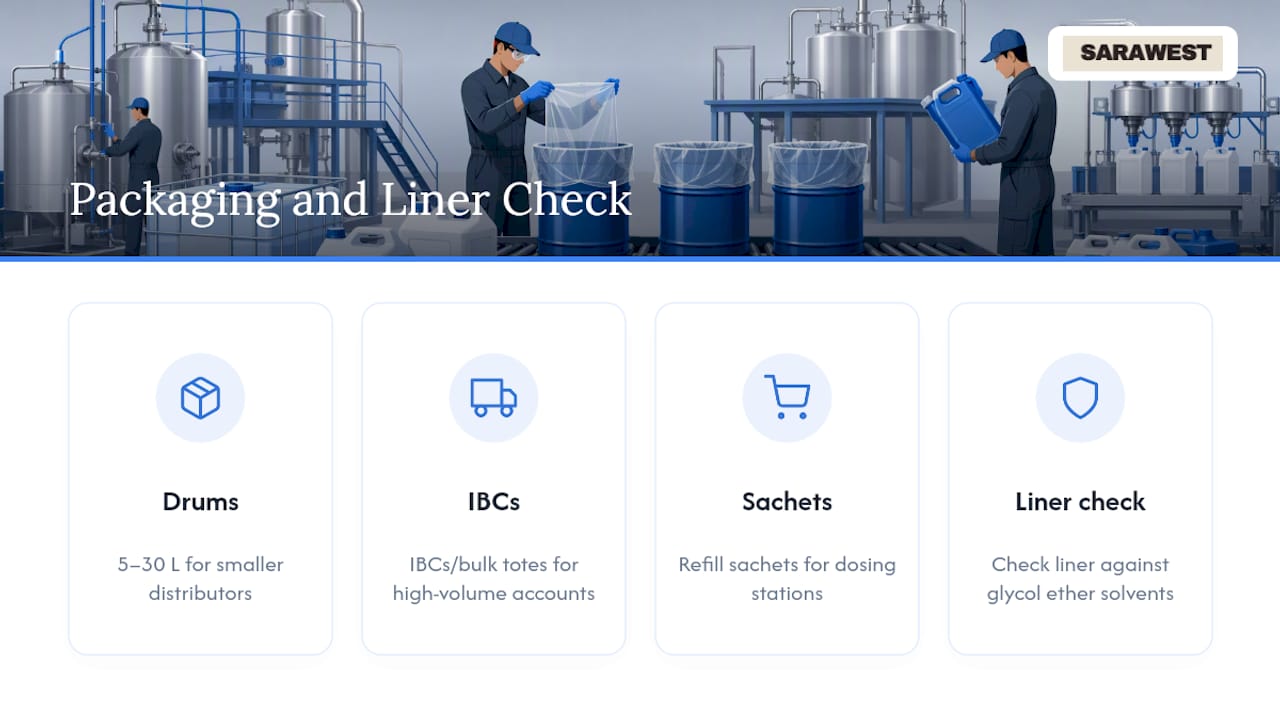
Pack format follows use case: 5 to 30 liter drums for smaller distributors, IBCs and bulk totes for high-volume accounts, and refill sachets for customers running dosing stations. Liner material needs to be checked against your solvent package, since some glycol ethers degrade certain plastics over time.
Labels need to carry more than a brand name. At minimum: product name, a clear dilution ratio table matching your validated range (say, 1:128 for light maintenance up to 1:32 for heavy soil), pH, hazard pictograms where applicable, batch or lot number, and recommended storage temperature.
Run a basic stability protocol before release: real-time storage at ambient conditions alongside an accelerated check at elevated temperature, watching for color shift, phase separation, or fragrance drift. Auto-scrubber fleets often use closed dosing systems, so confirm your concentrate's viscosity and clarity are compatible with the machine's metering pump before a customer discovers a clog in the field.
What Actually Breaks Floor Cleaner Batches at Scale?
Underrated water quality causes more complaint calls than bad surfactant chemistry ever does. Wrong mixing order, usually surfactant before builder, produces foam and haze that a rushed team blames on the formula instead of the process. Skipped maturation and thin QC documentation are the two habits that separate a reliable production partner from one that ships problems downstream. Sarawest USA reduces that risk with a formulation library built from real production runs, in-house chemists who validate batch records before scale-up, and pilot samples that catch issues while they still cost pennies to fix instead of a full truckload.
— Faisal Mansur
Get Your Floor Cleaner Concentrate Formulated and Scaled
Building a compliant, machine-ready concentrate from scratch eats months if you're doing it alone, testing surfactant blends, chasing water-quality issues, and learning scale-up the hard way on your own tanks. Some contract manufacturers offer in-house chemists who adapt existing formulas from a large library of proprietary chemistries or build new ones, then move customers from pilot batch to full production without a broker sitting between the client and the lab.
If you're formulating a commercial cleaning line, our white-label and bulk drum manufacturing capabilities cover everything from single-drum pilots to truckload orders. Sourcing packaging or custom fill hardware alongside your formulation work is worth planning early too, and partners like Machining Technologies handle the precision components some fill lines require. When you're ready to see how your concentrate performs before committing to a production run, request product samples and get a real batch in hand within days, not months.
Sources
The T16AMR scrubber specs clarify machine-compatible dilution limits. Zep's Formula 22 data lays out dilution ranges by soil level. Kärcher's RM 69 page shows alkaline grease-cleaner pH targets in practice.
- T16AMR Industrial Robotic Floor Scrubber
- FloorPro Industrial Cleaner RM 69
- Floor Cleaner Concentrate (manufacturer guidance)