
Green Seal certification for cleaning services is the most credible third-party verification a commercial cleaning program can carry in the U.S. market. If you manage facilities, run a cleaning operation, or write procurement specs, this guide gives you the standard that matters most (GS-42), the benefits that show up in real purchasing decisions, and a preparation checklist you can act on today.
- What gets certified: Under GS-42, Green Seal certifies your commercial or institutional cleaning service program, including procedures, training, and chemical controls. Product certifications (GS-8, GS-37, and others) are separate but often required alongside a service program.
- Core benefits: Recognition in more than 100 government purchasing policies, LEED credit eligibility, documented protection for building occupants, and a competitive edge in institutional contract bids.
- Immediate next step: Submit an interest form through Green Seal's website to receive a tailored fee estimate and begin the prescreen conversation.
Key Takeaways
Green Seal's GS-42 standard certifies commercial cleaning service programs through evidence-based audits, and recognition in more than 100 government purchasing policies makes it the most procurement-relevant ecolabel for U.S. institutional cleaning contracts.
| Point | Details |
|---|---|
| GS-42 is the service standard | It certifies your cleaning program's procedures, training, and chemical controls, not just individual products. |
| Product standards are separate | GS-37 covers institutional cleaning products; GS-8 covers household-channel products; each SKU is certified individually. |
| Certification is audit-based | Document review plus an on-site visit; periodic monitoring makes it an ongoing compliance obligation. |
| Fees are customized | No published flat rate; submit an interest form to receive a tailored estimate based on your program scope. |
| Typical timeline is 2–3 months | That timeline assumes complete documentation and production-ready samples on submission day. |
| Sarawest USA supports readiness | In-house R&D chemists produce pilot batches, QC documentation, and compliant formulations to accelerate your Green Seal product review. |
Table of Contents
- What are green seal certification cleaners and how does the ecolabel work?
- Which Green Seal standards apply to your cleaning operation?
- Who and what does Green Seal actually certify?
- What are the real benefits of Green Seal certification for your organization?
- What does GS-42 actually require from your cleaning operation?
- How does the Green Seal certification process work, step by step?
- A practical preparation checklist before you apply
- What we've learned from the formulation side of Green Seal readiness
- Why organizations pursue certification in phases, not all at once
- Sarawest USA supports your Green Seal product readiness
- An editorial perspective on what certification actually signals
- The gap between what a green label promises and what it proves
- Sources
What are green seal certification cleaners and how does the ecolabel work?
Green Seal is a nonprofit organization that issues science-based, third-party ecolabels for products and services. The term "green seal certification cleaners" refers to cleaning products or cleaning service programs that have passed Green Seal's independent review process and earned the right to display its mark.
What separates Green Seal from a brand's own "eco-friendly" marketing claim is the multi-attribute model. Rather than checking a single box (say, biodegradable surfactants), Green Seal evaluates across five lifecycle elements: safer chemicals, responsible sourcing, low-impact manufacturing, sustainable packaging, and verified performance. Every element requires documented evidence, not marketing language.
That distinction matters for procurement teams. A product with a self-declared "green" label carries no independent verification. A Green Seal–certified product or service has been reviewed by technical staff, tested against published standards, and is subject to ongoing monitoring. Greenwashing claims collapse under that scrutiny. Certified claims hold.
| Verification element | What Green Seal checks |
|---|---|
| Chemical safety | Ingredient restrictions, hazardous substance prohibitions (PFAS, certain VOCs) |
| Performance | Third-party test results against ASTM, AATCC, and HCPA methods |
| Manufacturing | Process controls, waste, and energy considerations |
| Packaging | Recyclability, post-consumer content, labeling accuracy |
| Ongoing compliance | Periodic monitoring and recertification audits |
Which Green Seal standards apply to your cleaning operation?
GS-42 is the standard you need if you run or procure a commercial or institutional cleaning service. It covers the service program itself: how your staff is trained, which chemicals they use, how procedures are documented, and how you protect occupants in settings like schools, hospitals, and office buildings. GS-42 is specifically designed for commercial and institutional cleaning services, and it is the standard auditors evaluate during a site visit.
Product standards are separate, and most service programs will need at least one of them to satisfy GS-42's chemical requirements:
- GS-8: General-purpose cleaners for household use. Relevant when products cross over from consumer to light-commercial channels.
- GS-37: Professional general-purpose cleaning products for industrial and institutional use. This is the most common product standard for commercial cleaning contractors. Note that EPA-registered disinfectants regulated under FIFRA fall outside GS-37's scope.
- GS-34: Cleaners and degreasers for institutional and industrial use.
- GS-52: Specialty surface cleaners (glass, bathroom, floor care).
- GS-53: Hand cleaners for institutional and industrial use.
Performance testing under GS-8 references recognized methods such as ASTM D4488-95 for particulate soil removal and ASTM D5343 for bathroom cleaners; glass cleaners must meet HCPA DCC 09 rating requirements. GS-37 applies comparable rigor to the institutional channel.
For comparison, UL ECOLOGO (UL 2700 and related standards) is a parallel multi-attribute ecolabel that also uses lifecycle-based criteria and ingredient restrictions. Both are credible. Green Seal tends to dominate U.S. government purchasing specs; ECOLOGO carries strong recognition in Canada and some federal procurement contexts. When your RFP language specifies one, confirm which the contracting agency requires.
Pro Tip: Build your approved product inventory around GS-37–certified products first. That single step satisfies the chemical-control requirement in GS-42 and eliminates one of the most common documentation gaps auditors flag.
Who and what does Green Seal actually certify?
Certification attaches to a specific scope, and getting that scope right is critical for procurement language.
- Service program certification (GS-42): Green Seal certifies the cleaning service program operated by a company or contractor. This can cover a single location or a portfolio of sites, but each location included in the scope must meet the standard's requirements and be listed in the certification.
- Product certification (GS-8, GS-37, etc.): Certification attaches to a specific product formulation, not to a company's entire catalog. A manufacturer with 40 SKUs must certify each one individually.
- Company-level vs. location-level scope: A cleaning contractor can hold a GS-42 certification that covers multiple client sites, but the certification document will name those sites. Adding new locations typically requires notifying Green Seal and may trigger a supplemental review.
For RFP and procurement language, the distinction matters. "Green Seal–certified commercial cleaning program" means the service procedures and training are certified. "Green Seal–certified cleaning products" means specific formulations have passed product-level review. Specifying both in a contract gives you the strongest protection.
Common eligibility limitations worth knowing before you apply:
- Products that require EPA registration as disinfectants or sanitizers (FIFRA-regulated) fall outside most Green Seal product standards.
- Products still in pre-production cannot complete certification. Final verification requires production samples and dated lab reports.
- Service programs that cannot document staff training or SOPs will not pass the initial document review.
What are the real benefits of Green Seal certification for your organization?
The procurement signal is the most immediate win. Green Seal is recognized in more than 100 federal, state, and local government purchasing policies. For cleaning contractors bidding on public sector work, that recognition can be the difference between qualifying for a contract and being screened out at the RFP stage.
For facility managers:
- Documented evidence that cleaning products meet ingredient safety thresholds, reducing occupant exposure to hazardous chemicals.
- Verified performance data (soil removal, streak resistance) rather than manufacturer claims.
- A defensible record for sustainability reporting and building certification programs.
For cleaning contractors:
- A competitive differentiator in institutional bids (schools, healthcare, government buildings).
- Access to procurement channels that require or prefer certified programs.
- Marketing tools and listing on Green Seal's certified-products database, which procurement officers actively search.
For procurement professionals:
- A trusted, independently verified spec that reduces the risk of greenwashing claims from vendors.
- Alignment with LEED v4 and LEED v4.1 credits for green cleaning, which accept Green Seal–certified products and services.
- Simplified vendor qualification: if a contractor holds GS-42 certification, the training, chemical, and procedure requirements have already been audited.
Procurement recognition: Green Seal is specified in more than 100 government purchasing policies across federal, state, and local agencies — making it one of the most widely accepted ecolabels in U.S. institutional procurement.
What does GS-42 actually require from your cleaning operation?
GS-42 is an operational standard, not just a product checklist. Auditors evaluate six major areas, and gaps in any one of them can stall certification.
Documented SOPs: Every cleaning procedure must be written down, version-controlled, and accessible to staff. Verbal training alone does not satisfy this requirement.
Training programs and competency evidence: Staff must complete documented training on chemical handling, equipment use, and safety procedures. Dated training logs with employee signatures are the expected evidence format.
Chemical and product controls: Products used in the program must meet Green Seal or equivalent third-party standards. Auditors will review your approved product list and cross-reference it against SDS records.
Equipment requirements: Certain equipment categories (HEPA-filter vacuums, microfiber systems, low-moisture floor care) are specified or preferred under GS-42. Equipment maintenance logs are part of the audit record.
Performance verification: The standard requires evidence that cleaning outcomes meet defined thresholds. For products, this means third-party lab reports referencing recognized test methods.
Recordkeeping: Waste disposal records, incident logs, and chemical inventory records must be maintained and available for review.
| GS-42 requirement area | Acceptable evidence formats |
|---|---|
| SOPs | Written procedures, version history, staff sign-off sheets |
| Training | Dated logs, competency assessments, certificates of completion |
| Chemical controls | Approved product list, SDS binder, vendor certificates |
| Equipment | Maintenance logs, purchase records for HEPA vacuums |
| Performance | Third-party lab reports (ASTM, AATCC methods) |
| Recordkeeping | Waste disposal manifests, incident reports, inventory logs |
Hazardous-chemical restrictions are specific. PFAS-containing products are excluded. Low-VOC formulations are required for most product categories. Every product on your approved list must have a current SDS that confirms compliance with these restrictions.
Pro Tip: Organize your SDS records into a single binder indexed by product category before the site visit. Auditors work through chemical controls first. A clean, indexed binder signals operational maturity and speeds that portion of the review by hours.
How does the Green Seal certification process work, step by step?
The process is linear but iterative. Reviewers work with applicants to close gaps rather than issuing a flat rejection, so preparation quality directly affects how long each stage takes.
-
Submit an interest form. Contact Green Seal through its website to initiate the prescreen conversation. This is where you describe your program scope and receive a tailored fee estimate. Fees are customized based on scope, number of products or locations, and application complexity — there is no published flat rate.
-
Complete the formal application. Submit the application package, including program description, product inventory, and preliminary documentation. Green Seal's technical staff reviews completeness before moving to full review.
-
Technical document review. Reviewers evaluate SOPs, training records, chemical lists, SDS files, and any third-party lab reports you have submitted. This stage typically generates a corrective action list for items that need clarification or additional evidence.
-
Corrective action period. You address gaps identified in the document review. Missing production samples or incomplete lab reports are the most common causes of delay at this stage.
-
On-site audit. A Green Seal auditor visits one or more locations in your certification scope. They observe procedures, interview staff, inspect chemical storage, and verify that documented SOPs match actual practice.
-
Certification award. If the audit confirms compliance, Green Seal issues the certification and lists your program or products in its public database. Certified customers receive marketing tools and one-on-one support to communicate the certification.
-
Periodic monitoring. Certification is not permanent. Green Seal conducts ongoing monitoring to confirm continued compliance. Changes to formulations, procedures, or locations must be reported and may trigger a supplemental review.
Typical timeline from application submission to certification award generally runs a few months when documentation is complete and production samples are ready. Incomplete packages or pre-production applications can extend that significantly.
A practical preparation checklist before you apply
Complete documentation is the single biggest factor in a fast review. Assemble these items before submitting your application:
- Product inventory mapped to GS standards. List every product used in your program, the applicable GS standard (GS-37, GS-52, etc.), and its certification status or pending application.
- SDS records for every product. Current, supplier-issued SDS files confirming ingredient compliance and VOC levels. Organize by product category.
- Third-party lab test reports. Reports referencing ASTM or AATCC methods for each product category. If reports are missing, commission them before applying.
- Training records. Dated logs for every employee in the program scope, with competency evidence (quiz scores, supervisor sign-off).
- Written SOPs. Procedures for each cleaning task, including chemical dilution ratios, contact times, and equipment use. Version-dated and signed.
- Equipment logs. Maintenance records for vacuums, floor machines, and dispensing systems.
- Waste disposal procedures. Written protocol and disposal manifests for chemical waste.
- Sample product labels. Labels must match SDS content and meet Green Seal's labeling requirements.
On the day of the site visit, designate one trained employee to accompany the auditor and demonstrate procedures live. Prepare a one-page "audit pack" that lists your certification scope, product inventory, and key contacts. Hand it to the auditor on arrival. It signals that your operation is organized and reduces the time spent on orientation.
Pro Tip: Commission third-party lab reports before you submit your application, not after. Waiting for lab results during the document-review stage is the most common cause of a 4–6 week delay. Most accredited labs turn around ASTM soil-removal tests in 2–3 weeks.
What we've learned from the formulation side of Green Seal readiness
Working in contract chemical manufacturing gives us a specific vantage point on where certification applications stall. It is almost never the service procedures. It is the product documentation.
A few things we see consistently:
- Preservative efficacy is underestimated. Many formulations pass ingredient screening but fail preservative challenge testing. Run preservative efficacy testing early, before you finalize the formula, not after you have committed to a production run.
- Packaging choices create labeling problems. A formulation that meets GS-37 can still fail the labeling requirement if the container's label doesn't match the SDS exactly. Align label copy with the SDS during formulation, not at the print stage.
- Pre-production applications stall. Green Seal requires production samples and dated lab reports for final verification. Applying before manufacturing begins adds months to the timeline. Accelerate your manufacturing readiness first.
- COA practices matter. Reviewers expect lot-level documentation. A certificate of analysis that covers only the bulk batch, not individual lots, creates gaps in the audit record.
Align your R&D, QC, and documentation teams around Green Seal's test method references from the start. Use official ASTM and AATCC methods, keep dated lab records for every batch, and treat the SDS as a living document that tracks every formulation change.
Pro Tip: When you need a compliant trial batch fast, a contract manufacturer with in-house R&D chemists can produce a pilot run aligned to GS-37 or GS-8 requirements in weeks rather than months. That pilot batch becomes your certification sample, and the manufacturer's QC records become part of your documentation package.
Why organizations pursue certification in phases, not all at once
Most organizations we work with don't certify everything on day one. They start with a pilot location, usually the one with the most procurement pressure (a school district contract, a hospital RFP), get GS-42 certified for that scope, and then extend to additional sites as the operational model proves out.
The pattern is consistent: the pilot surfaces documentation gaps that would have been much harder to fix across 20 locations simultaneously. Training logs that looked complete turn out to be missing competency evidence. The approved product list has two products without current SDS files. These are fixable problems at one site. They are expensive problems at scale.
After the pilot, the next phase is usually product certification. Once the service program is certified, procurement teams start asking for certified products specifically. That's when contractors come to us for help producing compliant formulations or sourcing pilot batches that can go through GS-37 review.
The procurement wins compound. A GS-42 service certification plus GS-37–certified products gives a contractor a complete, verifiable green cleaning program. That combination qualifies for LEED credits, satisfies the most demanding government purchasing specs, and gives the sales team a concrete, audited claim to lead with.
If you are at the pilot stage and need product formulation or sample production support to get your chemical inventory certified, contact Sarawest USA. We can help you get compliant product samples into the review process faster.
Sarawest USA supports your Green Seal product readiness
Certification is awarded by Green Seal. Getting your products ready for that review is where Sarawest USA comes in.
Our in-house R&D chemists formulate cleaning products against GS-37, GS-8, and GS-52 requirements from the start, not as an afterthought. We produce pilot batches from 1,000 units with full QC documentation, including lot-level COAs, SDS files, and third-party lab coordination for ASTM and AATCC performance testing. If your current product inventory has formulations that won't pass ingredient screening, we can reformulate them without restricted chemistries (PFAS-free, low-VOC) and produce compliant samples ready for Green Seal submission.
Our commercial cleaning manufacturing capabilities cover white-label and private-label production, from pilot runs to full truckloads, with the documentation package that Green Seal reviewers expect. Request product samples or reach out for formulation support at Sarawestusa.
An editorial perspective on what certification actually signals
The gap between what a green label promises and what it proves
Most of the friction we see in institutional procurement comes from the same place: a vendor shows up with a product labeled "eco-friendly" or "plant-based," and the facility manager has no reliable way to evaluate whether that claim means anything. The label looks credible. The SDS is vague. The sales rep is confident. And the procurement officer, who has 40 other line items to manage, approves it.
Green Seal certification closes that gap, but not in the way most people assume. The seal is not primarily a chemistry credential. It is an operational one. GS-42 exists because Green Seal recognized that you can fill a building with certified products and still run a cleaning program that harms occupants, if the training is inadequate, the dilution ratios are wrong, or the chemical storage is unsafe. The service standard forces the operational question: does the program actually work the way it's supposed to?
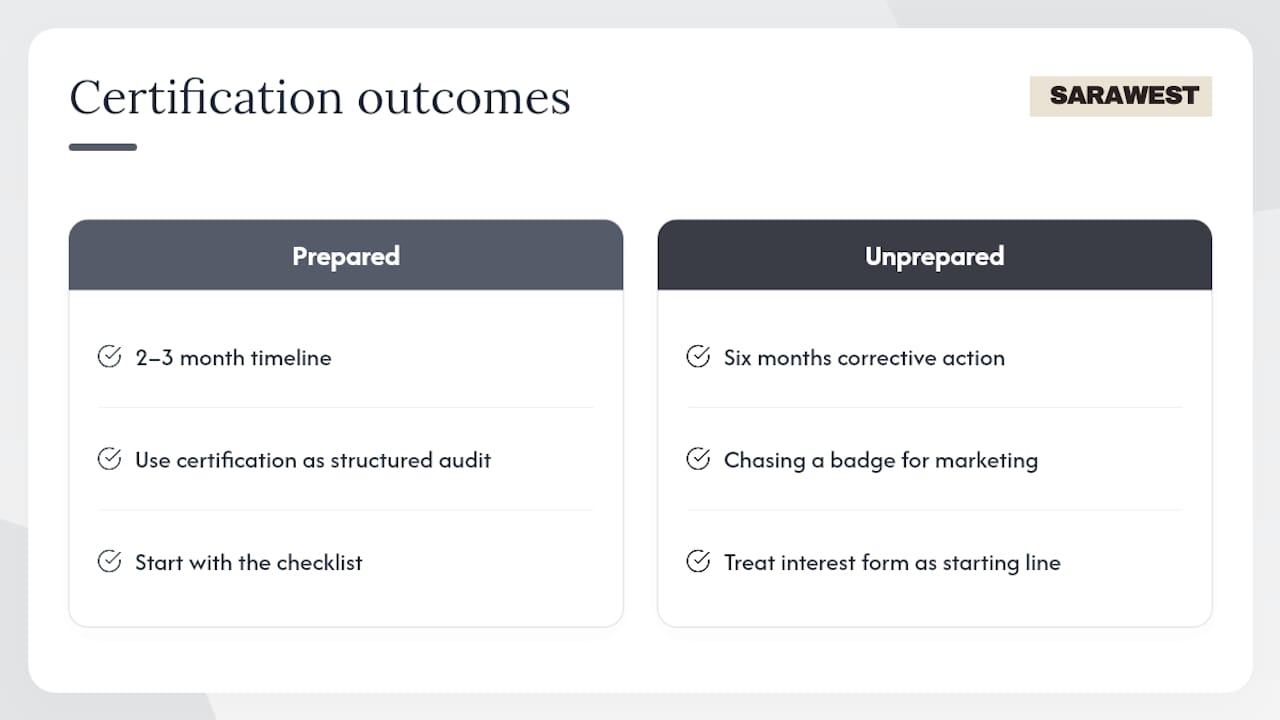
That framing shifts how you should think about certification. The organizations that get the most out of GS-42 are not the ones chasing a badge for marketing purposes. They are the ones that use the certification process as a structured audit of their own operations, find the gaps, fix them, and come out with a program that is genuinely better. The procurement wins follow from that, not the other way around.
One more thing worth saying plainly: the 2–3 month timeline is real, but it assumes you have done the work before you apply. The organizations that treat the interest form as the starting line, rather than the documentation assembly, are the ones that spend six months in corrective action. Start with the checklist. Then submit.
Sources
When writing procurement language or verifying vendor claims, go directly to the primary sources: