
The right filling method comes down to how your product actually behaves, not what a catalog page recommends. Viscosity, particulates, foaming tendency, and shear sensitivity dictate which technology will hold a repeatable fill, and throughput and accuracy targets narrow it further. The main families are gravity/overflow, piston (volumetric), pump-driven (gear, peristaltic, progressive cavity), isobaric/counter-pressure, vacuum, and net-weight systems.
TL;DR:
- Piston or net-weight filling systems are recommended for products with viscosities over 200 centipoise to ensure accurate and consistent fills.
- Pump-driven fillers, like progressive cavity or peristaltic pumps, handle particulates better and are suitable for higher-viscosity or shear-sensitive formulas.
- Automation features such as servo-driven pistons, PLC recipe storage, and remote diagnostics improve fill accuracy, reduce changeover times, and minimize downtime.
- Proper container selection and compatibility testing with formulation chemistry prevent long-term issues like leakage, brittleness, or discoloration.
- Running actual product at production conditions before purchase and utilizing pilot batches helps validate equipment fit without significant capital investment.
Table of Contents
- Understanding the Liquid Filling Process: Method by Method
- Matching Filler Technology to Viscosity, Foam, and Shear
- Machinery Components That Determine Uptime and Accuracy
- How to Size and Automate a Filling Line
- Commissioning, Calibration, and Keeping the Line Running
- Testing Before You Commit Capital
- What a Filling Line Actually Costs and Takes to Install
- Safety and Regulatory Compliance in Liquid Filling
- Material Compatibility and Container Considerations
- Quality Control and the Defects That Actually Show Up
- Environmental Impact and Waste Minimization
- Where Liquid Filling Technology Is Headed
- A Practical Starting Point
- Pilot Production Without the Equipment Investment
- Sources
- FAQ
Understanding the Liquid Filling Process: Method by Method
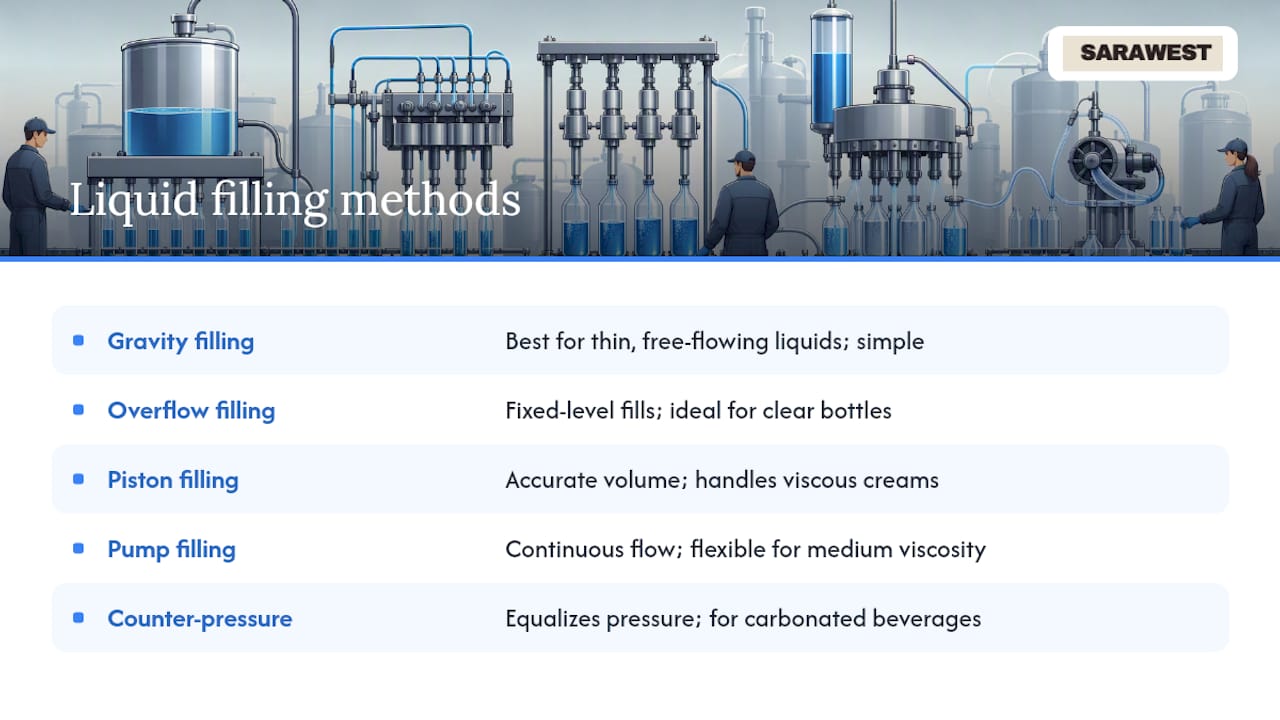
Every liquid filling process traces back to one of a handful of core mechanisms, and each one earns its place for a specific reason. Get the match wrong and you'll fight stringing, underfills, or foam for the life of the line.
Gravity and atmospheric filling rely on the product's own weight to move it into the container. This works well for thin, free-flowing liquids like water, light oils, or diluted cleaners, where cost and simplicity matter more than precision. Overflow filling is a close cousin: it fills to a fixed level rather than a fixed volume, which is why beverage bottlers and anyone packaging into clear containers lean on it. Consumers notice inconsistent fill lines on a clear bottle far more than a half-gram variance they can't see, and overflow fillers solve exactly that problem by design, as Fillers in its rundown of food and beverage filling lines.
Volumetric, or piston, filling is positive displacement at its most direct. A piston draws a fixed volume of product and pushes it out, which makes it the workhorse for viscous liquids, creams, and anything where accurate volume matters more than speed. Piston fillers handle everything from thin sanitizers to thick gel formulations with the same basic mechanism, just different cylinder sizing and nozzle geometry.
Pump-based fillers trade some of that precision for flexibility. Gear pumps, lobe pumps, and peristaltic pumps move product continuously rather than in discrete strokes, which suits multi-product lines running medium-viscosity formulas. Peristaltic pumps in particular shine when the product can't touch metal or needs a fully sealed, sanitary path.
Isobaric (counter-pressure) filling equalizes pressure between the container and the source tank before the fill starts, which is essential for carbonated beverages or oxygen-sensitive liquids that would foam or oxidize under standard atmospheric filling.
Vacuum-assisted filling pulls product in using negative pressure, useful for thin liquids in narrow-neck containers where gravity alone fills too slowly. Common filler types across these families include gravity, overflow, piston, pump-driven, vacuum, and counter-pressure systems, according to the packaging overview on Wikipedia).
Matching Filler Technology to Viscosity, Foam, and Shear
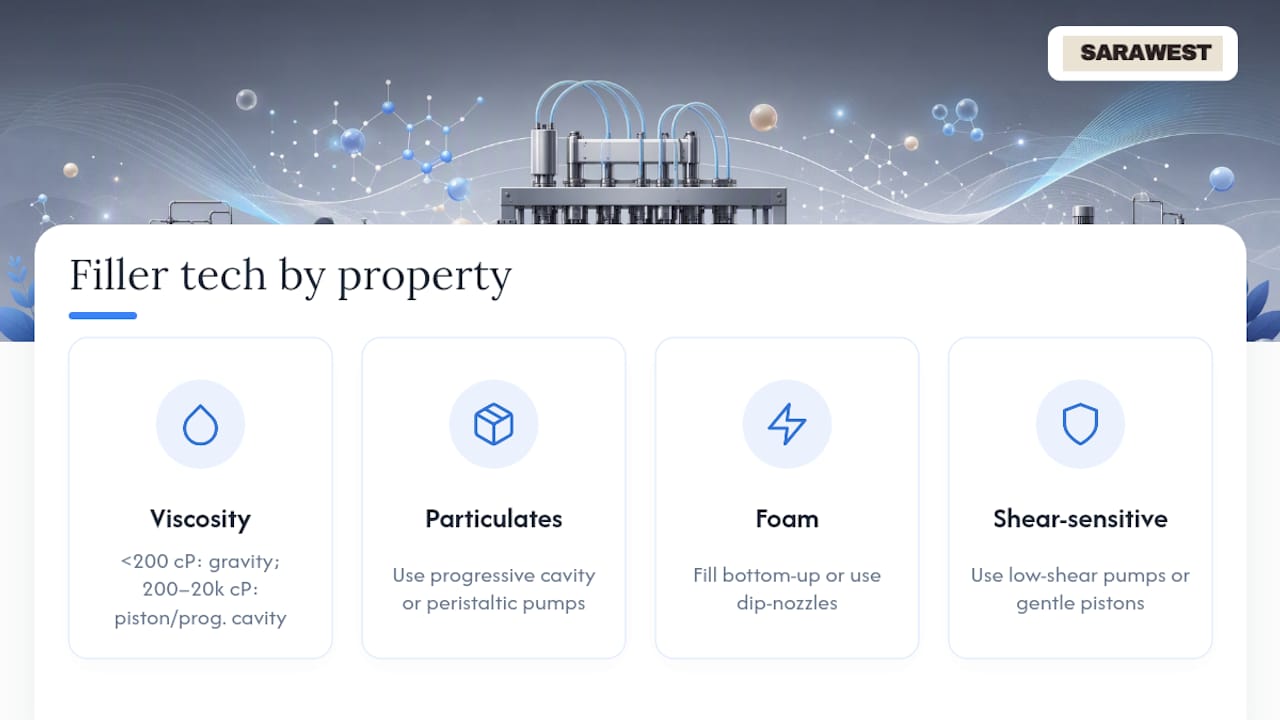
Viscosity is the single biggest variable in filler selection. Thin liquids move happily through gravity or overflow systems, while anything thicker than a light lotion usually needs positive displacement, according to InLine Packaging Systems. As a practical guide, formulas under roughly 200 centipoise (think water, light cleaners) run fine on gravity or vacuum systems. Products in the 200 to 20,000 centipoise range, which covers most creams, lotions, and thick liquid soaps, generally call for piston or progressive cavity pumps. For pastes and gels, heated piston systems or jacketed lines may be required to keep viscosity stable enough to meter.
Particulates change the equation further. Nozzles and valves with tight tolerances clog fast when a formula carries suspended solids, so pump styles with larger clearances, like progressive cavity or peristaltic, tend to tolerate particulates better than tight-fitting piston seals.
Foam-prone formulations, especially surfactant-heavy cleaners, benefit from bottom-up or dip-nozzle filling, which fills from beneath the liquid surface rather than dropping product from above and whipping in air.
Shear-sensitive products, like enzyme blends or anything with a delicate emulsion, do better on low-shear pump types or gently actuated pistons rather than high-speed gear pumps that can break the formula apart.
Pro Tip: Don't rely on a static lab viscosity reading alone. Measure how your product behaves at actual filling temperature and line speed, since shear and heat can change viscosity dramatically once the product is moving.
Temperature control often solves problems that look like formulation issues. A heated hopper or jacketed line can bring a stubborn viscosity down to a fillable range without touching the recipe at all.
Machinery Components That Determine Uptime and Accuracy
The pump or drive mechanism sets the ceiling on what a filler can do. Piston pumps deliver the tightest accuracy and handle viscosity well but need more cleanup between product changes. Gear pumps run fast and consistent on thinner liquids but chew up shear-sensitive formulas. Progressive cavity pumps handle particulates and higher viscosities gracefully, and peristaltic pumps offer the gentlest, most sanitary path since the product never touches the pump housing itself, only the tubing.
Valve and nozzle design decides whether your line strings, drips, or fills clean. Anti-drip valves and suck-back mechanisms pull the last bit of product back into the nozzle after each cycle, which is often the difference between a clean cutoff and a trail of product down the bottle neck. Tapered orifices reduce stringing on viscous or sticky liquids, and dip nozzles that reach below the liquid surface cut down on splashing and foam.
Controls are where modern lines earn their keep, especially when paired with effiziente Tanktransporte und Schwertransporte für Gastanks und Behälter to optimize logistics in handling bulk liquid containers. Look for:
- Servo-driven pistons for repeatable, adjustable fill volumes without mechanical cam changes
- PLC-based recipe storage so operators can switch SKUs by pulling a saved program instead of manually resetting fill parameters
- Alarm and fault logging to catch shortfalls or jams before they become a batch of rejects
- Remote diagnostics for faster troubleshooting on multi-line facilities
Sanitary design matters just as much as speed. Quick-release fittings, CIP (clean-in-place) compatibility, food-grade gaskets, and stainless contact surfaces keep changeover and cleaning fast, which matters more than most buyers expect until they're doing it three times a day. Load-cell fill heads, inline flow meters, and checkweighers verify that every container actually got what the recipe called for, catching drift before it becomes a recall.
How to Size and Automate a Filling Line
Throughput and accuracy pull against each other, and the honest starting point is deciding which one your product can't compromise on. A semi-automatic benchtop filler might handle a few hundred units an hour with excellent accuracy for a low-volume specialty product. A servo piston line can push several thousand units an hour while holding tight tolerances. Multi-head rotary systems scale into the tens of thousands per hour but demand more consistent upstream product supply and more disciplined maintenance to keep every head calibrated together.
A workable sizing framework looks like this:
- Define your accuracy tolerance first. Legal metrology, high-value products, or export requirements often force net-weight or piston systems regardless of speed goals.
- Estimate SKU turnover. If you're changing formulas or container sizes multiple times a day, prioritize modular fill heads, quick-change nozzles, and servo recipe storage over raw speed.
- Match container handling to line topology. Inline systems are simpler and cheaper for lower speeds; rotary systems fit high-speed runs but need a bigger footprint and more upfront engineering.
- Confirm utilities before you commit. Compressed air, three-phase power, and floor drainage for CIP systems are easy to overlook until installation day, and they can delay a launch by weeks.
Net-weight filling deserves a specific mention here. When product density or entrained air makes volumetric fills unreliable, weighing each container as it fills eliminates that variability entirely, according to DNC Automation. It runs slower than volumetric methods, but for high-value formulas or anything under strict net-weight regulation, the trade-off is worth it.
Commissioning, Calibration, and Keeping the Line Running
Before a single production run starts, run the actual product, not water, through the line. Prime the pump or piston fully, deaerate the product if it's prone to entrained air, and confirm nozzle selection matches the container neck and fill height.
Calibration means verifying with a checkweigher against a real sample set, not just trusting the machine's programmed volume. Set your acceptance range before the run, not after you see the first numbers.
Common problems and fast fixes:
- Stringing or dripping: check anti-drip valve timing and nozzle taper before assuming it's a viscosity problem.
- Short fills: look for air trapped in the product or a priming issue upstream of the fill head.
- Foaming: switch to a bottom-up or dip-nozzle fill pattern instead of top-fill.
- Conveyor misfeeds: verify container spacing and sensor alignment, especially after a changeover.
Seals and pump components on viscous-product lines wear faster than on thin-liquid lines, so build shorter inspection intervals into your maintenance schedule for anything running thick or particulate-heavy formulas, a point Fillingmachinepp emphasizes for viscous setups specifically.
Testing Before You Commit Capital
Run your actual product at production temperature and agitation before choosing equipment. Entrained air and density shifts hide in lab samples and surface only at line speed. A pilot batch, even a small one, tells you more than a spec sheet ever will, and a contract manufacturer with in-house R&D and pilot production from 1,000 units can validate that fit without a capital purchase.
What a Filling Line Actually Costs and Takes to Install
Semi-automatic benchtop fillers typically start in the low five figures. Servo piston systems and small rotary lines climb into the mid five to low six figures, and multi-head rotary lines built for high volume run higher still. Custom manifolds, sanitary upgrades, and factory/site acceptance testing (FAT/SAT) extend lead times well beyond the base machine build. Budget for installation, validation runs, and spare-parts stocking on top of the sticker price. None of these figures replace a formal quote, but they set realistic expectations before you request one.
Safety and Regulatory Compliance in Liquid Filling
Chemical-resistant seals, proper grounding for flammable or static-sensitive liquids, and pressure relief on any pressurized fill system aren't optional extras. Isobaric and vacuum systems both introduce pressure differentials that need engineered safeguards, not just operator caution.
Regulatory weight varies by product category, but a few realities apply broadly. Net-weight accuracy requirements under legal metrology rules affect any product sold by weight rather than volume, which is common in cleaning and personal care categories. Cosmetic, sanitation, and food-contact liquids typically require documented cleaning validation between product changeovers to prevent cross-contamination, particularly on shared lines running multiple SKUs. Material safety data for the formulation should travel with the line's standard operating procedures, not sit in a separate binder nobody checks during a shift change.
Operator training matters just as much as machine design. A well-guarded fill head still needs an operator who understands lockout/tagout procedures, chemical handling protocols for the specific product on the line, and what a fault alarm actually means before they override it. Facilities running solvent-based or flammable formulations need ventilation and static-control measures built into the line layout, not added afterward. None of this is glamorous, but it's the difference between a line that runs for a decade and one that generates an incident report in its first year.
Material Compatibility and Container Considerations
The container and the formula have to agree chemically, or you'll find out the hard way, usually months after the product ships. Aggressive solvents, high-pH cleaners, and citrus-based formulas can degrade certain plastics over time, leading to brittleness, discoloration, or leaching that shows up long after the fill line has moved on to the next batch.
Match container material to formula chemistry before locking in packaging. HDPE and PET handle a wide range of household and personal care formulas well, but strong solvents or high-alcohol content sometimes call for glass or specially lined containers instead. Cap and gasket materials need the same scrutiny; a gasket that softens or swells against your specific formula will leak eventually, even if it passes an initial seal test.
Container geometry affects filling accuracy as much as material choice. Narrow necks slow gravity fills and increase splash risk, wide-mouth jars need different nozzle positioning to avoid overspray, and irregular shapes complicate conveyor handling and sensor alignment. Testing packaging compatibility before a full production commitment, rather than after the first customer complaint, is a habit worth building into every new product launch.
Quality Control and the Defects That Actually Show Up
Underfills and overfills are the most obvious defects, but they're rarely the only ones worth watching. Foam trapped in a viscous fill can register as a correct volume on a checkweigher while shorting the customer on actual product once the foam settles. Air pockets in gel or paste formulas create the same illusion of a full fill that isn't.
Stringing and dripping create cosmetic defects that don't affect volume but still trigger customer complaints and returns. Cap seating problems, whether from a misaligned capper or a container defect, cause leaks that surface days or weeks after the product leaves the facility, long after any in-line inspection could catch them.
A layered inspection approach catches more than any single check. Checkweighers verify mass on every unit or a statistical sample, vision systems catch fill-level and cap-seating problems, and periodic manual sampling catches the subtle defects automated systems miss, like off-color product or inconsistent viscosity between batches. Running that inspection cadence consistently, not just during startup, is what actually keeps defect rates low over a full production year.
Environmental Impact and Waste Minimization
Product loss during filling adds up fast across a full production run, and most of it is preventable. Anti-drip valves and precise cutoff timing reduce the product wasted in stringing and drips, which cuts both material cost and the cleanup burden that follows.
CIP systems reduce water and chemical use compared to manual line breakdown and cleaning, provided they're sized correctly for the line rather than oversized out of caution. Overfilling to "play it safe" on a checkweigher tolerance wastes product across an entire run; tighter, well-calibrated accuracy bands solve that without sacrificing compliance.
Packaging choices matter here too. Right-sizing containers to the actual fill volume, rather than defaulting to a larger container with headspace to spare, reduces both material use and shipping weight. None of this requires exotic technology, just disciplined calibration and container selection from the start.
Where Liquid Filling Technology Is Headed
Servo-driven piston systems have become the default recommendation for manufacturers juggling multiple SKUs and tight accuracy targets, since a servo-driven piston filler tends to offer the best long-term flexibility when both SKU variety and precision matter, according to fillingmachinepp.com. That flexibility is pushing older cam-driven piston systems toward retirement on lines that run frequent changeovers.
Inline sensor integration is the other real shift. Flow meters and load cells that feed data directly into a PLC let a line self-correct fill volume in real time rather than relying on end-of-batch sampling to catch drift. Combined with remote diagnostics, this means fewer unplanned stops and faster root-cause troubleshooting when something does go wrong.
Modular tooling, quick-change nozzle sets, and recipe-based automation are shrinking changeover time from hours to minutes on well-designed lines. For manufacturers running short runs across many SKUs, that changeover speed matters more than raw fill speed, since it determines how many different products a single line can realistically support in a week.
A Practical Starting Point
Test the real product before buying equipment. Run a small pilot to confirm the fit, and if timelines or sanitary demands outpace what you can build in-house, outsourcing that first run is often the faster path.
— Faisal Mansur
Pilot Production Without the Equipment Investment
If a full filling line isn't the right move yet, or you need production running before capital equipment can even be quoted and installed, Sarawest USA runs pilot batches from 1,000 units without asking you to own a piston, pump, or piece of controls hardware first. That's the real contrast with buying your own line: no capital outlay, no commissioning timeline, and no waiting on custom manifolds or FAT/SAT testing before your product ships.
In-house R&D chemists can adapt existing formulas or build new formulations tailored to your viscosity and container requirements, then scale that formula into full production once the pilot proves out. Review our formulation track record for examples of past pilot-to-scale work, or start a project directly through our contract manufacturing page to get a fast RFQ moving.
Sources
- Understanding Viscosity: How It Impacts Filler Selection | InLine Packaging Systems, Inc.
- Viscous Liquid Filling Machine: Best Practices & Setup
FAQ
How much does a liquid filling machine cost?
Semi-automatic benchtop fillers typically cost less, while servo piston and small rotary lines are more expensive depending on customization and sanitary requirements.
How does a liquid filling machine work?
Most machines use gravity, positive displacement (piston or pump), or pressure differentials (vacuum or isobaric) to move a set volume or weight of product into each container, guided by PLC or servo controls for repeatability.
What are the different types of liquid filling machines?
The main types are gravity/atmospheric, overflow, piston (volumetric), pump-driven (gear, peristaltic, progressive cavity), vacuum, isobaric/counter-pressure, and net-weight systems.
How accurate are filling machines?
Accuracy varies by family: piston and net-weight systems can reach under 0.5% to 0.2% variance under controlled conditions, while high-speed pump systems trade some of that tightness for higher throughput, according to DNC Automation.