
Packaging compatibility testing confirms whether a specific final product formula and its proposed packaging can remain safe, stable, and functional for the intended shelf life. It is not a screening exercise. It is a systematic program run on the final filled primary package, with documented acceptance criteria, appropriate controls, and analytical methods matched to the actual risk. Three situations make it non-negotiable: launching a new product or reformulation, changing a packaging material or supplier, and filing with a regulator or classifying a product as dangerous goods (aerosols included).
At minimum, a program must include:
- Filled final-pack samples tested under representative and stressed conditions
- Inert control samples (typically glass) filled with the same formula
- Documented acceptance criteria set before testing begins, covering appearance, function, and analytical thresholds
Key Takeaways
Packaging compatibility testing is not optional for any product where safety, shelf life, or regulatory filing is at stake — the right program design, analytical methods, and integrated partner determine whether you catch failures before launch or after.
| Point | Details |
|---|---|
| Test the full assembly | Include caps, liners, pumps, labels, and adhesives — not just the primary container. |
| Set acceptance criteria first | Define pass/fail thresholds before filling samples, not after reviewing results. |
| Run accelerated and real-time in parallel | Starting both simultaneously prevents months of delay if accelerated data is acceptable. |
| Use supplier charts for screening only | Cole-Parmer and similar charts are 48-hour guides, not finished-package validation. |
| Sarawest USA shortens the fix cycle | In-house R&D, pilot filling, and scale production under one roof compress fail-to-fix timelines. |
Table of Contents
- What packaging compatibility testing actually involves
- Why compatibility failures cost more than the testing does
- Common packaging failure modes and what causes them
- Core test types and analytical methods
- Standards and regulatory guidance for study design
- How to plan a packaging compatibility program
- How to interpret results and act when a package fails
- Situations that should always trigger a compatibility study
- How to choose a testing lab or development partner
- What working chemists know that protocols often miss
- Sarawest USA supports your compatibility program from pilot fill to scale
- Sources
What packaging compatibility testing actually involves
The phrase "compatibility testing" covers a range of activities, from a 48-hour visual soak to a multi-year ICH-aligned stability program. What separates a defensible program from a checkbox exercise is the combination of test design, analytical depth, and documentation. A filled aerosol sitting at 54°C for three months tells you something. A filled aerosol sitting at 54°C for three months with ICP-MS analysis of the product, a glass control, and a documented specification for iron and tin tells you something you can act on.
The core question is bidirectional: does the packaging change the product, and does the product change the packaging? Both directions matter. A surfactant-heavy cleaner can swell a polypropylene pump. A metal aerosol can detinning under acidic conditions, releasing tin into the formula and clogging the valve. Neither failure is obvious from a supplier data sheet.
Why compatibility failures cost more than the testing does
Safety is the first stake. Toxic leachables, catalyst-mediated degradation, and contamination from packaging materials can reach the end user. Functional failures, including leakage, loss of dispensing performance, and seal failure, follow closely. Both categories create product recalls, regulatory rejection, and consumer complaints that dwarf the cost of a proper compatibility program.
The data on failure rates is sobering. A published study in the Journal of Intelligent Manufacturing reported that roughly 40% of compatibility tests in historical development datasets returned negative results, meaning the formula and packaging combination failed and required follow-up. That is not a rare edge case. It is the baseline expectation in active development programs.
Statistic: In one published dataset of new product development compatibility tests, more than 40% of results were negative, requiring reformulation or packaging changes before launch.
Commercial consequences extend beyond recalls. A failed compatibility test late in development can delay a launch by months, force a packaging redesign, or trigger additional regulatory studies. Running the test early, with the right scope, is cheaper than running it twice.
Pro Tip: Use supplier chemical-compatibility charts, including the Cole-Parmer chemical compatibility database, for initial screening only. These charts are typically based on pure chemicals and short exposure periods, often 48 hours, and explicitly disclaim suitability for long-term finished-package performance. Always validate with filled final-pack studies.
Common packaging failure modes and what causes them
Recognizing failure patterns before you design a test is how you write acceptance criteria that actually catch the right problems.
-
Migration and leachables. Plasticizers, monomers, antioxidants, and processing aids migrate from polymer packaging into the product. Root causes include elevated temperature, polar solvents, and long contact time. Detected by GC-MS, LC-MS, or ICP-MS depending on analyte class.
-
Corrosion and detinning. Acidic or oxidizing formulas attack tin-plate aerosol cans, releasing metal ions into the product and corroding valve components. A low-pH cleaner in an unlined steel can is a classic example: the valve clogs, pressure builds unevenly, and the product discolors. Detected by ICP-MS for metal ions and visual inspection of valve components.
-
Coating blistering and delamination. Internal coatings on metal cans or lacquered closures blister when solvents or surfactants penetrate the coating film. Root causes include high solvent content, elevated temperature, and incompatible coating chemistry. Detected by visual inspection and FTIR of coating cross-sections.
-
Swelling and softening of polymers. ISO 17508 identifies swelling, softening, and stress cracking as primary failure mechanisms for PE and fluorinated PE packaging in contact with chemical products. Solvents and aromatic compounds are the main drivers. Detected by dimensional measurement, Shore hardness, and weight gain.
-
Loss of barrier (permeation). Moisture or oxygen ingress through thin-wall containers or inadequate closures degrades moisture-sensitive formulas. Detected by Karl Fischer titration for water content and headspace analysis for volatiles.
-
Label and adhesive failure. Solvent-based or high-water-activity formulas attack pressure-sensitive adhesives, causing label lifting, ink bleed, or adhesive migration into the product. Detected by visual inspection under stressed storage conditions and adhesive peel testing.
-
Mechanical failures. Seal integrity loss, closure torque drift, pump failure, and actuator clogging are functional failures that often have chemical root causes. A pump that delivers correctly at fill but fails after six months at 40°C has a compatibility problem, not a manufacturing defect. Detected by functional dispensing tests and torque measurement at each stability pull.
Core test types and analytical methods
The table below maps test type to what it evaluates, the instrumentation typically used, and the standards most commonly referenced.
| Test type | What it evaluates | Typical instrumentation / outputs | Standards referenced |
|---|---|---|---|
| Stress / forced degradation | Rapid identification of failure modes under extreme conditions (heat, humidity, light, oxidation) | Visual, functional, pH, FTIR, ICP-MS | ICH Q1A(R2), ICH Q1B |
| Accelerated stability | Compatibility and shelf-life prediction at elevated temperature/humidity | FTIR, ICP-MS, Karl Fischer, GC-MS, HPLC, headspace-GC | ICH Q1A(R2), ASTM/ISTA |
| Long-term real-time stability | Regulatory confirmation of shelf life in final packaging | Full analytical panel, microbial where relevant | ICH Q1A(R2), ISO/IEC 17025 |
| Migration / extractables / leachables | Quantification of compounds migrating from packaging into product | ICP-MS (metals), GC-MS / LC-MS (organics), HPLC (semi-volatiles) | ICH Q3C/Q3D |
| Mechanical / functional | Seal integrity, closure torque, dispensing performance, drop resistance | Torque meter, seal tester, dispensing volume, drop rig | ASTM D4169, ISTA 2A |
| Photostability | Light-induced degradation in final packaging | UV-Vis, HPLC, visual | ICH Q1B |
| Polymer compatibility | Swelling, softening, stress cracking of PE and co-extruded plastics | Dimensional, Shore hardness, weight gain, FTIR | ISO 17508 |
Analytical techniques in detail
ICP-MS (inductively coupled plasma mass spectrometry) is the method of choice for metal migration, particularly tin, iron, chromium, and aluminum from metal packaging. Detection limits in the low parts-per-trillion range make it sensitive enough to catch early-stage corrosion before it becomes a sensory or safety problem.
FTIR (Fourier-transform infrared spectroscopy) identifies polymer types, detects coating degradation, and confirms whether a packaging component has changed chemically after contact. It is also used to verify that a replacement supplier's material matches the original specification.
Karl Fischer titration measures water content in the product and, by extension, detects moisture ingress through the packaging barrier. It is the standard method for moisture-sensitive formulas where water activity drives degradation.
GC-MS and LC-MS cover volatile and semi-volatile leachables, respectively. Headspace-GC is the preferred technique for volatile organic compounds in aerosols and pump-spray products. For a non-targeted extractables screen, high-resolution LC-MS provides the broadest coverage.
HPLC tracks active ingredient assay and degradation product formation over time, connecting packaging-induced changes to product potency or safety.
For extractables studies, samples are prepared under aggressive solvent and temperature conditions to force migration. Leachables studies use the actual product under accelerated or real-time conditions. When the extractables screen identifies a compound of concern, targeted leachables analysis confirms whether it appears in the product at a toxicologically relevant level. A qualified safety assessor should review any leachable above the analytical evaluation threshold.
Accelerated aging methods can support early compatibility conclusions, but they do not replace real-time data for regulatory submissions.
Standards and regulatory guidance for study design
Knowing which documents govern your program is not a compliance formality. Each standard shapes what you test, how you test it, and what your data must show.
-
ICH Q1A(R2): The primary regulatory anchor for pharmaceutical and regulated consumer products. It requires stability studies in the container closure system proposed for marketing, stress testing (temperature, humidity, oxidation, photolysis), and data from at least three primary batches for formal submissions. Storage statements and retest periods derive from this data.
-
ICH Q1B: Governs photostability testing. Requires exposure to both UV and visible light in the final packaging and a confirmatory study if the product is light-sensitive.
-
ISO 17508:2025: Specifies chemical compatibility test methods for PE, fluorinated PE, and co-extruded plastic packaging, particularly for transport packaging containing dangerous goods. Identifies swelling, softening, and stress cracking as the key failure mechanisms and defines type tests for proof of compatibility.
-
ISO/IEC 17025: The accreditation standard for testing and calibration laboratories. A lab operating under ISO/IEC 17025 has demonstrated method validation, measurement traceability, and quality management. For regulatory submissions and litigation defense, accredited data is significantly stronger than non-accredited data.
-
ASTM D4169 / ISTA 2A: Mechanical and distribution simulation standards. ASTM D4169 covers vibration, drop, compression, and climate cycling. ISTA 2A is the common baseline for parcel shipment simulation. Both are relevant when mechanical failure modes are in scope.
-
FDA guidance on container closure systems: For drug products, FDA's 1999 guidance on container closure systems for packaging human drugs and biologics defines the scope of extractables and leachables studies and the documentation expected in Module 3 of a regulatory submission.
For HDPE and PET bottle selection, ISO 17508 and the relevant ASTM methods should both be consulted when the product is a chemical or dangerous good.
How to plan a packaging compatibility program
A well-designed program answers a specific question: will this formula, in this package, remain acceptable for this shelf life under these storage and distribution conditions? Every design decision flows from that question.
Study design checklist
- Define the study objective and the specific failure modes you are testing against
- Identify the risk level: high-risk formulas (acidic, alkaline, oxidizing, solvent-heavy, or aerosol) warrant a broader analytical scope than low-risk aqueous products
- Select final-filled production-representative samples, not lab-prepared mock-ups
- Include inert controls (glass) filled with the same formula and stored identically
- Apply matrixing or bracketing where multiple container sizes or closure types share the same formula, to reduce sample burden without losing coverage
- For regulatory submissions, plan for data from at least three primary batches per ICH Q1A(R2)
- Document lot numbers, fill dates, headspace conditions, and storage orientation for every sample set
Timeline: accelerated vs. real-time
Accelerated studies (typically 40°C/75% RH for 6 months) can support early go/no-go decisions and, in some regulatory contexts, provisional shelf-life claims. Real-time studies at the intended storage condition remain the gold standard for label claims and regulatory filings. Run both in parallel from the start. Waiting for accelerated results before starting real-time adds months to your timeline if the accelerated data is acceptable.
For distribution simulation, freeze-thaw cycling and humidity cycling should be included where the product will experience temperature extremes in transit.
- Perform a risk assessment and define acceptance criteria before filling samples.
- Fill samples in the final commercial package, including all secondary components (caps, liners, pumps, labels).
- Place samples at all required conditions simultaneously (real-time, accelerated, stressed).
- Pull samples at defined intervals (e.g., 0, 1, 3, 6, 9, 12 months for accelerated; longer for real-time).
- Analyze against pre-defined acceptance criteria and document every result, including passing results.
- Archive raw data, instrument logs, and chain-of-custody records for regulatory use.
For regulatory filings, Module 3 (CTD format) or the equivalent technical file requires the study protocol, raw data, analytical methods with validation summaries, and a signed summary of results. Certificate of analysis documentation practices apply to every analytical pull.
Pro Tip: When budget or timeline is constrained, prioritize extractables and leachables testing for high-risk combinations (metal packaging, aerosols, acidic or alkaline formulas) and defer mechanical testing to a second phase for low-risk combinations. A mechanistic permeation model can help narrow packaging candidates before committing to full empirical studies, particularly for moisture-sensitive products.
How to interpret results and act when a package fails
A lab report is not a pass/fail verdict until you compare it against pre-defined acceptance criteria. Detection of a leachable compound is not automatically a failure. What matters is the concentration relative to the toxicological threshold, the trend over time, and whether the control shows the same finding.
- Read against controls first. If the glass control shows the same compound at the same level, the source is the formula, not the packaging. If only the test package shows it, the packaging is the source.
- Assess trends, not single points. A leachable that appears at 0.1 ppm at month 1 and 0.8 ppm at month 6 is a different risk profile than one that plateaus at 0.1 ppm. Trend data drives the toxicological evaluation.
- Apply detection limit context. A result "below the limit of detection" is not zero. It means the method cannot confirm presence below that threshold. For safety-critical analytes, confirm the method's detection limit is below the toxicological threshold of concern.
When a package fails, the corrective action path follows this sequence:
- Confirm root cause (analytical, not assumed).
- Implement short-term containment: quarantine affected lots, tighten incoming QC on the supplier component.
- Select a corrective action: reformulate to remove the incompatible ingredient, upgrade the barrier (fluorination, inner coating, liner), change the closure or pump material, or switch to a different packaging substrate.
- Validate the fix with a targeted retest, not a full repeat of the original program unless the change is substantial.
The cost/benefit calculation between reformulation and packaging upgrade depends on the root cause. If the incompatibility is driven by a single formula ingredient that can be replaced without affecting performance, reformulation is usually faster. If the formula is locked, a barrier upgrade or coating change is the path. Involve toxicology or regulatory counsel early when leachables are above the analytical evaluation threshold.
Pro Tip: Preservative efficacy can be affected by packaging-induced changes to pH or preservative concentration. If your corrective action involves reformulation, rerun the preservative efficacy test on the revised formula before closing out the compatibility study.
Situations that should always trigger a compatibility study
Change control is where compatibility testing lives or dies. These triggers should be embedded in your change control procedure so no one has to make a judgment call in the moment.
- New product launch. No prior compatibility data exists. Full program required.
- Formulation change. Any change to an active, preservative, solvent, pH adjuster, or fragrance can alter the interaction profile with existing packaging.
- New packaging material or supplier. Even a nominally identical resin from a new supplier can have different additive packages, processing aids, or impurity profiles.
- New coating, ink, or adhesive. Secondary components are often overlooked. A new label adhesive or can coating is a new contact material.
- Manufacturing process change. A change in fill temperature, fill speed, or headspace gas can alter the chemical environment inside the package.
- Change in fill volume or container orientation. Different fill levels change the headspace-to-product ratio and the surface area of contact. Orientation affects which surfaces are in continuous contact.
- Classification as dangerous goods or aerosol. Regulatory requirements for transport packaging of dangerous goods, including aerosols, require documented compatibility data. ISO 17508 applies directly to PE packaging in this category.
For triggers 2 through 4, a targeted screening study is often sufficient before committing to a full stability program. For triggers 1 and 7, a full program is the baseline expectation.
How to choose a testing lab or development partner
The lab you choose shapes the quality of your data, the speed of your corrective action cycles, and the defensibility of your regulatory filing. These are the criteria that matter.
- ISO/IEC 17025 accreditation for the specific methods you need (ICP-MS, FTIR, Karl Fischer, GC-MS). Accreditation scoped to general chemistry is not the same as accreditation for extractables and leachables.
- Demonstrated method validation for your analyte classes and matrices. Ask for the method validation summary, not just the accreditation certificate.
- Chain-of-custody documentation from sample receipt through data reporting. This is non-negotiable for regulatory submissions.
- Experience with your product category. A lab experienced with aerosol compatibility studies understands valve component testing, propellant interactions, and the relevant pressure-test protocols. A lab that primarily handles food packaging may not.
- Transparent reporting with raw data access. You should receive instrument raw files, not just a summary table. If a result is challenged, you need the underlying data.
- Project management with clear retest timelines. When a package fails, the clock starts on your corrective action. A lab that can commit to a retest turnaround time is worth more than one that cannot.
The strongest argument for an integrated development partner rather than a standalone testing lab is the fail-to-fix cycle. When the lab that identifies the failure is separate from the team that reformulates or sources the replacement packaging, every iteration adds weeks. An in-house R&D team that can reformulate, pilot-fill, and submit for retest within days rather than weeks compresses a 6-month corrective action into 6 weeks.
Pro Tip: Ask any prospective lab for a sample report from a comparable study. The format, the level of raw data included, and the quality of the analytical narrative tell you more about their capabilities than a capabilities brochure. Also check whether their formulation track record includes products in your category.
Microbial challenge testing is a related capability worth confirming if your product's preservative system could be affected by packaging-induced pH or concentration changes.
What working chemists know that protocols often miss
The most common reason a product passes a compatibility study and then fails in the field is that the study tested the container but not the full assembly. Labels, cap liners, pump seals, dip tubes, and actuator gaskets are all contact materials. Each one can outgas, leach, or swell. Testing only the bottle while ignoring the closure system is like testing a car's engine while leaving the fuel line unexamined.
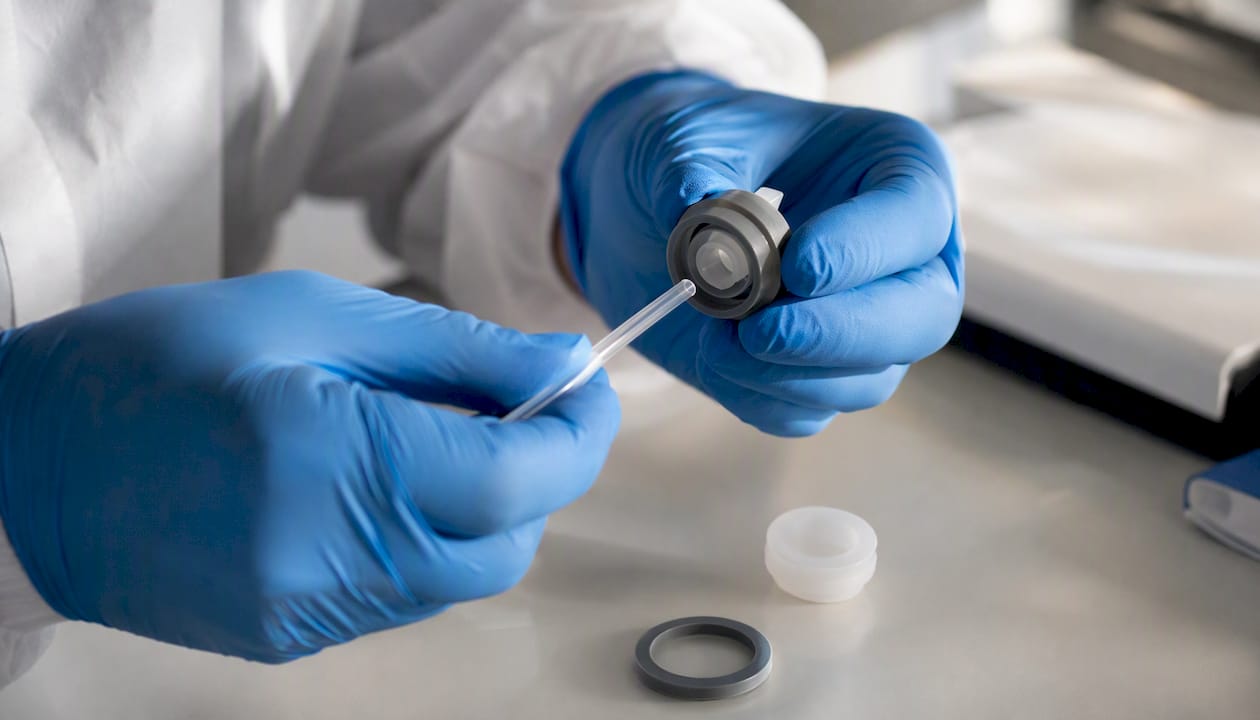
Orientation matters more than most protocols acknowledge. A product stored upright for six months at 40°C has a different contact profile than one stored on its side during distribution. If the formula contacts the closure liner only during shipping, that is the condition you need to test, not just the upright storage condition.
Distribution simulation is another blind spot. Temperature stress alone does not replicate what happens to a package in a truck crossing the Mojave in July. Vibration, drop, and compression cycling per ASTM D4169 or ISTA 2A should be part of any program where the product will move through a commercial supply chain. Passing a chemistry-only test and then discovering a seal failure after a drop event is an avoidable outcome.
The practical fix is to test the full commercial assembly, including every secondary component, under conditions that include both chemical stress and physical stress. For candidate reduction before committing to a full empirical program, machine-learning classifiers trained on historical compatibility data have reached up to 90% accuracy for binary pass/fail prediction, which can meaningfully reduce the number of physical tests needed in early development. Pair that with a mechanistic permeation model for moisture-sensitive products, and you can enter empirical testing with a much shorter candidate list.
Sarawest USA supports your compatibility program from pilot fill to scale
Compatibility testing is only as useful as the speed at which you can act on the results. Sarawest USA's in-house R&D chemists can reformulate, adjust, and pilot-fill within the same facility, cutting the fail-to-fix cycle from months to weeks. That is the concrete difference between a standalone testing lab and an integrated contract manufacturing partner.
From a sample request through pilot stability batches to full-scale production, Sarawest USA handles formulation, filling, and analytical program coordination under one roof. The proprietary library of over 1,200 formulas across eight industries, including commercial cleaning, sports care, and equine products, means many compatibility challenges have already been solved for similar product categories. For new formulas, the R&D team can adapt or build from scratch, then support the stability run with production-representative pilot fills that meet regulatory batch requirements.
Ready to move from testing to production? Request samples or submit an RFQ to start the conversation, or review Sarawest USA's formulation track record to see how similar programs have been handled.
Sources
These are the primary documents to consult when designing or reviewing a compatibility program.
- ICH Q1A(R2) Stability Testing of New Drug Substances and Products (FDA copy)
- ISO 17508:2025 - Packaging — Transport packaging for dangerous goods — Compatibility testing of polyethylene, fluorinated polyethylene and co-extruded plastic
- Machine learning approach to packaging compatibility testing in new product development | Journal of Intelligent Manufacturing
- Predictive Modeling of Drug Product Stability in Pharmaceutical Blister Packs