

Use a mutual NDA when both parties share sensitive information, and a unilateral NDA when only you disclose. Either way, execute it before you share a single specification, formula, or prototype detail. That one rule prevents most of the confidentiality problems we see in product development.
Three things to do before sharing anything non-public:
- Mark every file, folder, and physical sample as "Confidential" — courts look for this under the Defend Trade Secrets Act
- Get the NDA signed by an authorized signatory, not just acknowledged
- Limit recipients to the specific individuals who need the information to do their job
One more thing worth noting upfront: if you're working with a contract manufacturer, your NDA must include a need-to-know carve-out that lets the manufacturer share specs with their own employees and subcontractors, while holding them liable for any breach downstream. And set your survival period at a minimum of two to five years for routine confidential information, or indefinitely for true trade secrets. Survival periods in the 2–5 year range are most common in product development NDAs, though they may be too short for some highly sensitive information.
Table of Contents
- Which NDA template should you use for product development?
- What a product development NDA actually protects — and what it doesn't
- When should you use a product development NDA?
- What clauses does every product development NDA need?
- How do you customize an NDA for your specific product project?
- Manufacturing caveats: making NDAs work across development stages
- Downloadable NDA templates and your pre-share checklist
- Electronic signatures, audit trails, and what to do if your NDA is breached
- Key Takeaways
- The gap most product teams don't see until it's too late
- Sarawest USA works under NDA from day one
- Useful sources and references
Which NDA template should you use for product development?
The choice between mutual and unilateral comes down to one question: who is sharing sensitive information?
| Scenario | NDA Type | Typical Use Case | Recommended File Format |
|---|---|---|---|
| Only you disclose specs, formulas, or designs | Unilateral | Sharing with a contract manufacturer, freelance developer, or design firm | Word (editable) for customization; PDF for signature |
| Both parties share proprietary information | Mutual | Co-development partnerships, joint ventures, technology licensing discussions | Word for negotiation; PDF for final execution |
| Requesting manufacturing quotes (RFQ) | Unilateral | Sending product specs to multiple vendors for pricing | PDF for quick signature before sharing |
| Early-stage investor or advisor conversations | Mutual or Unilateral | Depends on whether the investor shares proprietary deal terms | PDF for signature-ready use |
For most product development projects, a unilateral NDA covers the majority of situations: you're the one sharing formulas, prototypes, or roadmaps with a manufacturer or developer. A mutual NDA makes sense when a co-development partner brings their own proprietary technology to the table.
Signature-ready checklist before you send:
- Full legal names and addresses of both parties
- Clear definition of what counts as Confidential Information
- Permitted use limited to the specific project
- Need-to-know carve-out for subcontractors (with flow-down obligation)
- Survival period stated explicitly
- Governing law clause (specify your state)
- Signature lines with date fields
Download the editable Word version to customize clauses for your product type. Use the PDF version when you need a clean, signature-ready document for DocuSign or Adobe Sign.
What a product development NDA actually protects — and what it doesn't
A non-disclosure agreement (NDA) for product development is a contract that obligates the receiving party to keep your disclosed information confidential and to use it only for the stated purpose. That's its job. Nothing more.
An NDA does not assign intellectual property. It does not set milestones, define deliverables, or govern who owns what gets built. Those obligations belong in a separate product development agreement, which covers funding, milestone obligations, acceptance testing, and IP ownership. Treating an NDA as a substitute for a full product development agreement is one of the most common and costly mistakes founders make.
Think of the NDA as the lock on the door before the work begins. The product development agreement is the contract that governs the work itself.
Pro Tip: Label every file, email attachment, and physical sample "Confidential — [Your Company Name]" before sharing. This creates the audit trail that courts look for when evaluating trade-secret claims under the Defend Trade Secrets Act (DTSA). A folder named "Project Specs — CONFIDENTIAL" is evidence. An unlabeled shared drive is not.
When should you use a product development NDA?
Timing is everything. The NDA must be signed before you share anything non-public. Here's how that plays out across a typical development cycle:
-
Early concept meetings. Before you describe your product idea, target market, or competitive positioning to any outside party, get the NDA signed. This includes advisors, consultants, and potential co-founders who haven't yet joined the company.
-
Design and specification sharing. When you hand over CAD files, chemical formulas, ingredient lists, or software architecture documents to a design firm or developer, the NDA should already be executed. Not in progress. Signed.
-
RFQ and manufacturing quotes. Sending a request for quotation to a contract manufacturer requires sharing enough detail for them to price the job. That detail is confidential. Execute the NDA before the RFQ goes out, even for preliminary pricing conversations.
-
Prototype development and testing. Physical prototypes, pilot batches, and test samples reveal your formulation, materials, and manufacturing approach. As development moves from concept to prototype to production, the nature of what you're disclosing changes, and the NDA should reflect that.
-
Scale-up and production handoff. When you move from pilot batches to full production runs, you're sharing process parameters, quality specs, and supplier relationships. This is often when a second or updated NDA is warranted, alongside a formal supply or manufacturing agreement.
The rule of thumb: if the information isn't already public, the NDA comes first.
What clauses does every product development NDA need?
A well-drafted confidentiality agreement for product work covers eight core areas. Here's what each clause does and why it belongs in your agreement.
| Clause | What It Does | Why It Matters |
|---|---|---|
| Definition of Confidential Information | Specifies what's protected: prototypes, formulas, code, roadmaps, pricing, supplier lists | Prevents disputes over what was and wasn't covered |
| Permitted Use | Limits use to the specific project only; prohibits reverse engineering where appropriate | Stops the recipient from using your specs to build a competing product |
| Need-to-Know / Subcontractor Carve-Out | Allows disclosure to employees and subcontractors who need it; requires flow-down agreements | Critical for contract manufacturers who must share specs with their own teams |
| Term and Survival Period | Sets the active agreement term and how long confidentiality survives termination | Survival periods of several years are standard; trade secrets often warrant indefinite protection |
| Return or Destruction | Requires the recipient to return or destroy confidential materials on termination | Limits ongoing exposure after the relationship ends |
| Exclusions | Carves out public domain info, prior knowledge, and independently developed information | Prevents overreach and makes the agreement enforceable |
| Remedies and Injunctive Relief | Authorizes injunctive relief without bond; may include liquidated damages | Gives you fast legal recourse without proving dollar damages first |
| Governing Law | Specifies which state's law governs | Avoids jurisdictional disputes; pick your home state when possible |
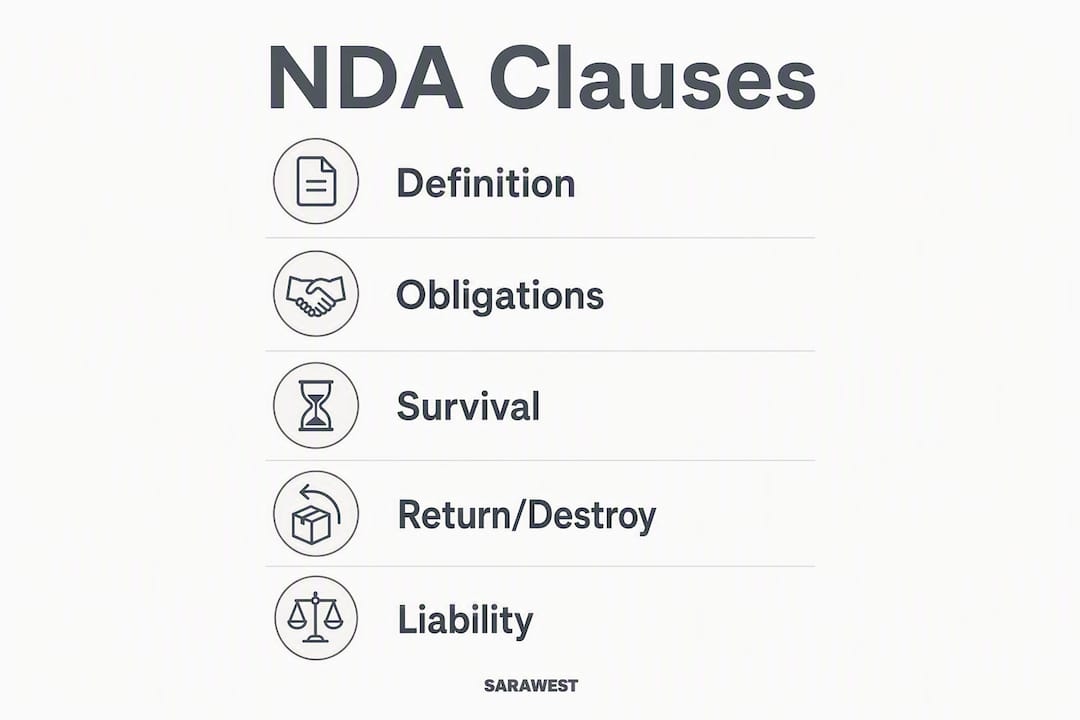
Standard product development NDAs include all of these elements. If a template you're reviewing is missing even one, treat that as a gap to fill before signing.
Sample clause language you can adapt:
Definition of Confidential Information: "Confidential Information means any non-public information disclosed by Disclosing Party to Receiving Party, whether orally, in writing, or in any other form, that is designated as confidential or that reasonably should be understood to be confidential given the nature of the information and the circumstances of disclosure, including without limitation product formulas, prototypes, technical specifications, manufacturing processes, software code, business plans, and customer data."
Survival: "The obligations of confidentiality set forth herein shall survive termination of this Agreement for a period of [five (5) years / indefinitely with respect to information constituting a trade secret under applicable law]."
Return/Destroy: "Upon written request by Disclosing Party or upon termination of this Agreement, Receiving Party shall promptly return or certifiably destroy all Confidential Information and any copies thereof, and shall provide written certification of such destruction within ten (10) business days."
How do you customize an NDA for your specific product project?
Generic NDA templates are a starting point, not a finish line. Here's how to adapt one for your product type and manufacturing context.
Scope the definition to your product category
For chemistry and formulation projects, the definition of Confidential Information should explicitly name ingredient lists, concentration ratios, processing parameters, and stability data. For hardware, include CAD files, bill of materials, and tooling specifications. For software, add source code, API documentation, and architecture diagrams. A definition that says only "technical information" is too vague to enforce cleanly.
Customize need-to-know provisions for manufacturers
Contract manufacturers cannot operate under an NDA that prohibits all downstream disclosure. Their quality team, production supervisors, and raw material suppliers all need access to some portion of your specs. The fix is a well-drafted carve-out: the manufacturer may disclose to "employees, agents, contractors, and suppliers on a need-to-know basis," provided each such party is bound by written confidentiality obligations at least as protective as the NDA itself. The manufacturer remains liable for any breach by those parties.

Pro Tip: Ask your manufacturer for a copy of their standard subcontractor confidentiality agreement before you sign. If they don't have one, require them to use your form as an exhibit to the NDA. This closes the gap between your agreement and their supply chain.
Set survival periods that match the sensitivity of the information
Routine business information — pricing, timelines, vendor contacts — warrants a two to three year survival period. Formulas, proprietary processes, and product architectures that qualify as trade secrets under the Defend Trade Secrets Act should carry indefinite survival language. Survival clauses in the 2–5 year range are the most common in product development templates, but they're often too short for chemistry and formulation work.
Red flags to watch for in any NDA you're asked to sign
- Overly broad "Confidential Information" definition that captures everything the other party tells you, with no carve-outs for public domain or prior knowledge
- No permitted use limitation — the agreement doesn't restrict how the recipient can use your information
- Missing employer/employee carve-out — if the receiving party's employees aren't bound by the same obligations, the agreement has a structural gap
- Indefinite active term with no termination right — you should be able to exit the agreement once the project ends
- No governing law clause — creates jurisdictional uncertainty if you ever need to enforce
Manufacturing caveats: making NDAs work across development stages
NDAs alone are rarely enough for contract manufacturing relationships. Here's the honest picture.

A standard two-page NDA protects the information you share at the time of signing. But product development is not static. You start with a concept, move to a prototype, refine the formula through pilot batches, and eventually hand over full production specs. Each of those stages involves a different category of disclosure, and the NDA you signed at the concept stage may not adequately cover what you're sharing at the production stage.
Practitioners treat confidentiality as a living control: refresh or re-execute NDAs when disclosures shift from conceptual to technical to production information. This is especially true in chemistry and formulation, where the gap between a concept brief and a validated production formula is enormous. The formula you share at scale is far more valuable than the concept you shared at the start.
For manufacturers specifically, the need-to-know structure must be explicit. The manufacturer's liability for their subcontractors' breaches is not automatic under most state laws. You need to build it in.
Sample flow-down clause:
"Manufacturer may disclose Confidential Information to its employees, agents, contractors, and suppliers solely on a need-to-know basis for purposes of performing its obligations under this Agreement, provided that (a) each such party is bound by written confidentiality obligations no less protective than those set forth herein; (b) Manufacturer shall obtain such written agreements prior to any disclosure; and (c) Manufacturer shall remain fully liable for any breach of confidentiality by any such party as if such breach were committed by Manufacturer itself."
When a project moves from prototype to scale, consider whether a full supplier audit and a refreshed or restated NDA is warranted. The specifications change. The people with access change. The stakes go up.
Pro Tip: When your product moves into accelerated aging or microbial challenge testing, you're often disclosing formulation details to a third-party lab. Make sure your NDA covers contract testing labs explicitly, or execute a separate lab confidentiality agreement before samples are submitted.
Downloadable NDA templates and your pre-share checklist
Two template formats cover the majority of product development scenarios:
Template 1: Mutual NDA (Co-Development) Covers situations where both parties share proprietary information. Includes bilateral definitions, mutual permitted-use limits, and shared survival obligations. Available in editable Word format for negotiation and PDF for final execution.
Template 2: Unilateral NDA (Manufacturer / Developer) Covers situations where only one party discloses. Includes the need-to-know carve-out, flow-down obligation, and manufacturer liability clause. This is the format most teams use when sending specs to a contract manufacturer or freelance developer.
Pre-share checklist — run this before every disclosure:
- Confirm the NDA is fully executed (signed by authorized signatories on both sides)
- Label every file and folder "Confidential — [Project Name] — [Date]"
- Limit the recipient list to named individuals, not departments or roles
- Log the disclosure: date, recipient, description of what was shared, and the NDA reference
- Attach a specification exhibit rather than embedding detailed specs in the NDA body — template providers consistently recommend this approach to keep the main agreement clean and editable
- Confirm the recipient has a signed subcontractor confidentiality agreement in place if they use outside suppliers
The exhibit approach deserves a note. Embedding a 40-page technical specification into an NDA body makes the agreement unwieldy and creates version-control problems. Attach the spec as Exhibit A, reference it in the definition clause, and update the exhibit as the project evolves without re-executing the entire agreement.
Electronic signatures, audit trails, and what to do if your NDA is breached
Signing methods that hold up
DocuSign and Adobe Sign both produce time-stamped, court-admissible records under the Electronic Signatures in Global and National Commerce Act (E-SIGN Act). Either platform works. What matters is that you retain the signed original, the signing certificate, and the IP address log. Store these in a dedicated project folder, not your email inbox.
For high-stakes agreements, consider a witnessed wet signature alongside the electronic version. It's rarely necessary, but it removes any ambiguity about intent.
Building an audit trail that protects you
Marking shared materials and digital folders as "Confidential" strengthens trade-secret protection under the DTSA. Courts look for evidence that you treated the information as secret. That means:
- Version-controlled files with access logs
- Dated email threads referencing the NDA by name
- A disclosure log that records what was shared, when, and with whom
- Physical samples labeled with your company name and "Confidential"
Pro Tip: Create a single shared folder for each manufacturing partner, named "Confidential — [Partner Name] — NDA Ref: [Agreement Date]." Every file that goes to that partner lives in that folder. If you ever need to demonstrate what was disclosed and when, the folder is your evidence.
Immediate steps if you suspect a breach
- Stop further disclosure immediately. Do not share additional information until you understand the scope of the breach.
- Preserve evidence. Screenshot, download, and timestamp any evidence of misuse before it disappears.
- Send a written notice. A formal cease-and-desist letter puts the other party on notice and creates a record.
- Assess DTSA remedies. The Defend Trade Secrets Act allows federal civil claims for trade-secret misappropriation, including injunctive relief and, in cases of willful misappropriation, exemplary damages up to two times actual damages.
- Consult counsel before filing. Injunctive relief moves fast, but the evidentiary threshold is real. Get a lawyer involved before you file.
This article provides general legal information, not legal advice. Confirm current requirements with a qualified attorney before executing or enforcing any agreement.
Key Takeaways
A product development NDA protects confidential disclosures during development, but only if it's signed before sharing, scoped to your product type, and paired with flow-down obligations for any manufacturer or subcontractor.
| Point | Details |
|---|---|
| Sign before you share | Execute the NDA before disclosing any non-public specification, formula, or prototype detail. |
| Match the NDA type to the relationship | Use a mutual NDA for co-development; use a unilateral NDA when only you disclose to a manufacturer or developer. |
| Build in flow-down obligations | Require manufacturers to bind their subcontractors in writing and remain liable for downstream breaches. |
| Set survival periods by sensitivity | Use 2–5 years for routine information; use indefinite survival language for trade secrets and proprietary formulas. |
| Refresh NDAs as the project evolves | Re-execute or update confidentiality terms when disclosures shift from concept to prototype to full production specs. |
| Sarawest USA signs NDAs before R&D begins | Sarawest USA's contract manufacturing process includes confidentiality agreements before any formulation or prototyping work starts. |
The gap most product teams don't see until it's too late
There's a pattern we see repeatedly in contract manufacturing and formulation work. A team spends months developing a concept, signs a basic NDA, and hands over a spec sheet to a manufacturer. The NDA covers the initial disclosure. What it doesn't cover is everything that happens next: the formula refinements shared over email, the pilot batch parameters discussed on a call, the stability data sent as an attachment three months later.
The NDA was a snapshot. The project was a film.
Most standard NDAs are drafted for a single disclosure event. Product development is a series of disclosures, each one more specific and more valuable than the last. By the time you're sharing production-ready formulas and process parameters, you may be operating well outside the scope of what you signed at the concept stage.
The fix isn't complicated. It's a habit: review the NDA every time the nature of what you're sharing changes materially. When you move from concept brief to prototype specs, check the definition clause. When you move from prototype to pilot batch, check the need-to-know carve-out and the survival period. When you move from pilot to full production, consider whether a formal product development agreement should accompany or replace the NDA entirely.
An NDA is the right tool for protecting confidential disclosures. It is not the right tool for governing a manufacturing relationship, allocating IP, or setting milestone obligations. Knowing the difference, and acting on it at the right stage, is what separates teams that protect their ideas from teams that wish they had.
Sarawest USA works under NDA from day one
When you bring a product concept to Sarawest USA, confidentiality isn't a formality. It's the starting point. Before our in-house R&D chemists touch a formula or a pilot batch, we execute a confidentiality agreement that covers your specifications, your formulation goals, and any proprietary information you share during the development process. That's how we've built trust with brands across commercial cleaning, sports care, equine products, solar care, and more.
Our contract manufacturing process runs from rapid prototyping through pilot batches to full-scale production, all under one roof with no broker in the middle. If you need a manufacturer who takes confidentiality seriously at every stage, not just at the RFQ, we're ready to talk. Browse our formulation track record to see the range of projects we've handled under protected development agreements, then send us your RFQ. A real person reads every one.
Useful sources and references
- Defend Trade Secrets Act — LegalTemplates NDA Guide
- Product Development NDA Template — Genie AI (US)
- Product Development Non-Disclosure Agreement — eForms
- Product Development Agreement Definition — CASRAI
- Product Development NDA Guidance — NonDisclosureAgreement.com
- Product Development Agreement Template — PandaDoc
- Product Development Agreement Template — Fynk
- SEC EDGAR — Sample Product Development Agreement (Exhibit 10.3)
- Sarawest USA Contract Manufacturing
- Sarawest USA Capabilities
- Sneaker Prototype Development — Shoemakers International