
A quality agreement is a standalone written document that allocates the cGMP responsibilities between the company that owns a product and the facility that makes it. FDA guidance treats this document as an expectation for outsourced drug manufacturing, and it cannot shift statutory accountability. Under 21 CFR and the ICH Q10 quality system model, the Owner's quality unit stays legally responsible for final product release no matter what the contract says.
TL;DR:
- A responsibilities matrix should clearly assign key activities such as batch release, environmental monitoring, and material qualification to specific parties with signed approval, including necessary revision history and effective date.
- Change control protocols must categorize changes by impact, set explicit notice windows, define investigation timelines, and flag regulatory filing requirements to prevent inspection deficiencies.
- Audit rights require access to the signed quality agreement, responsibilities matrix, batch records, and subcontractor documentation, with clear procedures for electronic record access and record retention after termination.
- Sign-off by quality units, explicit responsibilities, and detailed procedures for change management and record retention are crucial for a compliant, inspection-ready quality agreement.
- Drafting should avoid vague language, ensure responsibilities are action-based, and separate quality obligations from commercial terms to pass FDA inspections and maintain GMP compliance.
Table of Contents
- What a Quality Agreement Is and Why Regulators Expect One
- [The essential elements every quality agreement should address include clear ownership across key areas such as quality unit activities, facilities and equipment, materials management, product-specific considerations, laboratory controls, documentation, and change control. Omitting any critical area can lead to compliance gaps.](#the-essential-elements-every-quality-agreement-should-address-include-clear-ownership-across-key-areas-such-as-quality-unit-activities-facilities-and-equipment-materials-management-product-specific-considerations-laboratory-controls-documentation-and-change-controlhttpsrjrworldwidecominsightsusp-grade-compliance-omitting-any-critical-area-can-lead-to-compliance-gaps)
- Building a Responsibilities Matrix That Closes Gaps
- Change Control, Deviations, and OOS Reporting Timelines
- Audit Rights, Record Access, and Inspection Readiness
- Drafting Best Practices and Pitfalls to Avoid
- How Sarawest USA Builds Quality Agreements Into Real Capability
- What Actually Matters When You're Negotiating This Document
- Getting Your Quality Agreement Right From Day One
- Sources
What a Quality Agreement Is and Why Regulators Expect One
The FDA guidance draws a hard line between two parties: the Owner, who holds the marketing authorization and legal accountability, and the Contract Facility, which performs the manufacturing, testing, or packaging. That distinction isn't paperwork for its own sake. It exists because outsourcing has become the norm in drug and chemical production, and regulators need a documented trail showing who caught a deviation, who approved a specification change, and who signed off on the batch before it shipped.
We've seen companies bury quality terms inside a supply agreement or purchase order, assuming legal counsel covered the bases. It usually hasn't. A standalone quality agreement, or a clearly labeled annex, separates GMP obligations from commercial terms like pricing and delivery, so an auditor can find compliance language without wading through negotiated freight terms. Auditors expect to see this document wherever manufacturing, packaging, labeling, testing, or storage gets outsourced. If your product touches a facility you don't own, expect an inspector to ask for it.
The essential elements every quality agreement should address include clear ownership across key areas such as quality unit activities, facilities and equipment, materials management, product-specific considerations, laboratory controls, documentation, and change control. Omitting any critical area can lead to compliance gaps.
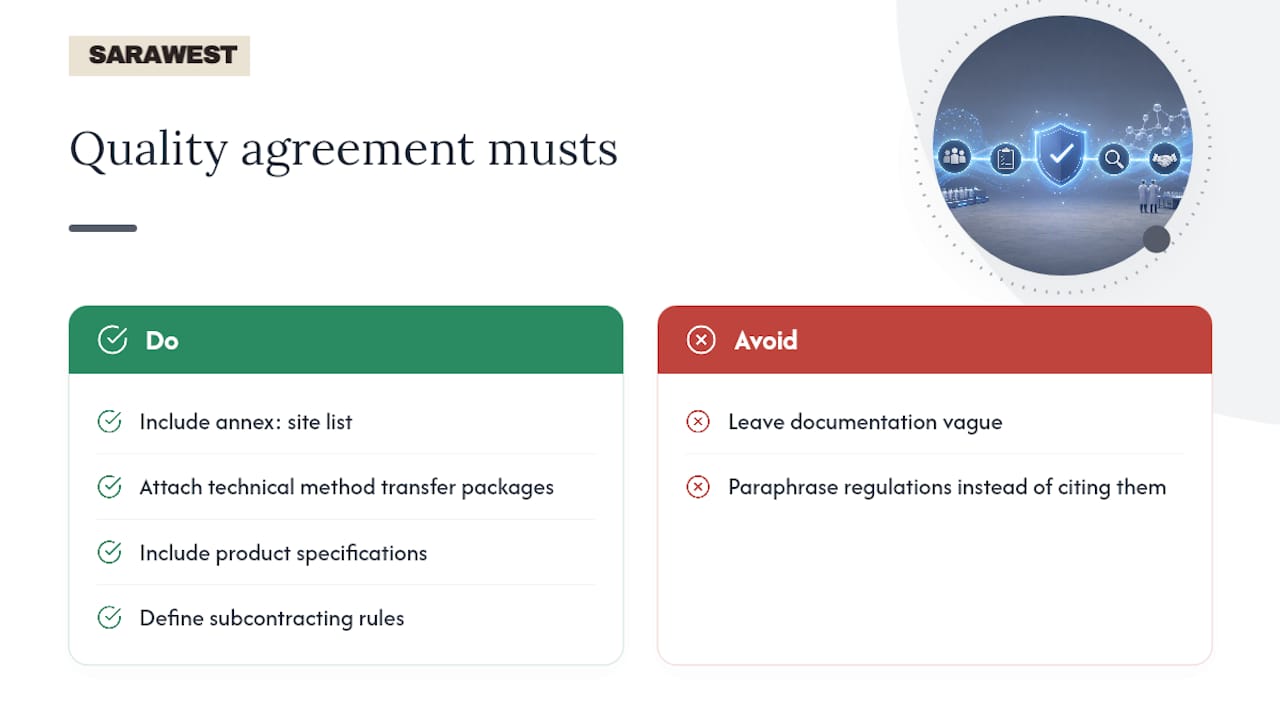
Beyond these seven, most agreements need annexes covering the site list (which facility does what), technical method transfer packages, product specifications, and subcontracting rules. Industry guidance from MasterControl treats documentation and change control as the two areas inspectors scrutinize hardest, so don't leave either one vague. Reference the specific CFR part or ICH guideline tied to each element rather than paraphrasing it. That precision saves you a follow-up question during inspection.
Building a Responsibilities Matrix That Closes Gaps
A responsibilities matrix, formatted like a RACI table, is the single most effective tool for preventing the "we thought you had it" problem that shows up during FDA inspections. Assign each activity to the Owner, the Contract Facility, or Joint, and name the actual QA contact responsible for sign-off, not just the department.
Build the matrix around these line items at minimum:
- Batch release and final disposition authority
- Environmental monitoring and trending
- Analytical method ownership and transfer
- Labeling and artwork approval before print runs
- Supplier qualification for raw materials and components
- Record retention duration and transfer-on-termination terms
Format the matrix as a numbered appendix, not loose prose in the body text. Include an effective date, a version number, and a revision history table. Every version needs new signatures. A matrix with no sign-off row is functionally a draft, and vague handoffs remain a leading cause of findings during outsourced manufacturing inspections.
Change Control, Deviations, and OOS Reporting Timelines
Change control is where quality agreements either hold up under inspection or fall apart. Build in three things: categories, timelines, and clear approval authority.
- Classify changes by impact. Minor changes (a label vendor swap) might need only notification. Major changes (a new raw material source, a process parameter shift) should require Owner approval before implementation. A change classification table listing example change types, impact level, and required notice windows makes this concrete instead of aspirational.
- Set explicit notice windows. Many agreements use 30 to 90 days for planned changes and immediate notification (within 24 to 48 hours) for deviations or out-of-specification results.
- Define investigation and review timelines. State how long the Contract Facility has to complete a root-cause investigation and how the Owner's quality unit reviews and approves the closure before batch disposition.
- Flag regulatory-filing triggers. Some changes require updates to a marketing application. Name who assesses that regulatory impact and by when, so a facility change doesn't accidentally trigger an unfiled variation.
Our guide to change control procedures walks through notice-window language in more depth if you're drafting from scratch.
Audit Rights, Record Access, and Inspection Readiness
Inspectors ask for specific documents: the signed quality agreement itself, the responsibilities matrix, evidence of quality unit sign-off, and the underlying batch manufacturing records. Structure your audit clause to grant access to GMP-relevant records without exposing pricing or unrelated commercial terms buried in a separate supply contract.
- Set an audit cadence (annual is standard for higher-risk products; biennial can work for lower-risk categories).
- Require subcontractor flow-down so the Contract Facility's own suppliers get audited under the same standard your agreement sets, following the same expectations sponsors apply to CMOs directly.
- Address electronic record access, including Part 11 considerations, if either party relies on e-signatures or electronic batch records. Our QMS software overview covers what to look for there.
- Spell out retention periods and who receives original records if the relationship ends.
Pro Tip: Inspectors commonly ask for a signed and dated quality agreement on the spot. An agreement that's been drafted but never formally reviewed and stamped by both parties' quality units gets treated as evidence of insufficient oversight, not evidence of intent.
Drafting Best Practices and Pitfalls to Avoid
Keep the quality agreement separate from the commercial contract, and write responsibilities as actions, not intentions. "The Contract Facility will maintain calibration records" beats "quality shall be maintained." That specificity matters when an inspector reads the document line by line.
- Push for sign-off by quality units, not procurement or legal alone. A contract negotiated entirely by purchasing teams tends to miss GMP nuance.
- Require subcontractor flow-down language explicitly, so your standards travel down the supply chain instead of stopping at the first contract.
- Fix notice-of-change windows in writing. Don't leave "reasonable notice" undefined; that phrase means nothing during an audit.
- Watch for the classic pitfalls: unsigned agreements, vague handoffs between departments, and missing retained-sample provisions. Each one gets flagged the same way, as evidence the quality system isn't operating as documented.
How Sarawest USA Builds Quality Agreements Into Real Capability
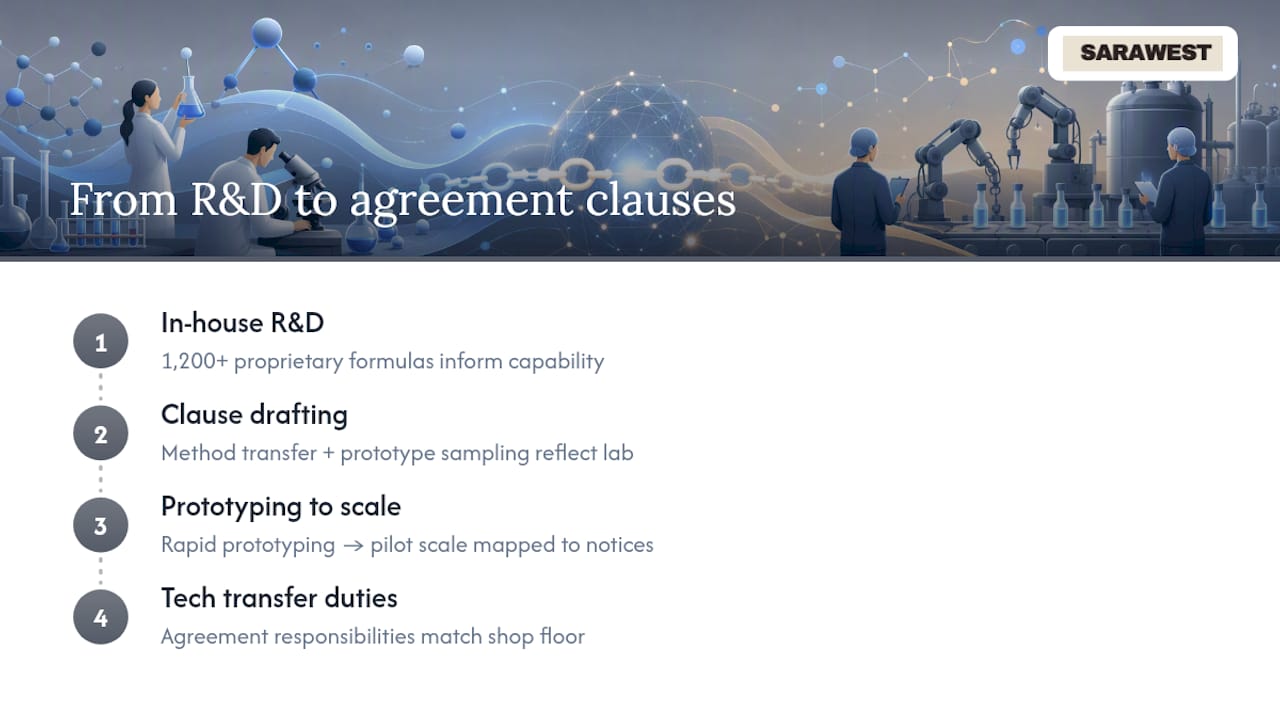
Sarawest USA's in-house R&D chemists and library of over 1,200 proprietary formulas mean method transfer and prototype sampling clauses reflect actual lab capability, not aspirational language. Rapid prototyping and pilot-to-scale production map directly to production-scaling notice provisions, so tech-transfer responsibilities in your agreement match what happens on our floor.
What Actually Matters When You're Negotiating This Document
Before any batch run starts, insist on five clauses: quality unit sign-off, a responsibilities matrix, defined change-notice windows, audit rights with subcontractor flow-down, and a record-retention term that survives termination. Everything else is negotiable detail. Keep a one-page checklist of those five items in every RFQ review, and check our supplier audit checklist for the deeper version.
— Faisal Mansur
Getting Your Quality Agreement Right From Day One
Sarawest USA gives you a shorter path to a compliant, inspection-ready quality agreement because our in-house chemists and formulation library mean the technical annexes, method transfer plans, and scaling clauses reflect capability we already have on hand, not promises made to win the bid.
Our services cover contract chemical manufacturing with in-house R&D, rapid prototyping for new formulas, and pilot-to-scale production runs across eight industries. When you send an RFQ, ask for certificates of analysis, audit history, sample COAs, and a proposed method transfer plan. That request alone tells you whether a facility's QMS is documented or improvised. Review our manufacturing capabilities or start a contract manufacturing RFQ to see how quickly a compliant quality agreement can move from draft to signature.
Sources
- Contract Manufacturing Arrangements for Drugs: Quality Agreements (FDA guidance)
- Quality Agreements With Contract Manufacturing Organizations (MasterControl)
- Quality Agreement: What It Is and What FDA Requires (LegalClarity)