
The smartest move for any brand chasing sustainable liquid packaging is to stop thinking about the bottle and start thinking about the formula. Real progress happens in R&D, not the recycling bin. Prioritize contract manufacturers with in-house chemists and proven pilot-to-scale capability, since they're the ones who can actually deliver a greener liquid product without wrecking performance. A contract manufacturer that combines in-house chemists with pilot-to-scale capability is one option built around exactly that combination.
TL;DR:
- Bio-based feedstocks are roughly two to three times more expensive than conventional materials, impacting retail pricing and requiring cost planning upfront.
- Successful scale-up depends on detailed engineering batch data, as mixing and heat transfer do not scale linearly from lab to full production volumes.
- Early safety and sustainability screenings, including SSbD and green-chemistry assessments, reduce costly reformulations and ensure regulatory compliance.
- End-of-life biodegradability is crucial, but formulas must balance environmental breakdown with shelf stability to avoid separation and efficacy loss.
- Choosing a contract manufacturer with in-house R&D, pilot-to-scale proof, and transparency on stability and sustainability testing is essential for reliable, sustainable product development.
Table of Contents
- Why Sustainable Formulation Matters More Than the Bottle
- Cost Drivers Behind Bio-Based Feedstocks and Safety Screening
- Scale-Up Failures That Wreck Good Liquid Formulas
- What Testing and Documentation Should You Demand?
- How Do You Choose a Contract Manufacturer for Sustainable Liquids?
- How Much Impact Does Sustainable Liquid Formulation Actually Have?
- What Happens to Sustainable Liquid Products at End of Life?
- Regulatory Standards Shaping Sustainable Liquid Products
- What's New in Materials for Sustainable Liquid Formulations?
- Do Consumers Actually Care About Sustainable Formulations?
- Sustainable Formulations vs. Traditional Liquid Products: What Actually Changes?
- What Buyers Get Wrong About "Sustainable" Formulation
- Ready to Move From Formula Concept to Pilot Run?
- Sources
- FAQ
Why Sustainable Formulation Matters More Than the Bottle
Sustainable formulation covers what actually happens inside the liquid: how ingredients are sourced, whether they break down safely, and whether performance holds up once you swap in a greener alternative. This is where Safe and Sustainable by Design (SSbD) principles earn their keep, pushing formulators to weigh feedstock origin, biodegradability, and toxicity before a formula ever locks in.
Polymers used in liquid formulations, often shortened to PLFs, sit at the center of the tension. Some biodegrade cleanly but destabilize under heat or shelf life. Others hold a product together beautifully for two years and never break down at all once they hit wastewater. A mission-oriented roadmap for sustainable PLFs argues this problem needs coordinated R&D and shared testing standards across the industry, not one brand solving it alone.
Brands that get this right track lifecycle hotspots from day one:
- Feedstock origin and renewability of raw materials
- End-of-life fate: does it biodegrade, and under what conditions
- Performance stability across shelf life and climate variation
- Water and energy intensity of the manufacturing process itself
Cost Drivers Behind Bio-Based Feedstocks and Safety Screening
Bio-based feedstocks cost more, and the gap is not small. Industry analysis on sustainable formulation polymers for home, beauty, and personal care puts bio-based feedstocks at roughly two to three times the cost of conventional fossil-derived materials. That multiplier flows straight into retail pricing, which means your positioning strategy needs to account for it before you commit to a formula, not after you've already quoted a shelf price.
Statistic Callout: Bio-based raw materials generally cost significantly more than standard petrochemical inputs, according to peer-reviewed analysis of sustainable formulation polymers. Budget for that premium at the concept stage, not the pricing meeting.
Benign-by-design thinking helps offset some of that cost long term. Screening for toxicology and environmental impact early, rather than after a formula is finalized, avoids the expensive reformulation cycle that catches brands off guard. A recent framework on operationalizing SSbD from business case to launch makes the case directly: companies that build safety and sustainability checks into the stage-gate process, rather than bolting them on at the end, spend less time reworking formulas that already failed a late-stage safety review.
Supply variability is the other cost risk nobody talks about enough. Bio-based feedstocks fluctuate with harvests, weather, and regional politics in ways petrochemical supply chains rarely do. Manufacturers manage that risk through a few concrete tactics:
- Mass-balance accounting to blend certified and conventional material without disrupting supply
- Multi-sourcing agreements so no single crop failure stalls production
- Supplier quality audits that verify origin claims instead of taking them on faith
Scale-Up Failures That Wreck Good Liquid Formulas
A formula that performs beautifully in a 500-milliliter beaker can fall apart in a 5,000-liter tank, and this is where a lot of promising eco-formulations die. Liquid manufacturing does not scale volumetrically. Mixing time, shear force, and heat transfer all behave differently as vessel size grows, which means a recipe that worked in the lab needs its own equipment-specific validation before anyone trusts it at commercial volume. Research on how semi-solid and liquid scale-up actually works confirms this directly: mixing and heat transfer don't scale linearly, so pilot and engineering batches are non-negotiable steps, not paperwork.
Four failure modes show up again and again once a sustainable formula hits pilot scale:
- Viscosity drift from inconsistent shear rates. Fix it by matching impeller design and mixing speed to the specific batch size, not the recipe on paper.
- Phase separation in emulsions that relied on a narrow processing window. Fix it by validating temperature ramp rates at each scale step.
- Content uniformity failures when active ingredients settle unevenly. Fix it with in-process sampling at multiple tank depths.
- Microbial control gaps introduced by natural, preservative-light formulas. Fix it with tighter environmental monitoring during fill.
Pro Tip: Ask any prospective manufacturer to walk you through their engineering batch data before you sign anything. If they can't show you how lab parameters mapped to pilot-scale results, you're about to become their first real test case.
The sequence that actually works runs from lab batch to engineering batch to pilot run, with in-process controls checked at each stage. Manufacturers who document scale-up properly will show you this data before you ever commit to a production run.
What Testing and Documentation Should You Demand?
Before any sustainable liquid formula goes to full-scale production, a manufacturer should hand you real data, not reassurance. The baseline quality control suite covers stability testing across temperature extremes, preservative efficacy challenges, pH consistency, viscosity checks, and microbial challenge testing where the formula's preservative system is lighter than conventional alternatives.
Sustainability screening deserves its own checklist, separate from standard QC:
- SSbD review confirming hazard and function were weighed together, not hazard alone
- Green-chemistry score outputs showing how ingredient substitutions were evaluated
- Basic life-cycle assessment (LCA) screening covering water use, energy intensity, and end-of-life fate
Green-chemistry scoring tools have moved from theory to practice at scale. The Estée Lauder Companies' Green Score framework demonstrates how a formal profiler helps formulators choose substitutions by tracking waste impact, feedstock sourcing, and biodegradability side by side, rather than guessing which ingredient sounds greener.
On the documentation side, request Safety Data Sheets, feedstock origin statements, and traceability records with actual batch numbers behind them. Where relevant, ask whether ingredients carry ISO 16128 natural origin index (NOI) support. A manufacturer that hands over this paperwork without hesitation is telling you something about how they operate. One that stalls is telling you something too.
How Do You Choose a Contract Manufacturer for Sustainable Liquids?
Choosing the right partner comes down to five checkpoints, run in this order:
- Confirm in-house R&D capability. Ask whether formulation happens on-site with dedicated chemists, or whether your project gets outsourced to a broker who doesn't touch the chemistry.
- Request pilot-to-scale proof. A manufacturer should be able to show engineering batch data and explain how they validated the jump from lab to commercial volume.
- Clarify minimum order quantities and turnaround. Pilot runs starting around 1,000 units let you test market response without committing to a truckload before you know the formula sells.
- Push for data transparency. Stability data, SDS sheets, and batch traceability records should arrive without a fight.
- Verify their SSbD and green-chemistry workflow. Ask directly how they screen ingredient substitutions for hazard and biodegradability before formula lock.
Sample RFQ questions worth asking, grouped by category:
- Formulation: "Can you adapt an existing formula to remove [specific ingredient] while maintaining stability?"
- Manufacturing: "What batch size do you require for a validated pilot run, and what does that pilot cost?"
- Quality: "What stability and microbial testing do you run before releasing a batch?"
- Sustainability: "Do you screen new ingredients using a green-chemistry score or SSbD checklist?"
Red flags include vague answers about batch sizes, reluctance to share engineering data, and pricing that seems too good to reflect real bio-based feedstock costs. If you hit any of these, ask for references or case study evidence before moving forward.
How Much Impact Does Sustainable Liquid Formulation Actually Have?
Carbon footprint and water usage tell two different stories depending on where in the process you measure. Bio-based feedstock sourcing tends to carry a lower cradle-to-gate carbon footprint than petrochemical extraction, but the picture flips once you account for processing energy. Some biosurfactant production routes require significant energy input during fermentation and purification, which can offset upstream carbon savings if the manufacturing site runs on a carbon-heavy grid.
Water usage is the metric brands underestimate most. Formulation processes that rely on aqueous-phase mixing, dilution steps, and equipment cleaning between batches can use substantial water volumes, and that number scales directly with batch frequency. A manufacturer running efficient cleaning-in-place systems and closed-loop water recovery will show a materially different water footprint than one that doesn't, even if both are making the same formula.
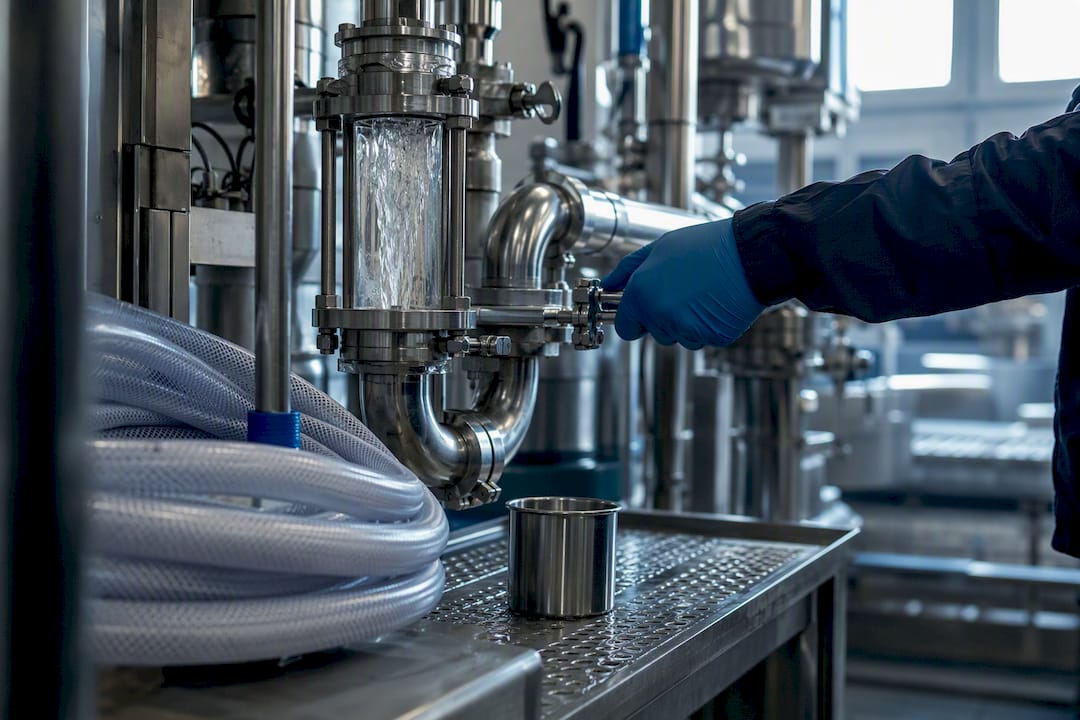
This is exactly why lifecycle screening needs to happen before scale-up, not after. A roadmap for sustainable polymers in liquid formulation makes the point that lifecycle thinking only works when it's built into early R&D decisions, since retrofitting a greener process onto an already-scaled formula rarely produces the same gains.
Ask your manufacturer directly whether they track energy use per batch and water recovery rates. If they can't answer, that's a data gap you're inheriting the moment you sign a production agreement. Brands serious about carbon claims need numbers from their manufacturing partner, not estimates pulled from an industry average that may not reflect the actual facility running their formula.
What Happens to Sustainable Liquid Products at End of Life?
End-of-life fate is where formulation science gets genuinely difficult, because biodegradability and in-use stability tend to pull in opposite directions. A polymer that breaks down quickly in wastewater treatment often struggles to hold a formula together on a store shelf for eighteen months. That tension is the central challenge facing PLFs right now, and no single ingredient solves it cleanly.
Wastewater treatment compatibility matters more than most brands realize when a liquid product goes down the drain, which covers most cleaning products and a large share of personal care liquids. A formula's polymers, surfactants, and preservatives all pass through municipal treatment systems, and how readily they biodegrade there determines the actual environmental outcome, not just the marketing claim on the label.
Biosurfactants offer one credible path forward. Research on Unilever's SSbD approach to a novel biosurfactant shows that renewable-carbon surfactants can reduce reliance on fossil inputs, but only after staged screening confirms they're safe for consumers, workers, and the environment across their full life cycle. Skipping that staged process to rush a "biodegradable" claim to market is how brands end up with a reformulation crisis six months post-launch.
Manufacturers should be able to explain, ingredient by ingredient, what happens after the product goes down a drain or into a landfill. If they can't answer that question with actual biodegradation data, they're guessing, and so are you when you put a biodegradable claim on your packaging.
Regulatory Standards Shaping Sustainable Liquid Products
Regulatory pressure on liquid formulations is tightening, and it's shifting from voluntary green claims toward frameworks that demand actual evidence. SSbD, originally developed within European Union chemical policy, is increasingly referenced by manufacturers globally as a structured way to prove a formula was evaluated for both hazard and function, not just marketed as safer.
ISO 16128 governs how natural and organic claims get calculated for ingredients, giving brands a standardized natural origin index rather than a marketing team's own estimate. Manufacturers who can produce ISO 16128 support for their ingredients are giving you a real compliance asset, not just a talking point for your packaging copy.
Safety documentation requirements haven't relaxed either. Every ingredient substitution, especially a bio-based one replacing a well-understood petrochemical, needs its own toxicological review before it goes into a commercial formula. Skipping that step to hit a launch date is how brands end up issuing recalls.
The practical takeaway for brands: ask your manufacturer which regulatory frameworks they actively work within, not which ones they've heard of. A contract manufacturer with real in-house chemistry should be able to walk you through how SSbD principles shaped a specific reformulation decision, citing the actual trade-off they weighed. If the answer is vague, that's the same red flag as vague batch-size answers. Compliance readiness and formulation competence tend to travel together, and a manufacturer weak on one is usually weak on the other.
What's New in Materials for Sustainable Liquid Formulations?
The most meaningful innovation in this space isn't happening in packaging labs. It's happening in polymer chemistry, where researchers are working to replace conventional PLFs with alternatives that biodegrade without sacrificing the thickening, stabilizing, and sensory functions those polymers provide.
Biosurfactants represent the most commercially advanced innovation right now. Derived from renewable carbon sources rather than petrochemical feedstocks, they're being adopted by major consumer goods companies for cleaning and personal care applications, though staged safety screening remains essential before full-scale rollout.
Green-chemistry scoring systems are the quieter innovation, and arguably the more important one for brands sourcing formulations today. These internal profilers, like the framework Estée Lauder has built out, let formulators compare ingredient substitutions on waste impact, biodegradability, and sourcing simultaneously, rather than optimizing for one metric while ignoring the others. That kind of structured comparison is what separates a genuinely improved formula from one that swapped a bad ingredient for a different bad ingredient with better marketing.
Compatibility between formula and container remains part of the picture too, even though this article's focus stays on what's inside the bottle. A formula reformulated with new bio-based surfactants may interact differently with container materials than the original recipe did, which is why packaging compatibility testing still belongs on your validation checklist even when the primary innovation is happening in the liquid itself.
Do Consumers Actually Care About Sustainable Formulations?
Consumer demand for greener liquid products keeps growing, but the demand is more specific than a general preference for anything labeled "eco-friendly." Shoppers increasingly want proof, not adjectives. Vague green claims draw skepticism faster than they used to, and brands leaning on unverified biodegradability language are getting called out more often.
What actually moves purchase decisions is specificity: a named ingredient swap, a real biodegradation timeframe, a certification a shopper can verify. This shift explains why more brands are asking their manufacturers for documentation they can put directly into marketing copy, rather than generic sustainability language that sounds nice but says nothing checkable.
Retailers are reinforcing this trend from their own side of the shelf. Buyers increasingly ask brands for supporting data before agreeing to stock a "sustainable" liquid product, which pushes the documentation requirement further upstream, straight back to the contract manufacturer producing the formula. A brand that can't answer a retailer's sustainability questionnaire because their manufacturer never provided the underlying data is stuck rebuilding trust from scratch.
This is where the market is heading through 2026 and beyond: fewer vague claims, more ingredient-level transparency, and growing pressure on manufacturers to hand brands real numbers instead of reassurance. Brands sourcing sustainable liquid formulations now need a manufacturing partner who treats documentation as part of the product, not an afterthought requested after a retailer complains.
Sustainable Formulations vs. Traditional Liquid Products: What Actually Changes?
Performance parity is the real question brands need answered before they commit to a greener reformulation, and the honest answer is: it depends heavily on the category. Cleaning products built around biosurfactants can match conventional surfactant performance in many applications, though some high-demand uses like heavy degreasing still favor conventional chemistry for now. Personal care liquids face a similar split, with some categories reformulating cleanly and others requiring genuine trade-offs in texture or shelf stability.
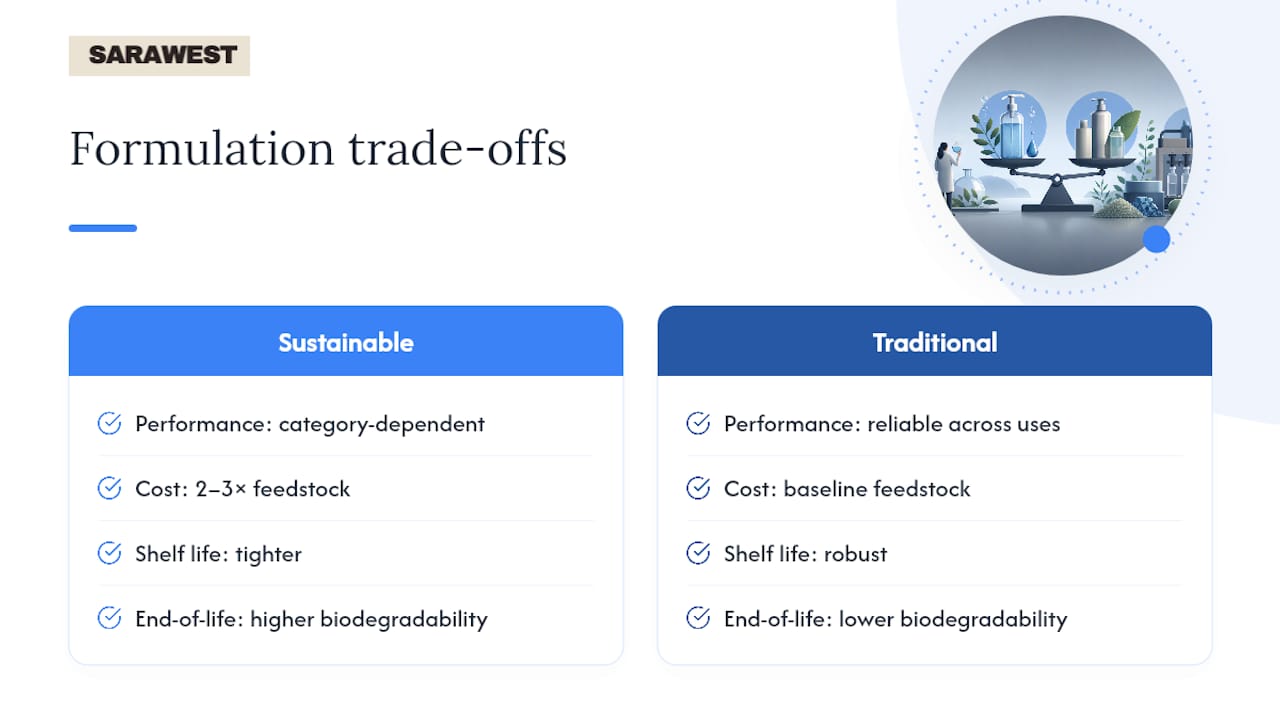
Cost is the most consistent difference, and it runs one direction. Bio-based feedstocks costing two to three times more than conventional inputs means a sustainable reformulation rarely ships at price parity with the product it replaces, at least not yet. Brands positioning a greener liquid product need pricing strategy that accounts for that gap honestly, rather than absorbing the cost quietly and hoping volume fixes the margin later.
Shelf stability tends to be where the comparison gets uncomfortable. Traditional preservative systems and synthetic stabilizers were engineered over decades for long shelf life under variable storage conditions. Newer bio-based alternatives sometimes need tighter storage requirements or shorter use-by windows, which has real implications for retail logistics and return rates.
The upside runs the other direction on end-of-life impact. A well-formulated sustainable liquid, built with biodegradable PLFs and screened through an SSbD process, genuinely outperforms conventional chemistry once it reaches wastewater treatment. That's not a marketing claim, it's the specific trade-off brands are buying when they accept the cost premium and the tighter stability window: better performance where it matters after the bottle is empty, in exchange for real constraints while the bottle is still on the shelf.
What Buyers Get Wrong About "Sustainable" Formulation
Here's what the industry keeps getting backwards: brands treat sustainable liquid formulation as a marketing checkbox to clear before launch, when it should be treated as an engineering discipline that shapes the entire product roadmap. That mindset gap is exactly why so many "green" reformulations quietly fail eighteen months after launch, once the stability data the brand never asked for finally catches up with them on a retail shelf.
The uncomfortable truth is that most brands chasing sustainable liquid packaging don't actually need a packaging conversation at all. They need a chemistry conversation they've been avoiding because it's harder and more expensive than swapping a bottle material. Bio-based feedstocks costing two to three times more than conventional inputs isn't a footnote, it's the single biggest variable determining whether a "sustainable" reformulation survives contact with a real pricing meeting. Brands that skip the cost conversation up front end up cutting corners on testing later, which is exactly backwards.
I'd also push back on the industry's obsession with biodegradability as the finish line. A formula that biodegrades beautifully but separates on a truck in July, or loses efficacy after four months on a shelf, isn't sustainable. It's a return-rate problem wearing a green label. Real sustainability in liquid formulation means holding both ends of that trade-off at once: genuine end-of-life improvement without sacrificing the stability that keeps a product usable long enough to actually get used. Manufacturers who can document both sides of that equation, not just the biodegradability half, are the ones worth building a long-term supply relationship with.
— Faisal Mansur
Ready to Move From Formula Concept to Pilot Run?
Some contract manufacturers provide a library of proprietary formulas ready to adapt, backed by in-house chemists who can adjust existing formulas or build new ones from client specifications without routing projects through brokers.
That combination matters most at the pilot stage, where speed and flexibility separate a workable partnership from a stalled one. If you're ready to move, request product samples to evaluate real performance before committing to volume, or start a fast RFQ with your target spec, expected order size, and timeline in hand. Manufacturers need those three details to quote accurately, and having them ready before your first call speeds up everything that follows. For brands scaling into commercial cleaning or personal care liquids specifically, the contract manufacturing landing page outlines pilot minimums and turnaround directly. Once product is ready to move, a logistics partner like Envio 3PL can handle warehousing and distribution so the handoff from factory to shelf doesn't become its own bottleneck.
Sources
- Sustainable formulation polymers for home, beauty and personal care: challenges and opportunities
- Industrial operationalisation of safe-and-sustainable-by-design from business case to launch
- How Semi-Solid and Liquid Scale-Up Works in Pharma
FAQ
What does "sustainable liquid packaging" actually mean for a brand?
In practical terms, it means the formulation and manufacturing process behind a liquid product, not the bottle. Brands should evaluate feedstock sourcing, biodegradability, and manufacturing footprint before worrying about container material.
Why do bio-based feedstocks cost more than conventional ingredients?
Bio-based feedstocks typically cost two to three times more than fossil-derived materials due to supply variability, extraction complexity, and smaller-scale production infrastructure.
What's the minimum pilot batch size for testing a new formula?
Pilot runs commonly start at modest batch sizes that let brands validate market response and manufacturing consistency before committing to larger orders.
How do I know if a contract manufacturer can actually scale my formula?
Ask for engineering batch data showing how lab-scale parameters translated to pilot volume, since mixing and heat transfer don't scale linearly and a manufacturer without that documentation is guessing.
Do contract manufacturers offer in-house R&D for custom sustainable formulations?
Some manufacturers have chemists working in-house to adapt existing formulas or build new ones from a brand's specification, with pilot batches available before committing to full-scale production.