
Turnkey chemical manufacturing is contract manufacturing that takes a product from formula to finished, packaged goods under one roof, without a brand ever touching a mixing tank. You need this model when you lack in-house formulation expertise, need a prototype fast, or have outgrown what your own facility can produce. Two proof points worth knowing before you call anyone: a partner with a deep existing formula library can skip months of R&D, and Quality by Design (QbD) is the industry standard for keeping batches consistent as volume grows.
- Formulation, prototyping, pilot runs, scale-up, and packaging all happen with one contract
- Best fit for brands needing speed, flexible order sizes, or formulation know-how they don't have in-house
- QbD-driven processes reduce the batch-to-batch variation that sinks new product launches
TL;DR:
- Choosing a turnkey manufacturer with a proven formula library and in-house chemists can significantly reduce development time and ensure consistent product quality.
- Expect to see comprehensive documentation such as batch manufacturing records, quality management system details, and Certificates of Analysis before proceeding.
- Building a new formula from scratch often extends timelines to several months, while adapting existing formulas can shorten the process to weeks.
- Protect your intellectual property by confirming ownership rights, confidentiality terms, and proprietary formula access details upfront.
- Raw material sourcing and packaging lead times can cause delays, so verify supplier redundancy, origin, and internal logistics early in the process.
Table of Contents
- What Turnkey Chemical Manufacturing Covers
- How Does a Turnkey Chemical Project Move From Formula to Finished Product?
- How Do You Evaluate a Turnkey Chemical Manufacturer?
- What Timeline and Costs Should You Budget For?
- Why Do QMS and QbD Matter for Batch Consistency?
- What Risks Should You Plan for Before You Sign a Contract?
- How Do You Protect Your Formula When Outsourcing Production?
- How Does Supply Chain Reliability Affect Your Production Schedule?
- How Sarawest USA Delivers Turnkey Chemical Manufacturing
- What Founders Get Wrong About Outsourcing Chemical Production
- Sources
What Turnkey Chemical Manufacturing Covers
We use "turnkey" here to mean contract chemical manufacturing, not the construction of chemical plants. If you're picturing engineers designing a facility, that's a different industry entirely. What we're talking about is a manufacturer that builds your product for you, start to finish, inside a facility that already exists.
A full-service arrangement typically includes:
- Formulation and in-house R&D — chemists adapt a proven base or build something new to your spec.
- Prototyping — small batches that let you test performance, scent, viscosity, or packaging fit before committing.
- Pilot runs — production at a scale large enough to catch process issues before a full commercial run.
- Scale-up — moving from pilot to commercial volume without losing product consistency.
- Packaging and labeling — filling, labeling, and compliance documentation handled under the same contract.
- Private label or white label — choosing an existing formula and putting your brand on it instead of starting from zero.
Contract models vary. Full turnkey means the manufacturer sources raw materials, formulates, and produces everything. Tolling means you supply the raw materials and pay for processing only. White-label manufacturing works best when speed matters more than exclusivity, since you're picking from an existing catalog rather than commissioning something new.
How Does a Turnkey Chemical Project Move From Formula to Finished Product?
Every turnkey project moves through four stages, and each one produces a specific deliverable you should expect to see in writing. Complete turnkey contract manufacturing can start or stop at any of these points, so you're never locked into buying more than you actually need.
Formulation and R&D comes first. A chemist either adapts an existing formula to your specs (faster, cheaper) or builds one from scratch (slower, but fully proprietary). Either way, ask for a formulation package: ingredient function breakdown, stability rationale, and a rough cost model before you approve anything.
Prototyping and pilot batches come next. The goal isn't just "does it work" — it's collecting the data you'll need later: performance specs, early stability results, and a batch manufacturing record (BMR) that documents exactly how it was made. Pilot sizes vary, but runs at a scale large enough to test real production variables like mixing time and fill accuracy are a common benchmark.
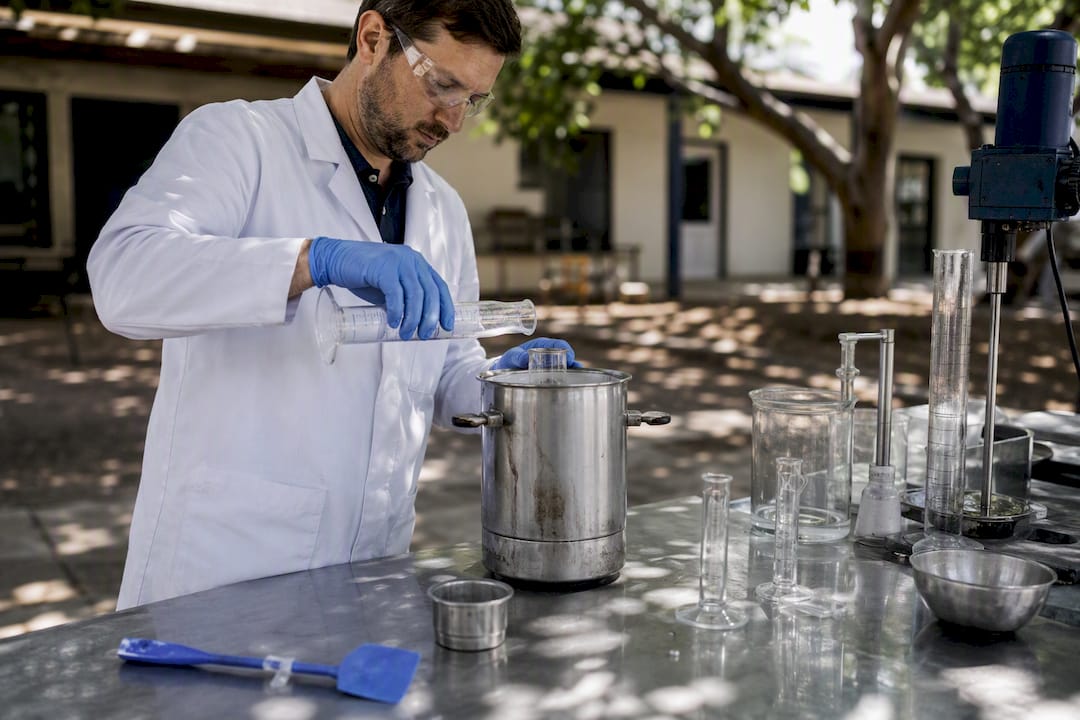
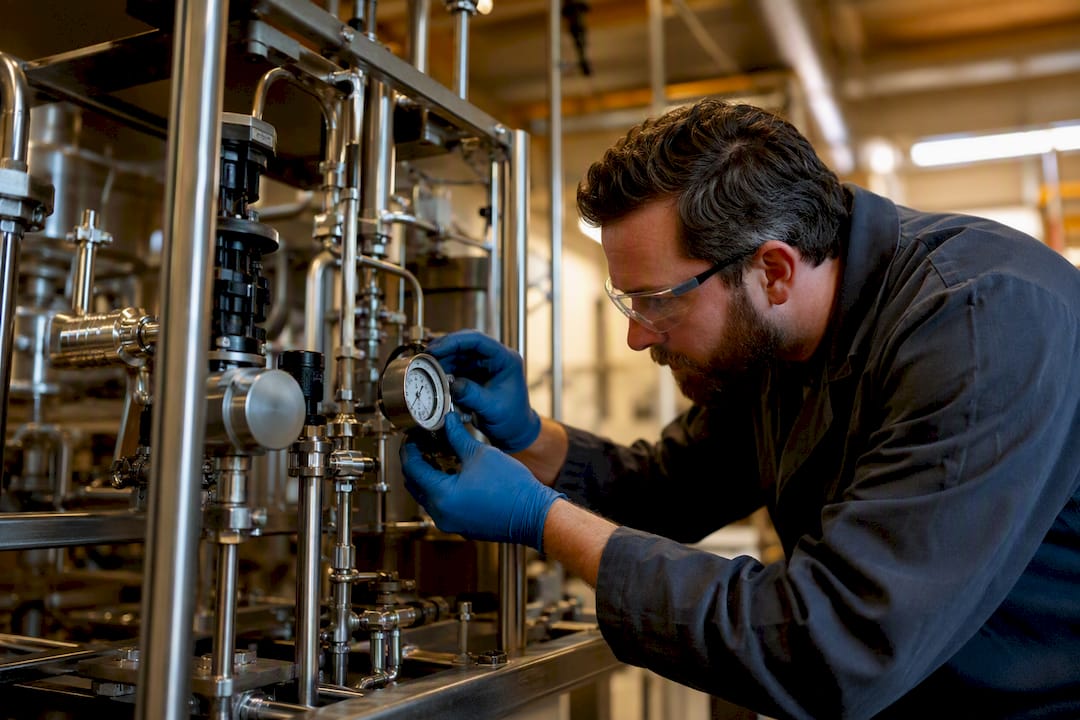
Scale-up is where most projects run into trouble if the groundwork was skipped. Specialized process chemistry partners typically run design of experiments (DoE) to map how variables interact, alongside process hazard analyses and equipment fit checks. Modular process skids let a manufacturer add capacity in stages instead of committing to custom equipment upfront.
Packaging and labeling close out the process: finalizing artwork, confirming compliance language for your product category, and sourcing containers that match your order volume.
Pro Tip: Ask to see a sample BMR before you sign anything. If a manufacturer can't produce one, they're not tracking your process closely enough to reproduce it reliably at scale.
How Do You Evaluate a Turnkey Chemical Manufacturer?
Picking a partner comes down to six things: their formulation library and in-house chemistry team, a documented quality management system (QMS), real pilot-to-scale experience, how they structure minimum order quantities (MOQs) and pricing, honest lead times, and transparency about where raw materials come from.
Trust signals matter more than sales pitches here. Pilot-to-scale experience, documented QMS, and accessible case studies are the things that separate a manufacturer you can build a brand on from one that will leave you scrambling six months in.
Bring these questions to your first call or RFQ:
- Can you show me a case study of a product you took from pilot to full-scale production?
- What does your QMS documentation actually include, and can I see a sample batch record?
- What's your change control process if a raw material becomes unavailable?
- What are your MOQs for a new formula versus an existing one in your library?
- Who owns the formula if I ask you to modify an existing one?
- What's your typical lead time from signed quote to first shipment?
- Do you handle regulatory or compliance testing in-house, or is that outsourced?
- Can you provide certificates of analysis (COAs) for raw material batches?
- What happens if my pilot batch fails specs? Is that retested at no cost?
- Can I speak to a current client in my industry?
Walk away if a manufacturer can't produce a BMR, has no formal change control process, or refuses to share a sample quality report. Those aren't quirks. They're signs the operation isn't built to scale with you.
What Timeline and Costs Should You Budget For?
Timelines split sharply depending on whether you're adapting an existing formula or building one from scratch. Adapting something from a manufacturer's library can move from prototype to pilot relatively quickly. A brand-new formulation, especially one requiring stability or regulatory testing, typically takes significantly longer before it's ready for commercial scale.
Cost drivers follow a predictable pattern:
- MOQs — lower minimums cost more per unit; bulk orders bring the price down
- Custom tooling or mixers — long lead times on specialized equipment can add weeks to a schedule
- Raw material availability — scarce or single-source ingredients raise both cost and risk
- Stability and regulatory testing — required for most cleaning, care, and solar-exposure products before launch
- Packaging — custom bottles or labels take longer to source than stock options
You can shave real time off a launch by choosing an existing formula over a custom one, scaling in phases instead of committing to a full truckload immediately, and asking for flexible MOQs during your first production run. Choosing synthetic routes built around commercially available raw materials is consistently one of the highest-impact decisions for keeping your per-unit cost predictable once you scale.
Why Do QMS and QbD Matter for Batch Consistency?
Reproducibility isn't a nice extra. It's the difference between a product that performs the same in batch 40 as it did in batch one, and a customer complaint you can't trace back to a cause.
A serious manufacturer will have, at minimum:
- A documented QMS covering every stage of production
- Batch manufacturing records for every run
- A formal change control process for raw material or process changes
- Supplier qualification records and certificates of analysis (COAs)
QbD principles push chemists to design formulas that tolerate normal variation in raw materials and equipment, rather than formulas that only work under perfect lab conditions. That's what keeps unit 10,000 performing like unit one. Behind that discipline sits a testing and release program: stability testing over time, contaminant screening, and retained samples held in case a batch needs to be re-examined later.
Pro Tip: Ask specifically for batch manufacturing records from a past project, not just a description of the QMS. A manufacturer that hesitates here is telling you something.
What Risks Should You Plan for Before You Sign a Contract?
Every turnkey project carries risk, and the brands that get burned are almost always the ones who didn't ask about it upfront. Raw material shortages are the most common disruption. A single-source ingredient can delay a launch by months if the supplier has a production issue, which is why supplier redundancy belongs on your evaluation checklist, not just your manufacturer's.
Process risk is the second big one. Something that performs perfectly in a 1,000-unit pilot can behave differently at commercial volume, whether that's heat transfer, mixing time, or how an ingredient settles during longer storage. This is exactly why pilot data should be collected to answer specific scale-up questions rather than just to prove a batch can be made bigger.
Contract and timeline risk round out the list. Ask what happens if a batch fails spec, whether retesting is included, and what your cancellation terms look like if a formula doesn't perform as expected. A manufacturer with a real process hazard analysis and a documented contingency plan for material shortages is telling you they've dealt with this before.
Build in buffer time for your first order. Even a well-run turnkey project can face a two to four week delay on a first commercial batch while a manufacturer fine-tunes equipment settings that a pilot run couldn't fully predict. Brands who plan around that buffer launch on schedule. Brands who don't end up explaining delays to retailers.
How Do You Protect Your Formula When Outsourcing Production?
Handing your formula to an outside manufacturer means handing over something valuable, and the contract you sign should treat it that way. A non-disclosure agreement (NDA) is the baseline, but it's not enough on its own. You need a manufacturing agreement that spells out exactly who owns the formula, especially if the manufacturer's chemists helped adapt or improve it.
Ownership questions get murky fast when a brand starts with a manufacturer's existing formula and asks for modifications. Ask directly: if your chemist tweaks a base formula to fit my specs, do I own the resulting version, or does the manufacturer retain rights to reuse it with other clients? Get the answer in writing before production starts, not after you've launched.
Confidentiality clauses should also cover your suppliers, your customer list if you're sharing sales data for forecasting, and any proprietary testing results. Ask who inside the manufacturing facility has access to your formula file, and whether that access is logged. A manufacturer with a real quality system will already have change control and access tracking in place. That same documentation discipline protects your intellectual property as a side effect.
One more detail brands overlook: confirm what happens to your formula and any unused raw materials if you switch manufacturers later. A clean exit clause, where your formula file and remaining inventory come with you, is a sign you're working with a partner rather than a gatekeeper.
How Does Supply Chain Reliability Affect Your Production Schedule?
A finished product is only as reliable as its slowest ingredient. Raw material sourcing is where most turnkey timelines quietly fall apart, and it's worth understanding before you commit to a launch date. Ask your manufacturer directly how many suppliers they use for each critical raw material in your formula. A single-source ingredient is a single point of failure.
Geography matters too. A manufacturer sourcing domestically for most raw materials generally faces fewer customs delays and shorter lead times than one relying heavily on overseas suppliers, though most formulas blend both. Ask which ingredients in your specific formula come from where, and what the manufacturer's backup plan looks like if a supplier runs short.
Packaging deserves the same scrutiny as raw chemicals. Custom bottles, pumps, and labels often carry longer lead times than the chemical fill itself, and a manufacturer who plans packaging sourcing in parallel with formulation, rather than after, will consistently hit tighter launch windows.
Logistics inside the facility matters as well. Ask how orders move from pilot approval to full production scheduling, and whether your reorder gets prioritized based on contract terms or handled on a first-come basis. Brands that ask this upfront avoid the unpleasant surprise of a reorder getting pushed behind a larger client's rush order. A manufacturer with modular production capacity, flexible enough to run smaller batches without disrupting larger contracts, tends to handle these scheduling conflicts better than one running a single fixed line.
How Sarawest USA Delivers Turnkey Chemical Manufacturing
Sarawest USA is built around the exact criteria this guide just walked through. Our proprietary formula library covers more than 1,200 formulas across eight industries, from commercial cleaning to equine and solar care, so most projects start with a proven base rather than a blank page.
Every formula runs through in-house R&D chemists, not a broker relaying requests to a third-party lab. That means answers to your technical questions come the same day, not the same week. Our pilot-to-scale capability runs from 1,000-unit batches up through full truckloads, backed by a documented QMS and batch records for every run we produce. Rapid prototyping is a real capability here, not a marketing line. Some projects move from formula approval to sample in hand the same day.
Matching this guide's evaluation criteria against what we offer: formulation library and chemists, covered. QMS and documentation, covered. Pilot-to-scale range, covered. Transparent MOQs and lead times, covered.
If you're ready to see what that looks like for your product, request samples from three SKUs, review our formulation track record, or start a fast RFQ and tell us what you need made.
What Founders Get Wrong About Outsourcing Chemical Production
The most common mistake brands make is treating the first manufacturer quote as the finish line instead of the start of due diligence. They skip the pilot run to save two weeks, then spend three months fixing a commercial batch that never should have shipped.
Five things to do before you sign anything: request a sample BMR, insist on a pilot run even if it feels unnecessary, confirm the QMS in writing, ask where every raw material in your formula actually comes from, and pin down MOQs and lead times before you need them, not after.
The gap between a brand that scales cleanly and one that stalls almost always traces back to whether these five steps happened before the first commercial order, not after something went wrong.
— Faisal Mansur
Turnkey chemical manufacturing works best when brands treat pilot data, QMS documentation, and supplier transparency as non-negotiable steps rather than optional extras.
| Point | Details |
|---|---|
| Define the scope first | Turnkey means contract manufacturing end-to-end: formulation through packaging, not plant construction. |
| Demand documentation early | Ask for a sample BMR and QMS overview before signing any production contract. |
| Budget realistic timelines | Adapting an existing formula moves in weeks; new formulations often take months due to testing. |
| Protect your formula in writing | Confirm ownership and access terms for any modified formula before production starts. |
| Sarawest USA covers each criterion | Over 1,200 formulas, in-house chemists, documented QMS, and pilot runs from 1,000 units to full truckloads. |
Sources
For deeper technical detail beyond what this guide covers, these resources go further into specific stages of the process.
- Inside Rosti: Contract manufacturing
- Process Chemistry: Lab to Pilot in 5 Stages | ChemContract
- The Ultimate Chemical Manufacturing Scale-Up Checklist - Re:Build Optimation
- Commercial scale-up manufacturing: A complete guide