

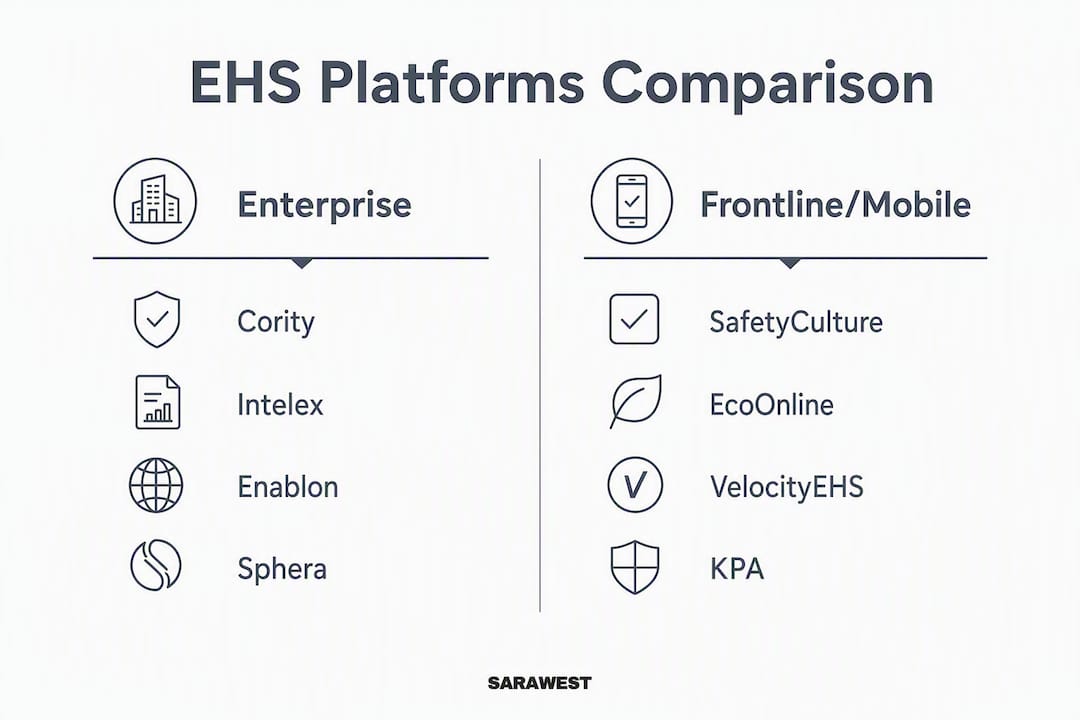
For enterprise governance, Cority and Intelex lead the shortlist. For frontline mobile engagement, SafetyCulture (iAuditor) is the clearest choice. For fast adoption with minimal IT overhead, Donesafe and HSI deliver. And for organizations that need AI-embedded workflows across a connected platform, VelocityEHS stands apart.
The best EHS software for your organization depends less on feature count and more on where your program stands today — and where your operations actually run. EHS roles carry real pressure: complex OSHA regulations, ISO 45001 compliance requirements, and the constant demand to prevent incidents while cutting administrative load. The right platform removes friction. The wrong one adds it.
Quick shortlist by buyer fit:
- Cority — Large multi-site enterprises needing unified safety, occupational health, and sustainability governance
- VelocityEHS — Organizations wanting embedded AI and broad domain coverage in one connected platform
- SafetyCulture (iAuditor) — Frontline-first teams prioritizing rapid inspection capture and mobile adoption
- Donesafe / HSI — Teams that need configurable, no-code workflows and faster time-to-value
- EHS Insight — Mid-market organizations seeking core EHS modules with straightforward deployment
- Intelex — Regulated industries requiring heavy process customization and audit-ready documentation
Verdantix and Gartner Peer Insights both track this market actively. Before you finalize any shortlist, check verified customer reviews there — they surface deployment realities that vendor demos rarely show.
Table of Contents
- Which EHS platforms compare best on the dimensions that matter?
- What does each platform actually deliver?
- How do you choose the right EHS software for your organization?
- What core EHS modules do you actually need?
- What do experienced EHS procurement teams get wrong?
- Which vendor should you pilot first?
- Key Takeaways
- What we've learned advising chemical and manufacturing customers
- Useful sources and further reading for procurement teams
- Sarawest USA: a different kind of compliance partner for chemical manufacturers
Which EHS platforms compare best on the dimensions that matter?
The table below maps each platform against the buyer-critical dimensions procurement teams ask about most. Pricing is directional — most vendors require a custom quote based on user count, modules, and deployment scope.
| Platform | Best For | Company Scale | Core Modules | Deployment & Integrations | Mobile/Frontline | Pricing Shape | Implementation | AI / Analytics | Support / Services |
|---|---|---|---|---|---|---|---|---|---|
| Cority | Multi-site enterprise governance + occupational health | Enterprise | Safety, occ. health, env., sustainability, quality | Cloud; SAP, Oracle, BI integrations | Moderate | Custom enterprise pricing | 6–18 months | Strong analytics; AI roadmap | Dedicated CSM; partner ecosystem |
| Intelex | Heavy process customization; audit-ready compliance | Mid-market to enterprise | Incidents, audits, training, doc control, env. | Cloud; broad API library | Moderate | Custom; module-based | 4–6 months | Reporting dashboards; analytics | Professional services; partner network |
| Enablon | Complex EHS, risk, and sustainability reporting at scale | Enterprise | EHS, risk, sustainability, regulatory reporting | Cloud/on-prem; SAP, Oracle | Moderate | Custom enterprise | 6–18 months | Advanced analytics; ESG dashboards | Dedicated services |
| VelocityEHS | Single connected platform with embedded AI | Mid-market to enterprise | Safety, chemicals, ergonomics, env., training | Cloud; Microsoft 365, BI tools | Moderate to high | Subscription; module tiers | 3–6 months | VelocityAI assistant; predictive risk | Onboarding + professional services |
| Sphera | High-hazard process safety and industrial risk | Enterprise | Process safety, risk modeling, EHS, sustainability | Cloud/on-prem; SAP-native | Limited | Custom enterprise | 6–18 months | Risk modeling analytics | Dedicated services |
| Benchmark Gensuite | Modular EHS + ESG compliance across sectors | Mid-market to enterprise | Compliance, audits, corrective actions, ESG | Cloud; API integrations | Good | Modular subscription | 3–6 months | ESG reporting; compliance dashboards | Partner ecosystem |
| KPA | Compliance automation for regulated industries | Mid-market | Incidents, training, compliance, doc control | Cloud; HRIS integrations | Good | Subscription tiers | 2–6 months | Compliance analytics | Dedicated support |
| EcoOnline | Chemical safety and hazardous-substance management | SMB to enterprise | Chemical mgmt, SDS, frontline safety, training | Cloud; ERP integrations | Good | Subscription | 2–6 months | Chemical risk analytics | Standard + premium support |
| SafetyCulture (iAuditor) | Frontline inspection capture and mobile engagement | SMB to enterprise | Inspections, incidents, training, checklists | Cloud; Slack, Microsoft 365, APIs | Excellent | Freemium to subscription | Days to weeks | Analytics dashboards; AI features | Self-serve + premium support |
| HSI (Donesafe) | Fast adoption; no-code configurable workflows | SMB to mid-market | Safety, incidents, audits, training | Cloud; Microsoft 365, SSO | Good | Subscription | 2–6 weeks | Standard reporting | Onboarding support |
| Donesafe | Configurable no-code EHS without long services engagements | SMB to mid-market | Incidents, audits, corrective actions, training | Cloud; API-first | Good | Subscription | 2–6 weeks | Standard dashboards | Onboarding + support |
| EHS Insight | Core EHS modules for mid-market teams | SMB to mid-market | Incidents, audits, training, doc control, corrective actions | Cloud; standard integrations | Moderate | Affordable subscription | 2–6 months | Standard reporting | Standard support |
| Gensuite | Modular compliance and audit tracking | Mid-market | Audits, compliance, corrective actions | Cloud | Moderate | Modular | 3–6 months | Compliance dashboards | Support services |
| HSI (Health & Safety Institute) | Training-led safety programs | SMB to mid-market | Training, LMS, safety content, incidents | Cloud | Good | Subscription | Weeks | Standard reporting | Standard support |
Pricing reality check: Lightweight platforms like SafetyCulture and EHS Insight start at accessible subscription tiers. Enterprise systems — Cority, Enablon, Sphera — routinely carry six-figure total-cost-of-ownership once implementation services are included. Mid-market platforms like VelocityEHS and Benchmark Gensuite sit between those poles. Always request a fully loaded quote that includes implementation, training, and annual maintenance.
Implementation timelines range from days (SafetyCulture's mobile-first setup) to 18 months for full enterprise deployments. Validate SOC 2 Type II certification and ISO 27001 posture with every vendor before contracting. Both Verdantix and Gartner publish analyst assessments of this market — use them as a cross-check against vendor claims.
What does each platform actually deliver?
Profiles below are organized by buyer archetype, not alphabetically, so you can scan to the segment that matches your program.
Enterprise governance platforms
Cority delivers the broadest EHS+ scope on this list. Its CorityOne platform unifies safety, occupational health, environmental monitoring, sustainability, and quality into a single configurable system. Large manufacturers and chemical companies choose it specifically for occupational health depth — medical surveillance, exposure tracking, and case management sit natively inside the platform rather than bolted on. SAP and Oracle integrations are mature. Expect a 6–18 month implementation and a dedicated customer success manager.

Intelex competes on configurability. Regulated industries — pharma, energy, heavy manufacturing — use it when audit-ready documentation and process customization matter more than out-of-the-box speed. Its API library is broad, and the reporting layer handles complex multi-site compliance workflows. Professional services engagements are standard.
Enablon (now part of Wolters Kluwer) targets enterprises with complex sustainability reporting obligations alongside EHS. Its risk and ESG modules are tightly integrated, which matters for organizations facing SEC climate disclosure requirements or GRI reporting. Available as cloud or on-premises, which is rare in this market.
Sphera is the specialist pick for high-hazard industries — oil and gas, chemicals, utilities — where process safety management (PSM) and quantitative risk modeling are non-negotiable. Its SAP-native architecture suits organizations already running SAP ERP. Not the right fit for teams without dedicated process safety engineers.
Mid-market connected platforms
VelocityEHS positions its Accelerate® platform as a connected system that moves teams from reactive reporting to predictive risk identification. The embedded VelocityAI assistant surfaces risk signals and automates routine reporting tasks — one of the more mature AI implementations shipping in production today. Domain coverage spans safety, chemicals, ergonomics, and environmental, which reduces the need for point solutions. Microsoft 365 and BI tool integrations are documented.
Benchmark Gensuite earns its place through modularity. Organizations that need to start with compliance tracking and audits, then add ESG reporting later, can do that without renegotiating the entire contract. Its corrective action tracking is well-regarded in peer reviews.
KPA focuses tightly on compliance automation for regulated mid-market teams — automotive dealerships, construction, and light manufacturing are its strongest verticals. Training management and incident tracking are solid. Implementation is faster than enterprise alternatives, typically 2–6 months.
Frontline and mobile-first platforms
SafetyCulture (iAuditor) is the clearest choice when frontline adoption is the primary success metric. Its mobile UX is genuinely excellent — workers complete inspections on phones without training sessions. The freemium entry point lets teams pilot at zero cost before committing. Analytics dashboards and AI-assisted features have matured significantly. For distributed field operations, construction sites, or logistics, it is hard to beat on time-to-adoption.

EcoOnline specializes in chemical safety and hazardous-substance management. If your operations involve SDS management, chemical inventory, or COSHH-equivalent compliance in the US context, EcoOnline's depth in that domain exceeds most generalist platforms. Frontline engagement tools are included.
Fast-adoption and SMB-friendly platforms
Donesafe and HSI (Donesafe) share a no-code configurability story. Workflows are built without developer involvement, which cuts implementation time to weeks rather than months. For organizations moving off spreadsheets and needing a working system quickly, this matters. The trade-off is less depth in advanced analytics compared with enterprise platforms.
EHS Insight covers the core modules — incidents, audits, corrective actions, training, document control — without the complexity tax of enterprise systems. Mid-market teams that need a working EHS program and a predictable subscription cost find it fits well. Deployment is straightforward, and the learning curve is low.
Gensuite and HSI (Health & Safety Institute) round out the list. Gensuite offers modular compliance and audit tracking for mid-market teams. HSI's strength is training-led safety programs, with a built-in LMS and safety content library that suits organizations where training compliance is the primary driver.
Pro Tip: Before any vendor demo, pull two or three customer reviews from Gartner Peer Insights in your industry vertical. The deployment notes in those reviews reveal integration friction and post-go-live support quality that no sales deck will show you.
How do you choose the right EHS software for your organization?
The decision framework below is organized by program maturity. Start at the stage that matches where your program is today.
Decision checklist by maturity stage
- Spreadsheet/paper-based programs: — Begin with targeted digitization tools — SafetyCulture, EHS Insight, or Donesafe — and run a focused pilot before buying enterprise capability you won't use for 18 months.
- Multi-site or global programs: — Shortlist Cority, Intelex, or Enablon. Require a reference customer in your industry with a comparable site count before signing.
Questions to ask vendors in demos and RFPs
- What does tenant deployment look like — do we own the data boundary, or does it sit in your managed cloud?
- Which ERP, HRIS, and BI integrations are native versus API-custom, and who maintains them?
- What is the full implementation timeline, and what percentage of that is billable professional services?
- Can we export raw data in a portable format at any time, without a services engagement?
- What SOC 2 Type II and ISO 27001 certifications are current, and can you provide the audit report?
- Who are two reference customers in our industry with a comparable deployment size?
- What does your change management and end-user training program include?
- What are the SLA terms for uptime and critical incident response?
Red flags to watch for
- Implementation scoped entirely as a mandatory professional services project with no self-serve configuration path
- No raw data export option or data portability clause in the contract
- Frontline UX that requires more than five minutes of training to complete a basic inspection
- Missing SOC 2 Type II certification or inability to provide the audit report on request
- No presence in Gartner Peer Insights or Verdantix analyst coverage
- Pricing that bundles modules you cannot unbundle if your scope changes
Vendor-selection success is often determined by fit with existing IT infrastructure and operational maturity. Organizations that force a complex enterprise system onto a spreadsheet-era program tend to fail adoption — not because the software is bad, but because the gap is too wide.
What core EHS modules do you actually need?
Leading EHS platforms share a common module set. What varies is depth, configurability, and how well each module connects to the others.
- Audits and inspections: — Scheduled and ad-hoc checklists tied to corrective action workflows. SafetyCulture leads on mobile inspection UX; Cority and Intelex lead on audit governance depth for regulated industries.
- Environmental monitoring: Tracks emissions, waste, water, and energy data against regulatory thresholds. Enablon and Cority have the deepest environmental modules. For EPA disinfectant registration and related compliance workflows, document control integration with environmental monitoring is essential.
- Document control: Version-controlled SOPs, safety data sheets, and regulatory submissions. Pairs with audit readiness — a supplier audit checklist is only as good as the document management system behind it.
What AI features are actually shipping in 2026?
The shift to connected platforms is driving real demand for embedded AI that moves teams from reactive reporting toward predictive risk identification. In practice, the AI features shipping in production today include:
- Natural-language reporting assistants: — Allows users to query EHS data in plain English rather than building reports manually
VelocityEHS's VelocityAI is the most publicly documented implementation. To validate AI maturity in any vendor, ask for a live demo of the AI feature in a real tenant — not a recorded walkthrough — and request a reference customer who uses it in production.
Pro Tip: AI features in EHS software are often positioned as roadmap items rather than shipping capabilities. Ask vendors to show you the feature live in a production environment, then ask the reference customer whether they actually use it daily. The gap between those two answers tells you everything.
What do experienced EHS procurement teams get wrong?
That observation cuts to the core of most EHS software failures. The platform that wins the RFP on feature count is often the one that stalls in deployment because nobody uses it.
Common selection mistakes procurement teams make:
- Buying the feature list, not the workflow fit. A platform with 40 modules is worthless if your frontline workers won't open the app. Adoption rate at 90 days post-go-live is a more honest success metric than module count.
- Ignoring integration and data governance. EHS data that lives in a vendor-managed cloud silo creates audit friction and IT governance risk. Ask explicitly who manages the security boundary.
- Skipping user pilots. Procurement teams that go straight from demo to contract routinely discover usability problems at rollout. A 3–6 week pilot with real end users surfaces those problems cheaply.
- Neglecting frontline adoption signals. If the platform requires a laptop to complete a basic inspection, field adoption will fail. Test the mobile experience on the actual devices your workers carry.
- Underestimating change management. Software is 30% of the implementation. Change management, training, and workflow redesign are the other 70%.
Practical tips for procurement and EHS leaders:
- Design your pilot around one high-frequency workflow — incident reporting or daily inspections — not the full module set
- Set adoption KPIs before go-live: target completion rate, time-to-report, and audit closure rate at 30 and 90 days
- Build an integration checklist that maps EHS data flows to your HRIS, ERP, and BI tools before vendor selection, not after
- For manufacturing and chemical operations, confirm whether the platform supports offline mobile capture — connectivity gaps on plant floors are real
Pro Tip: When evaluating tenant deployment options, ask the vendor: "Can our IT team deploy this inside our Microsoft 365 tenant, and who owns the security boundary?" Solutions deployed into your enterprise tenant keep data under your IT governance. Vendor-cloud solutions create a separate boundary your IT team must audit and accept — and that audit adds time and cost to every compliance cycle.
Which vendor should you pilot first?
The right pilot pick depends on your buyer archetype. Three archetypes cover most corporate EHS programs.
Archetype 1: Enterprise governance lead
Profile: Multi-site organization, 1,000+ employees, existing ERP (SAP or Oracle), OSHA recordkeeping and ISO 45001 certification in scope.
Pilot pick: Cority or Intelex. Both handle multi-site governance and audit-ready documentation at scale.
- Pilot scope (4–6 weeks): Incident management and CAPA workflow across two sites
- Success metrics: Incident report completion rate above 90%, CAPA closure within defined SLA, integration with ERP confirmed in test environment
- Go/no-go criteria: Integration works without custom development; IT governance review passed; two reference customers confirmed in same industry
TCO watch: Enterprise implementations carry significant professional services costs. Get a fully itemized statement of work before signing — hidden data migration and configuration costs are the most common budget overruns.
Archetype 2: Frontline/mobile-first program
Profile: Construction, logistics, or distributed field operations; frontline workers as primary users; rapid inspection capture and incident reporting are the core need.
Pilot pick: SafetyCulture (iAuditor). Its freemium entry point lets you run a real pilot at zero cost.
- Pilot scope (2–3 weeks): Daily inspection workflow on mobile devices with 20–30 frontline users
- Success metrics: Inspection completion rate above 85%, average time-to-complete under 4 minutes, zero training escalations after day 3
- Go/no-go criteria: Workers use the app without prompting by week 2; inspection data flows to analytics dashboard without manual intervention
Archetype 3: SME with limited IT resources
Profile: Under 500 employees, no dedicated IT team, moving off spreadsheets, need a working system within 60 days.
Pilot pick: Donesafe or EHS Insight. Both deploy quickly without heavy professional services.
- Pilot scope (3–4 weeks): Incident reporting and corrective action tracking for one site
- Success metrics: System live within 30 days, all incidents logged digitally within pilot period, one completed audit cycle
- Go/no-go criteria: Configuration completed without vendor professional services; subscription cost fits within budget without add-on fees
TCO signals to watch during any pilot: recurring license tier increases tied to user count growth, data migration costs if you switch vendors later, and whether training is included or billed separately.
Key Takeaways
The best EHS software is the platform your team actually uses — fit with operational maturity and existing IT infrastructure determines adoption more than any feature list.
| Point | Details |
|---|---|
| Match platform to maturity | Start with lightweight tools if your program runs on spreadsheets; enterprise systems require readiness to match. |
| Pilot before you commit | A 3–6 week pilot on one high-frequency workflow surfaces adoption and integration problems before contract signing. |
| Validate security posture | Require SOC 2 Type II certification and confirm who owns the data boundary — tenant vs. vendor-managed cloud. |
| AI features need live proof | Ask vendors to demonstrate AI capabilities in a live production tenant, then verify with a reference customer who uses them daily. |
| Sarawest USA for chemical manufacturing | For chemical manufacturers needing EHS-aligned production workflows, Sarawest USA's contract manufacturing model integrates compliance documentation directly into production runs. |
What we've learned advising chemical and manufacturing customers
We work with brands and manufacturers across cleaning, sports care, equine, and industrial chemical categories. The EHS software question comes up constantly — not because our customers are buying platforms directly, but because their EHS programs and our production workflows intersect at every audit cycle.
The pattern we see most often: a manufacturer selects an enterprise EHS platform, then discovers at implementation that the system was never designed to talk to their MES or ERP. Data that should flow automatically — batch records, chemical inventory, environmental monitoring readings — ends up being re-entered manually. That friction kills adoption faster than any UX problem.
For chemical manufacturers specifically, offline mobile capture matters more than most software guides acknowledge. Plant floors have connectivity gaps. An inspection app that requires a live connection to submit a form is a liability in a controlled environment. We've seen teams revert to paper clipboards within three weeks of go-live because the app wouldn't work in the mixing area.
The integration that consistently removes the most adoption friction is Microsoft 365. When EHS workflows live inside Teams or SharePoint — tools workers already open every day — completion rates climb without any change management effort. One customer moved their permit-to-work process into a Teams-integrated workflow and saw compliance rates go from 60% to over 90% within a month. No new training. No new app. Just the tool they already used.
EPA and OSHA recordkeeping requirements add another layer of complexity for US chemical manufacturers. Platforms that generate OSHA 300/300A logs automatically and support Tier II chemical inventory reporting save significant administrative time. Confirm those outputs are native, not custom-built, before signing. For context on how compliance documentation connects to production records, our certificate of analysis guide covers the record-keeping standards US chemical manufacturers must maintain.
The under-estimated effort in almost every implementation we observe is change management. The software works. Getting 200 people to change how they report a near-miss takes months of deliberate effort — and that effort is rarely scoped into the vendor's implementation quote.
Useful sources and further reading for procurement teams
These resources are worth consulting before you finalize a shortlist or write an RFP.
- Gartner Peer Insights — EHS Software: Verified customer reviews organized by industry and company size. Filter by your vertical and read the deployment notes — they surface integration friction and post-go-live support quality that vendor demos won't show.
- VelocityEHS Accelerate® platform: — The product page documents the connected platform approach and VelocityAI capabilities. Use it to understand what a mature AI-embedded EHS workflow looks like before evaluating other vendors' AI claims.
- Sarawest USA supplier audit checklist: Practical checklist for supplier audits in contract chemical manufacturing — maps directly to the audit and inspection modules covered in this guide.
- EPA disinfectant registration guide: Regulatory guidance for US chemical manufacturers on EPA compliance documentation — relevant to environmental monitoring and document control module selection.
- Microbial challenge testing guide: Covers regulatory and testing considerations for chemical manufacturers, including documentation requirements that EHS platforms must support.
For AI-driven analytics and real-time manufacturing data capture, the Gemba Labs intelligence platform offers a useful reference point for what production-floor analytics can look like when integrated with safety and quality workflows.
Sarawest USA: a different kind of compliance partner for chemical manufacturers
The platforms compared above are software tools. They manage records, automate workflows, and generate reports. What they don't do is manufacture your product, formulate your chemistry, or carry the accountability that comes with putting something in a drum and shipping it.
Sarawest USA is built for brands and manufacturers that need more than a compliance dashboard. Our in-house R&D chemists work directly on your formulation — adapting one of our 1,200+ proprietary formulas or building something new from your specifications. Every production run comes with the documentation your EHS and quality teams need: batch records, certificates of analysis, and regulatory-ready paperwork that integrates with whatever platform you're running.
For commercial cleaning, sports care, equine, and industrial chemical brands, that means you get production speed and compliance documentation in the same conversation. No broker in the middle. No waiting weeks for a quote. Our formulation track record covers eight industries and hundreds of production runs — the kind of reference base that procurement teams and EHS managers can actually verify.
If your EHS program is tightening up and your supply chain needs to match that standard, talk to us. Tell us what you need made. A real person reads every inquiry, and we'll respond with specifics — not a generic brochure. Start with a conversation about your next production run.