
Use a staged checklist, initial screen, technical assessment, quality and compliance audit, then contract terms, to qualify any contract manufacturer. Prioritize six items first: equipment fit, a working quality management system, real certifications, realistic capacity and lead times, IP protection, and contract clauses that survive a dispute. A scoring matrix and audit prompts turn those checks into a number you can defend to your team.
TL;DR:
- Vendors must have flexible MOQs, clear lead times that include formulation, and transparent pricing breakdowns to avoid hidden costs and delays.
- Demonstrating in-house formulation capability and providing pilot batches are crucial for assessing a manufacturer’s technical adaptability and flexibility.
- Verifiable quality systems, actual GMP compliance documents, and recent CAPA records are essential for ensuring product safety and regulatory standards.
- A detailed contract should specify scope, IP ownership, and exit conditions to prevent disputes and protect proprietary information over time.
- Conducting pre-audit document requests and organized floor walkthroughs helps predict reliability better than relying solely on the vendor’s years of operation.
Table of Contents
- What Should a Contract Manufacturing Checklist Include?
- How Do You Screen Vendors on Capacity, MOQs, and Pricing?
- Which Technical Capabilities Actually Predict a Good Fit?
- What Quality Systems and Certifications Should You Verify?
- How Do You Prepare for a Contract Manufacturing Audit Checklist?
- What Contract Terms Protect Your Product and IP?
- What Documents Does a Tech Transfer Checklist Require?
- How Do You Score and Compare Contract Manufacturers?
- Applying This Checklist to Chemical Contract Manufacturing
- A Buyer's Note on Negotiation and Next Steps
- How SaraWest USA Fits Into Your Contract Manufacturing Checklist
- Sources
What Should a Contract Manufacturing Checklist Include?
A working checklist moves in a specific order: initial screen, technical assessment, quality and regulatory review, on-site or virtual audit, then contract terms. This sequence exists because it's cheaper to disqualify a vendor at step one than after you've shared a formula at step three. Evaluation should follow a staged approach that filters hard before it filters deep.
Here's the sequence, and the exact data to request at each stage:
- Initial screen: minimum order quantities, published capabilities list, pricing transparency, quoted lead times.
- Technical review: equipment schedules, R&D staffing, sample or pilot batch availability.
- Quality and regulatory check: QMS documentation, certifications, Certificates of Analysis, third-party audit reports.
- References: two to three active clients in your category, contacted directly, not through the sales rep.
- Audit: on-site or virtual walkthrough with a document pack requested in advance.
- Contract: scope of work, IP terms, pricing structure, change control language.
Certain answers should end the conversation immediately: no written QMS, refusal to share a CoA sample, MOQs that don't flex downward for pilot runs, or a lead time quote with no explanation of what's included. If a vendor can't answer basic questions before you've signed anything, they won't get more transparent afterward.
How Do You Screen Vendors on Capacity, MOQs, and Pricing?
Most procurement teams lose weeks chasing vendors that were never going to fit, because they skip financial and capacity screening before technical calls. Fix that by front loading four questions.
- Does the MOQ scale down for a pilot run and up for a full truckload, or is it fixed regardless of order size?
- What's the realistic lead time from purchase order to shipment, and does that number include formulation or tooling time?
- Is pricing broken out by tooling amortization, raw material cost, and labor, or bundled into one opaque line?
- How does the price per unit change at defined volume tiers, and is that schedule in writing?
Vendors that dodge the pricing breakdown question are usually padding somewhere you can't see. Ask for a sample quote structure before you send your actual specs. It costs them nothing to share, and their willingness to show the math tells you more than the number itself.
Pro Tip: Request lead time in writing tied to a specific order size and formulation status. "2 to 4 weeks" means nothing without knowing if the clock starts at signed PO or approved sample.
Which Technical Capabilities Actually Predict a Good Fit?
Equipment lists matter less than whether the vendor's R&D team can adapt an existing formula to your specs without starting from a blank page. A manufacturer running only high-volume fillers will struggle with a small-batch specialty product, no matter how modern their floor looks.
Ask for these before you commit to a technical call:
- A capability statement listing specific equipment classes, not just "full production capabilities."
- Evidence of in-house formulation chemists, versus a broker who outsources R&D to a third party.
- A pilot batch or first article inspection (FAI) sample, with documented acceptance criteria attached.
- Analytical method transfer history, meaning they've successfully co-validated test methods with another lab before.
A pilot batch tells you more in one sample than a facility tour ever will. If a vendor resists producing one before contract signing, that's a signal about how flexible they'll be later when your formula needs adjustment.
What Quality Systems and Certifications Should You Verify?
Paperwork proves a system exists. Verification proves it's actually used. A GMP-focused audit needs to confirm data integrity, equipment validation lifecycle stages, and analytical testing infrastructure, specifically IQ, OQ, and PQ documentation, before you accept a supply arrangement in a regulated category.
Check these directly, don't just accept a claim:
- Ask for the actual QMS document, then ask how a deviation was logged and closed in the last six months.
- Request lab testing evidence: HPLC results, microbiology reports, and a sample Certificate of Analysis matching your product category.
- Confirm certifications with the issuing body directly rather than trusting a logo on a website. ISO and cGMP certifications should have verifiable numbers.
- Pull the CAPA file for the past year and read the pattern, not just the count. Three unrelated one-off issues read differently than three repeats of the same failure.
Scoring matrices that build in hard disqualifiers, an environmental controls failure, for instance, keep a vendor from scoring well on paper while failing the one category that actually matters for product safety.
How Do You Prepare for a Contract Manufacturing Audit Checklist?
Effective audits start before anyone walks the floor. Send a document request, then follow this order:
- Request the pre-audit pack, prior audit reports, corrective action logs, and organizational charts, at least three to four weeks before your visit.
- Walk the floor checking environmental controls, sanitation logs, and equipment calibration records against the dates on file.
- Trace one incoming raw material lot from receiving through supplier qualification records to confirm the paper trail matches practice.
- Ask for current production utilization percentage. A facility running near full capacity has less room to absorb your surge orders without delay.
Utilization numbers and maintenance cadence data predict reliability better than a vendor's years in business, which is a number that tells you nothing about whether their equipment gets serviced on schedule.
What Contract Terms Protect Your Product and IP?
A contract manufacturing agreement lives or dies on specificity. Vague scope-of-work language is where disputes start six months into production.
- Define scope of work down to the specification sheet, and lock in a written engineering change order process for any deviation.
- Require explicit IP and tooling ownership language, plus an NDA that survives termination of the relationship.
- Demand a pricing structure that separates base cost, material surcharges, and volume discounts as distinct line items.
- Include first article approval, hold-and-release protocols, and exit terms covering tooling return and formula ownership if you leave.
A contract manufacturing agreement checklist built around these clauses, scope, IP, pricing, delivery metrics, and dispute resolution, protects you long after the honeymoon period of a new vendor relationship ends. Our quality agreement clause breakdown covers the inspection-readiness language worth adding here too.
What Documents Does a Tech Transfer Checklist Require?
A clean tech transfer to manufacturer runs on a specific document set, not a verbal handoff.
- Master manufacturing record (MMR), standard operating procedures, and defined critical quality attributes and critical process parameters.
- Analytical method transfer with co-validation between your lab and theirs before you accept their release testing.
- A demonstration or pilot batch matched against written acceptance criteria, not a subjective "looks right" sign-off.
- Post-transfer monitoring: control charts, scheduled product review meetings, and stability checks at defined intervals.
Method transfer without co-validation is where regulated categories get burned later, when a batch fails a test the buyer's lab would have caught. Our batch manufacturing records guide breaks down what a compliant MMR actually looks like line by line.
How Do You Score and Compare Contract Manufacturers?
Turn audit notes into numbers using weighted categories, then set decision bands so the comparison isn't a gut call.
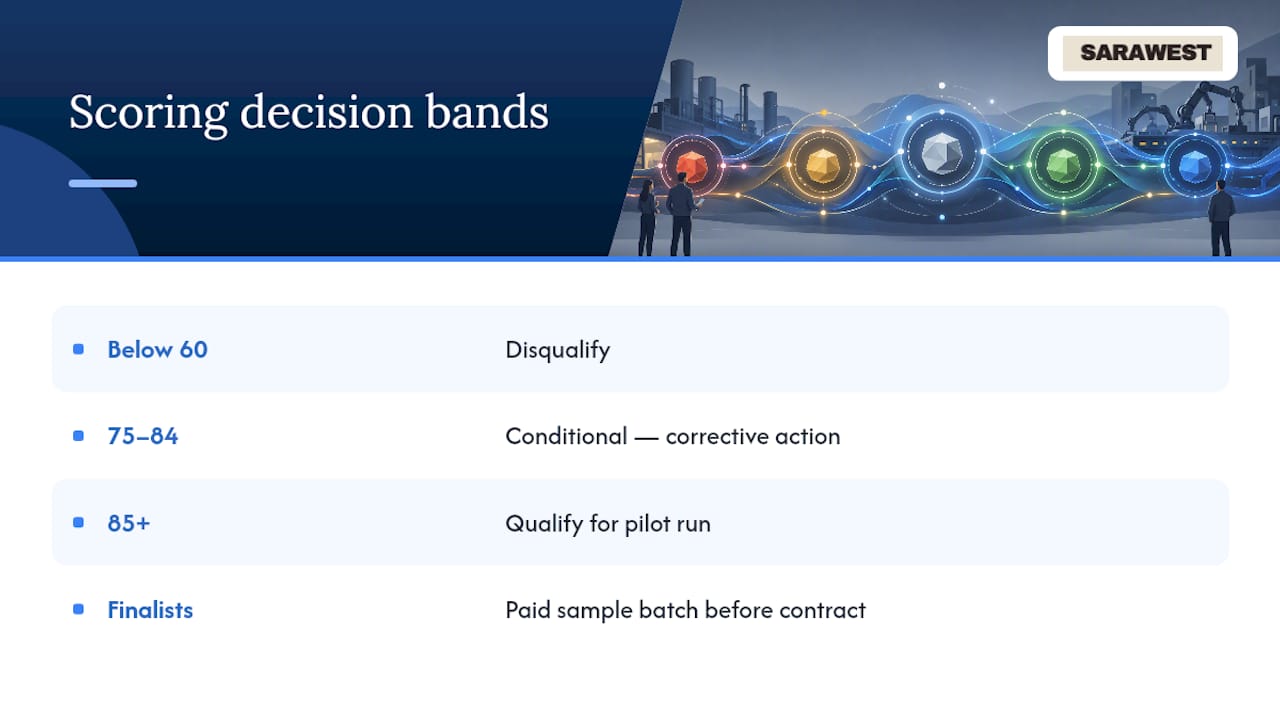
A total below 60 disqualifies, 75 to 84 sits conditional pending corrective action, and 85 or above qualifies for a pilot run. Finalists move to a paid sample batch before any contractual milestone gets signed.
Applying This Checklist to Chemical Contract Manufacturing
Rapid prototyping changes the screening order: ask for a sample formula adjustment before capacity discussions. Request a pilot batch report, matching CoA, and a short stability snapshot, and read whether the numbers match the claim, not just whether documents exist.
A Buyer's Note on Negotiation and Next Steps
Most vendors have fixable gaps, missing calibration logs or an outdated CAPA form are worth a 30-day correction window. A facility that fails environmental controls or won't share a CoA is not. Advance two to three finalists to paid pilot runs before signing anything. Then: request the document pack, run the scoring matrix, and schedule the audit.
— Faisal Mansur
How SaraWest USA Fits Into Your Contract Manufacturing Checklist
Sarawest USA shortens the technical assessment stage most buyers dread: instead of waiting weeks for a formulation quote, our in-house chemists respond to specs directly, no broker relaying messages back and forth, sometimes with a sample turnaround the same day it's requested.
If your product falls in sports care, commercial cleaning, or one of our other core categories, our library of over 1,200 proprietary formulas means you're often adapting a proven base rather than starting from zero, which cuts both cost and pilot timeline. That fits smaller brands running a first pilot batch just as well as it fits an operator scaling toward a full truckload order. Our formulation track record shows how that process plays out across past projects.
If you're ready to move past screening calls, request samples from three SKUs or send your specs through a fast RFQ and get a real chemist's response, not a sales script.
Sources
- How often should firms audit their suppliers in the FDA-regulated industries
- Contract Manufacturing Toolkit — AURI
- GMP audit checklist CDMO evaluation — CDMO World
- Contract manufacturing audit guidance — Applied Engineering